
Patient Financial Experience the New Focus for Revenue Cycle Tech

https://revcycleintelligence.com/features/patient-financial-experience-the-new-focus-for-revenue-cycle-tech?eid=CXTEL000000093912&elqCampaignId=8479&elqTrackId=be91ef7e45814e448e63f5f449863c07&elq=c0883462d36f46f1919e194284b0fcd0&elqaid=8937&elqat=1&elqCampaignId=8479

Facing healthcare consumerism and high deductibles, providers are seeking revenue cycle technology to deliver a high-quality patient financial experience.

Hospitals and practices have traditionally relied on public and private payers to cover the bulk of patient charges and costs for their services. Everything from their revenue cycle technologies to billing workflows has been tailored to create cleaner claims, reduce denials, and collect payer reimbursement.

But in an environment of record spending and changing attitudes towards purchasing and payment, payers are starting to shift more financial responsibility to their consumers. Nearly 21 million Americans had a high-deductible health plan or health savings account in 2017, and AHIP experts anticipate enrollment in high-deductible plans to continue climbing.

Increases in patient out-of-pocket spending are driving individuals to become more discerning healthcare consumers who demand more value for the medical services they receive. Plans and policymakers argue that the rise in healthcare consumerism will ultimately result in lower cost, higher quality care.

In the meantime, however, high-deductible health plans and other increases in out-of-pocket spending are presenting challenges to providers who are not used to this new player: the patient as a payer.

Three-quarters of providers report that they are seeing a noticeable upward trend in what patients must pay out of pocket.   At hospitals, total revenue attributable to patient balances after insurance rose 88 percent from 2012 to 2017.

While payers have been steadily shifting the financial responsibility to consumers, providers have yet to adapt their workflows and systems to collect revenue from this new source while delivering a satisfactory experience to consumers.

For example, nearly all 900 healthcare financial executives recently surveyed by HIMSS Analytics said their organizations still use paper-based billing and collection strategies – despite the fact that the same survey revealed more than half of patients prefer electronic billing methods.

Patients in the survey even said they were more likely to pay their medical bills if they had the option to do so online.

In light of these statistics, providers are facing the difficult task of transforming their manual patient collection processes to address this changing, consumer-focused trend.

“What we’ve seen historically has been that the revenue cycle has been not as well funded or not as strategically prioritized for healthcare delivery networks. A lot of the decision making has been either reactive or more short-term oriented,” Joe Polaris, Senior Vice President of Product and Technology at the health IT company R1 RCM, recently told RevCycleIntelligence.com.

“But we’re starting to see more of a long-term strategic vision coming together for their revenue cycles,” he added. “Organizations understand they need to make transformative change in light of some of the challenges that are only growing in the market, especially the need to be consumer-friendly.”

Revenue cycle technologies that cater to the patient financial experience are part of that transformative change, added Matt Hawkins, the CEO of Waystar, the newly combined revenue cycle management company formed by ZirMed and Navicure.

“Innovators are beginning, more so than ever, to treat the patient as a consumer,” he said. “A lot of health systems are demanding or embracing services or technologies that get them closer to patients from the earliest interaction point.”

The demand for technologies that cater to the patient financial experience is on the rise. And providers could face significant financial losses and patient retention problems if they fail to adapt to healthcare consumerism.

Becoming a patient-centered entity that can collect what it’s owed without alienating its consumers is a significant challenge, experts agree.  But embracing a handful of high-impact strategies could help to ensure that both patients and their providers complete the payment process feeling satisfied.

PRICE TRANSPARENCY LAYS THE FOUNDATION FOR PATIENT FINANCIAL EXPERIENCE

“Consumerism” may be a popular buzzword in the healthcare industry, but providers still have a long way to go before their patients can accurately compare their clinical journeys to their retail experiences.

For one thing, patients often agree to services or procedures with no clear idea of what they will ultimately cost.

Providers rarely offer prices or price estimates to patients prior to service delivery. In fact, the percentage of hospitals that are not able to give consumers price estimates actually increased from 14 percent in 2012 to 44 percent in 2018, a recent JAMA Internal Medicine study revealed.

With patients expecting the ability to plan their expenses, providers are looking to implement new revenue cycle technologies that can deliver accurate cost estimates and boost overall healthcare price transparency.

“How do we give patients shoppable experiences, so they can find out the cost of an MRI?” asked Christy Martin, Senior Vice President of Product Management at Optum360. “In their local care market, where is the best place to go in terms of both quality and cost? Then, if they go to a certain location, what are they expected to pay based on their insurance coverage? What would the out-of-pocket costs be at this point in the year?”

Informing consumers of their patient financial responsibility before the point-of-service is critical for providers seeking to improve the patient financial experience.

“In the immediate future, one of the things that we can unlock using technology is an understanding upfront about what the payment responsibility will be, and have that help inform all of the things that happen subsequent to presenting that to the patient,” Hawkins said.

Providing price estimates up front helped one health system in Oklahoma increase point-of-service collections by $17 million in seven years.

The Consumer Priceline tool at INTEGRIS Health is a database of charges for most procedures and services. The health system also promises to deliver written price quotes to consumers within two days if the service is not already included in the database.

INTEGRIS may be seeing significant patient collection improvements using price estimates, but providers should be aware that databases like the Consumer Priceline tool require a wealth of historical financial data.

“In the immediate future, one of the things that we can unlock using technology is an understanding upfront about what the payment responsibility will be.”

Merely posting chargemaster prices for common services and procedures is not necessarily helpful for patients. Giving consumers information about their patient financial responsibility and out-of-pocket costs is supposed to prevent sticker shock. Yet chargemaster prices are primarily used to start negotiations with payers, and the numbers can seem exorbitant to consumers.

“Chargemaster prices serve only as a starting point; adjustments to these prices are routinely made for contractual discounts that are negotiated with or set by third-party payers. Few patients actually pay the chargemaster price,” the Healthcare Financial Management Association (HMFA) explained to policymakers in May 2018.

Despite reservations about chargemaster prices, CMS recently required hospitals to publish a list of their standard charges online. And providers are scrambling to understand how to present the information in a meaningful way to consumers.

About 92 percent of providers in a recent poll said they were concerned about the new hospital price transparency requirement, and the majority also expressed concerns about how the public would perceive their standard charges.

Now more than ever, revenue cycle technologies that aggregate and analyze information on what patients actually pay will be critical for health systems.

UNIFYING THE PATIENT FINANCIAL EXPERIENCE

Healthcare is nothing like going grocery shopping. Not only do consumers not have access to prices, but the funding mechanism for medical services is also vastly different from a traditional retail experience.

Unlike what happens during a retail transaction, healthcare consumers rarely pay providers directly for services or procedures rendered. Instead, healthcare consumers use insurance plans, health savings accounts, and a wide range of other funding mechanisms to eventually pay providers after a service is delivered. They may also receive several bills and benefit documents from providers and insurers before receiving the final bill listing their financial responsibility.

As patients become more responsible for their healthcare spend, the onus is on providers to simplify the patient financial experience if they want to boost collections and save their bottom line.

Delivering a navigable and consistent financial experience is key to making the most of the newly consumer-driven environment, Polaris advised providers.

“The patient wants to have a clear and transparent journey through the healthcare system, and that’s much more challenging when they have to navigate different departments on different systems, asking for the same data over and over again, never coordinating, and never communicating a holistic end-to-end experience,” he said.

Integrated and seamless revenue cycle technologies aim to deliver a consistent patient financial experience by simplifying medical bills and bringing all providers in a practice, hospital, or health system under the same billing brand.

For example, a multi-specialty physician group in central Texas boosted patient collections by 24 percent and reduced the amount of patient cash sitting in A/R from 14 to two percent in one year by unifying the patient financial experience across their organization.

“Even though we were one clinic with 60 providers, our collection process treated every healthcare encounter separately,” explained Abilene Diagnostic Clinics CFO Andrew Kouba, CPA. “Patients were receiving bills for each physician they saw, which allowed them to pick and choose which bills to pay. When you get four statements and you think you got one experience, you’re confused as a patient.”

Consolidating all of Abilene’s providers under one billing system helped the group to deliver a consistent patient financial experience, which in turn simplified the payment process for consumers.

Revenue cycle departments are finding that end-to-end systems or interoperable bolt-on solutions are worth the investment. The integrated technologies allow healthcare organizations to guide the patient through the financial experience.

But to truly advance the patient financial experience, revenue cycle technology experts agreed that clinical and financial data integration is also vital.

“Being able to leverage the clinical and billing data to provide a better patient experience all the way around is a key capability,” Martin of Optum360 stated.

“While hospitals are certainly focused on providing high-quality care, there’s also this focus on how they can improve the overall patient financial experience to reduce the confusion, complexity, and lack of understanding around patient responsibility. Health systems are looking to provide ease of doing business to address patient responsibility and reduce patient bad debt.”

Revenue cycle technologies that can leverage both clinical and financial data are crucial to transforming the patient experience into a consumer-friendly encounter. Understanding the whole patient can help providers offer a consistent experience from the front office to the billing department.

SELF-SERVICE AS THE ULTIMATE PATIENT FINANCIAL EXPERIENCE GOAL

Price transparency tools and integrated revenue cycle technologies lay the groundwork for a consistent, intuitive patient financial experience. But revenue cycle technology vendors are also observing an increased interest in self-service portals and kiosks for the ultimate retail-like experience.

The disjointed, manual processes involved in the patient financial experience have not been convenient for consumers. Patients often have to interact with a call center or sit down with a staff member to complete basic tasks like scheduling, filling out insurance forms, or paying a medical bill, Polaris explained. In other industries, these tasks have already been replaced by mobile apps or automated systems.

“With digital self-service, we automate tasks like they do in the airline industry,” he said. “We let the patient book an appointment right on their mobile phone, get all the paperwork, fill out the forms they need, and check in at a kiosk.”

“Automation takes repetitive tasks that are frankly not patient- or consumer-friendly out of the process and makes the whole healthcare experience much more satisfying,” he stressed.

Self-service portals and kiosks have the potential to truly transform the patient financial experience into a more convenient, navigable journey. But healthcare organizations would need to invest in large amounts of revenue cycle automation to achieve this goal, Polaris acknowledged.

“Automation takes a lot of forms,” he explained. “There’s always been robotics, user emulation, and basic automation to complete individual tasks. But very few organizations have driven automation of entire processes, and that’s where we’re seeing more investment in transformative automation.”

Healthcare consumers have already voiced their support for more self-service options and more automation. A recent survey of over 500 individuals showed that in addition to offering more payment options and sending simpler bills, expanding access to self-service tools was a top suggestion for improving the patient financial experience.

“Automation takes repetitive tasks that are frankly not patient- or consumer-friendly out of the process and makes the whole healthcare experience much more satisfying.”

Providers are also expressing interest in implementing the relatively new technology in the revenue cycle space. Kouba from Abilene Diagnostic Clinic in Texas said he wanted to create a type of Disney FastPass for the patient financial experience.

“We want to simplify the process from pre-registration through bill collection and try to automate that similar to Disney’s FastPass,” Kouba stated. “Disney is one of the best experiences of all time and when you go there, they want you to interact with the people, all their products, and just enjoy yourselves. The last thing Disney wants you to think of is the terrible lines.”

“If we can remove the pain points and strive to ease that front piece, the patient will be focused on a friendly conversation when they walk in the door with the person that can answer questions, rather than being pestered to pull out their wallet.”

However, Kouba is not convinced that full automation will take over the healthcare industry any time soon.

As much as adopting retail-style approaches can improve the patient financial journey, providers must still ensure their technologies and processes work for them, too.

For example, Kouba decided that self-service technology that automates scheduling is not ideal for Abilene.

“In our group, most of our physicians like to follow their patients to the hospital, so the difficult piece with self-scheduling, especially from the provider’s side, is their schedules depend on what their rounds look like for the day. It’s very difficult to get them to commit to blocks of time,” he continued.

Self-service and automated tools may still be maturing in the revenue cycle technology space. But providers still have the option to improve the patient financial experience through systems that estimate patient financial responsibility and unify the billing experience.

And providers should be looking to the revenue cycle technology market for help. The rise of patient financial responsibility has been steady. Deductibles and out-of-pocket costs have been growing, particularly since healthcare spending growth rates rapidly accelerate.

Implementing the right tools for their patients and their providers will be key to empowering patients to choose the highest value care while ensuring providers get paid for it.


Clinical Documentation and Coding Top Revenue Cycle Vulnerability

https://revcycleintelligence.com/news/clinical-documentation-and-coding-top-revenue-cycle-vulnerability?eid=CXTEL000000093912&elqCampaignId=8479&elqTrackId=0bbef7eb6fb747b58d9ba9db66b25519&elq=c0883462d36f46f1919e194284b0fcd0&elqaid=8937&elqat=1&elqCampaignId=8479

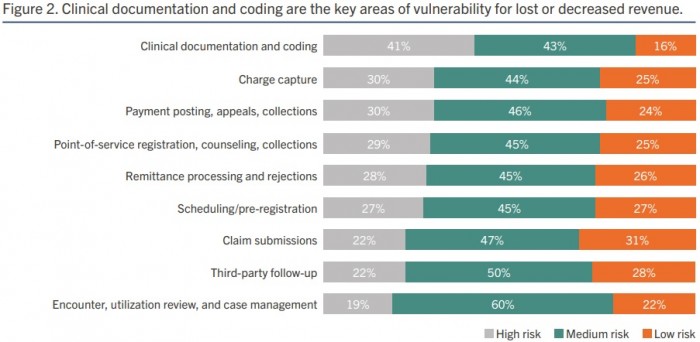
Image shows clinical documentation and coding is the top area at risk of lost or decreased revenue, according to most hospital leaders.

Hospitals are concerned their clinical documentation and coding processes are resulting in lost or decreased revenue, a new survey shows.

Hospital leaders are concerned that their organization’s clinical documentation and coding processes are vulnerable to errors that could result in lost or decreased revenue, according to a recent survey.

Consulting firm and technology vendor BESLER recently partnered with HIMSS Media to identify the greatest industry challenges and potential opportunities for revenue cycle improvement. They surveyed over 100 leaders within finance, revenue cycle, reimbursement, and health information management (HIM) departments at hospitals and acute-care facilities in October 2018.

The recently released survey results showed that 84 percent of respondents believe clinical documentation and coding are high or medium revenue cycle risk.

Hospital finance leaders were the most adamant that clinical documentation and coding presented significant revenue cycle challenges. Almost one-half of finance leaders chose clinical documentation and coding as their greatest revenue cycle vulnerability.

Although, the area was considered high or medium risk by over one-third of revenue cycle, reimbursement, and HIM leaders as well.

Clinical documentation and coding are creating revenue cycle vulnerabilities because solutions are not optimized for the diagnosis-related group (DRG) payment system, respondents shared. Only about one-third of hospital leaders said DRG optimization is a solved problem. In other words, the majority of hospital leaders (68 percent) do not think their solutions are equipped to manage DRG coding.

The DRG payment system has been around for over three decades. And major payers, including Medicare, use the payment system to determine lump-sum payments for hospitals that treat specific diagnoses.

While the payment system is not new, it is constantly evolving. Payers are attempting to get more specific about diagnoses to ensure hospitals are paid accurately for treating patients with certain conditions. The introduction of ICD-10 in 2015 is a prime example of how the industry has changed the DRG payment system.

But DRG changes are not ideal for providers. Hospitals find it difficult to follow and comply with constant DRG changes, and as a result, DRG coding accuracy has decreased. The report stated that the national benchmark for DRG assignment fell from 95 percent under ICD-9 to 72 percent in 2018.

Revenue cycle solutions, however, are optimized for inpatient coding and audits. Approximately 72 percent of respondents felt their technology is optimized for inpatient coding.

The survey also uncovered that respondents thought the accuracy of inpatient coding at their organizations was about the same as the industry benchmark.

Additionally, the majority of respondents (72 percent) agreed that their revenue cycle solutions are optimized for outpatient coding.

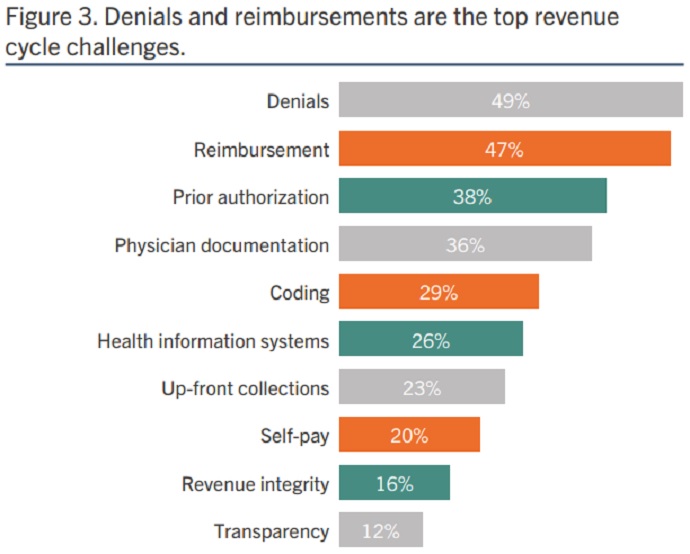
Opportunities to improve revenue cycle management technology remain. And poor coding integrity could result in the top two challenges hospitals face: claim denials (49 percent of respondents) and inaccurate reimbursements (47 percent of respondents).

Image shows claim denials and inaccurate reimbursements are the top two revenue cycle challenges, according to most hospital leaders.

Source: BESLER and HIMSS Media

However, hospitals and health systems face significant obstacles with improving their mid-revenue cycle processes, including DRG coding and documentation. Chief among the challenges is a lack of budget. Nearly one-half of hospital leaders (49 percent) said budget constraints prevented their organization from improving DRG coding and documentation.

Nearly the same percentage of leaders also felt return on investment (ROI) was an obstacle. Forty-eight percent of respondents said difficulty proving ROI from investment stopped their organization from executing DRG optimization efforts.

Other obstacles to improving the mid-revenue cycle included:

  • Competing projects (45 percent)
  • Lack of staff/headcount to manage improvement efforts (38 percent)
  • Lack of familiarly with solutions to address challenges (34 percent)
  • Existing solutions already widely entrenched or accepted (32 percent)
  • Overcoming internal perceptions that there is no need for improvement (30 percent)

Respondents identified a variety of challenges, but the survey also found a potential solution for hospitals and acute-care facilities. The survey showed that nearly half of respondents (47 percent) have created a revenue integrity program, which ensures organizations are being fully compliant with coding and billing practices while also achieving operational efficiency and legitimate reimbursement.

That means about 53 percent of hospitals still haven’t implemented a revenue integrity program.

About three-quarters of hospitals with revenue integrity programs reported improvements in net collections, increases in gross revenue capture, and/or reduction in compliance risk.


Cybersecurity for revenue cycle should be a KPI

https://www.healthcarefinancenews.com/news/intermountain-ciso-west-cybersecurity-revenue-cycle-should-be-kpi?mkt_tok=eyJpIjoiTmpCbE5tWmtNak5qTkdOayIsInQiOiJjMUJtNEJkTGxjbTNFWHl0Tmg4YUdrSjhQc0RpQWdid1VDQm5KQjBBeXRTaUluTjdwbnFnVEJ1aDhLcTNVdTl0Z2ZNM2RlbHRNRmJheDNsSVwvVU5qdHlFSkxIWHpBVHFQaVFDbnpPYkpGaU5oU1I5U0JvWEI2bFwveGRvRUpwMEZjIn0%3D

Image result for cybersecurity in revenue cycle

The revenue cycle is an important target for cybercriminals because of the information that flows through it.

Intermountain Healthcare’s chief information security officer Karl West kicked off the HIMSS19 Revenue Cycle Solutions Summit with a strong message for his captive audience. If you’re a revenue cycle leader, you need to understand a fundamental reality: There’s a whole host of data available for hackers in your rev cycle. Not only is there payment information, there is also member information and all of your PHI. All of those are sources of cyber risk.

For example, patient portal credentials are highly valuable for hackers at around $1,500 or more according to one study, West said.

As such, there needs to be a strong partnership between your cyber organization/operation and your revenue cycle. You also need to understand what are the threats and sources of loss. First, there’s phishing. It’s common and proven to be effective. At Intermountain, they phish their employees four times a year to test their proclivity to fall victim. Even though some find the measure frustrating, it’s essential to flushing out vulnerability.

Malware is also a significant security threat. To thwart such threats, it’s important to keep your systems patched. In your system, you need to have someone watching for vulnerability and patching.

“That’s the basic blocking and tackling,” West said.

Another source of loss is the misconfiguration of public-facing systems, which occurs when at build time, the proper protections are not built in.

And then there are nation-state actors, which are harder to protect against because smaller organizations do not have the resources to spend a lot on cybersecurity. Intermountain has a 24/7 security station/operation with eyes on such threats.

Finally, there are theft or loss/inadvertent accidents that involve employee error or bad action.

“If you aren’t, those are things you should be considering,” West said.

As consumerism continues to drive healthcare, the revenue cycle must move with that trend, and in a consumer-driven revenue cycle organization, fraud, breach, patient card information, PHI, personally identifiable information and the cloud are both assets and areas of risk.

As such, vulnerability management in the revenue cycle should be a big part of your operation and claims processing.

“When a caregiver gives care, they must be current on flu shots and vaccines,” West said. “It’s not an option. It’s a condition of employment. It means that the caregiver is protected to the best ability that we can. In the cyber world, it’s the same. Your networks, laptops and servers, how are you protecting them?”

While updates are annoying, vulnerabilities do need to be patched. Most healthcare organizations patch on an annual basis. At Intermountain, however, it is on a weekly or monthly basis. It’s a different mindset, West said. That is because not only did healthcare cyber attacks increase 320 percent between 2015 and 2016, but the attacks are also growing in sophistication. They don’t just slow systems down – they can cripple them for days, weeks or even months.

So, it is important to know that your patches are in place and your action plans are in place, he said. Have arrangements with vendors and partners. And for the many who have migrated to the cloud to streamline and cut costs, develop a strategy that isn’t just focused on one cloud but the whole cloud and know the controls required to protect you. West asked, does your cloud partner have a vulnerability and what are their safety practices?

“Have an inventory of your partnerships and manage them. Establish governance. As the primary organization, you are the one accountable to your patients,” he said.

Have an inventory of your data – where it is stored, where will it move to, and how it will move safely and securely. This should be a key performance indicator (KPI). Classify your data as public, restricted, private, classified or confidential, such that it is properly protected, and have data loss protection tools.

“When you wonder how did one system get taken down and not another, it’s your patching and practices,” West said.


14 hospitals with strong finances

https://www.beckershospitalreview.com/finance/14-hospitals-with-strong-finances-021219.html?origin=rcme&utm_source=rcme

Here are 14 hospitals and health systems with strong operational metrics and solid financial positions, according to recent reports from Moody’s Investors Service, Fitch Ratings and S&P Global Ratings.

Note: This is not an exhaustive list. Hospital and health system names were compiled from recent credit rating reports and are listed in alphabetical order.

1. Dallas-based Baylor Scott & White Health has an “Aa3” rating and stable outlook with Moody’s. The health system has strong cash flow margins, and its favorable demographics will contribute to volume and revenue growth, according to Moody’s.

2. Los Angeles-based Cedars-Sinai Medical Center has an “Aa3” rating and stable outlook with Moody’s. The hospital has strong margins, excellent balance sheet metrics and a strong reputation locally and nationally for patient care and research, according to Moody’s.

3. Orange, Calif.-based Children’s Hospital of Orange County has an “AA-” rating and stable outlook with Fitch. The hospital has a strong financial profile, and Fitch expects its capital-related ratios to improve.

4. Newark, Del.-based Christiana Care has an “Aa2” rating and stable outlook with Moody’s. The health system has solid margins and a robust balance sheet, according to Moody’s.

5. Fort Worth, Texas-based Cook Children’s Medical Center has an “Aa2” rating and stable outlook with Moody’s. The hospital has a strong market position and solid operating performance, according to Moody’s.

6. Durham, N.C.-based Duke University Health System has an “Aa2” rating and stable outlook with Moody’s. The health system is a leading provider of tertiary and quaternary services and has solid margins and cash levels, according to Moody’s.

7. Midland County (Texas) Hospital District has an “Aa3” rating and stable outlook with Moody’s. The district, which was created to operate a hospital in the county, has a manageable debt load, a modest pension liability and the ability to produce strong operating margins, according to Moody’s.

8. Chicago-based Northwestern Memorial HealthCare has an “Aa2” rating and stable outlook with Moody’s. Moody’s expects that the health system’s operating model and comprehensive IT systems will enable it to execute growth strategies while maintaining strong margins.

9. Winston-Salem, N.C.-based Novant Health has an “Aa3” rating and stable outlook with Moody’s. The credit rating agency expects Novant to continue generating strong cash flow margins in favorable markets.

10. Boston-based Partners HealthCare has an “Aa3” rating and stable outlook with Moody’s and an “AA-” rating and stable outlook with S&P. The health system has an excellent reputation in the clinical and research spaces, a long track record of fundraising, and adequate balance sheet measures, according to Moody’s.

11. St. Louis-based SSM Health Care has an “AA-” rating and stable outlook with Fitch. SSM has a strong financial profile, and Fitch expects the system to continue growing unrestricted liquidity and to maintain improved operational performance.

12. Appleton, Wis.-based ThedaCare has an “AA-” rating and stable outlook with Fitch. The health system has a leading market share in a stable service area and strong operating performance, according to Fitch.

13. Cincinnati-based TriHealth has an “AA-” rating and stable outlook with Fitch. Fitch expects the health system to maintain good operating ratios, leading to liquidity growth.

14. Yale New Haven (Conn.) Health has an “Aa3” rating and stable outlook with Moody’s. The health system has a leading market position in Connecticut, with a broad reach for tertiary and quaternary patients from throughout the state, and strong brand recognition, according to Moody’s.


Aetna, Anthem, Health Care Service Corporation, PNC Bank and IBM announce blockchain network

https://www.healthcarefinancenews.com/news/aetna-anthem-health-care-service-corporation-pnc-bank-and-ibm-announce-blockchain-network?mkt_tok=eyJpIjoiT0RJNU16UTNOakl4WlRFNCIsInQiOiJ1WHRTRHREbE5rM1hkZmc1QnRcL3JCSjdxMWdtXC9weGE1OE4yT0tMZ2d0eGVCYnlXbkVDSmVtU09UTzZDaUVSTmE2aVRpT1YzSklCVmVsZ3VaMWVyMDlNa1Z2b25DbXZ2QnpxSUpySWluXC8zSDRoTmkya2JCMU53b1h5YkRQUDlNcyJ9

Network will eventually be open to new members for secure digital sharing of healthcare information.

Aetna, Anthem, IBM, Health Care Service Corporation and PNC Bank have partnered to create a blockchain technology network aimed at improving transparency and interoperability in the healthcare industry. 

The groups intend to use blockchain for more efficient claims and payment processing. Blockchain enables the secure exchange of information. It will also benefit more accurate provider directories.

WHY THIS MATTERS

Collaboration is key in the industry as a more cost-effective alternative to merging to create more competitive and efficient systems.

The current network is expected to add additional health organizations in the coming months, including providers, startups, and technology companies.

Initial members include three of the nation’s largest insurers, Anthem; HCSC,a customer-owned health insurer that includes Blue Cross and Blue Shield plans; Aetna, which is now part of the CVS Health business; IBM, which is a leading blockchain provider; and PNC Bank, which is a member of The PNC Financial Services Group.

Blockchain technology gives health systems an edge because it ideally creates faster, more efficient and secure claims and payment processing.

Insurers are mandated to maintain accurate provider directories, a time consuming and often manual practice involving numerous emails, phone calls and even fax exchanges.

For providers, a new technology that can actually reduce time spent in administrative clicks on a computer is a boon.

THE TREND

Despite major initiatives to digitize healthcare information, improvements in transparency and interoperability are still needed for that data to be shared.

Blockchain is designed to fill that role, reducing administrative errors and costs and ultimately enhancing patient care. The network also enables the companies to build and deploy new solutions.

Walmart last year filed a patent to use blockchain for medical records. A pharmaceutical industry consortium called the MediLedger Project, launched in 2017, is using blockchain to track pills across the supply chain, according to Fortune.

ON THE RECORD

“Through the application of blockchain technology, we’ll work to improve data accuracy for providers, regulators, and other stakeholders, and give our members more control over their own data,” said Claus Jensen, chief technology officer at Aetna

Rajeev Ronanki, Anthem chief digital officer Rajeev Ronanki: “Timely access to medical information has been a stumbling block for creating a seamless consumer experience. With a trusted foundation based on transparency and cryptography, we will provide a faster, safer and more secure way to exchange medical information to transform the  consumer healthcare experience.”

What’s more, blockchain will enable large networks to exchange health data in a transparent and controlled way, according to Lori Steele, general manager for Healthcare and Life Sciences for IBM.

“Using this technology, we can remove friction, duplication, and administrative costs that continue to plague the industry,” added Chris Ward, head of product, PNC Treasury Management.


Are healthcare jobs safe from AI? More so than many might think

https://www.healthcarefinancenews.com/news/are-healthcare-jobs-safe-ai-more-so-many-might-think?mkt_tok=eyJpIjoiT0RJNU16UTNOakl4WlRFNCIsInQiOiJ1WHRTRHREbE5rM1hkZmc1QnRcL3JCSjdxMWdtXC9weGE1OE4yT0tMZ2d0eGVCYnlXbkVDSmVtU09UTzZDaUVSTmE2aVRpT1YzSklCVmVsZ3VaMWVyMDlNa1Z2b25DbXZ2QnpxSUpySWluXC8zSDRoTmkya2JCMU53b1h5YkRQUDlNcyJ9

No occupation will be unaffected by the technology, but healthcare will be affected less than other industries, owing much to its inherent complexity

Across the country and across industries, workers are nervous that automation and artificial intelligence will eventually take over their jobs. For some, those fears may be grounded in reality.

Healthcare, however, looks like it will be largely safe from that trend, a new report from the Brookings Metropolitan Policy Program finds.

Examining a chunk of time from the 1980s to 2016, the piece tracks the historical evolution of the technology and uses those findings to project forward to 2030.

The verdict? AI will replace jobs in various industries, but not so much in healthcare.

IMPACT

AI is projected to be an increasingly common form of automation, and the report claims the effects should be manageable in the aggregate labor market. Uncertainty remains, of course, and the effects will vary greatly — across geography, demographics and occupations.

Overall, though, only about 25 percent of U.S. jobs are at a high risk of replacement by automation. That translates to about 36 million jobs, based on 2016 data.

A higher percentage, 36 percent, are at medium risk (52 million jobs) while the largest group is the low-risk group, at 39 percent (57 million jobs).

Most of healthcare belongs in the medium-to-low categories, largely driven by the complexity of healthcare jobs. Still, the risk varies wildly. Medical assistants have what the report calls “automation potential” of 54 percent, but home health aids have just an 8 percent automation potential. Registered nurses sit somewhere in between, at 54 percent.

For healthcare support occupations, the number is closer to 49 percent; healthcare practitioners and technical jobs have 33 percent automation potential.

TREND

The report emphasizes that while some occupations will be safer from automation than others, no industry will be unaffected totally. Mundane tasks will be the most vulnerable.

Fortunately for those in the industry, there’s little in healthcare that’s mundane. AI and machine learning algorithms tend to rely on large quantities of data to be effective, and that data needs human hands to collect it and human eyes to analyze it.

And since AI in healthcare is currently utilized mainly to aggregate and organize data — looking for trends and patterns and making recommendations — a human component is very much needed, an opinion shared by several experts, who point out that empathy are reasoning skills are required in the field.


DIGNITY HEALTH, CHI FINALIZE $29B COMMONSPIRIT HEALTH MEGAMERGER

https://www.healthleadersmedia.com/strategy/dignity-health-chi-finalize-29b-commonspirit-health-megamerger

Image result for common spirit health
CommonSpirit

The newly merged, $29 billion system will have a footprint in 21 states, with more than 700 care sites and 142 hospitals, and an extensive social services and population health network.


KEY TAKEAWAYS

CHI CEO Kevin E. Lofton and Dignity Health President and CEO Lloyd H. Dean ‘are each a CEO in the Office of the CEO’ for the new health system, which will be based in Chicago.

CommonSpirit Health pledges to focus on underserved communities, population health, and social determinants of health.

Dignity Health and Catholic Health Initiatives on Friday finalized the megamerger of the two Catholic health systems that will now be known as CommonSpirit Health.

The newly merged, $29 billion system will have a footprint in 21 states, with more than 700 care sites and 142 hospitals, along with research programs, virtual care services, home health programs, and population health initiatives to tackle the root causes of poor health.

CHI CEO Kevin E. Lofton and Dignity Health President and CEO Lloyd H. Dean are “each a CEO in the Office of the CEO” for the new health system, which will be based in Chicago.

“We didn’t combine our ministries to get bigger, we came together to provide better care for more people,” Dean said in a media release.

“We created CommonSpirit Health because in order to solve national health challenges, we need the breadth, scope, and resources to make a nationwide impact,” Dean said.

Lofton said CommonSpirit Health “will bring the expertise of a national health system to neighborhoods across the country.”

“Whether it’s a neurological institute in Arizona, a 25-bed critical access facility in North Dakota, a mobile lung cancer screening program in Tennessee, or a ‘hospital at home’ in Nebraska, CommonSpirit Health will expand the best approaches from across our new organization,” Lofton said. “Our whole will be much greater than the sum of our parts.”

The new health system has 150,000 employees and 25,000 physicians and advanced practice clinicians.

Dean noted that 27 million Americans remain uninsured, and life expectancy continues to fall, despite some progress made under the Affordable Care Act. He said CommonSpirit will focus on underserved populations and the social causes of poor health.

“Too many people still can’t access quality healthcare in their communities,” Dean says. “America’s healthcare system need big changes, and we have a big goal of improving the health of millions of people in this country.”

Lofton said CommonSpirit “will focus on treating the whole person, particularly the social causes of poor health that lead to needless suffering, unnecessary hospital visits, and premature deaths.”

“Our goal is to be the leader in every type of care, whether you need brain surgery, urgent care for the flu, or help managing your diabetes,” he said.

CHI and Dignity Health previously announced that the new ministry will retain the names of local facilities and services in the communities where they are located.

‘GAINING ECONOMIES OF SCALE’

Brad Haller, director in West Monroe Partners’ Mergers & Acquisitions practice, notes that “so far, the new entity has shown very little change to how they will actually deliver care.”

“While the organization has a name for the merged entity, CommonSpirit, both systems indicated they are going to continue operating under both the CHI and Dignity names in their local markets,” he says.

“The merger wasn’t about branding or changing the nature of its business, but rather gaining economies of scale and geographic footprint, which makes sense for the like-mindedness in the way they deliver care and manage operations,” he says.

Concerns had been raised during the merger talks that women’s healthcare services would be ill-affected under the consolidated health system. Haller says those concerns appear to have been addressed with California approved the merger with a stipulation that CommonSpirit “must maintain emergency services and women’s healthcare services for 10 years after the deal closes.

“(California) also required CommonSpirit to create a Homeless Health Initiative to support hospitalized homeless patients,” Haller says. “I would suspect that the newly merged organization will find more synergies in care delivery as time goes on, as most merged organizations find during the post-integration phase, but in the spirit of efficiency or expansion.”

“The merger wasn’t about branding or changing the nature of its business, but rather gaining economies of scale and geographic footprint, which makes sense for the like-mindedness in the way they deliver care and manage operations.”

—Brad Haller

Allan Baumgarten, a veteran observer of the hospital sector in Midwestern states, says several Dignity hospitals are considered “non-Catholic” and not subject to the Vatican guidelines, such as not performing tubal ligations.

“Those hospitals will be kept somewhat separate so they can continue to offer those services,” he says.

Baumgarten notes the odd choice of Chicago as a headquarters for CommonSpirit, “even though neither system has a presence there.”

“CHI has three small hospitals in Minnesota (Park Rapids, Breckenridge, LIttle Falls) and some nursing homes, but otherwise the combined system has only a small presence in the Midwest,” he says.

“Not sure what to say about the impact on care delivery,” Baumgarten says. “In theory, if one system has certain strengths, like better care management and discharge planning, thereby reducing the number of readmissions, it could share those strengths and practices with the other hospitals.”

“To gain efficiencies, you might see them agreeing on a single vendor for certain medical devices or commodity suppliers that all hospitals will have to use in the future,” he says. “In any of these mergers, health economists will tell you that most of the benefits could be achieved by contracts and strategic partnerships.”

CHI and Dignity announced their plans to merge in December 2017. The deal was expected to close at the end of 2018, but it was delayed for one month. No specific reason was given for the delay.

The name CommonSpirit Health was chosen in November from among more than 1,200 possible names. The health systems said they settled on that name because it represents a shared sense of missional service and because it resonates with the diverse populations being served, the organizations said.

“WE DIDN’T COMBINE OUR MINISTRIES TO GET BIGGER, WE CAME TOGETHER TO PROVIDE BETTER CARE FOR MORE PEOPLE.”


As small hospitals ally with big ones, do patients benefit?

https://www.washingtonpost.com/national/health-science/as-small-hospitals-ally-with-big-ones-do-patients-benefit/2019/01/25/ccd50f2c-0a14-11e9-88e3-989a3e456820_story.html?utm_term=.44da63db320e

After seven years of a vigorous fight, Jim Hart worried he was running out of options.

Diagnosed with prostate cancer at age 60, Hart had undergone virtually every treatment — surgery, radiation and hormones — to eradicate it. But a blood test showed that his level of prostate-specific antigen, which should have been undetectable, kept rising ominously. And doctors couldn’t determine where the residual cancer was lurking.

“I didn’t like the sound of that,” said Hart, a retired international oil specialist for the federal government. “I wanted it gone,” he added, especially after learning that he had inherited the BRCA2 gene, making him vulnerable to other cancers.

So when Andrew Joel, Hart’s longtime urologist at Virginia Hospital Center in Arlington, mentioned the hospital’s membership in the Mayo Clinic Care Network and suggested consulting specialists at the Rochester, Minn., hospital for a second opinion, Hart enthusiastically agreed.

A Mayo immunologist told Joel about a new PET scan, not then available in the Washington area, that can detect tiny cancer hot spots. Hart flew to Mayo for the scan, which found cancer cells in one lymph node in his pelvis. He underwent chemotherapy at Virginia Hospital Center and five weeks of radiation at the Mayo Clinic. Since September 2016, there has been no detectable cancer.

“This collaboration was sort of a magic process,” Hart said. “I feel very fortunate.”

‘Benefit by association’

Hart’s experience showcases the promise of a much-touted but little understood collaboration in health care: alliances between community hospitals and some of the nation’s biggest and most respected institutions.

For prospective patients, it can be hard to assess what these relationships actually mean — and whether they matter.

Leah Binder, president and chief executive of the Leapfrog Group, a Washington-based patient safety organization that grades hospitals based on data involving medical errors and best practices, cautions that affiliation with a famous name is not a guarantee of quality.

“Brand names don’t always signify the highest quality of care,” she said. “And hospitals are really complicated places.”

Affiliation agreements are “essentially benefit by association, ” said Gerard Anderson, a professor of health policy and management at the Johns Hopkins Bloomberg School of Public Health. “In some cases it’s purely branding and in other cases it’s a deep association.”

A key question is “how often does the community hospital interact with the flagship hospital? If it’s once a week, that’s one thing. If it’s almost never, that’s another,” Anderson said.

Feeling ‘plugged in’

To expand their reach, flagship hospitals including Mayo, the Cleveland Clinic and Houston’s MD Anderson Cancer Center have signed affiliation agreements with smaller hospitals around the country. These agreements, which can involve different levels of clinical integration, typically grant community hospitals access to experts and specialized services at the larger hospitals while allowing them to remain independently owned and operated. For community hospitals, a primary goal of the brand name affiliation is stemming the loss of patients to local competitors.

In return, large hospitals receive new sources of patients for clinical trials and for the highly specialized services that distinguish these “destination medicine” sites. Affiliations also boost their name recognition — all without having to establish a physical presence.

In some cases, large hospital systems have opted for a different approach, largely involving acquisition. Johns Hopkins acquired Sibley Memorial and Suburban hospitals in the Washington area, along with All Children’s Hospital in St. Petersburg, Fla. The latter was re-christened Johns Hopkins All Children’s Hospital in 2016.

New York’s Memorial Sloan Kettering Cancer Center has embraced a hybrid strategy. It operates a ring of facilities surrounding Manhattan and has forged alliances with three partners in Connecticut, Pennsylvania and Florida.

“Every one of these models is different,” said Ben Umansky, managing director for research at the Advisory Board, a Washington-based consulting firm.

Local hospitals, he said, particularly those operating “in the shadows of giants,” may be better able to retain patients “by getting a name brand on their door. . . . There is a sense that they are plugged in.” (Virginia Hospital Center, for example, competes with Hopkins, MedStar Washington Hospital Center, which has an alliance with the Cleveland Clinic, and the Northern Virginia-based Inova system.)

Doctors can obtain speedy second opinions for their patients and streamline visits for those with complex or unusual medical needs, processes that can be daunting and difficult without connections.

Michael Kupferman, senior vice president of the MD Anderson Cancer Network, said it seeks to “elevate the quality of cancer care” by forming partnerships with “high-quality [hospitals] to keep patients at home and provide the imprimatur of MD Anderson.”

Virginia Hospital Center’s association with Mayo is “not just a branding affiliation, it’s a deep clinical affiliation,” said Jeffrey DiLisi, senior vice president and chief medical officer at the Arlington facility.

Despite extensive marketing, many patients seem unaware of the linkage. “We still think a lot about ‘How do we communicate this?’ ” DiLisi said.

Although affiliation agreements differ, many involve payment of an annual fee by smaller hospitals. Officials at Mayo and MD Anderson declined to reveal the amount, as did executives at several affiliates. Contracts with Mayo must be renewed annually, while some with MD Anderson exceed five years.

Acceptance is preceded by site visits and vetting of the community hospitals’ staff and operations. Strict guidelines control use of the flagship name.

“It is not the Mayo Clinic,” said David Hayes, medical director of the Mayo Clinic Care Network, which was launched in 2011. “It is a Mayo clinic affiliate.”

Of the 250 U.S. hospitals or health systems that have expressed serious interest in joining Mayo’s network, 34 have become members.

For patients considering a hospital that has such an affiliation, Binder advises checking ratings from a variety of sources, among them Leapfrog, Medicare, and Consumer Reports, and not just relying on reputation.

“In theory, it can be very helpful,” Binder said of such alliances. “The problem is that theory and reality don’t always come together in health care.”

Case in point: Hopkins’s All Children’s has been besieged by recent reports of catastrophic surgical injuries and errors and a spike in deaths among pediatric heart patients since Hopkins took over. Hopkins’s chief executive has apologized, more than a half-dozen top executives have resigned and Hopkins recently hired a former federal prosecutor to conduct a review of what went wrong.

“For me and my family, I always look at the data,” Binder said. “Nothing else matters if you’re not taken care of in a hospital, or you have the best surgeon in the world and die from an infection.”


How health care is like an airline

A rapidly consolidating industry. One that generally delivers on very difficult work, but with such a horrible customer-service reputation that people hate dealing with it. Known for wringing every last dollar out of its customers. You and the person next to you may be paying wildly different prices.

Health care, or an airline?

It’s a common comparison, and not without merit.

  • Harvard doctor and researcher Ashish Jha invoked the metaphor last year, in response to a non-profit hospital telling investors that it was trying to boost admissions: “Every extra passenger they can squeeze in is profit,” Jha said.
  • Here’s Brent Miller, a nephrologist at Indiana University, explaining to Modern Healthcare why most dialysis patients are treated in facilities instead of at home: “An empty chair is kind of like an empty seat on an airplane. If we were just looking at this not as people and not as health care but just as a business like an airline, our goal would be to fill all those slots.”
  • And, for the trifecta, here’s Elizabeth Rosenthal, writing in Kaiser Health News: “Just as airlines have been shown to exaggerate flight times so they can boast about on-time arrivals, hospitals set prices crazy high so they can tout their generous discount.”

The bottom line: In all seriousness, this analogy does get at an underlying problem with health care: As much as providers love to talk about new payment models, volume is still king — it’s simply too lucrative to give up.

Cutting costs top 2019 priority for healthcare finance execs & other survey findings

Click to access 2019-cfo-outlook-healthcare.pdf

https://www.beckershospitalreview.com/finance/cutting-costs-top-2019-priority-for-healthcare-finance-execs-other-survey-findings.html?origin=cfoe&utm_source=cfoe

Image result for Cutting costs top 2019 priority for healthcare finance execs & other survey findings

Many senior finance executives are not fully prepared to manage the financial impact of evolving business conditions in today’s healthcare environment, according to a survey by strategic and financial consulting firm Kaufman Hall.

The survey, conducted in September and October, asked CFOs, vice presidents of finance, directors of finance, and other senior finance executives more than 20 questions to gauge performance management progress and trends. Participants represented more than 160 U.S. hospitals, health systems, and other healthcare organizations.

Five findings:

1. Only 13 percent of respondents said their organizations are very prepared to manage evolving payment and delivery models with the financial planning processes and tools now available.

2. Additionally, only 23 percent said they are very confident that their teams can quickly and easily adjust to strategies and plans.

3. Ninety-six percent of respondents said they believe their organizations should be making greater efforts to leverage financial and operational data as part of decision-making.

4. Cost reduction and management is the biggest priority for senior finance executives this year, followed by predicting and managing changing payment models.

5. Along those lines, more than half of respondents cited the following as top improvement priorities for financial planning and analysis:

  • Cost management and efficiency
  • Reporting and analysis to support decision-making
  • Operational budgeting and forecasting
  • Profitability measurement across specific dimensions