Surprise hospitals bills are everywhere

An analysis of out-of-network claims in large employer health plans

Surprise hospital bills are remarkably common, my colleague Caitlin Owens reports. A new Kaiser Family Foundation brief finds that, among people with employer-based coverage, almost 1 in 5 patients admitted to the hospital end up getting a bill from an out-of-network provider.

Why it matters: Patients have to pay more out of their own pockets for out-of-network care.

  • As a lot of excellent recent reporting on emergency room billing has shown, it can be almost impossible to avoid out-of-network bills even when you take pains to ensure you’re going to an in-network hospital.

Balance billing — the practice of providers billing patients for the difference between their charges and insurance payments — is often responsible for these situations.

  • The Affordable Care Act required private plans to limit annual cost-sharing, but these generally only apply to in-network service charges.
  • Patients with emergency room claims and psychological/substance abuse claims are more at risk of receiving an out-of-network provider claim, per Kaiser.

By the numbers:

  • For inpatient admissions, those who use in-network facilities still receive a claim from an out-of-network provider 15.4% of the time.


Allina’s operating income sinks 45% in Q2

https://www.beckershospitalreview.com/finance/allina-s-operating-income-sinks-45-in-q2.html

Image result for allina health

Allina Health’s revenues increased in the second quarter of 2018, but the Minneapolis-based system’s operating income plummeted due to growth in expenses.

Allina reported revenues of $1.07 billion in the second quarter of this year, up from $1.01 billion in the same period of 2017, according to recently released bondholder documents. The boost was attributable to higher net patient service revenue, which climbed 6.4 percent year over year.

The system’s operating expenses totaled $1.06 billion in the second quarter of 2018, up from $990.4 million in the same period a year earlier.

Allina ended the second quarter of this year with operating income of $13.1 million. That’s down 45 percent from the first quarter of 2017, when the system reported operating income of $23.9 million.

Allina reported an investment return of $33.8 million in the second quarter of 2017, but that number dropped to $6.3 million in the second quarter of this year.

After factoring in the drop in investment income, Allina’s net income tumbled 56 percent year over year to $19.1 million in the second quarter of 2018.


Montefiore Health scores $1.2 billion financing deal that will add $600 million to flagship hospital’s balance sheet

https://www.healthcarefinancenews.com/news/montefiore-health-scores-12-billion-financing-deal-will-add-600-million-flagship-hospitals?mkt_tok=eyJpIjoiTVRNMk5XUm1PR1EwT1dFMyIsInQiOiIyeElkV3FjNjcrbkVCUTRURUlLZ0tTaXBaQW9OZVFQXC9Rd3lDdlJFcjhcL0FJU1FQUGdvOTd3aFc2aGZ5S21ndm9vY2pHcHgzcUV1VUg4UXZnVjVSY2xSMVVmdHpWUkpIbW0wb0plVjFSUVpLRFhuMXZBdG1tWFFFZWVpMEM0aDZjIn0%3D

Credit: Google Street View


The financing package is a hybrid of taxable and nontaxable bonds that will reimburse the system for more than $350 million in capital projects.

Montefiore Health System has landed a $1.2 billion financing deal with the Dormitory Authority of the State of New York that will add roughly $600 million of cash to Montefiore Medical Center’s coffers.

The bonds issued by DASNY were 30-year revenue bonds that were used to pay down $315 million in prior bonds insured by the Federal Housing Administration, including bonds backed by securities guaranteed by the Government National Mortgage Association. The new bonds issued also reimburse Montefiore for $357 million in past capital project spending on its facilities and take advantage of low interest rates in the market, the system said.

The system confirmed that the revenue bonds were secured by a pledge of gross receipts of Montefiore Medical Center and a mortgage on the Moses Division’s primary care facilities and its two parking garages. The new bonds were used to refinance existing bonds and loans as well as reimburse the health system for prior capital expenditures.

“The financing benefits the system by refinancing front-loaded debt to achieve a more level debt service structure and implements a flexible financing structure that can support future initiatives,” a spokesperson said.

According to a recent report from Moody’s Investors Service, the proceeds of the Series 2018 bonds will be used to refinance existing debt including FHA insured bonds, and will add about $600 million of cash to MMC’s balance sheet.

Moody’s assigned an initial Baa2 rating to Montefiore Obligated Group’s $1.2 billion in revenue bonds, which are a hybrid of both taxable and nontaxable bonds. Moody’s also gave a rating outlook of stable.

“Montefiore Obligated Group’s Baa2 rating reflects Moody’s belief that Montefiore Health System will maintain a leading market position in the Bronx, supported by its clinical excellence and its flagship position as the primary teaching hospital for the Albert Einstein College of Medicine (AECOM). Montefiore’s rating also reflects its experience with value based contracting, which will be aided by integration with its large base of faculty practice and primary care physicians,” Moody’s said.

“With this bond rating, Montefiore can continue our leadership in developing risk-based care and delivering care in the most appropriate settings at the right time. In the rating, Montefiore was noted for its clinical excellence, care, and its ability to attract internationally renowned physician scientists, complementing Albert Einstein College of Medicine’s long history of pioneering medical research,” Montefiore said in a statement.

Moody’s also cautioned that the system’s “keen commitment to its community and surrounding counties” could mean uncertainty, as some of MHS’s affiliated hospitals will experience losses despite state funding. The agency also said the med school’s financial issues will require cash support from Montefiore and unusually high levels of Medicaid and a “heavily unionized” workforce will also strain the system’s margins.

Montefiore is a major medical system in the New York metro area that includes three inpatient campuses with 1,558 licensed beds in the Bronx, as well as several other affiliated organizations in Westchester, Rockland and Orange Counties. Its hospitals include the 292-bed White Plains Hospital, 121-bed Montefiore Mount Vernon Hospital, 223-bed lMontefiore New Rochelle Hospital, 375-bed Nyack Hospital, 242-bed St. Luke’s Cornwall Hospital, and 150-bed Burke Rehabilitation Hospital. Montefiore Medicine Academic Health System is the parent above MHS that controls its Albert Einstein College of Medicine.


Investors Cash Out of HCA Healthcare as Stock Soars to Record

https://www.bloomberg.com/news/articles/2018-08-14/investors-cash-out-of-hca-healthcare-as-stock-soars-to-record

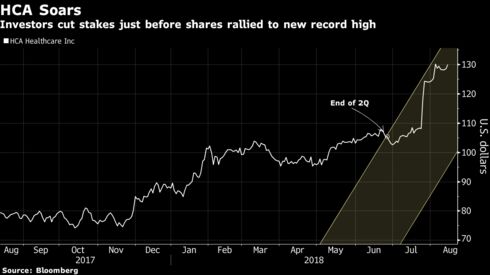
Long-term shareholders were cashing out of HCA Healthcare Inc. in the second quarter, as the stock rallied to record highs in late June — levels since eclipsed by bigger gains this quarter.

Hedge funds Glenview Capital Management, Highfields Capital Management, Wellington Management Group, Magellan Asset Management and Harris Associates cut their stakes in the hospital chain, which saw its shares rise 17 percent in the first half and an additional 27 percent so far this quarter. The investment firms sold a combined 17.3 million shares, according to their latest 13F filings.

After being under pressure for nearly two years, hospitals have staged a comeback in 2018, outperforming most of their health-care peers with a 21 percent gain. The rally was led by Tenet Healthcare Corp., which has more than doubled, and HCA, which saw earnings and patient visits improve. HCA was also among hospitals uniquely benefiting from the U.S. corporate tax overhaul.


Cigna prevails in Texas hospital’s suit over $50M in unpaid claims

https://www.bna.com/cigna-prevails-texas-n73014481565/

Image result for hospital out of network fee forgiving

Cigna Healthcare defeated a lawsuit by a Houston hospital accusing it of underpaying hundreds of medical benefit claims.

Cigna didn’t abuse its discretion when it reduced benefit payments to North Cypress Medical Center Operating Co. Ltd after it learned that the hospital engaged in fee-forgiving—a practice where out-of-network providers charge patients less than what they owe under their health insurance plans, a federal judge in Texas held Aug. 7.

Multiple lawsuits challenging the billing and payment practices between out-of-network providers and health insurers have been filed in the past decade, when insurers started reducing or withholding payments to providers that engaged in fee-forgiving. Insurers such as Cigna, Aetna, and UnitedHealthcare allege this practice is fraudulent.

The ruling, which came after an eight-day bench trial, is a significant victory for Cigna in a long-running lawsuit by North Cypress, which sought to hold the insurer liable for at least $50 million in unpaid claims.

In 2016, Judge Keith P. Ellison held that Cigna violated federal benefits law by denying full payment of benefit claims.

Since then, the U.S. Court of Appeals for the Fifth Circuit issued a number of opinions in favor of insurers, including one where it reversed a $16.4 million judgment against Cigna in a case in which another small Texas-based hospital accused it of underpaying medical claims. Last week, the Fifth Circuit affirmed a ruling against the hospital in its lawsuit accusing Aetna Life Insurance Co. of underpaying medical claims in violation of the Employee Retirement Income Security Act and Texas law.

After the parties Cigna and North Cypress engaged in full discovery, the claims at issue were limited to the 575 benefit claims for which the hospital exhausted its administrative remedies. Cigna argued at trial that in these 575 claims, it didn’t apply its fee-forgiving protocol to reduce payments to 395 of them because they were for nonemergency services.

Cigna’s interpretation of its plans to require an out-of-network provider to collect the full portion of coinsurance from a patient was reasonable, Ellison said.

Ellison, who sits in the U.S. District Court for the Southern District of Texas, pointed out that Cigna had substantial evidence to support its determination that North Cypress engaged in fee-forgiving. Cigna had sent surveys to patients who had received treatment at North Cypress and it discovered that the hospital was discounting or forgiving out-of-network coinsurance, Ellison said.


NOT-FOR-PROFIT OPERATING MARGINS CONTINUE TO DECLINE

https://www.healthleadersmedia.com/finance/not-profit-operating-margins-continue-decline?utm_source=silverpop&utm_medium=email&utm_campaign=ENL_180801_LDR_BREAKING_DeKalb_Emory%20(1)&spMailingID=14040768&spUserID=MTY3ODg4NTg1MzQ4S0&spJobID=1460932625&spReportId=MTQ2MDkzMjYyNQS2

Operating margins for systems and hospitals continued to decline due to increasing expense pressures as well as slowing net patient revenue growth across all rating levels.


KEY TAKEAWAYS

Strong balance sheets and capable leadership continue to lead the way for stable success.

M&A activity has bolstered the financial standing and credit ratings of not-for-profit health systems.

Not-for-profit systems are outnumbering stand-alone hospitals through increased M&A activity.

Stand-alone hospitals experienced their second consecutive year of negative outlooks.

Not-for-profit health systems and stand-alone hospitals have maintained generally favorable bond ratings due in large part to strong balance sheets, despite the continual decline in operating margins and cash flows.

S&P Global Ratings released research this week on the financial status of not-for-profit health systems and stand-alone hospitals in 2017.

The sector remained consistent in several year-to-year, such as improving days’ cash-on-hand levels and marginal reduction in debt levels, though the study found that the underlying pressures on not-for-profits are beginning to take their toll. The operating margin for the sector declined from 2.4% in 2016 to 1.8% in 2017.

S&P also noted that not-for-profit health systems continue to outnumber stand-alone hospitals and received stronger overall ratings from the agency.

RATINGS ACTIONS FOR THE SECTOR THROUGH JUNE 22:

  • 152 total affirmations
  • 16 total upgrades, though six upgrades were driven by systems merging together.
  • 15 total downgrades

S&P said a major factor that allowed health systems and hospitals to weather financial challenges last year was the combination of strong balance sheets and leadership. 

CREDIT STRENGTHS OF NOT-FOR-PROFIT SYSTEMS:

  • Robust M&A activity has improved the financial profile for systems.
  • Despite the same challenges with maintaining an overall patient base, systems have experienced a growth in outpatient services.
  • Sizable investments in information technology have resulted in strong credit ratings.

S&P analysts said that stand-alone hospitals featured stronger medians than systems but found they are weakening. This is due to softer patient volumes, a weakening payor mix combined with increased pressure from commercial payors, and labor expenses. 

HOW STAND-ALONE HOSPITALS PERFORMED:

  • While the amount of stand-alone hospitals are shrinking, they produced stable balance sheets that were noted as a “principal strength of financial profile.
  • Debt levels fell due to declining unrestricted net assets.
  • However, negative operating margins appeared in BBB rating levels.


CHS faces investigation related to EHR incentive program

https://www.beckershospitalreview.com/legal-regulatory-issues/chs-faces-investigation-related-to-ehr-incentive-program.html

Image result for community health systems

Franklin, Tenn.-based Community Health Systems has received a civil investigative demand related to the company’s adoption of EHRs and adherence to the meaningful use program, according to CHS’ latest financial filing.

Under the meaningful use program, now called the promoting interoperability program, CMS distributed incentive payments to eligible providers for installing EHR systems and using them to engage patients and families and to improve care coordination.

In its financial filing, CHS said it is responding to a civil investigative demand related to its “adoption of electronic health records technology and the meaningful use program.”

Federal and state authorities issue these types of demands to collect records and information related to ongoing civil investigations, including False Claims Act cases.

CHS declined to comment on the investigative demand beyond what is included in the financial filing.

EHR incentive payments grabbed the attention of federal regulators after HHS’ Office of Inspector General released a report in 2017 that revealed Medicare made approximately $729.4 million in EHR incentive payments to medical providers who did not comply with federal requirements.


Fitch brightens its view on nonprofit hospitals

https://www.healthcaredive.com/news/fitch-brightens-its-view-on-nonprofit-hospitals/529618/

Dive Brief:

  • Fitch Ratings said its “Rating Watch” for U.S. nonprofit hospitals and health systems is over after the organizations showed improved or stable results this year.
  • During a six-month review of 125 existing issuers, Fitch affirmed 52% of the graded facilities and upgraded 28%.
  • More than 93% of rating changes moved only one to two notches. There were two extreme outliers. Fitch downgraded Lexington Medical Center six notches due to pension liability. Presence Health Network, meanwhile, shot up seven notches.

Dive Insight:

Fitch’s move is a sign of optimism for nonprofits reeling from years of wobbly financial times. The report comes months after Moody’s revised its outlook for the sector from stable to negative. That move followed nonprofit hospitals seeing more credit downgrades in 2017.

Nevertheless, Fitch’s announcement this week shows that hospitals are finding ways to combat tough finances, including lower reimbursements and inpatient admissions. One way acute care hospitals confront those issues is by investing in outpatient services. The strategy helps health systems defend market share.

At the end of 2017, Fitch said investing in outpatient assets is usually favorable for credit profiles, but also leads to “more economic cyclicality and seasonality in patient volumes for hospital companies.”

In its report this week, Fitch said a hospital’s cash and investment portfolio and asset allocation policy play significant roles in its creditworthiness. Balance sheet strength is also an essential piece of ratings — more than operational success or size and scale.

Fitch said size and scale are no longer direct rating factors. However, Fitch may consider if the size and scale enhance or weaken its ability to provide rating stability.

“As borne out by Fitch’s rating actions, it is apparent that providers with strong net leverage are able to withstand potential financial pressures and return to existing rating levels more quickly than credits without strong balance sheet metrics,” the ratings agency said.

Fitch’s review of 125 existing issuers was just under half of its total acute portfolio. Fitch Ratings Senior Director Kevin Holloran said it’s somewhat surprising there were more upgrades than downgrades.

About half of the upgrades were connected to criteria revision, 14% based on credit reasons and 34% because of a combination of credit and criteria reasons. On the other end, about half of downgrades were based on criteria review, 24% on credit reasons and 24% on a combination of credit and criteria factors.

Holloran said upgrades were mostly from “long-time consistent performers that benefited from a ‘new look’ through the lens of our upgraded criteria.” Downgrades were more varied, but balance sheet strength played a pivotal role in predictable credit stability.

Fitch said the future rating trajectory for nonprofit hospitals is “normalcy.” That said, Holloran noted that the sector is dealing with multiple operational challenges this year. Those issues, including external factors, such as regulations and legislation, could drag into 2019.


‘Disrespected’: UC Davis health care workers say their proposed wage increase is ‘garbage’

https://www.sacbee.com/news/local/health-and-medicine/article215886990.html

Image result for ‘Disrespected’: UC Davis health care workers say their proposed wage increase is ‘garbage’

Dietitians, physical therapists and other health care professionals at UC Davis Health say that, over nearly a year of bargaining, the university’s labor negotiators have been skipping sessions and have not offered raises of more than 2 percent a year.

Ahead of one bargaining session attended by a Bee reporter this spring, labor negotiator Dan Russell asked dozens of the rank-and-file members of the University Professional and Technical Employees-Communications Workers of America: “How does that offer make you feel?”

Voices rose above a murmur of discontent, yelling, “not good,” “insulted” and “disrespected,” among other things.

Physical therapist Rachel Hammond told the UC bargaining team that day: “You can go onto the Social Security Administration website, and if you average out over the last 40 years, the average (cost-of-living adjustment) is 4 percent per year, so your offer of 2 percent a year is garbage. … When are you prepared to give us a fair contract?”

Claire Doan, a spokeswoman for the UC Office of the President, confirmed that the university system had offered raises of 2 percent a year over the life of a four-year contract. She said administrators also had offered to sweeten raises for employees in certain classifications, based on local market wages, to help ensure that pay for UC health care professionals remains competitive.

“Despite multiple proposals presented by the university, it took union leaders months to finally respond with a counter-proposal,” she said in a statement emailed to The Bee.

“UPTE leaders are demanding double-digit pay increases that are unreasonable and out of line with what other UC employees receive: 16.5 to 22 percent over the term of the agreement.”

Doan said President Janet Napolitano and other UC leaders would have no further comment because they believe the proper venue for detailed discussion of wages and related issues is at the negotiating table, not the media.

While pay is a huge issue for the health care professionals in UPTE-CWA, they are just as concerned about what they see as UC’s attempts to treat them like second-class employees, said senior dietitian Greg Wine, a labor representative for 800-plus UPTE Local 6 UCD Medical Center employees.

One example is how the university system rewards UPTE-CWA health care professionals when it comes to holiday pay, said Brandon Sessler, a physician assistant at UC San Francisco. The union’s members receive overtime pay for just six holidays, while nurses get overtime for nine such days.

Respiratory therapists, physical therapists and other UPTE-CWA members are working side-by-side with nurses on those three additional holidays, he said.

Union representatives said UC negotiators have come to only six of 16 bargaining sessions.

Wine said UC Davis negotiators told him they are too short-staffed to show up, though he said they have done so for talks with the California Nurses Association and AFSCME 3299. The attendance record didn’t change, he said, until he voiced complaints to UC Davis Chancellor Gary May and UC Davis Medical Center CEO Anne Madden Rice.

“Our clinical lab scientists are working 16-hour, back-to-back shifts,” Wine said. “They don’t tell units that they are understaffed and we cannot perform their blood work. … We cannot say to the oncology ward or our cancer patients: ‘Because of our lack of staffing … we cannot provide any services to you for the next several months.’”

Wine and other UPTE-CWA members said their departments at UCDMC are severely understaffed because the university has a hard time recruiting since salaries aren’t comparable to Kaiser or Sutter in the Sacramento market.

Neurology dietitian Erin Lavin, a UC Davis graduate, said she came back to work at UCD because she had loved being part of research there during her years as an undergraduate and wanted to have the opportunity to continue doing it while also helping patients.

Lavin said she’s taught nutrition classes in the community and at UCDMC, but always on her own time, because UC Davis doesn’t offer her professional leave for that. That would be more palatable, Lavin said, if she at least earned as much as her peers at other local health systems.

“I want to be the best dietitian I can be, and I’ll never stop doing that,” she told UC negotiators, “but I would hope that you would also try to be the best you can be for me.”

Wine said that the university had offered to increase wage ranges for new hires in some occupations beyond the 2-percent-a-year offer, but they did not propose adjusting salaries for any current employees such as he and Lavin.

The university system wants to be competitive when it comes to labor recruitment, Wine said, but once employees are hired, the university has no mechanism to address market inequities in pay.

Wine and other UC union representatives said they are all facing demands from the UC president that would shift risk from the UC system onto employees.

The UPTE-CWA health care professionals contract, which expired in October, was one of the last of six UC labor agreements to lapse without prospect for settlement, Wine said. UPTE-CWA also represents technical workers and research-support professionals — roughly 15,000 UC employees in total — and both of those contracts expired in September 2017.

About 14,000 registered nurses at UC have been without a contract since September, when an extension ran out. They are represented by the California Nurses AssociationAFSCME 3299 represents 24.000 workers in the UC system: Its patient-care workers saw their contract expire in December, and its service-unit agreement lapsed in June 2017.

All of the unions worry that UC wants to move new union hires into 401(k)-style retirement plans and away from the traditional pension that promises set income for retirement.

In a traditional pension, companies make all payments to the retirement plan and take on all investment risk. In a 401(k), workers must contribute money from their salaries toward retirement and assume the investment risk.

Pension money managers have traditionally outperformed 401(k) money managers, and although some companies have reneged on their obligation, most have proven to be more effective contributors to pensions than U.S. workers have been to their 401(k) plans. A survey of 2,003 adults by Northwestern Mutual found that one in five Americans have nothing saved at all for their golden years, and one in three have less than $5,000 put away.

With this sort of record, Wine said, Medi-Cal — and that means taxpayers — could end up paying to care for UC retirees who choose a 401(k) option. But this is not the only shifting of risk that UC is attempting during current contract negotiations, Wine said.

“They want to eliminate any cap on the shared cost of our health benefits, and they want to eliminate any cap on parking costs for their employees,” Wine said. “When you do that, what cost-of-living increase are you really getting?…Currently, we believe if we accepted the 2 percent and we accepted elimination of these caps to the costs of benefits and parking, we believe the employee would actually take home less (money).”

Both UPTE leaders and UC officials said they will continue talks in hopes of bringing negotiations to a close with a fair agreement. Wine noted that during the last contract negotiations with UC, however, UPTE-CWA members went nearly three years without a contract before an agreement was reached.


15 recent hospital, health system outlook and credit rating actions

https://www.beckershospitalreview.com/finance/15-recent-hospital-health-system-outlook-and-credit-rating-actions-8-3-18.html

The following hospital and health system credit rating and outlook changes and affirmations occurred in the last week, beginning with the most recent.

1. S&P downgrades Westchester County Health Care to ‘BBB-‘
S&P Global Ratings downgraded Valhalla, N.Y.-based Westchester County Health Care’s revenue and refunding bonds to “BBB-” from “BBB.”

2. S&P revises UAB Medicine’s outlook to negative over weaker operations
S&P Global Ratings revised Birmingham, Ala.-based UAB Medicine’s outlook to negative from stable.

3. S&P upgrades Torrance Memorial Medical Center’s rating to ‘A’
S&P Global Ratings upgraded its long-term and underlying rating on Torrance (Calif.) Memorial Medical Center’s outstanding debt to “A” from “BBB.”

4. Moody’s affirms ‘A1’ rating on ProHealth Care
Moody’s Investors Service affirmed its “A1” rating on Waukesha, Wis.-based ProHealth Care, affecting $181 million of outstanding debt.

5. Moody’s assigns ‘Baa1’ to Baptist Healthcare System’s bonds
Moody’s Investors Service assigned its “Baa1” rating to Louisville-based Baptist Healthcare System’s proposed $130 million series 2018A revenue refunding bonds. At the same time, Moody’s upgraded the health system’s parity debt to “Baa1” from “Baa2,” affecting $442 million of debt.

6. S&P assigns ‘BBB+’ rating to CHI’s bonds
S&P Global Ratings assigned its “BBB+” long-term rating on Englewood, Colo.-based Catholic Health Initiatives’ proposed $275 million series 2018A bonds.

7. S&P places Essentia Health on credit watch negative
S&P Global Ratings placed its “A” underlying rating on Duluth, Minn.-based Essentia Health on credit watch with negative implications.

8. S&P revises Halifax Hospital Medical Center’s outlook to negative over litigation risks
S&P Global Ratings affirmed its “A-” long-term rating on Daytona Beach, Fla.-based Halifax Hospital Medical Center’s revenue bonds and revised the outlook to negative from stable.

9. Fitch assigns ‘AA’ IDR to Advocate Aurora Health
Fitch Ratings assigned an issuer default rating of “AA” to Advocate Aurora Health — the entity formed by the recent merger of Downers Grove, Ill.-based Advocate Health Care and Milwaukee-based Aurora Health.

10. Fitch affirms Nebraska Medicine’s ‘AA-‘ rating
Fitch Ratings affirmed its “AA-” rating on Omaha-based Nebraska Medicine’s outstanding bonds. Concurrently, Fitch assigned its “AA-” issuer default rating to the academic healthcare provider.

11. Fitch affirms ‘AA’ rating on Presbyterian Healthcare
Fitch Ratings affirmed its “AA” rating of Albuquerque, N.M.-based Presbyterian Healthcare Services’ outstanding bonds, affecting $850 billion of debt. At the same time, Fitch assigned its “AA” issuer default rating to the health system.

12. Moody’s affirms ‘Aa3’ rating on Main Line Health
Moody’s Investors Service affirmed its “Aa3” rating on Philadelphia-based Main Line Health’s outstanding bonds, affecting $219.5 million of debt.

13. Moody’s downgrades Lafayette General Medical Center
Moody’s Investors Service downgraded its rating on Lafayette (La.) General Medical Center to “Baa2” from “Baa1,” affecting $147 million of rated debt.

14. Moody’s affirms SCL Health’s ‘Aa3’ rating
Moody’s Investors Service affirmed its “Aa3” long-term rating on Sisters of Charity of Leavenworth (Kan.) Health System, which does business as SCL Health. The rating affects about $1.2 billion of debt.

15. S&P ratings on ProMedica debt unchanged after HCR ManorCare acquisition
ProMedica’s acquisition of Toledo-based nursing home chain HCR ManorCare will not immediately affect its “A+” long-term ratings on the Ohio-based health system’s debt, according to S&P Global Ratings.