The American Health Care Act: 10 things to know

http://www.beckershospitalreview.com/hospital-management-administration/gop-health-bill-is-out-10-things-to-know-this-morning.html

Image result for american healthcare act

After years of lobbying to repeal and replace the ACA, House Republicans put forth The American Health Care Act on Monday. Here are 10 things to know about the legislation.

1. The AHCA would eliminate the ACA’s individual mandate, or requirement for American adults to enroll in health insurance. Further, the legislation eliminates the tax penalty adults faced if they were not covered. However, the concept of penalties still remains in some form: To encourage people to buy coverage, the AHCA lets insurers charge a 30 percent penalty for those who let their health plans lapse and try to buy a new policy, according to NPR.

2. The AHCA calls for Medicaid expansion to remain in effect through Jan. 1, 2020. This is different from earlier drafts of legislation, which called for an immediate reversal of Medicaid expansion. Thirty-one states, plus Washington, D.C., have opted to expand Medicaid under the ACA. By 2020, the government will “freeze” the expanded programs and restrict funding only to people who were in the program as of then — no added enrollees from that date on. States would keep getting that amount of federal aid for each Medicaid enrollee as long as the enrollee doesn’t lose eligibility for more than a month. There is also a provision in the AHCA that calls for grants of extra Medicaid provider reimbursement funds to go toward states that didn’t expand Medicaid.

3. The AHCA restructures Medicaid’s federal funding to a per-capita cap opposed to the current open-ended federal entitlement, reports Politico. States would receive capped payments based on how many people are enrolled in Medicaid. The plan also calls for more frequent eligibility testing of Medicaid enrollees.

4. The AHCA restructures Americans’ tax credits to buy health insurance. It replaces income-based subsidies under the ACA with refundable, age-based and income-capped tax credits, according to Politico. These credits increase with age, from as low as $2,000 for those under 30 or as high as $4,000 for those over 60. There would be a limit as far as credits for a single household — $14,000 — and subsidies would be eliminated over time for individuals with annual income of $75,000 and for families with annual income of $150,000, according to the report.

5. A few ACA staples roll over in the AHCA. The ACA provision related to pre-existing conditions would remain intact, meaning insurers would not be able to deny coverage or increase prices for people with such conditions, reports Reuters. Also, the AHCA retains provisions allowing adults up to age 26 to maintain coverage through their parents’ health plans, according to the report.

6. The AHCA eliminates the cap on the tax exemption for employer-sponsored insurance. Although earlier drafts of legislation capped the exemption at 90 percent of current premiums, the final version eliminated the proposal, according to Politico. The bill also gets rid of the penalty for businesses that do not offer employees health coverage.

7. The AHCA delays the effective date for the ACA’s Cadillac Tax on costly health plans from 2020 to 2025, according to The Hill. GOP lawmakers are delaying but keeping the tax to make certain their replacement plan will not increase the national deficit after a decade.

8. The AHCA bars federal Medicaid funds or federal family planning grants for Planned Parenthood clinics, according to the report. (Separate from the AHCA, the White House earlier this week extended terms for a compromise to Planned Parenthood by proposing maintained federal funding if the group agrees to discontinue providing abortions, according to ABC News.)

9. The cost of the AHCA is not yet known. The nonpartisan Congressional Budget Office has not yet scored the legislation, which means there is neither a cost estimate for the plan or how many Americans would gain or lose insurance under it.

10. What’s next? The House Ways and Means and Energy and Commerce committees are expected to review the AHCA legislation Wednesday. If the committees approve the measure, the full House could potentially act on it before April 7, according to The New York Times. The measure would then be taken up by the Senate.

GOP releases bills to repeal and replace ObamaCare

http://thehill.com/policy/healthcare/322609-gop-releases-bill-to-repeal-and-replace-obamacare

Image result for gop healthcare plan

Click to access AmericanHealthCareAct.pdf

Click to access AmericanHealthCareAct_WM.pdf

House Republicans on Monday unveiled their long-awaited legislation to repeal and replace ­ObamaCare, with plans to quickly push the measure through committee votes this week.

The two measures dismantle the core aspects of ­ObamaCare, including its subsidies to help people buy coverage, expansion of Medicaid, taxes and mandates for people to have insurance. The bills also dramatically restructure the Medicaid program overall by capping federal payments.

In its place, Republicans would put a new system centered on a tax credit to help people buy insurance.

House Republicans plan to take up the legislation at a breakneck pace, with two committees — Energy and Commerce and Ways and Means — scheduled to hold votes on Wednesday. A vote in the full House is expected to soon follow, within weeks.

House Ways and Means Committee Chairman Kevin Brady (R-Texas) said Monday on Fox News that he’s confident the legislation will pass with solid Republican support despite recent party infighting over the details.

“We’ve been listening very carefully to our Republican members for months now to make sure we get it right,” he said. “I am confident we are going to pass this.”

Brady noted that many of the elements of the bills have passed the House “a number of times” over the years.

Speaker Paul Ryan (R-Wis.) in a statement claimed that ­ObamaCare “is rapidly collapsing” and vowed the GOP’s plan — dubbed the American Health Care Act — will “give every American access to quality, affordable health insurance.”

Republicans acknowledge that their plan will cover fewer people, saying that unlike ­ObamaCare, they are not forcing people to buy coverage through a mandate. They say their system is less intrusive and provides people a tax credit without mandates or a range of tax increases.

But the measures face a rocky path, particularly in the Senate. Four Republican senators earlier Monday objected to an earlier version of the House plan, saying that it fails to protect ­ObamaCare’s Medicaid expansion.

Even in the House, there are objections. Conservatives in the House Freedom Caucus object that the new tax credit is a “new entitlement.” They have enough votes to kill the legislation, but it remains to be seen whether they will actually vote against a bill that dismantles the core of ­ObamaCare.

The GOP measure significantly restructures the Medicaid program, which provides coverage for around 70 million poor, disabled and elderly people, to cap federal payments.

The repeal of the Medicaid expansion and ­ObamaCare’s subsidies would not take effect until 2020, meaning current enrollees could keep their coverage this year.

Republicans would also grandfather in current Medicaid enrollees so that they can stay on the program. But once 2020 arrives, the federal government would no longer provide the extra federal funds that allow for expansion.

That plan has drawn objections from more centrist Republican senators, who want to protect the expansion and are worried about constituents losing coverage and their states losing federal funds.

The legislation would maintain ­ObamaCare’s protections for people with pre-existing conditions, who could still not be denied coverage by insurers. Instead of ­ObamaCare’s mandate, the GOP plan would seek to encourage healthy people to sign up by allowing insurers to charge people 30 percent higher premiums if a new enrollee has had a gap in coverage.

The legislation also repeals nearly all of the taxes created by ­ObamaCare, including the medical device tax and health insurance tax, starting in 2018. The bills scrap a controversial Republican proposal in earlier drafts that would have started taxing some employer-sponsored health insurance.

To ensure that the legislation passes muster under special budgetary rules, it keeps ­ObamaCare’s “Cadillac tax” on generous plans after 2025. That provision, which could prove controversial, will help ensure that the measure does not add to the federal deficit in that decade.

Koch-backed group details hopes for healthcare reform

http://thehill.com/policy/healthcare/316875-koch-backed-group-pushes-for-high-risk-pools-medicaid-freeze-in-obamacare

Koch-backed group details hopes for healthcare reform

A conservative group funded by the Koch brothers is pushing for high-risk pools and a freeze on Medicaid expansions as lawmakers try to coalesce around a replacement for ObamaCare.

Freedom Partners began circulating a memo on Capitol Hill Monday with specific reforms it thinks lawmakers should pass, including: the creation of high-risk pools at the state level to cover people with pre-existing conditions; the elimination of the ObamaCare mandate, which required everyone buy insurance or pay a penalty; and the expansion of access to health savings accounts, so people can save and pay for healthcare with pre-tax dollars.

The recommendations fall in line with what top Republicans in Congress have indicated they support.

High-risk pools offer coverage for sick people that otherwise could be denied coverage for having pre-existing conditions if ObamaCare is repealed.

Why risk adjustment is a crucial component of individual market reform

https://www.brookings.edu/blog/up-front/2017/01/25/why-risk-adjustment-is-a-crucial-component-of-individual-market-reform/

Related image

The mantra of ‘Repeal and Replace’ has escalated in recent weeks, though what, specifically, the ‘Replace’ component might look like is still unclear. However, many of the current proposals include, at a minimum, some type of continuous coverage provision that allows people with chronic health conditions who have continuously maintained coverage to buy health insurance at standard rates. For example, Paul Ryan’s A Better Way proposal and Tom Price’s Empowering Patients First Act would each prohibit insurers from charging sicker patients more than standard premiums in the individual market as long as they have maintained continuous coverage since before becoming sick.

Such provisions are important to keep patients from seeing their health insurance premiums sky-rocket after becoming sick, which would defeat the purpose of insurance in the first place. However, these provisions also require that insurers sell policies to these patients at premiums that they know will not cover their expected health care spending, generating losses for the insurance company. On its own, this would create a situation where insurers have a strong financial incentive to avoid enrolling these sicker patients.

Risk adjustment combats disincentives to provide coverage for sicker patients

In order to mitigate these incentives for insurance companies to avoid sicker patients, policymakers will need to include a risk adjustment program in any replacement reforms that require insurers to issue insurance to any applicant (also known as “guaranteed issue”) and set limits on adjusting premiums to fully reflect an enrollee’s health status. Continuous coverage provisions are one example of such limits, but risk adjustment will be necessary to combat against adverse selection across a wide range of potential reforms.

A risk adjustment program would make behind-the-scenes financial transfers to insurers to adequately compensate them for enrolling these sicker patients when they are not allowed to charge the individual higher premiums. Risk adjustment will be necessary to promote a well-functioning market where private insurers compete based on the value they deliver and not simply by avoiding sicker patients.

ACA Repeal Efforts Would Impact State Laws, Too

http://www.commonwealthfund.org/publications/blog/2017/jan/aca-repeal-efforts-impact-state-laws

Although the debate over the future of the Affordable Care Act (ACA) focuses largely on federal legislation, repeal and replacement efforts would significantly affect state approaches to insurance regulation.

State-level legislation and regulations help ensure that state regulators have full authority to enforce the ACA market reforms. As of November 2013, 32 states and D.C. had taken legislative or regulatory action to implement at least one of them. States with full enforcement authority can, for example, issue regulations or guidance, undertake market conduct exams, or take disciplinary action related to the law’s consumer protections, such as its ban on denying coverage based on preexisting conditions or charging women more than men. (To learn more about states’ approaches, see this resource and previous reports on implementation of the early market reforms and the 2014 market reforms.)

Balance enrollee risk to sustain individual marketplaces, report says

http://www.fiercehealthcare.com/payer/balancing-enrollee-risk-key-to-sustainable-individual-marketplaces-report?mkt_tok=eyJpIjoiTkRGbE9XWTBNVGcwTUROaSIsInQiOiJOZEtcLzhSNHFcL3A2UGlyd2JIQWNwK2ZoRGpWcENHODJZQTlLQ1R1OVo0b3JvdUdSdkN0a0FyTzhIdHVnYVhCN0lxNHRQbW5ibEVVWjBiR0VPU2tFdXBCVmxSYWtWcWZJQ2dyOUxIRnBlNURrakpFXC93Y2xHS21RdGFybUtZZVJlViJ9&mrkid=959610&utm_medium=nl&utm_source=internal

Document titled "Patient Protection and Affordable Care Act"

Stability and sustainability in health insurance marketplaces requires a more balanced risk profile for enrollees and rules that are communicated clearly and quickly to payers, according to a new report.

The analysis (PDF), published by the American Academy of Actuaries, examined the state of insurance markets under the Affordable Care Act and noted that, while the law’s implementation did slash uninsured rates, individual marketplace enrollment was lower than anticipated and many enrollees aren’t healthy. To be most effective, the report states that more healthy people need to enroll to help offset the costs of the most ill people.

ACA Changes Favored 2 to 1 by Healthcare Leaders Over Repeal and Replace

http://www.healthleadersmedia.com/leadership/aca-changes-favored-2-1-healthcare-leaders-over-repeal-and-replace

Image result for aca repeal

As the Trump administration officially begins later this week, a new HealthLeaders Media survey shows that healthcare industry leaders support changes to the existing law rather than replacing it. Two-thirds of respondents (66%) say the best option for the healthcare industry regarding the Patient Protection and Affordable Care Act is to make some changes but otherwise retain it.

At the opposite ends of the spectrum, 27% favor full repeal and replacement, while only 7% of respondents say keep it as it is, indicating the extent of dissatisfaction with the PPACA.

Interestingly, a greater share of health systems (78%) than hospitals (66%) and physician organizations (65%) favor making some changes to the PPACA.

On the other hand, a greater share of hospitals (28%) and physician organizations (27%) than health systems (17%) prefer full repeal and replacement. This is perhaps an indication that health systems are less able than other providers to accept full repeal and replacement because of their greater complexity as organizations.

Among the 66% of respondents who say that the best option for the PPACA is to make some changes, the top three changes they advocate are adding a public health insurance option (61%), eliminating the excise tax on high-cost employer health benefit plans (‘Cadillac tax’) (50%), and eliminating the individual mandate and noncompliance penalty (37%).

The two changes receiving the fewest responses are eliminating Medicaid expansion (10%) and abandoning the focus on value-based care and reimbursement (16%).

Obamacare architect’s 5 points about health care reform

Obamacare architect’s 5 points about health care reform

Dr. Ezekiel Emanuel,  M.D., Ph.D., former Chief Health Policy advisor to
the Obama Administration; Chair of the Department of Medical Ethics and
Health Policy at the University of Pennsylvania.
Photo credit: Courtesy of The Commonwealth Club

In a wide-ranging conversation Wednesday night at the Commonwealth Club in San Francisco, Dr. Ezekiel Emanuel, Obamacare’s main architect, talked about health care reform and the debate over President-elect Donald Trump’s pledge to repeal and replace the Affordable Care Act, which has helped insure at least 20 million more  Americans, including five million Californians.

Emanuel is still a strongly advocate of the law, saying it has contributed to keeping U.S. health care costs more under control than at any time in the last 50 years. But like many other health care experts, he acknowledges room for improvement — and hopes it can now be done a bipartisan fashion. Here are five key points he made:

1) If you abolish the mandate that everyone must have health insurance, there are few options to induce people to get covered and create a stable insurance market. You need compulsion, but Americans don’t like compulsion.

2) A possible bipartisan alternative? One possibility is for the government to automatically enroll everyone in a catastrophic coverage plan — and if someone wants more coverage, that person would pay a higher premium.

3) The two biggest mistakes made by the Obama administration and supporters of the Affordable Care Act: flawed communication and rollout. The administration should have relied more on doctors and nurses and less on politicians to explain the reform to the public because the “white coats” are trusted sources of health care information. The botched launch of HealthCare.gov, the website for the federal exchange, didn’t help.

4) The subsidies for Obamacare aren’t high enough to drive down prices for many people.

5) A bipartisan-backed health care law isn’t a dream.  The U.S. almost got nearly universal health care in the early 1970s with a plan proposed by Republican President Richard Nixon and supported by two powerful Democrats: veteran Arkansas Congressman Wilbur Mills, chairman of the House Ways and Means Committee, and Massachusetts Sen. Ted Kennedy. But scandals led to its derailment after Mills was caught with stripper Fanne Fox — and Nixon was implicated in Watergate. Democrats had hoped to regain traction on the issue after the 1974 mid-term elections, but the proposal lost momentum.


7 things you need to know about the future of Obamacare

http://www.latimes.com/politics/la-na-pol-obamacare-explainer-20170105-story.html?utm_campaign=KHN%3A+Daily+Health+Policy+Report&utm_source=hs_email&utm_medium=email&utm_content=40201659&_hsenc=p2ANqtz-9Uem4u-88vm0uSaKSUtpimygRZcnoFsTKnFjgSMV_-DO2M1uADZ2botlQqf2or2w1gLrjuw6jxaztyZOpFjfhhh2nvKQ&_hsmi=40201659

You’ve seen the headlines and you’ve heard the slogans: Obamacare is on the chopping block and President-elect Donald Trump is going to replace it with “something terrific.”

But what are the new president and Congress really going to do? How much of the current law will really go away? And what could “Trumpcare” look like?

In case it’s been a while since you read about the Affordable Care Act and the GOP replacement plans, here’s a refresher on the biggest Obamacare issues.

After the Election, the Public Remains Sharply Divided on Future of the Affordable Care Act

http://connect.kff.org/after-the-election-the-public-remains-sharply-divided-on-future-of-the-affordable-care-act?ecid=ACsprvtkG7thn0KvqmasXGGSnW1I2ovnfcZhoigDXi-aw9Wa_OhWGcyqpjasxqgfF_XFOsbs0N1f&utm_campaign=KFF-2016-November-Tracking-Poll&utm_source=hs_email&utm_medium=email&utm_content=38490459&_hsenc=p2ANqtz–qXSbCJ4pmKneag47QgP5kargBeYht5Al3rljRS8wEAQj-n-71yE8rwo5xn_Bg9Nwp-C89R9o_HVKBqqv5G6aMyddn9g&_hsmi=38490459

november poll1.png

Among Those Who Favor Repeal, Arguments About Loss of Coverage for Those with Pre-Exiting Conditions Can Sway Some Opinions

Many Obamacare Provisions Remain Broadly Popular Across Party Lines, But Not its Mandate

The first Kaiser Health Tracking Poll since the 2016 election finds that Americans are largely divided on the future of the Affordable Care Act even though many of the law’s major provisions remain quite popular across party lines.

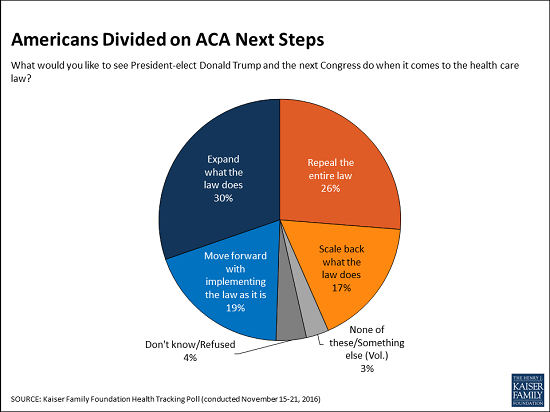
The new survey finds that one fourth (26%) of Americans want to see President-elect Donald Trump and the next Congress repeal the entire law, and an additional 17 percent want them to scale back what the law does. This compares to 30 percent of the public who want to see the law expanded and 19 percent who want to see lawmakers move forward with implementing the law as it is.

The poll captures a slight uptick in the share of Americans who want lawmakers to scale back the law as well as a decrease in the share who want lawmakers to repeal the entire law.  This is largely driven by Republicans: About half (52%) of Republicans now say they want to see the Affordable Care Act repealed, down from 69 percent in October. At the same time, a quarter (24%) of Republicans now want to see the law scaled back, up from 11 percent in October.

Among the quarter (26%) of Americans that want to see the Affordable Care Act repealed, 31 percent want to see the health care law just repealed and not replaced. About two-thirds wants lawmakers to repeal the health care law and replace it with a Republican-sponsored alternative, with 42 percent wanting lawmakers to wait to repeal it until the details of a replacement plan have been figured out and 21 percent wanting lawmakers to repeal it immediately and figure out a replacement plan later.

Among those who want the law repealed, 38 percent (or 10% of the public overall) change their opinion after hearing the argument that repealing the ACA would mean that insurance companies could deny coverage to people with pre-existing conditions. A slightly smaller share change their opinion after hearing that more than 20 million Americans could lose their coverage.