Uwe Reinhardt, 80, Dies; a Listened-to Voice on Health Care Policy

Uwe Reinhardt, an economist whose keen, caustic and unconventional insights cast him as what colleagues called a national conscience in policy debates about health care, died on Monday in Princeton, N.J. He was 80.

The cause was sepsis, his wife, Tsung-Mei Cheng, said. He had taught in the economics department at the Woodrow Wilson School of Public and International Affairs at Princeton University since 1968.

Professor Reinhardt helped shape health care deliberations for decades as a prolific contributor to numerous publications, an adviser to White House and congressional policymakers, a member of federal and professional commissions and a consultant and board member, paid and unpaid, for private industry.

“His work was instrumental in advocating some of the reforms embodied in the Affordable Care Act, such as having Medicare pay for performance rather than entirely on a fee-for-service basis,” Professor Janet Currie, the chairwoman of the Princeton economics department, wrote in an email.

Another colleague, Stuart H. Altman, a professor at Brandeis University, wrote, “No one was close to him in terms of impact on how we should think about how a decent health care system should operate.”

In 2015, the Republic of China awarded Professor Reinhardt its Presidential Prize for having devised Taiwan’s single-payer National Health Insurance program. The system now provides virtually the entire population with common benefits and costs 6.6 percent of the nation’s gross domestic product (about one-third the share that the United States spends).

Just last month, he received the 2017 Bipartisan Health Policy Leadership Award from the Alliance for Health Policy, a nonpartisan research and educational group in Washington.

Professor Reinhardt argued that what drove up the singularly high cost of health care in the United States was not the country’s aging population or a surplus of physicians or even Americans’ self-indulgent visits to doctors and hospitals.

“I’m just an immigrant, so maybe I am missing something about the curious American health care system,” he would often say, recalling his childhood in Germany and flight to Canada and apologizing that English was only his second language.

Then he would succinctly answer the cost question by quoting the title of an article he wrote with several colleagues in 2003 for the journal Health Affairs: “It’s the Prices, Stupid.”

What propelled those prices most, he said, was a chaotic market that operates “behind a veil of secrecy.”

That market, he said, is one in which employers “become the sloppiest purchasers of health care anywhere in the world,” as he wrote in the Economix blog in The New York Times in 2013.

It is also defined by the high cost of prescription drugs, he said, and the astronomical amounts that hospitals spend in dealing with a maze of insurers and health maintenance organizations.

“Our hospitals spend twice as much on administration as any hospital anywhere in the world because of all of this complexity,” he told Managed Care magazine in 2013.

If the nation cut the cost of health care administration in half, he said, the savings would be enough to insure everyone.

Professor Reinhardt’s prescription for a more sensible system included imposing penalties on the uninsured so that people would not postpone buying policies until they got sick. That idea, the so-called individual mandate, requiring most people to purchase health insurance, became an integral component of the Affordable Care Act, otherwise known as Obamacare. Republicans in Congress are now seeking to repeal that provision as part of a tax overhaul.

Professor Reinhardt also advocated providing government subsidies so that low-income families could afford mandated insurance, another feature of Obamacare.

His ideal model was the German system in which insurers negotiate with health care providers to set common binding prices in a specific region.

“I believe it is still the best model there is, because it blends a private health care delivery system with universal coverage and social solidarity,” he told The Times in 2009. “It’s inexpensive and equitable. Coverage is portable. You’re never uninsured in Germany. No family goes broke over health care bills.”

Always opinionated, Professor Reinhardt was also unsparing in inflicting his mordant wit on any self-satisfied expert he considered hypocritical or illogical.

“He was a knife twister of the first class,” the health economist Austin Frakt wrote on the blog The Incidental Economist, of which he is an editor in chief. “Should you hold dearly an idea he targeted for systematic dismantling, you would squirm.”

Professor Reinhardt excoriated college students who blamed loneliness for their binge drinking, describing them as “among the most pampered and highly privileged human beings on the planet.” He suggested that before applying for college young people “be required to spend one to two years in a tough job in the real world.”

And when critics complained that doctors were overpaid, he countered that their collective take-home pay amounted to only 10 percent of national health spending. Slicing it by 20 percent, he wrote, “would reduce total national health spending by only 2 percent, in return for a wholly demoralized medical profession to which we so often look to save our lives.

“It strikes me as a poor strategy,” he added.

With near unanimity, colleagues and admirers praised Professor Reinhardt for transforming raw data into moral imperatives.

Senator Bernie Sanders, the Vermont independent who advocates a “Medicare for all” national health care system, wrote in an email, “Uwe Reinhardt was one of the leaders in the effort to make health care a right, not a privilege.”

And Professor Elliott S. Fisher of Dartmouth called Professor Reinhardt “in so many ways the conscience of the U.S. health care system.”

Uwe (pronounced OO-vuh) Ernst Reinhardt was born on Sept. 24, 1937, in the city of Osnabrück in northwest Germany. His father, Wilhelm, was a chemical engineer. His mother, the former Edeltraut Kehne, was a photographer and painter.

He was raised near the Belgian border and the Hürtgen forest, where American and German soldiers engaged in hand-to-hand combat for four months in 1944.

“I could not help but become witness daily to the horrors of war,” Professor Reinhardt wrote in 2003 in a Times Op-Ed article, praising a Marine chaplain for urging soldiers to pray for their enemies ad well as themselves. “Millions of Europeans of my generation, whom many Americans now disparage so contemptuously as pacifists, had a similar experience.”

His exposure to the war so dismayed him that in the mid-1950s, at 18, rather than be drafted into the army and have to salute a German officer in the wake of “the unimaginable atrocities committed by Nazi Germany” years earlier, his wife said, he left the country, setting off for Canada and leaving his parents and four siblings behind.

He landed in Montreal with $90 in his pocket and no Canadian connections. Having had some apprentice training in shipping in Germany, he found work at a shipping company and worked nights parking cars in a parking lot. He always ate oatmeal for breakfast because it was cheap, his wife said, and to make extra money he routinely volunteered to work overtime for co-workers who had families.

After three years, he had saved enough money to enroll, hundreds of miles away, at the University of Saskatchewan in Saskatoon, the cheapest university he knew of, Ms. Cheng said. (Selling his used Chevrolet and beloved guitar helped defray the costs.)

He graduated with a bachelor of commerce degree and went on to Yale, where he received his doctorate. His thesis was titled “An Economic Analysis of Physicians’ Practices.”

In addition to Ms. Cheng, a health policy research analyst at Princeton who is known as May, he is survived by their children, Dirk, Kara and Mark Reinhardt; his sisters, Heide Cermin and Imeltraut Arndt; his brother, Jurgen; and two grandchildren.

Professor Reinhardt joined the Princeton faculty in 1968 as an assistant professor. At his death, he was the James Madison professor of political economy and professor of economics and public affairs at the Woodrow Wilson School.

“He was so inspired a teacher,” said Henry J. Aaron, a senior fellow at the Brookings Institution, the research organization in Washington, “that he could make accounting the most popular course at Princeton.” Among his students was Bill Frist, a surgeon and a former Republican Senate majority leader from Tennessee.

In 2015, Professor Reinhardt humbly — and facetiously — announced that after reflecting on the global economic crisis that had occurred several years earlier, he was calling it quits.

“After the near-collapse of the world’s financial system has shown that we economists really do not know how the world works, I am much too embarrassed to teach economics anymore,” he wrote.

In an interview not long before that, though, he belied any pretense of self-doubt when he was asked whether he was perplexed by the seemingly insolvable challenges of health care economics.

“Have you ever seen a perplexed economist?” Professor Reinhardt replied. “We have an answer for everything.”


The evolving CFO role, in quotes

https://www.beckershospitalreview.com/finance/the-evolving-cfo-role-in-quotes.html

Image result for evolving CFO role


As healthcare evolves, so too are the roles of hospital and health system CFOs.

The CFO role is becoming more strategic as organizations face additional financial pressures and navigate the shift to value-based care. CFOs today generally play a greater role in operations and are seen as business partners by CEOs.

Four panelists provided thoughts on this evolving role during a session at the Becker’s Hospital Review 6th Annual CEO + CFO Roundtable in Chicago. Here are quotes from the panelists.

Jim McNey, senior vice president and CFO of North Kansas City (Mo.) Hospital, addressed the development of Centrus Health, a physician-led clinically integrated network including City, Mo.-area physicians across NKCH, the University of Kansas Health System, Merriam, Mo.-based Shawnee Mission Health and Kansas City Metropolitan Physician Association. In these types of scenarios, he said the CFO almost acts like a “salesman.”

“You have to sell these ideas to people who may not be receptive. … You’ve got to go out. You’ve got to get educated. You’ve got to stay current on what’s going on. …You can’t ever quit learning.”

Britt Tabor, executive vice president and CFO/treasurer of Chattanooga, Tenn.-based Erlanger Health System, noted the move away from the traditional CFO role.

“What I’ve seen … is there’s [now] dramatic input of the CFO from a strategic and operation standpoint. I’m meeting with two or three physicians a week talking about the business model of the health system.

“As pressures have come, we’ve hired a lot of doctors. I do think physicians are getting the idea that we’ve got to balance the quality, the patient care and the business scene,” he added.

Angela Lalas, senior vice president of finance for Loma Linda (Calif.) University Health, talked about the skills necessary for today’s CFO.

“We’ve [previously] looked at finance professionals as number crunchers and more focused on historical. Now it’s more communication and interpersonal skills [are the] top needs for finance professionals to become impactful and effective.”

Brad Fetters, COO of Prism Healthcare Partners, a healthcare consulting firm, described the finance discipline as “becoming more sophisticated.”

“What I mean by that is the leadership used to be kind of the scorecard — they were in the room to make sure the numbers jived up — then somebody else was working with physicians and influencing. What you’re seeing now … in other industries … [is] when CEOs abruptly leave … they promote the CFO because they’ve gotten more strategic, there [are]softer skills around influencing and changing behaviors. That’s what you’ve got to do with this information so those successful CFOs are in the room kind of influencing everybody.”


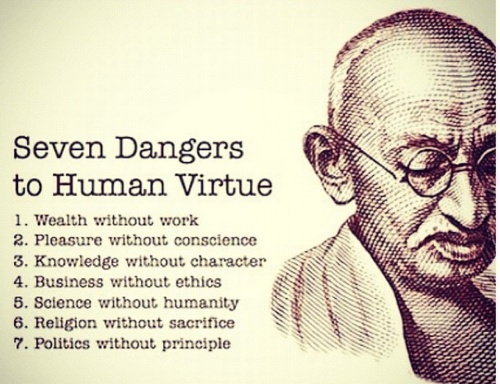
The Seven Deadly Social Sins

https://en.wikipedia.org/wiki/Seven_Social_Sins

Image result for gandhi's seven social sins

The Seven Deadly Social Sins
explained by Arun Gandhi, grandson of Mohandas Gandhi

POLITICS WITHOUT PRINCIPLES

Gandhi said those who firmly believe in nonviolence should never stand for elections, but they
should elect representatives who are willing to understand and practice the philosophy. Gandhi
said an elected representative is one on whom you have bestowed your power of attorney.
Such a person should be allowed to wield authority only as long as s/he enjoys your
confidence. When politicians indulge in power games, they act without principles. To remain in
power at all cost is unethical. Gandhi said when politicians (or anyone else, for that matter)
give up the pursuit of Truth they, or in the case of parties, would be doomed. Partisan politics,
lobbying, bribing, and other forms of malpractice that are so rampant in politics today is also
unprincipled. Politics has earned the reputation of being dirty. It is so because we made it dirty.
We create power groups to lobby for our cause and are willing to do anything to achieve our
goal. Not many among human kind have learned how to resist temptation, so who is to blame
for the mess we find ourselves in?

WEALTH WITHOUT WORK

This includes playing the stock market; gambling; sweat-shop slavery; over-estimating one’s
worth, like some heads of corporations drawing exorbitant salaries which are not always
commensurate with the work they do. Gandhiji’s idea originates from the ancient Indian
practice of Tenant Farmers (Zamindari). The poor were made to slog on the farms while the
rich raked in the profits. With capitalism and materialism spreading so rampantly around the
world the grey area between an honest day’s hard work and sitting back and profiting from
other people’s labor is growing wider. To conserve the resources of the world and share these
resources equitably with all so that everyone can aspire to a good standard of living, Gandhi
believed people should take only as much as they honestly need. The United States provides
a typical example. The country spends an estimated $200 billion a year on manufacturing
cigarettes, alcohol and allied products which harm people’s health. What the country spends in
terms of providing medical and research facilities to provide and find cures for health hazards
caused by over-indulgence in tobacco and alcohol is mind-blowing. There is enough for
everyone’s need but not for everyone’s greed, Gandhi said.

PLEASURE WITHOUT CONSCIENCE

This is connected to wealth without work. People find imaginative and dangerous ways of
bringing excitement to their otherwise dull lives. Their search for pleasure and excitement often
ends up costing society very heavily. Taking drugs and playing dangerous games cause
avoidable health problems that cost the world hundreds of billions of dollars in direct and
indirect health care facilities. Many of these problems are self-induced or ailments caused by
careless attitudes. The United States spends more than $250 billion on leisure activities while
25 million children die each year because of hunger, malnutrition, and lack of medical facilities.
Irresponsible and unconscionable acts of sexual pleasure and indulgence also cost the people
and the country very heavily. Not only do young people lose their childhood but innocent
babies are brought into the world and often left to the care of the society. The emotional,
financial, and moral price is heavy on everyone. Gandhi believed pleasure must come from
within the soul and excitement from serving the needy, from caring for the family, the children,
and relatives. Building sound human relationships can be an exciting and adventurous activity.
Unfortunately, we ignore the spiritual pleasures of life and indulge in the physical pleasures
which is “pleasure without conscience.”

KNOWLEDGE WITHOUT CHARACTER

Our obsession with materialism tends to make us more concerned about acquiring knowledge
so that we can get a better job and make more money. A lucrative career is preferred to an
illustrious character. Our educational centers emphasize career-building and not characterbuilding.
Gandhi believed if one is not able to understand one’s self, how can one understand
the philosophy of life. He used to tell me the story of a young man who was an outstanding
student throughout his scholastic career. He scored “A’s” in every subject and strove harder
and harder to maintain his grades. He became a bookworm. However, when he passed with
distinction and got a lucrative job, he could not deal with people nor could he build
relationships. He had no time to learn these important aspects of life. Consequently, he could
not live with his wife and children nor work with his colleagues. His life ended up being a
misery. All those years of study and excellent grades did not bring him happiness. Therefore, it
is not true that a person who is successful in amassing wealth is necessarily happy. An
education that ignores character- building is an incomplete education.

COMMERCE WITHOUT MORALITY

As in wealth without work we indulge in commerce without morality to make more money by
any means possible. Price gouging, palming off inferior products, cheating and making false
claims are a few of the obvious ways in which we indulge in commerce without morality. There
are also thousands of other ways in which we do immoral or unethical business. When profitmaking
becomes the most important aspect of business, morals and ethics usually go
overboard. We cut benefits and even salaries of employees. If possible we employ “slave”
labor, like the sweat shops and migrant farm workers in New York and California where
workers are thoroughly exploited. Profit supersedes the needs of people. When business is
unable to deal with labor it begins to mechanize. Mechanization, it is claimed, increases
efficiency, but in reality it is instituted simply to make more money. Alternate jobs may be
created for a few. Others will fall by the wayside and languish. Who cares? People don’t
matter, profits do. In more sophisticated language what we are really saying is that those who
cannot keep up with the technological changes and exigencies of the times do not deserve to
live–a concept on which Hitler built the Nazi Party. If society does not care for such people,
can we blame them if they become criminals?

SCIENCE WITHOUT HUMANITY

This is science used to discover increasingly more gruesome weapons of destruction that
threaten to eventually wipe out humanity. The NRA says guns don’t kill people, people kill
people. What they do not say is that if people didn’t have guns they wouldn’t have the capacity
to kill as quickly or as easily. If hunting can be considered a sport, it is the most insensitive and
dehumanizing sport on earth. How can killing animals bring fun and excitement to anyone?
This is pleasure without conscience. When we cease to care for any life, we cease to respect
all life. No other species on earth has wrought more destruction than man. Materialism has
made us possessive. The more we possess the more we need to protect and so the more
ruthless we become. As punishment, we will kill if some one steals to buy bread. We feel
violated. But we will not bother our heads to find out why, in times of plenty, people have to live
in hunger. In order to protect and secure our homes, our neighborhoods, our countries from
attacks, we use science to discover frightening weapons of destruction. The debate over the
use of the atom bomb on Hiroshima and Nagasaki is a question that falls under this category.
War is sometimes inevitable only because we are such ardent nationalists that we quickly label
ourselves by our country of origin, by gender, by the color of our skin, by the language we
speak, by the religion we practice, by the town or the state we come from and so on. The
labels dehumanize us, and we become mere objects. Not too long ago even wars were fought
according to rules, regulations, ethics and some semblance of morality. Then Hitler changed
the rules because of his monumental hate and the rest of us followed suit. Now we can
obliterate cities and inhabitants by pressing a button and not be affected by the destruction
because we don’t see it.

WORSHIP WITHOUT SACRIFICE

One person’s faith is another person’s fantasy because religion has been reduced to
meaningless rituals practiced mindlessly. Temples, churches, synagogues, mosques and
those entrusted with the duty of interpreting religion to lay people seek to control through fear
of hell, damnation, and purgatory. In the name of God they have spawned more hate and
violence than any government. True religion is based on spirituality, love, compassion,
understanding, and appreciation of each other whatever our beliefs may be — Christians,
Jews, Hindus, Muslims, Buddhists, Atheists, Agnostics or whatever. Gandhi believed whatever
labels we put on our faith, ultimately all of us worship Truth because Truth is God. Superficially
we may be very devout believers and make a tremendous public show of our worship, but if
that belief, understanding, compassion, love and appreciation is not translated into our lives,
prayers will have no meaning. True worship demands sacrifice not just in terms of the number
of times a day we say our prayers but in how sincere we are in translating those prayers into
life styles. In the 1930’s many Christian and Moslem clergy flocked into India to convert the
millions who were oppressed as untouchables. The Christian clergy stood on street corners
loudly denouncing Hinduism and proclaiming the virtues of Christianity. Months went by
without a single convert accepting the offer. Frustrated, one priest asked Grandfather: After all
the oppression and discrimination that the ‘untouchables’ suffer under Hinduism, why is it they
do not accept our offer of a better life under Christianity? Grandfather replied: When you stop
telling them how good Christianity is and start living it, you will find more converts than you can
cope with. These words of wisdom apply to all religions of the world. We want to shout from
roof-tops the virtues of our beliefs and not translate them into our lives.

Transparency – All Cards Face-Up

Transparency – All Cards Face-Up

Related image


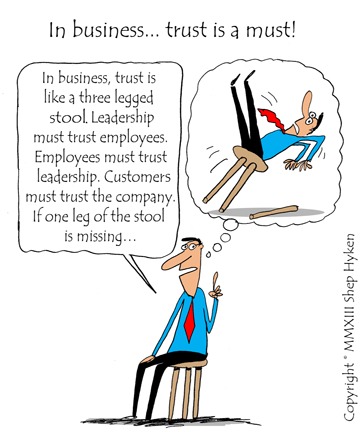
Creating and leading high-performing teams in any setting requires a high-trust environment.  A critical component in creating and keeping that trust is complete transparency across the team.  Having seen the empowering effect of this simple notion, I regularly reminded my direct-reports that the expectation was, “All cards are face-up on the table for the full team, in every decision and on every topic.”

I first learned the value of this kind of full transparency during my years working in the Mission Control Room while operating Space Shuttles and the International Space Station.  Everyone on the team reviewed every report, procedure, and mission-related communication of any kind between Mission Control and the astronauts.

That thorough transparency was never about micro-management.  It was in recognition that:

  • Every area of responsibility on the team affects the overall risk to the mission (e.g. if any single critical system fails, the entire spacecraft, and all the astronauts, are in jeopardy).
  • Any part of the team can and will make a mistake.
  • If not caught and corrected, combinations of seemingly small mistakes, or even some single mistakes, could lead to a failed mission or worse.
  • Conversely, there is so much talent in every part of the team, that as a team we can catch each other’s mistakes, offer suggestions from different perspectives, and come up with better overall solutions to problems.

Everyone on the team knew that it was team success that mattered, not simply individual performance.  “Showing our work” to our peers was not a threat to our individual authority.  It was an easy method to get more eyes on every problem and engage broader and deeper expertise to ensure nothing slipped past us.  Rather than slowing down decision-making, for decades these teams have routinely discussed and resolved exceptionally complex issues and have been able to take critical actions in minutes to protect a spacecraft hurtling through space.

The same risks often apply in management, where mistakes in one part of a company can have ripple effects that cause problems for other areas.  If poorly managed or left unsolved, those problems can cost the company money, erode product quality, bankrupt the company, and in some industries, injure employees and worse.

Just as we discovered in Mission Control, transparency is the simplest way to engage all members of the management team, and with them, the expertise and perspective of the organizations they led for the enterprise.  And just like in Mission Control, that greater engagement brings with it better informed, highly-reliable decision-making.

As an executive managing a $650 million/year enterprise, my direct-reports would often quote me before telling me and their peers some “ugly truth” or something they didn’t think I’d want to hear, “Just remember, you always say, all cards on the table…”

Every time they used that quote, it made me smile and think, “Now we’re talking!  Now we’re getting to it.”  More times than not, what followed was news about a project that was over budget or behind schedule, an unresolved engineering hurdle with an upcoming mission, or some mistake we had made in an earlier decision that was now putting us at risk.  Most importantly, it gave the full senior management team and the team’s they led an opportunity to help us find the best solution.  In the end, this is never about highlighting some part of the team’s mistakes, it is to ensure the team catches any weakness in our on-going performance.

Of course, transparency does not just protect the boss from the team’s mistakes.  It also allows the team to catch and correct the boss’s mistakes, as well as to offer innovations the boss may not see, which I was reminded of as the boss many times.

For example, during a tour in a development lab, I was shown a demonstration version for a new space station simulator based in a desktop personal computer.  Seeing a cost saving potential, I suggested several copies be made immediately available for testing by a number of our divisions.  Eyes widened around the room, including by several senior managers, but the team saluted and went to work.

After months of mixed reviews, the division responsible for managing and developing our training systems reported, “Look, Paul, this isn’t going to work.  We never thought it would, but you told our people to do it, so we did.  We can keep throwing money and manpower at it, but the answer won’t change for a long time.  However, we can accomplish what you’re after through some other work we’ve been doing, and we’re ready to show that to you and the management team any time.”

What followed became a project that moved our space station training software from $2 million sets of equipment that filled a room, to a single rack of servers costing $50,000 and contributed to total fixed cost reductions of more than 50 percent.

Lesson learned:  Share those great ideas with the full management team before giving direction.  Rely on the same transparency to spark discussions that can lead to better ideas and innovations that deliver.

This kind of transparency can become a habit and part of your culture.  It isn’t just for the bad news, but also for routine requests for better ideas, assurance that we’re not missing something, sharing resources to the areas that can make the next big gain… it makes us stronger and more successful as an enterprise.

Yes, the truth will set you free, and transparency is the way to find it and set the entire team free.

THE FEELING OF AN ORGANIZATION IS LEADERSHIP’S RESPONSIBILITY

The Feeling of an Organization is Leadership’s Responsibility

The feeling of an organization is leadership’s responsibility. Left to chance, the lights go out.

Organizational morale evaluates leadership. I’ve seen people smile, wave, and shout, “Hey,” when leaders walk through a plant. I’ve also seen people pay no mind.

More than rewards:

A manager I coach wanted to discuss rewards. I asked, “What’s the purpose of rewards?

He said, “The purpose of rewards is to build team morale.” He could have said rewards honor performance or affirm effort. But he didn’t.

Energy drain:

The simplicity of morale-building beguiles egotistical leaders. You don’t need big programs, big budget, or big plans.

Egotistical leaders suck energy.

Big egos love the mirror. But morale building begins with caring for others.

4 don’ts of morale building:

Reject lame reward programs that cost money and bore employees.

  1. Don’t create unrealistic expectations.
  2. Don’t wait for big budgets.
  3. Don’t demotivate good performers.
  4. Don’t embarrass people who prefer the shadows.

Low budget morale builders:

Provide recognition often enough to make it effective, but not expected.

  1. Coffee and bagels for no reason.
  2. Pie.
  3. Apples or candy on desks with handwritten thank you notes. Mention strengths or character in the notes. “You’re great at … .”
  4. Pizza or subs for the team.
  5. Ice cream bars.
  6. Anniversary celebrations. Have a cake when someone hits their one year anniversary with the company.
  7. Send a teammate to meet customers and see his/her product in use.

No budget morale builders:

Get out of your head and into your heart, if you hope to build morale.

  1. Notice people.
  2. Express care.
  3. Set challenging goals and provide support.
  4. Give pats on the back.
  5. Begin meetings by talking about wins.
  6. Smile.
  7. Invite the CEO to pat your team on the back.

How might leaders build team morale? How do you do it?

What should leaders avoid when it comes to building morale?

Leadership Forged In Crisis

http://www.leadershipdigital.com/edition/daily-management-development-2017-11-03?open-article-id=7475661&article-title=leadership-forged-in-crisis&blog-domain=leadershipnow.com&blog-title=leading-blog

Forged In Crisis

LEADERSHIP development is a very personal endeavor. The better you become, the better your leadership becomes.

It is a misconception of leadership that if you engage in the best practices of a great leader, you will become that leader. Applying the idea that if I do this or if I have this quality I will become a great leader like my chosen mentor, can derail your leadership development.

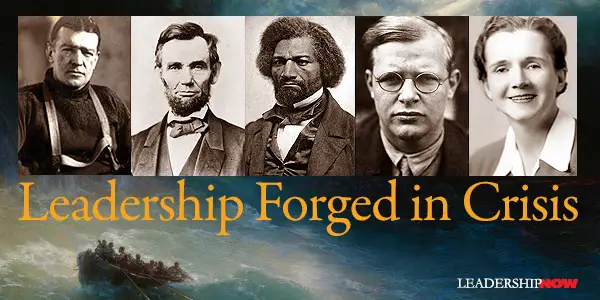
That said, there are principles you can discover that if adhered to will propel you in the right direction. Harvard professor Nancy Koehn illuminates some of these principles for us in Forged in Crisis as seen through the lives of five exemplary leaders: polar explorer Ernest Shackleton, President Abraham Lincoln, legendary abolitionist Frederick Douglass, Nazi-resisting clergyman Dietrich Bonhoeffer, and environmental crusader Rachel Carson. These principles set the stage for leadership effectiveness, but the decision to step into leadership is yours alone.

Koehn borrows from David Foster Wallace and defines an effective leader as one “who can help us overcome the limitations of our own individual laziness and selfishness and weakness and fear and get us to do better, harder things than we can get ourselves to do on our own.”

Coach Tom Landry said it this way: “Leadership is getting someone to do what they don’t want to do, to achieve what they want to achieve.” Henry Kissinger said, “The task of the leader is to get his people from where they are to where they have not been.” It’s intentional influence. But the ability to do that doesn’t come to us naturally. We have to work at it. But that’s good news. We can all get there. Leaders are not born, they are forged.

Each of the leaders Koehn has chosen faced an uncertain outcome in the midst of a crisis. Shackleton was marooned on an Antarctic ice floe trying to bring his men home alive; Lincoln was on the verge of seeing the Union collapse even as he tried to save it; escaped slave Douglass faced possible capture while wanting to free black Americans held in slavery; Bonhoeffer was agonizing over how to counter absolute evil with faith while imprisoned by the Gestapo; Carson raced against the cancer ravaging her to finish her book Silent Spring, in a bid to save the planet.

The crisis that can break one person can give birth to leadership in another. It’s a conscious choice to lead. Koehn brings out key lessons common to these people as they struggled with their thoughts in what were do or die situations. Here are some of the lessons that we should all take to heart:

They Were Made, Not Born

These leaders “were made into effective leaders as they walked their respective paths, tried to understand what was happening around them, and encountered failure and disappointment.”

They Were Ambitious but…

“The drive to make their respective marks was important in shaping them. It took each of them some of the way. But then, interestingly, ambition ceased to motivate and influence them as it once had. As they discovered a larger purpose and embraced it, each found his or her impetus, strength, and validation in the mission itself.” And importantly, Koehn adds, that “their leadership was partly shaped by a willingness to subordinate personal drive in a broader end, one inexorably linked with service to others.”

They Did the Inner Work of Leadership

They all worked on themselves, looking for opportunities to grow. “They did not do this as a single endeavor, but rather as a lifelong project in which they each kept working on themselves, learning specific lessons, developing more resilience, and using these resources to lead more effectively.”

(“Lincoln would have been flummoxed by talk of authentic leadership when he told a few constituents in 1862 that he did not have the luxury of publically expressing his disappointment about Union army defeats.”)

They Understood the Importance of Solitude

These leaders learned to detach themselves from the situation in order to see things from different perspectives. They “learned how to step back from a specific instant, assess the larger landscape, take the measure of their own emotions, and only then make a decision about what, if anything, they wanted to do.” Reflection and solitude helped them stay focused on the big picture.

They Learned to Manage Their Emotions

In dark moments, what Bonhoeffer called a “boundary situation,” they determined to manage their emotions. It was not willful blindness or forced optimism. They knew what they were up against. “Because they did, they used their emotional awareness and discipline to concentrate directly, almost exclusively, on how to move forward, how to take the next step, however small.” These people realized that “the emotional penetrability they experienced and that caused them so much suffering was also a door into new insights about themselves and new ways of being in the world.”

They Learned to Respond Rather Than to React

“At times, doing nothing at all was the best action each of these leaders could take. Time and time again as president, [Lincoln] refused to be goaded by the force of his own emotions or of those around him into taking precipitate action that might compromise his larger mission. Even when he was at his most frustrated, he managed somehow to acknowledge his feelings without acting on them in a way that was destructive to larger matters.”

They Were Resilient

Though these leaders didn’t always see a way through in the heat of the moment, “they vowed to find a way through the obstacles they confronted. They came out the other side of calamity without falling through the floorboards of doubt, without giving up on their mission and themselves.”

All five leaders were well chosen because of their humanity. They were not born leaders. They became leaders through successes, but mostly through failures and mistakes. Leaders can come from anywhere. As we look around the world today, if we are looking for larger-than-life heroes, we misunderstand what leadership is.

Although these leaders appear to be larger than life to us now, as you read their stories you see that they are you and me. They are ordinary people in turbulent and trying circumstances. They were often overwhelmed and depressed, but they kept moving on. What distinguishes these people from many of the leaders we see today is their approach to the experiences of their lives. Throughout their lives, they purposefully extracted the lessons they needed to grow. It was thoughtful and intentional. If you go through life any other way, you are just collecting experiences to no end. Experiences alone ensure nothing. We must reflect on them to gain insights and learn from them.


A Better Boss or a Pay Raise?

A Better Boss or a Pay Raise? What Would YOUR Employees Choose?

Ask yourself this question: If I gave my employees a choice between receiving a pay raise or me becoming a better boss, which would they choose?

Chances are you’d probably say your employees would choose a pay raise, right? I mean, after all, who wouldn’t want more money? Taking a few liberties with the classic song Money by Barrett Strong, your employees are probably saying “Your leadership gives me such a thrill, but your leadership don’t pay my bills, I need money!”

Getting a pay raise would be an immediately tangible reward that everyone could literally take to the bank. Besides, it’s not like you need any dramatic improvement as a boss, right? Sure, you may not be the greatest leader in the world, but there’s a whole lot of bosses plenty worse than you. Your people would definitely choose a pay raise, you say.

Well, you’d be wrong. One study showed that 65% of Americans would choose a better boss over a pay raise. How do you like them apples?

In many of our training courses we do a “best boss” exercise. We ask participants to share the characteristics of the person who was their best boss, and as you can see from the list below, many of these traits are ones you can develop and master with just a bit of effort and focus.

My best boss…

  • Was trustworthy—Often mentioned as the foundation of what makes a best boss, being trustworthy is paramount to being an effective leader. Research has shown that employees who have high levels of trust in their boss are more productive, engaged, innovative, creative, and contribute more to the organization’s bottom-line. Click here to learn more about how to build trust as a leader.
  • Believed in me—Best bosses believe in the capabilities and potential of their people. Through their words and actions they communicate a sincere faith in their employees that builds the confidence of their team members to go above and beyond expectations.
  • Showed respect—No one likes to be talked down to or treated as “less than.” Best bosses recognize the inherent worth each person possesses and they seek to build people up, not tear them down.
  • Listened to me—Being a good listener is one of the most powerful, yet underrated leadership skills. Good listeners don’t interrupt, ask clarifying questions, summarize what they’ve heard, probe for deeper understanding, and also pay attention to what’s not being said in the conversation. Check out The 5 Fundamentals of Effective Listening for more tips.
  • Helped me grow—People want leaders who are invested in helping them grow in their jobs and careers. Best bosses understand that leadership is not about them; it’s about the people they serve. As such, they are committed to helping their team members grow in their careers, even if that means the employee ultimately leaves the team or organization for better opportunities.
  • Had my back—Participants in our classes often say their best boss was always in their corner, or had their back. There are times in organizational life where the boss needs to step up and defend the needs or interests of his/her team. Supporting your employees doesn’t mean blindly defending them regardless of the circumstances, but it does mean you always have their best interests at heart and are committed to putting that belief into practice.
  • Gave feedback in a way I could hear it—I’ve learned in my career that people really do want, and deserve, honest feedback about their performance. The trick is to deliver feedback in a way the person on the receiving end can hear it without becoming defensive, internalize it, and take positive action moving forward. Here is a way to give feedback that builds trust in a relationship.
  • Cared about me as a person—It’s a cliché but it’s true: people don’t care how much you know until they know how much you care. You can be the most competent boss around, but if your people don’t feel you truly care about them as humans, then they will withhold their trust and commitment from you.
  • Adjusted their leadership style to my needs—The best bosses know that one size doesn’t fit all when it comes to leadership. Each team member can be at different development levels in their goals and tasks, so the leader needs to adjust his/her leadership style to meet the needs of the employee. Managers need to learn to become situational leaders.
  • Gave me autonomy—No one likes to be micro-managed. Helicoptering over your employees and telling them what to do, how to do it, and when to do it, creates a sense of learned helplessness. It erodes the morale and motivation of employees and leads to them developing a “quit but stay” mentality. Best bosses make sure their team members have been given the proper training and have the best resources and tools needed to do their jobs. Then the manager steps out of the way and lets their team do their thing, while providing any needed support and direction along the way.

Unfortunately, too many leaders are unwilling to admit they could use a bit of improvement, and too many organizations tolerate poor managerial performance (free whitepaper: 7 Ways Poor Managers Are Costing Your Company Money). But as you can see from this list, becoming a best boss isn’t rocket science. It’s within the grasp of any leader who is willing to put in a bit of work to improve his/her craft.