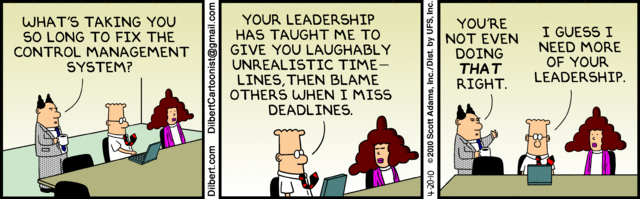
5 painfully ineffective leadership styles

http://www.beckershospitalreview.com/hospital-management-administration/5-painfully-ineffective-leadership-styles.html

Image result for negative leadership

Though there are many different leadership styles one can employ to inspire exceptional performance, poor leadership can have devastating effects on the morale and productivity of an organization, according to Entrepreneur.

Listed below are five ineffective leadership styles to avoid avoid if you hope to have a high-performing organization.

  1. Reactive leaders often wait to act until action has already occurred, in which case they are playing catch-up to leaders who had the confidence to plan ahead for expected outcomes.
  2. Overly optimistic leaders take the healthy virtue of optimism too far, thinking so positively that they fail to account for situations where their employees or organization may fall short. They may also trust their extreme optimism over the facts at hand, which contradict their gut assumptions.
  3. Controlling leaders don’t give their employees room to succeed on their own and insist on having a hand in every aspect of their organization. By not trusting people to do their jobs, all a controlling leader does is create more inefficiency and suffocate talent.
  4. Distant leaders do not connect with their employees, who like to feel as though their boss knows them and are often inspired to do better when they feel a leader is personally invested in their success.
  5. Narcissistic leaders inevitably alienate subordinates by taking credit for the success of the team, which makes employees feel less valued. This can make employees less motivated to work hard on the next project if they know their contributions will get swept under the rug.

The Golden Rule, With a Twist

http://www.leadershipdigital.com/edition/daily-operations-leadership-2017-07-13?open-article-id=6864960&article-title=the-golden-rule–with-a-twist&blog-domain=rapidstartleadership.com&blog-title=rapidstart-leadership

The Golden Rule with a Twist


Baylor Hires COO, Splits President and CEO Roles

http://www.healthleadersmedia.com/leadership/baylor-hires-coo-splits-president-and-ceo-roles?spMailingID=11450593&spUserID=MTY3ODg4NTg1MzQ4S0&spJobID=1200956765&spReportId=MTIwMDk1Njc2NQS2#

Related image

Northwestern EVP and COO Peter McCanna will take over Baylor Scott & White’s president role and some responsibilities from CEO James Hinton.

Baylor Scott & White Health says it will split the office of President and CEO, a little more than six months into President and CEO Jim Hinton’s tenure at the Dallas- and Temple, Texas-based organization. Hinton had been serving in both roles since he took over the nonprofit health system in January, as had his predecessor Joel Allison, who retired.

Pete McCanna, who is currently executive vice president and chief operating officer at Chicago-based Northwestern Memorial Healthcare, will assume the new president role in September, and will take over a number of Hinton’s current duties, according to a press release.

While his expected duties as president were not immediately apparent, McCanna has ties to Hinton, having served as chief financial officer at Presbyterian early in Hinton’s 20-year career at that organization, where Hinton served as president and CEO before coming to Baylor Scott & White. Hinton said the new office of the president will expand the capabilities of the health system’s “already talented leadership team, helping us more rapidly evolve.”

Presumably that rapid evolution involves Hinton focusing more intently on integrating the Scott & White Health Plan into the entire organization.

In fact, one reason for Hinton’s appointment in the wake of Allison’s retirement was his extensive experience running an integrated delivery system at Presbyterian, where the provision of healthcare services is combined with a proprietary health plan, allowing for smoother integration of population health principles and tactics. Baylor Health Care System’s 2013 merger with Scott & White Healthcare created the blueprint for such an integrated system, which includes 48 hospitals, 44,000 employees, and the Scott & White Health Plan.

“We are committed to extending Baylor Scott & White’s long history of success by transforming into a nationally recognized, high-value integrated delivery network; and to transform, we must drive costs down, while making the right investments in key areas,” said Hinton, in the release.

McCanna should be instrumental in helping Baylor Scott & White achieve financial and strategic growth targets. In his 15 years at Northwestern, operating revenue grew from $700 million to more than $5 billion, while patient experience, employee engagement and quality goals exceeded targets.

He also gets credit for helping integrate the faculty physician practice plan at Northwestern University Feinberg School of Medicine with Northwestern Memorial Hospital.

“Pete is a highly respected senior executive with a track record of helping to grow organizations, create and implement successful, long-range strategic plans and lead financial turnarounds,” said Hinton. “He is one of the best and brightest in healthcare.”


5 TRAGIC BLUNDERS OF INEXPERIENCED LEADERS

5 Tragic Blunders of the Inexperienced

Blunder #1: Getting lost in their own work.

Drive sabotages inexperienced leaders when they go into heads-down mode.

Leaders often have work responsibilities beyond leadership. Their job includes being part of the team as well as leading the team. Inexperienced leaders lose sight of others and the big picture. Reality sneaks up and smacks them later.

Suggestions:

  1. Adopt a morning ritual that includes greeting everyone in the morning. You came in early and went right to work and forgot to connect.
  2. Schedule connection time like lunch or coffee.
  3. Go on a gratitude walk in the afternoon.

Blunder #2: Minimizing the difficulty of doing things they haven’t done.

There’s almost always more to a job than you think, especially when you’ve never done it before.

When you minimize difficulties you offend those who are actually doing it.

Suggestions:

  1. Never minimize. Ask experienced team members to explain what it takes to get the job done.
  2. Become accountable to an experienced leader.

Blunder #3: Not asking for help.

You prefer giving help, but receiving help lets others know they matter.

Suggestion:

Self-confidence and trust are key factors in asking for help.

Blunder #4: Getting stuck in negative patterns.

Pattern recognition is a skill of experienced leaders that requires insight, input, and reflection. Quickly moving from one project to the next – without input and reflection – almost always produces self-defeating patterns. You wrongly think you understand the causes of success or failure.

Suggestions:

  1. Perform after action reviews. What worked? What didn’t? Why?
  2. Keep a personal journal.

Blunder #5: Feeling picked on and misunderstood.

The reason people don’t know you is you close them out. It’s safer to remain distant, but the consequences often short-circuit success.

Suggestions:

  1. Show interest in others.
  2. Leave a little of yourself in conversations. Talk about intentions and aspirations, for example.
  3. Connect with mentors.

What blunders do inexperienced leaders fall into? 

How might inexperienced leaders avoid common blunders?


3 WAYS TO LEAD IN PRESERVING OUR INDEPENDENCE

3 Ways to Lead in Preserving Our Independence

Amidst the social gatherings and backyard barbecues of the Independence Day celebrations that we have each year, there are many important and dramatic stories about the sacrifices of our founding fathers who signed the Declaration of Independence.

Some of them are inflated, but what is true is they knew that it was a bold, courageous step that would prompt a strong response from the mother country. What they expected was brutal military action against them by the best organized and equipped army in the world. There were personal and professional risks for those leaders.

The Price of Freedom in the POW Camps

The same challenges were true for our senior leaders in the Vietnam POW camps. There was a lot at stake as they wrestled to set an example for the rest of us to serve with honor in difficult times.

As POWs, we battled daily to have the freedoms that we enjoy in the U.S. We know what it’s like to live without freedom, and we don’t take it for granted. I know it can sound a bit trite, but it’s true—Freedom is not Free.

“FREEDOM IS THE BURNING DESIRE OF EVERY HUMAN BEING, BUT IT COMES WITH A RESPONSIBILITY.”

It can only be maintained by what my organization calls the core of courageous accountability – Character, Courage, and Commitment.

courageous accountability

The Courageous Accountability Model(tm) is featured in Lee’s book, Engage with Honor: Building a Culture of Courageous Accountability.

The Internal Battle

Human nature naturally goes toward the easy way out. The truth is that honor, character, courage, and commitment do not have many easy days.

“LIVING AND LEADING WITH HONOR REQUIRES SACRIFICE, AND IT’S MAINLY LETTING GO OF OUR EGO AND SELF-INTEREST.”

We’re always bound to self-interest, yet we must learn to periodically rise above it and that takes sacrifice to put the good of others first. That’s what our founders did, what the military does, and what our elected representatives are supposed to do.

In fact, we all play a role in preserving our freedom and national security.

Safeguarding our Freedom and Independence

As we reflect this month on our national independence and individual liberty, it’s a good time to reflect on our individual responsibilities for preserving these liberties that we can so easily take for granted.

So you might ask, “What can I do to help safeguard our independence and freedom?”Playing off our brand and mission at Leading with Honor®, we are engaged in a battle to be leaders who live with honor.

Here are three important points:

  1. Lead and manage yourself. Live as a person of honor. If you need some guidance, download the Honor Code.
  2. Set the example. Influence the next generation and help them understand that freedom requires responsibility.
  3. Hold your elected leaders accountable. Make sure that they’re serving with honorable behavior that serves the best interest of freedom and our country’s founding principles rather than themselves.

The Sacrificial Payoff

This mindset is not easy. It takes courageous, character, and commitment that’s supported by self-awareness and discipline. To be frank, living and leading with honor doesn’t come easy. It requires an ongoing battle with the dark and lazy side of human nature. it’s easy to just settle, drift and become indifferent and apathetic about our greatest treasures as a nation.

So as you gathered with your family and friends, I hope that you paused to remember your responsibilities as a citizen and as a protector of our freedoms.

It’s very clear that our founders understood that when they signed off on the Declaration of Independence and closed with these words:

“And for the support of this Declaration, with a firm reliance on the protection of Divine Providence, we mutually pledge to each other our Lives, our Fortunes, and our sacred Honor.”

Please share your comments and experiences below, too.

PROTECT YOUR FREEDOM BY ENGAGING WITH HONOR

The foundational pillars of Character, Courage, and Commitment form the bedrock to lead with a model of courageous accountability shown in the article. Want to learn the full model to continue growing as an honorable leader? 

For a limited time, we’re offering the Engage with Honor Launch Package when you purchase a copy this award-winning book.

“BEYOND COMPETENCY – WHY CHARACTER, COURAGE, AND COMMITMENT SETS YOU APART”

Watch this clip – “Beyond competency – why character, courage, and commitment sets you apart”

Rather than having fear and trepidation about the concept of accountability, Lee briefly explains the positive aspects of courageous accountability as a means to achieving your goals.

The key is to establish an authentic foundation of character, courage, and commitment so you can build consistency and trust with yourself and others. Please watch and share your comments – thank you

Why Geisinger’s health plan stays on the ACA exchange

http://www.beckershospitalreview.com/payer-issues/why-geisinger-s-health-plan-stays-on-the-aca-exchange.html

Image result for geisinger health plan

Danville, Pa.-based Geisinger Health Plan has maintained a steady presence in Pennsylvania’s individual ACA exchange, despite other insurers leaving the state’s marketplace.

Over the last two years, a number of U.S. insurers decided to exit states’ ACA exchanges, citing financial losses as well as concerns regarding future stability of the individual market. Pennsylvania’s individual ACA exchange is no exception. Hartford, Conn.-based Aetna, for instance, pulled out of ACA exchanges for 2017 in 11 states, including Pennsylvania. Additionally, Minnetonka, Minn.-based UnitedHealthcare left ACA exchanges in Pennsylvania and nearly 30 other states for 2017.

Ultimately five insurers remained on Pennsylvania’s individual ACA exchange for 2017 and will remain in the market for 2018 — Geisinger Health Plan, Pittsburgh-based UPMC Health Plan, Harrisburg, Pa.-based Capital BlueCross, Philadelphia-based Independence Blue Cross and Pittsburgh-based Highmark.

Because some insurers left the state’s individual ACA exchange, Geisinger Health Plan experienced an increase in membership, says Kurt Wrobel, the plan’s CFO and chief actuary. The plan currently has 47,000 members, up from more than 30,000 in 2016. About 60 percent of the plan’s enrollment is individuals with Medicaid, Medicare or plans on the state’s individual ACA exchange.

Geisinger Health Plan also requested a rate increase for 2018 that it says is consistent with other insurers in the state. According to the Pennsylvania Department of Insurance, the five insurers that will continue selling on Pennsylvania’s individual ACA exchange for 2018 requested average statewide rate increases of 8.8 percent for individual plans.

Regarding Geisinger Health Plan’s choice to stay on the ACA exchange in Pennsylvania, Mr. Wrobel says it comes down to Geisinger’s commitment to the people of central Pennsylvania. “As a nonprofit, our primary stakeholders are the people, so with that we’re going to have a different calculation as far as our interest in staying in a program. While policy improvements are still needed, we’ve stayed in the program and we believe it’s workable as it stands now.”

One significant advantage Geisinger Health Plan has is its connection with Geisinger Health System. Geisinger Health Plan representatives said that connection allows it to develop programs such as care management programs for members, and many of the plan’s case managers work directly with physicians’ offices to provide more support and connectivity to members’ physicians.

“We think that’s a really clear differentiator. Within that, we have more robust care management systems and programs that allow us to control costs and improve outcomes, especially relative to traditional insurance companies,” Mr. Wrobel says.

As far as the future, the health plan will remain on Pennsylvania’s individual ACA exchange as long as it has a workable program.

Mr. Wrobel says Geisinger Health Plan wouldn’t rule out expanding to ACA marketplaces in other states at some point, but it’s not a high priority right now.

Overall, without the elimination of cost-sharing reductions, which help insurers subsidize the cost of coverage for low-income Americans, Mr. Wrobel believes Geisinger Health Plan could see greater stability moving forward.

“It’s our hope we can move beyond discussions, beyond all the financial issues with the program and really get to the meat of what we try to do as a health plan, which is provide cost-effective quality care,” he says. “I think we all look forward to the day when there’s sufficient stability — and that’s what we have in the Medicare and Medicaid program as well as the employer group program — where the focus is on that operational excellence of providing cost-effective quality care and we can move beyond these discussions about financial issues.”