Have enough beds? Demographic trends paint an alarming picture

Have enough beds? Demographic trends paint an alarming picture

Healthcare providers know that inpatient volumes are down over historic levels. (But let’s not talk […]

Healthcare providers know that inpatient volumes are down over historic levels. (But let’s not talk about emergency department volumes—those are WAY up.)  They know this trend originates mostly with Medicare beneficiaries. They also know the causes: migration to outpatient services, observation day rules, intense focus on decreasing length of stay, and reduced readmissions as part of their quality initiatives.

What they may miss, however, is that this trend also has something to do with the declining average age of our nation’s senior population—a phenomenon that first began in 2005 and will continue until about 2020.  In 2005, the average age of our nation’s senior population was 75.2 years; in 2020, the average age is expected to be 74.4 years.

This fact is important because older seniors consume significantly greater healthcare resources than younger seniors. Today, those over 65 represent about 15 percent of the total U.S. population. By 2020, one out of six Americans will be 65 or older, rising to 22 percent by 2040. Understanding how this population is distributed among age cohorts is critically important not only in understanding current trends in reduced utilization, but also in preparing for the future.

Taking a Closer Look
This increasing proportion of the population that are seniors is important because the average Medicare beneficiary consumes about four times the hospital-based services as the average commercially insured person.
But it is just as important to look more closely at consumption patterns within the senior population. Those between ages 75 and 84 consume about 60 percent more services than seniors ages 65 to 74. Those age 85 and above consume about two-and-a-half times as much.

According to U.S. Census forecasts, in 2021, the over-75 population will make up the lowest percentage of the senior Medicare population in recent history, at about 41 percent. By 2040, seniors older than 75 will constitute 55 percent of the total senior population. This fact alone would suggest that we are in for a reversal of declining volume patterns—but by how much?

The answer is that if nothing is done to further reduce admissions and days per 1,000 for the senior Medicare population, inpatient days should almost double from about 70 million today to about 130 million in 2040 on the basis of demographic changes alone. That represents a need for some 220,000 additional beds at 75 percent capacity by 2040—never mind all the other healthcare services that will be needed. But even as there is general recognition among healthcare leaders of the advent of an aging population, there is also the general sense that somehow, we will not need the same level of resources to meet that demand as we do today.

Where does that sense of assurance come from? Apparently, it stems from the belief that unnecessary and excess utilization exists purely due to financial reasons, and that even more of the care delivered on an inpatient basis could be performed on an outpatient basis or at home with better monitoring and intervention through new technologies. But there also appears to be an ignoring of the well-known trend for the population becoming increasingly co-morbid at ever-younger ages. Additionally, some believe that increased focus on addressing social determinants of health, which impact 64 percent of health outcomes, will reduce need for medical services.

All of these assumptions may be true, in theory. In practice, however, as a senior healthcare executive and registered nurse said to me recently, “People are really sick. You have no idea.” There is also the enormous question of how one staffs and gets paid for programs and investments that might reduce demand for hospital-based services. The economics of today’s medicalized approach to health care is unprepared to address this.

A Critical Issue for Leadership
This is an issue that should be of paramount importance to healthcare providers. As seniors comprise a greater portion of our population, demand for inpatient and post-acute services will significantly increase. The hope and dream expressed in the view that hospital-based utilization might be reduced springs from a terrible reality: Hospitals in general, with the possible exception of high-end tertiary/quaternary services, lose money on government-reimbursed volume—and this will only get worse as cost inflation continues to exceed government reimbursement trends.

The prospect of the demand for inpatient days nearly doubling over the next 20 years paints a horrifying financial picture. Who, then, would not want to hope that something magical will happen to prevent a scenario that logic and data tell us is likely to occur?

It’s time for healthcare leaders to take a hard look at the trends around senior aging and have tough discussions with their executive teams and boards about the impact these trends could have on their organizations’ futures—and what they should be doing now to prepare.


5-Hour Rule: If you’re not spending 5 hours per week learning, you’re being irresponsible

View at Medium.com

“In my whole life, I have known no wise people (over a broad subject matter area) who didn’t read all the time — none. Zero.”
— Charlie Munger, Self-made billionaire & Warren Buffett’s longtime business partner

Why did the busiest person in the world, former president Barack Obama, read an hour a day while in office?

Why has the best investor in history, Warren Buffett, invested 80% of his time in reading and thinking throughout his career?

Why has the world’s richest person, Bill Gates, read a book a week during his career? And why has he taken a yearly two-week reading vacation throughout his entire career?

Why do the world’s smartest and busiest people find one hour a day for deliberate learning (the 5-hour rule), while others make excuses about how busy they are?

What do they see that others don’t?

The answer is simple: Learning is the single best investment of our time that we can make. Or as Benjamin Franklin said, “An investment in knowledge pays the best interest.”

This insight is fundamental to succeeding in our knowledge economy, yet few people realize it. Luckily, once you do understand the value of knowledge, it’s simple to get more of it. Just dedicate yourself to constant learning.

Knowledge is the new money

“Intellectual capital will always trump financial capital.” — Paul Tudor Jones, self-made billionaire entrepreneur, investor, and philanthropist

We spend our lives collecting, spending, lusting after, and worrying about money — in fact, when we say we “don’t have time” to learn something new, it’s usually because we are feverishly devoting our time to earning money, but something is happening right now that’s changing the relationship between money and knowledge.

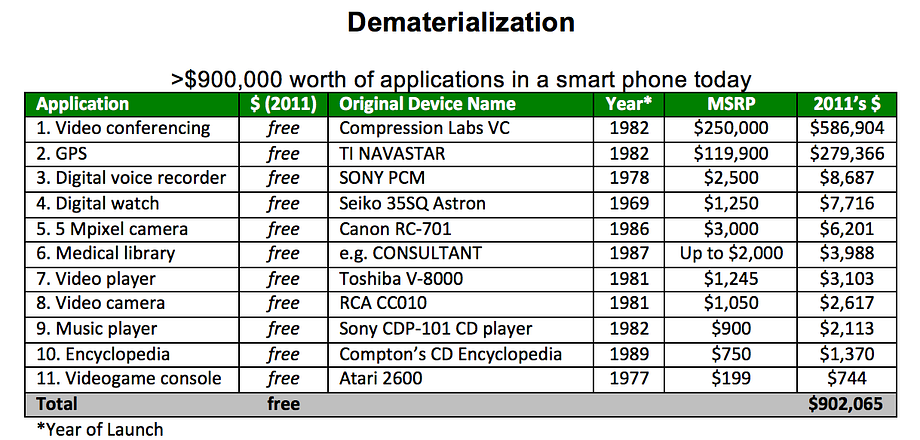
We are at the beginning of a period of what renowned futurist Peter Diamandis calls rapid demonetization, in which technology is rendering previously expensive products or services much cheaper — or even free.

This chart from Diamandis’ book Abundance shows how we’ve demonetized $900,000 worth of products and services you might have purchased between 1969 and 1989.

This demonetization will accelerate in the future. Automated vehicle fleets will eliminate one of our biggest purchases: a car. Virtual reality will make expensive experiences, such as going to a concert or playing golf, instantly available at much lower cost. While the difference between reality and virtual reality is almost incomparable at the moment, the rate of improvement of VR is exponential.

While education and health care costs have risen, innovation in these fields will likely lead to eventual demonetization as well. Many higher educational institutions, for example, have legacy costs to support multiple layers of hierarchy and to upkeep their campuses. Newer institutions are finding ways to dramatically lower costs by offering their services exclusively online, focusing only on training for in-demand, high-paying skills, or having employers who recruit students subsidize the cost of tuition.

Finally, new devices and technologies, such as CRISPR, the XPrize Tricorder, better diagnostics via artificial intelligence, and reduced cost of genomic sequencing will revolutionize the healthcare system. These technologies and other ones like them will dramatically lower the average cost of healthcare by focusing on prevention rather than cure and management.

While goods and services are becoming demonetized, knowledge is becoming increasingly valuable.

The central event of the twentieth century is the overthrow of matter. In technology, economics, and the politics of nations, wealth in the form of physical resources is steadily declining in value and significance. The powers of mind are everywhere ascendant over the brute force of things.” —George Gilder (technology thinker)

Perhaps the best example of the rising value of certain forms of knowledge is the self-driving car industry. Sebastian Thrun, founder of Google X and Google’s self-driving car team, gives the example of Uber paying $700 million for Otto, a six-month-old company with 70 employees, and of GM spending $1 billion on their acquisition of Cruise. He concludes that in this industry, “The going rate for talent these days is $10 million.”

That’s $10 million per skilled worker, and while that’s the most stunning example, it’s not just true for incredibly rare and lucrative technical skills. People who identify skills needed for future jobs — e.g., data analyst, product designer, physical therapist — and quickly learn them are poised to win.

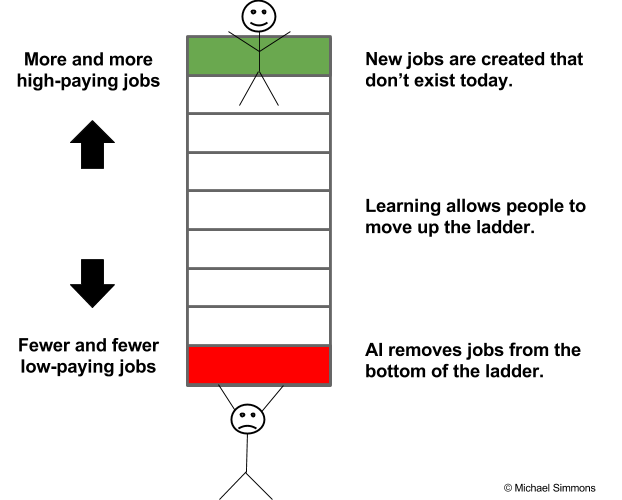
Those who work really hard throughout their career but don’t take time out of their schedule to constantly learn will be the new “at-risk” group. They risk remaining stuck on the bottom rung of global competition, and they risk losing their jobs to automation, just as blue-collar workers did between 2000 and 2010 when robots replaced 85 percent of manufacturing jobs.

Why?

People at the bottom of the economic ladder are being squeezed more and compensated less, while those at the top have more opportunities and are paid more than ever before. The irony is that the problem isn’t a lack of jobs. Rather, it’s a lack of people with the right skills and knowledge to fill the jobs.

An Atlantic article captures the paradox: “Employers across industries and regions have complained for years about a lack of skilled workers, and their complaints are borne out in U.S. employment data. In July [2015], the number of job postings reached its highest level ever, at 5.8 million, and the unemployment rate was comfortably below the post-World War II average. But, at the same time, over 17 million Americans are either unemployed, not working but interested in finding work, or doing part-time work but aspiring to full-time work.”

In short, we can see how at a fundamental level knowledge is gradually becoming its own important and unique form of currency. In other words, knowledge is the new money. Similar to money, knowledge often serves as a medium of exchange and store of value.

But, unlike money, when you use knowledge or give it away, you don’t lose it. In fact, it’s the opposite. The more you give away knowledge, the more you:

  • Remember it
  • Understand it
  • Connect it to other ideas in your head
  • Build your identity as a role model for that knowledge

Transferring knowledge anywhere in the world is free and instant. Its value compounds over time faster than money. It can be converted into many things, including things that money can’t buy, such as authentic relationships and high levels of subjective well-being. It helps you accomplish your goals faster and better. It’s fun to acquire. It makes your brain work better. It expands your vocabulary, making you a better communicator. It helps you think bigger and beyond your circumstances. It connects you to communities of people you didn’t even know existed. It puts your life in perspective by essentially helping you live many lives in one life through other people’s experiences and wisdom.

Former President Obama perfectly explains why he was so committed to reading during his Presidency in a recent New York Times interview:

“At a time when events move so quickly and so much information is transmitted,” he said, reading gave him the ability to occasionally “slow down and get perspective” and “the ability to get in somebody else’s shoes.” These two things, he added, “have been invaluable to me. Whether they’ve made me a better president I can’t say. But what I can say is that they have allowed me to sort of maintain my balance during the course of eight years, because this is a place that comes at you hard and fast and doesn’t let up.”

6 essentials skills to master the new knowledge economy

The illiterate of the 21st century will not be those who cannot read and write, but those who cannot learn, unlearn, and relearn.” — Alvin Toffler

So, how do we learn the right knowledge and have it pay off for us? The six points below serve as a framework to help you begin to answer this question. I also created an in-depth webinar on Learning How To Learn that you can watch for free.

  1. Identify valuable knowledge at the right time. The value of knowledge isn’t static. It changes as a function of how valuable other people consider it and how rare it is. As new technologies mature and reshape industries, there is often a deficit of people with the needed skills, which creates the potential for high compensation. Because of the high compensation, more people are quickly trained, and the average compensation decreases.
  2. Learn and master that knowledge quickly. Opportunity windows are temporary in nature. Individuals must take advantage of them when they see them. This means being able to learn new skills quickly. After reading thousands of books, I’ve found that understanding and using mental models is one of the most universal skills that EVERYONE should learn. It provides a strong foundation of knowledge that applies across every field. So when you jump into a new field, you have preexisting knowledge you can use to learn faster.
  3. Communicate the value of your skills to others. People with the same skills can command wildly different salaries and fees based on how well they’re able to communicate and persuade others. This ability convinces others that the skills you have are valuable is a “multiplier skill.” Many people spend years mastering an underlying technical skill and virtually no time mastering this multiplier skill.
  4. Convert knowledge into money and results. There are many ways to transform knowledge into value in your life. A few examples include finding and getting a job that pays well, getting a raise, building a successful business, selling your knowledge as a consultant, and building your reputation by becoming a thought leader.
  5. Learn how to financially invest in learning to get the highest return. Each of us needs to find the right “portfolio” of books, online courses, and certificate/degree programs to help us achieve our goals within our budget. To get the right portfolio, we need to apply financial terms — such as return on investment, risk management, hurdle rate, hedging, and diversification — to our thinking on knowledge investment.
  6. Master the skill of learning how to learn. Doing so exponentially increases the value of every hour we devote to learning (our learning rate). Our learning rate determines how quickly our knowledge compounds over time. Consider someone who reads and retains one book a week versus someone who takes 10 days to read a book. Over the course of a year, a 30% difference compounds to one person reading 85 more books.

To shift our focus from being overly obsessed with money to a more savvy and realistic quest for knowledge, we need to stop thinking that we only acquire knowledge from 5 to 22 years old, and that then we can get a job and mentally coast through the rest of our lives if we work hard. To survive and thrive in this new era, we must constantly learn.

Working hard is the industrial era approach to getting ahead. Learning hard is the knowledge economy equivalent.

Just as we have minimum recommended dosages of vitamins, steps per day, and minutes of aerobic exercise for maintaining physical health, we need to be rigorous about the minimum dose of deliberate learning that will maintain our economic health. The long-term effects of intellectual complacency are just as insidious as the long-term effects of not exercising, eating well, or sleeping enough. Not learning at least 5 hours per week (the 5-hour rule) is the smoking of the 21st century and this article is the warning label.

Don’t be lazy. Don’t make excuses. Just get it done.

“Live as if you were to die tomorrow. Learn as if you were to live forever.” — Mahatma Gandhi

Before his daughter was born, successful entrepreneur Ben Clarke focused on deliberate learning every day from 6:45 a.m. to 8:30 a.m. for five years (2,000+ hours), but when his daughter was born, he decided to replace his learning time with daddy-daughter time. This is the point at which most people would give up on their learning ritual.

Instead of doing that, Ben decided to change his daily work schedule. He shortened the number of hours he worked on his to do list in order to make room for his learning ritual. Keep in mind that Ben oversees 200+ employees at his company, The Shipyard, and is always busy. In his words, “By working less and learning more, I might seem to get less done in a day, but I get dramatically more done in my year and in my career.” This wasn’t an easy decision by any means, but it reflects the type of difficult decisions that we all need to start making. Even if you’re just an entry-level employee, there’s no excuse. You can find mini learning periods during your downtimes (commutes, lunch breaks, slow times). Even 15 minutes per day will add up to nearly 100 hours over a year. Time and energy should not be excuses. Rather, they are difficult, but overcomable challenges. By being one of the few people who rises to this challenge, you reap that much more in reward.

We often believe we can’t afford the time it takes, but the opposite is true: None of us can afford not to learn.

Learning is no longer a luxury; it’s a necessity.

Start your learning ritual today with these three steps

The busiest, most successful people in the world find at least an hour to learn EVERY DAY. So can you!

Just three steps are needed to create your own learning ritual:

  1. Find the time for reading and learning even if you are really busy and overwhelmed.
  2. Stay consistent on using that “found” time without procrastinating or falling prey to distraction.
  3. Increase the results you receive from each hour of learning by using proven hacks that help you remember and apply what you learn.

Over the last three years, I’ve researched how top performers find the time, stay consistent, and get more results. There was too much information for one article, so I spent dozens of hours and created a free masterclass to help you master your learning ritual too!


Healthcare as a zero-sum game: 7 key points

https://www.beckershospitalreview.com/hospital-management-administration/healthcare-as-a-zero-sum-game-7-key-points.html?origin=cfoe&utm_source=cfoe

This article sets out seven thoughts on healthcare systems.

The article discusses:

  1. Types of Healthcare Systems
  2. Mergers and Key Questions to Assess Mergers
  3. Headwinds Facing Systems
  4. The Great Fear of Systems
  5. What has Worked the Last 10 Years
  6. What is Likely to Work the Next 10 Years
  7. A Few Other Issues

Before starting the core of the article, we note two thoughts. First, we view a core strategy of systems to spend a great percentage of their time on those things that currently work and bring in profits and revenues. As a general rule, we advise systems to spend 70 to 80 percent of their time doubling down on what works (i.e., their core strengths) and 20 to 30 percent of their time on new efforts.

Second, when we talk about healthcare as a zero-sum game, we mean the total increases in healthcare spend are slowing down and there are greater threats to the hospital portion of that spend. I.e., the pie is growing at a slower pace and profits in the hospital sector are decreasing.

I. Types of Healthcare Systems

We generally see six to eight types of healthcare systems. There is some overlap, with some organizations falling into several types.

1. Elite Systems. These systems generally make U.S. News & World Report’s annual “Best Hospitals” ranking. These are systems like Mayo Clinic, Cleveland Clinic, Johns Hopkins Hospital, NewYork-Presbyterian, Massachusetts General, UPMC and a number of others. These systems are often academic medical centers or teaching hospitals.

2. Regionally Dominant Systems. These systems are very strong in their geographic area. The core concept behind these systems has been to make them so good and so important that payers and patients can’t easily go around them. Generally, this market position allows systems to generate slightly higher prices, which are important to their longevity and profitability.

3. Kaiser Permanente. A third type of system is Oakland-based Kaiser Permanente itself. We view Kaiser as a type in and of itself since it is both so large and completely vertically integrated with Kaiser Foundation Health Plan, Kaiser Foundation Hospitals and Permanente Medical Groups. Kaiser was established as a company looking to control healthcare costs for construction, shipyard and steel mill workers for the Kaiser industrial companies in the late 1930s and 1940s. As companies like Amazon, Berkshire Hathaway and JPMorgan Chase try to reduce costs, it is worth noting that they are copying Kaiser’s purpose but not building hospitals. However, they are after the same goal that Kaiser originally sought. Making Kaiser even more interesting is its ability to take advantage of remote and virtual care as a mechanism to lower costs and expand access to care.

4. Community Hospitals. Community hospitals is an umbrella term for smaller hospital systems or hospitals. They can be suburban, rural or urban. Community hospitals are often associated with rural or suburban markets, but large cities can contain community hospitals if they serve a market segment distinct from a major tertiary care center. Community hospitals are typically one- to three-hospital systems often characterized by relatively limited resources. For purposes of this article, community hospitals are not classified as teaching hospitals — meaning they have minimal intern- and resident-per-bed ratios and involvement in GME programs.

5. Safety-Net Hospitals. When we think of safety-net hospitals, we typically recall hospitals that truly function as safety nets in their communities by treating the most medically vulnerable populations, including Medicaid enrollees and the uninsured. These organizations receive a great percentage of revenue from Medicaid, supplemental government payments and self-paying patients. Overall, they have very little commercial business. Safety-net hospitals exist in different areas, urban or rural. Many of the other types of systems noted in this article may also be considered safety-net systems.

6. National Chains. We divide national chains largely based on how their market position has developed. National chains that have developed markets and are dominant in them tend to be more successful. Chains tend to be less successful when they are largely developed out of disparate health systems and don’t possess a lot of market clout in certain areas.

7. Specialty Hospitals. These are typically orthopedic hospitals, psychiatric hospitals, women’s hospitals, children’s hospital or other types of hospitals that specialize in a field of medicine or have a very specific purpose.

II. Mergers and Acquisitions

There have seen several large mergers over the last few years, including those of Aurora-Advocate, Baylor Scott & White-Memorial Hermann, CHI-Dignity and Mercy-Bon Secours, among others.

In evaluating a merger, the No. 1 question we ask is, “Is there a clear and compelling reason or purpose for the merger?” This is the quintessential discussion piece around a merger. The types of compelling reasons often come in one of several varieties. First: Is the merger intended to double down and create greater market strength? In other words, will the merger make a system regionally dominant or more dominant?

Second: Does the merger make the system better capitalized and able to make more investments that it otherwise could not make? For example, a large number of community hospitals don’t have the finances to invest in the health IT they need, the business and practices they need, the labor they need or other initiatives.

Third: Does the merger allow the amortization of central costs? Due to a variety of political reasons, many systems have a hard time taking advantage of the amortization of costs that would otherwise come from either reducing numbers of locations or reducing some of the administrative leadership.

Finally, fourth: Does the merger make the system less fragile?

Each of these four questions tie back to the core query: Does the merger have a compelling reason or not?

III. Headwinds

Hospitals face many different headwinds. This goes into the concept of healthcare as a zero-sum game. There is only so much pie to be shared, and the hospital slice of pie is being attacked or threatened in various areas. Certain headwinds include:

1. Pharma Costs. The increasing cost of pharmaceuticals and the inability to control this cost particularly in the non-generic area. Here, increasingly the one cost area that payers are trying to merge with relates to pharma/PBM the one cost that hospitals can’t seem to control is pharma costs. There is little wonder there is so much attention paid to pharma costs in D.C.

2. Labor Costs. Notwithstanding all the discussions of technology and saving healthcare through technology, healthcare is often a labor-intensive business. Human care, especially as the population ages, requires lots of people — and people are expensive.

3. Bricks and Mortar. Most systems have extensive real estate costs. Hospitals that have tried to win the competitive game by owning more sites on the map find it is very expensive to maintain lots of sites.

4. Slowing Rises in Reimbursement – Federal and Commercial. Increasingly, due to federal and state financial issues, governments (and interest by employers) have less ability to keep raising healthcare prices. Instead, there is greater movement toward softer increases or reduced reimbursement.

5. Lower Commercial Mix. Most hospitals and health systems do better when their payer mix contains a higher percentage of commercial business versus Medicare or Medicaid. In essence, the greater percentage of commercial business, the better a health system does. Hospital executives have traditionally talked about their commercial business subsidizing the Medicare/Medicaid business. As the population ages and as companies get more aggressive about managing their own healthcare costs, you see a shift — even if just a few percentage points — to a higher percentage of Medicare/Medicaid business. There is serious potential for this to impact the long-term profitability of hospitals and health systems. Big companies like JPMorgan, Amazon, Berkshire Hathaway and some other giants like Google and Apple are first and foremost seeking to control their own healthcare costs. This often means steering certain types of business toward narrow networks, which can translate to less commercial business for hospitals.

6. Cybersecurity and Health IT Costs. Most systems could spend their entire budgets on cybersecurity if they wanted to. That’s impossible, of course, but the potential costs of a security breach or incident loom large and there are only so many dollars to cover these costs.

7. The Loss of Ancillary Income. Health systems traditionally relied on a handful of key specialties —cardiology, orthopedics, spine and oncology, for example — and ancillaries like imaging, labs, radiation therapy and others to make a good deal of their profits. Now ancillaries are increasingly shifted away from systems toward for-profits and other providers. For example, Quest Diagnostics and Laboratory Corporation of America have aggressively expanded their market share in the diagnostic lab industry by acquiring labs from health systems or striking management partnerships for diagnostic services.

8. Payers Less Reliant on Systems. Payers have signaled less reliance on hospitals and health systems. This headwind is indicated in a couple of trends. One is payers increasingly buying outpatient providers and investing in many other types of providers. Another is payers looking to merge with pharmaceutical providers or pharmacy and benefit managers.

9. Supergroups. Increasingly in certain specialties and multispecialty groups, especially orthopedics and a couple other specialties, there is an effort to develop strong “super groups.” The idea of some of these super groups is to work toward managing the top line of costs, then dole out and subcontract the other costs. Again, this could potentially move hospitals further and further downstream as cost centers instead of leaders.

IV. The Great Fear

The great fear of health systems is really twofold. First: that more and more systems end up in bankruptcy because they just can’t make the margins they need. We usually see this unfold with smaller hospitals, but over the last 20 years, we have seen bankruptcies periodically affect big hospital systems as well. (Here are 14 hospitals that have filed for bankruptcy in 2018 to date. According to data compiled by Bloomberg, at least 26 nonprofit hospitals across the nation are already in default or distress.)

Second, and more likely, is that hospitals in general become more like mid-level safety net systems for certain types of care — with the best business moving away. I.e., as margins slide, hospitals will handle more and more of the essential types of care. This is problematic, in that many hospitals and health systems have infrastructures that were built to provide care for a wide range of patient needs. The counterpoint to these two great fears is that there is a massive need for healthcare and healthcare is expensive. In essence, there are 325,700,000 people in the United States, and it’s not easy to provide care for an aging population.

V. The Last 10 Years – What Worked

What has worked over the last five to 10 years is some mix of the following:

  1. Being an elite system has remained a recipe for financial success.
  1. Being regionally dominant has been a recipe for success.
  1. Being very special at something or being very great at something has been a recipe for success.
  1. Being great in high paying specialties like orthopedics, oncology, and spine has been a recipe for success.
  1. Systems have benefited where they provide extensive ancillaries to make great profits.

VI. The Next 10 Years

Over the next 10 years, we advise systems to consider the following.

  1. Double down on what works.
  1. Do not give up dominance where they have it. Although it may be politically unpopular and expensive to maintain, dominance remains important.
  1. Systems will need a new level of cost control. For years hospitals focused on expanding patient volume, expanding revenue and enlarging their footprint. Now cost control has surpassed revenue growth as the top priority for hospital and health system CEOs in 2018.
  1. Systems will have to be great at remote and virtual care. More and more patients want care where and when they want it.
  1. Because there will be so much change, systems must continue to have great leadership and great teams to adjust and remain successful.
  1. As systems become more consumer-centric, hospitals will have to lead with great patient experience and great patient navigation. These two competencies have to become systemwide strengths for organizations to excel over the next decade.

VII. Other Issues

Other issues we find fascinating today are as follows.

1. First, payers are more likely to look at pharma and pharma benefit companies as merger partners than health systems. We think this is a fascinating change that reflects a few things, including the role and costs of pharmaceuticals in our country, the slowly lessening importance of health systems, and payers’ disinterest in carrying the costs of hospitals.

2. Second, for many years everyone wanted to be Kaiser. What’s fascinating today is how Kaiser now worries about Amazon, Apple and other companies that are doing what Kaiser did 50 to 100 years ago. In essence, large companies’ strategies to design their own health systems, networks or clinics to reduce healthcare costs and provide better care is a force that once created legacy systems like Kaiser and now threatens those same systems.

3. Third, we find politicians are largely tone deaf. On one side of the table is a call for a national single payer system, which at least in other countries of large size has not been a great answer and is very expensive. On the other hand, you still have politicians on the right saying just “let the free market work.” This reminds me of people who held up posters saying, “Get the government out of my Medicare.” We seem to be past a true and pure free market in healthcare. There is some place between these two extremes that probably works, and there is probably a need for some sort of public option.

4. Fourth, care navigation in many elite systems is still a debacle. There is still a lot of room for improvement in this area, but unfortunately, it is not an area that payers directly tend to pay for.

5. Fifth, we periodically hear speakers say “this app is the answer” to every problem. I contrast that by watching care given to elderly patients, and I think the app is unlikely to solve that much. It is not that there is not room for lots of apps and changes in healthcare — because there is. However, healthcare remains as a great mix of technology and a labor- and care-intensive business.


Leadership Quotes That Inspire Me

http://www.leadershipdigital.com/edition/daily-leadership-marketing-2018-11-30?open-article-id=9326689&article-title=leadership-quotes-that-inspire-me&blog-domain=ericjacobsonblog.com&blog-title=eric-jacobson

These quotes truly inspire me:

“The three common characteristics of best companies — they care, they have fun, they have high performance expectations.” — Brad Hams

“The one thing that’s common to all successful people: They make a habit of doing things that unsuccessful people don’t like to do.” — Michael Phelps

“It is amazing what you can accomplish if you do not care who gets the credit.” — Harry S. Truman

“The leader of the past was a person who knew how to tell. The leader of the future will be a person who knows how to ask.” — Peter Drucker

“Leadership: The art of getting someone else to do something you want done because he wants to do it.” — Dwight D. Eisenhower

“Good leadership isn’t about advancing yourself.  It’s about advancing your team.” — John C. Maxwell

“People buy into the leader, then the vision.” — John C. Maxwell

“Great leaders have courage, tenacity and patience.” — Bill McBean

“People never learn anything by being told, they have to find out for themselves.” — Paulo Coelho

“We live in a time where brands are people and people are brands.” — Brian Solis

“In real life, the most practical advice for leaders is not to treat pawns like pawns, nor princes like princes, but all persons like persons.” — James MacGregor Burns

“The only source of knowledge is experience.” — Albert Einstein

“Nothing is a waste of time if you use the experience wisely.” — Auguste Rodin

“Nobody can go back and start a new beginning, but anyone can start today and make a new ending.” — Maria Robinson

“A good leader takes a little more than his share of the blame, a little less than his share of the credit.” — Arnold H. Glasgow

“I praise loudly, I blame softly.” — Catherine II of Russia

“Honest disagreement is often a good sign of progress.” — Mohandas Gandhi

“A long dispute means that both parties are wrong.” — Voltaire

“The least questioned assumptions are often the most questionable.” — Paul Broca

“One of the tests of leadership is the ability to recognize a problem before it becomes an emergency.” — Arnold Glasow

“Managers assert drive and control to get things done; leaders pause to discover new ways of being and achieving .”– Kevin Cashman

“It doesn’t matter where you’re coming from. All that matters is where you are going to.” — Stephen Covey

“Great works are performed not by strength, but by perseverance.” — Samuel Johnson

“Strength doesn’t come from what we can do. It comes from overcoming what we once thought we couldn’t.” — Rikki Roberts

“The art of progress is to preserve order amid change and to preserve change amid order.” — Alfred North Whitehead

“The most powerful predictable people builders are praise and encouragement.” — Brian Tracy

“Few things help an individual more than to place responsibility upon them and to let them know that and trust them.” — Booker T. Washington

“Ask because you want to know. Listen because you want to grow.” — Mark Scharenbroich

“If you want execution, hail only success. If you want creativity, hail risk, and remain neutral about success.” — Marcus Buckingham

“To get the best coaching outcomes, always have your 1-on-1’s on your employee’s turf not yours. In your office the truth hides.” — Marcus Buckingham

“The best way to predict the future is to invent it.” — Alan Kay

“Nothing great was ever achieved without enthusiasm.” — Ralph Waldo Emerson

“A pessimist sees the difficulty in every opportunity; an optimist sees the opportunity in every difficulty.” — Winston Churchill

“The greatest accomplishment is not in never failing, but in rising again after you fall.” — Vince Lombardi


The New Math of Leadership

http://www.leadershipdigital.com/edition/daily-leadership-marketing-2018-11-30?open-article-id=9320801&article-title=the-new-math-of-leadership&blog-domain=leadchangegroup.com&blog-title=lead-change-blog

“You are now the leader.” It is a sentence that implies a do-something role. If it ended with word “driver” or “cook” or “host,” you would have a clear sense of the actions required. New leaders think being a leader means doing something important. So, they stretch and adjust their style and practice like a new pair of shoes that must be broken in.

What if we altered the frame and thought of leadership more like the rheostat on a light switch—turned up or down, on or off, depending on what was required? If the goal is reading, the light goes up; romantic, the light dims; and time to turn in for the evening, the light turns off. The presence of light becomes relevant only in the context of a need or goal.

When I landed my first supervisory role, my boss advised me to think about leadership like arithmetic—only adding as much leadership as needed to get the net desired.

Too little, and the goal risks not getting accomplished; too much, and the goal gets done but with consequences that can be unhelpful. The implication is that, if all is going as planned, no leadership at all is necessary.

Add Leadership Only if Needed

Barbaro was the 2006 Kentucky Derby winning horse. He came into the race undefeated. His margin of victory—6 1/2 lengths—was the largest in over sixty years. A heavy favorite to win the Triple Crown, with a “mustang-like joy of racing,” he shattered his right hind leg two weeks later at the Preakness after he false started and, ultimately, had to be put down.

But there was a backstory to this memorable event—Edgar Prado, Barbaro’s proud jockey. Unlike most jockeys who generously used a whip, especially on the home stretch, Prado never touched Barbaro with his whip and never asked him to do anything more than necessary. “If he’s running really hard, why should he be punished?” Prado once told a reporter.

I invited a fellow consultant to assist me in working with the executive team of a long-term client. She had heard me repeatedly rave about the CEO of this high-tech company. Her flight was delayed and the meeting underway when she arrived, preventing us from introducing her to the team. After listening to the group have a lengthy, spirited dialogue over a strategic challenge, she whispered, “Which one is the CEO?” Leadership is not a rank to be displayed and trumpeted; it is a spirit to be summoned as required.

Err on the Side of Subtraction

I serve on the board of a community organization. There are no paid members, only volunteers. Most are fairly well-to-do and retired. In fact, I am the only board member still working in a profession. When I joined, I heard stories of the previous leader who thought his job was to give instructions and critique performance.

At the time I was asked to join, morale was low, recruitment of volunteers was challenging, and the organization was at a standstill. I quickly learned that the new leader’s philosophy was to focus on clarifying the vision, running interference to eliminate obstacles that slowed work, and providing lots of affirmation. The accomplishments went up dramatically, right along with morale. His subtraction of control enabled others to take initiative; his addition of affirmation made board members feel valued instead of brow-beaten.

Multiply Contribution Through Leadership Math

Tree trimmers aren’t typically known for their service sensitivity, but tree surgeon Richard Butler is an exception. He long served as caretaker for the massive oak trees in my yard when I lived in Texas. Richard’s service approach was as impressive as his team’s Cirque du Soleil antics in tall trees. For example, realizing I was an author, Richard requested a signed copy of “your latest book” as a part of his payment.

I needed a dozen tree stumps ground out of my yard, and asked Richard for an estimate. Satisfied with the price, work began a few days later. But further examination of the terrain revealed three stumps that were previously overlooked. “If you could please give me another signed copy of your book. Beep Beep!,” Richard announced, “I’ll throw these stumps in at no extra charge.” My delight multiplied!

On another occasion, lightning struck a large elm tree. A call was placed to Richard to “come give an estimate.” Arriving home after work, we found the tree gone and the stump removed. On the back door was not an invoice; it was Richard’s business card. On the back of his card were four words written in the language of a multiplier leader: ‘No charge. Beep Beep!”

Leaders are not just adders and subtractors, they are multipliers! Armed with a generous “Richard Butler” spirit, they create relationship synergy and model a Samaritan mentality. “To lead people, walk beside them,” wrote philosopher Lao-tsu in 500 BC.

“As for the best leaders, the people do not notice their existence. The next best, the people honor and praise. The next, the people fear; and the next, the people hate… When the best leader’s work is done the people say, ‘We did it ourselves!'”