Independence Is Not a Strategy for Health Systems

http://www.healthleadersmedia.com/leadership/independence-not-strategy-health-systems?spMailingID=11725844&spUserID=MTY3ODg4NTg1MzQ4S0&spJobID=1221639238&spReportId=MTIyMTYzOTIzOAS2#

Image result for john gribbin centrastate

There are ways to keep going it alone in the face of massive consolidation, says one health system’s CEO. It’s not a strategy, but a means to end, he says.

Afraid your hospital or health system can’t compete because you lack size and scale?

A merger might help, but it’s not the only possible answer to your problems. Freehold, NJ-based CentraState Healthcare System’s top leader is certain it’s not the best solution for his organization.

Consolidation continues to upend the acute and post-acute healthcare industry. In fact, in a recent HealthLeaders Media survey, some 87% of respondents said that their organization is exploring potential deals, completing deals already under way, or both.

But CentraState isn’t among them, says John Gribbin, its president and CEO.

On a continuum basis, CentraState is already diversified. That’s one of the potential selling points of an M&A deal.

Anchored by the 248-bed CentraState Medical Center in Freehold, NJ, the 2,300-employee organization also contains three senior care facilities—one assisted living, one skilled-nursing facility, and a continuing care retirement community.

It can be argued that CentraState may not possess the scale to compete with multifacility, multistate large health systems that can take advantage of a hub-and-spoke strategy for referrals. Nor may it be able to afford expensive interconnected IT systems.

But there ways other than mergers to achieve scale and collaboration, says Gribbin.

Means to an End

Gribbin insists that he and CentraState’s board, which supports and encourages independence, are not dogmatic about it.

“Independence is not a strategy,” he says. “It’s a means to an end. The moment that ceases to be worthwhile is the moment we’ll consider another way to achieve our mission.”

Change is part of that strategy, he says, adding that healthcare in 2017 needs to be far more collaborative, not only with patients and family, but with other healthcare organizations. That’s a big difference from previous generations.

“Our real strategy is scale and relevancy,” he says.

And there are ways to create scale short of taking on all the legacy costs and “baggage,” as Gribbin calls it, inherent in any merger.

“There’s a lot of costs involved in merging… and while mergers work in some instances, they don’t work in all, and in many communities, they are increasing costs to the consumer,” he says.

In addition to the commonly stated goals of improving the community’s health and wellness, patient costs are extremely important in fulfilling CentraState’s mission, Gribbin argues.

Many mergers involve replacing hospitals and adding patient towers and high-cost equipment. That adds to their cost structure means they have to extract higher pricing, says Gribben.

“That’s the vicious circle you find yourself in. I prefer to create scale in a different manner.”

Focus on the Mission

Gribbin, who has led CentraState for 17 years, prefers to solve that challenge in part through a strong network of physicians unburdened by excessive administrative overhead.

He says the health system has to increasingly take on value-based contracting and financial risk. To be successful under such value-based reimbursement, partnerships with physicians are increasingly important, as is a redefinition of the relationship with the patient.

“We used to look at our relationship with the patient as a typical hospital stay,” says Gribbin. “What we’re preaching now is that hospital stay is a temporary interruption in our relationship. What happens before or after defines the relationship’s success.”

With its physician alliance and clinically integrated network in place, CentraState, unlike many hospitals, has been able to avoid, in large part, expensive physician practice acquisitions that can be a financial challenge.

“I’ve done it in the past, and may do it again, but we’ve tried to avoid it,” he says. Instead, contracts define the relationships and incentives.

As an example of those relationships, CentraState partners with a major patient-centered medical home primary care practice on four performance and three utilization measures.

As a result of the shared savings generated in the first year, which came largely from hospital-based savings, the physicians in that group referred 59% of their patients to CentraState.

This year they’ve referred 71% of their patients to CentraState because of its low costs, which help drive financial reward for both parties under the contract.

“On one hand, we’re keeping people appropriately out of acute care, but on the other hand, they’re sending [more] people here. So we’re experiencing higher but more appropriate volume. In this scenario, everyone wins,” Gribbin says.

A New Deal with Physicians

In order to avoid the need to acquire physician practices, Gribbin says it helps to have a suite of services to offer them as a starting point.

“Most don’t want to sell their practice, but they feel like they have to, he says. “If you give them the opportunity to stay independent, they’ll take it.”

Helping them with access to better revenue cycle management, malpractice insurance, and risk management, and helping them create the ability to enter into risk-based contracts is another big help with defining a new relationship based on shared goals with physicians that ultimately benefit the patient, he says.

Physicians can establish a relationship with CentraState through its independent practice association, or a physician hospital association, and avoid surrendering their autonomy, he says.

“The physicians got paid better, the payer saved money even including the bonus, the hospital won because it’s high value care, and the patient’s winning too,” he says. “It’s a microcosm of what we’re trying to accomplish.”

As a small organization, both Gribbin and the board worry about being frozen out of narrow networks. Much of the energy they’ve expended in being a low-cost organization is wasted, he says, if they can’t get the big payers to include them in contracting.

“As long as the market isn’t rigged against us, we’re OK, because we’re a high-value organization.”


KeyBanc Capital Markets to acquire Cain Brothers

http://www.beckershospitalreview.com/hospital-transactions-and-valuation/keybanc-capital-markets-to-acquire-cain-brothers.html

Image result for key banc


Cleveland-based KeyBanc Capital Markets has entered into a definitive agreement to acquire New York City-based Cain Brothers & Co., a healthcare focused investment banking and public finance firm.

The transaction, which requires regulatory approvals, will expand KeyBanc’s healthcare investment banking group.

“Key’s established, integrated corporate and investment banking platform will allow us to bring enhanced capabilities to our clients, further improving our value proposition,” Robert J. Fraiman Jr., president and CEO of Cain Brothers, said. “At the same time, we look forward to bringing our knowledge and capabilities to Key’s extensive healthcare services and provider client base.”

The transaction is expected to close in late 2017.

Chinese billionaire Tianqiao Chen makes big stock buy in CHS, brings stake to 22.1%

http://www.healthcarefinancenews.com/news/chinese-billionaire-tianquo-chen-makes-big-stock-buy-chs-brings-stake-221?mkt_tok=eyJpIjoiWlRsaE56QTFZMk00WVdVdyIsInQiOiJPV2NZVXpmSXoxY2s2blNFdG9DYmt0UHh1bnkzc0NcL0R3YnpCcEhqdm5lWVwvNlJrN2xDVlwvUFZ5ZFBzOElGY253OGFMZWVKVnh5a3dTSDM1RFwvdFN3cklQTGd0NmN0YzFrQjIrK21WUW5UTWhaUXVUdUhZZU41dGNwcUtvYmZUaEMifQ%3D%3D

Image result for Chinese billionaire Tianqiao Chen

The purchases were made through Chen’s various Shanda affiliates, documents showed.

Chinese billionaire Tianqiao Chen is once again raising eyebrows in the healthcare sector, after significantly increasing his stake in struggling healthcare organization Community Health Systems, which is based in Franklin, Tennessee.

According to a filing with the Securities and Exchange Commission, now owns 22.1 percent of CHS‘ outstanding shares of common stock after buying up roughly 9.8 million additional shares over the last week. The price per share varied from $6.1 to $8 per share.

The purchases were made through Chen’s various Shanda affiliates, documents showed.

The big stock buy will inevitably be viewed by at least some as a move to take a bigger interest in the struggling company, something that has been speculated about in the past when Chen first came on the scene and bought a large block of stock in the company last year.

A spokesperson for Shanda Group issued the following statement. “Shanda maintains a good relationship with the CYH management team and intends to engage with them regarding business and operations, and the status of CYH’s ongoing turnaround strategy.”

CHS has been in the news lately as it forges ahead with its ambitious divestiture plan to offload 30 hospitals in hopes of alleviating its billions-large debt load and tightening up its operations. So far the company has sold 20 of those hospitals and has plans in the works to unload the remaining ten. It has also said in a recent earnings call that they are entertaining plans to sell even more, but no definitive details have been released.

The collapse of Community Health Systems

https://www.axios.com/the-collapse-of-community-health-systems-2471839258.html

Image result for The collapse of Community Health Systems


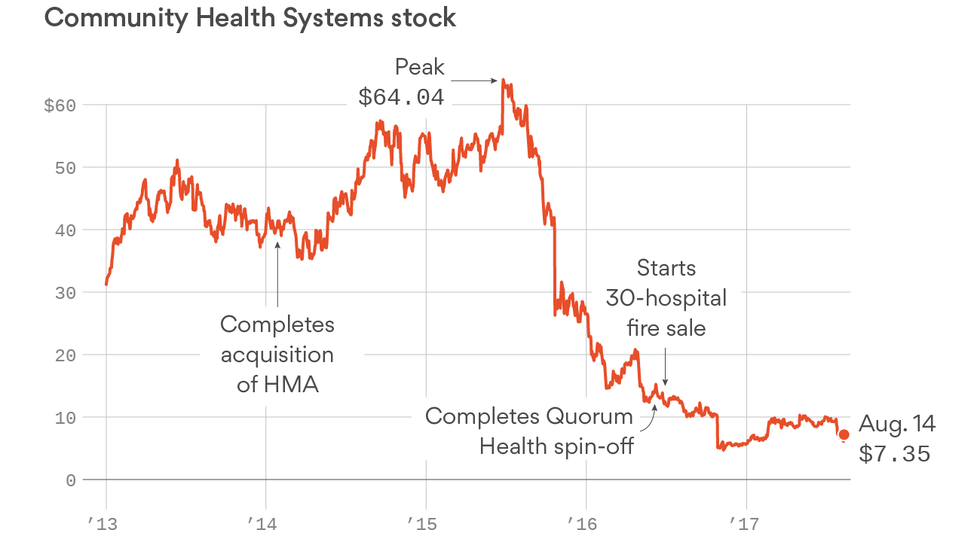
Just three years ago, Community Health Systems was the largest for-profit operator of hospitals with more than 200 facilities scattered in rural and suburban areas with growing populations. Now, the company is hemorrhaging money, sitting atop a mountain of debt and teetering on the edge of bankruptcy — all major reasons why CHS has lost almost 90% of its market value.

“I think the company has a nontrivial chance of defaulting,” said one CHS investor who asked to be unnamed because of the sensitivity of the issue. Tomi Galin, a CHS spokeswoman, did not make any company officials available for an interview, but said the company is confident it will have “a stronger core group of hospitals that are better positioned for long-term growth.”

Why it matters: CHS sits in a massive hole after a string of missteps, according to industry insiders. And it’s not likely to get better for CHS, or the local communities that rely on a CHS facility, as more people get treated in lower-cost outpatient centers instead of the hospital.

The collapse: It began in 2013 and continued into January 2014. That’s when CHS completed its acquisition of Health Management Associates, a for-profit hospital chain that had a slew of financial and legal problems. The deal was worth $7.6 billion, including debt, and made CHS the largest for-profit hospital company by number of facilities.

“That was the death knell,” a health care investment banker said. “HMA was a troubled company, and (CHS) thought bigger would be better.”

Here’s what has happened at CHS since then:

  • A market cap that crumbled from roughly $7.5 billion in 2015 to less than $800 million today.
  • Net losses of almost $1.9 billion from the start of 2016 through the second quarter of this year.
  • A ballooning debt load totaling $14.7 billion as of June 30.
  • Larry Robbins, a prominent hedge fund manager, dumped his entire portfolio of CHS stock. Paul Singer of Elliott Management did the same earlier this year.
  • A fire sale of 30 hospitals to get cash to pay down debt.
  • Some of those sold hospitals were HMA remnants, while others were considered CHS’ better, more profitable hospitals. “It’s almost like they’re burning the furniture,” the banker said. An investor said CHS was “selling off the fine china” to meet debt payments.
  • A completed spin-off of Quorum Health that, in essence, threw many struggling rural hospitals off CHS’ books. Quorum isn’t faring well either.
  • High amounts of uncompensated care. CHS owns many hospitals in the South, and most of those states did not expand Medicaid under the Affordable Care Act. That means CHS has absorbed more uncompensated care than hospitals in Medicaid expansion states.

Looking ahead: CHS plans on divesting even more hospitals, executives said during their latest earnings call. They likely will be profitable hospitals, as buyers won’t touch money-losing inpatient facilities with dwindling admissions.

But large debt payments are due in 2019 through 2022. Short-term cash from transactions appears to be a bandage, and a subsequently smaller profit base won’t solve the big debt picture, making bankruptcy a real possibility, an investor said.

Galin, the CHS spokeswoman, said the money from the hospital sales “are being used to reduce our debt” and that “cash flow generation remains strong.”

Leadership questions: Many CHS executives have retired or left in the past two years, including longtime CFO Larry Cash. Wayne Smith, the CEO of the hospital chain since 1997, remains in his position. Smith is one of the highest earners among hospital executives and reaped more than $1 million in bonuses alone the past two years even though CHS’ stock price tanked.

Numerous sources would not go on the record to talk about CHS. One hospital industry analyst said this when asked how Smith still had his job despite the company’s problems: “Your question is very valid.”

UPMC moves ahead on purchase of PinnacleHealth

http://www.healthcaredive.com/news/upmc-moves-ahead-on-purchase-of-pinnaclehealth/449305/

Image result for upmc

Dive Brief:

  • UPMC have reached a definitive agreement to with Harrisburg-based PinnacleHealth to be acquired, Philly.com reports.
  • The deal paves the way for UPMC to expand its market share in central Pennsylvania and compete directly with the University of Pennsylvania Health System, which owns Lancaster General Health.
  • Last month, Pinnacle bought four central Pennsylvania hospitals from Community Health Systems, a Tennessee-based hospital chain. The purchase included Lancaster Regional Medical Center and Heart of Lancaster Regional Medical Center.

Dive Insight:

The deal, first announced in March, is UPMC’s largest ever and the first to involve an entire health system. Previous purchases have involved single hospitals, the most recent being Sunbury Community Hospital and Lock Haven Hospital from Quorum Health. Those hospitals will become part of Williamsport, Pa.-based UPMC Susquehanna, which was added to the UPMC system last fall.

With Pinnacle’s acquisition now on track, UPMC also stands to boost its health insurance product line, which accounted for close to half of its 2016 operating revenue. The move will pit UPMC Health Plan against Capital BlueCross and Highmark, which together have 75% of the central Pennsylvania market. Aetna holds the rest.

Gaining a foothold in the Harrisburg region could help to compete with Highmark, which four years ago bought Pittsburgh-based Allegheny Health Network, putting it in direct competition with UPMC’s medical and coverage operations.

Merger and acquisition activity has kept up a steady pace this year, with no signs of abating. Reasons for deals include declining admissions, rising costs and a desire to expand into new regions or service lines.

In May, Cleveland Clinic and Dover, Ohio-based Union Hospital signed a letter of intent to merge Union into Cleveland Clinic. The move will expand Cleveland Clinic’s footprint into southern Ohio, while bringing new services and resources to Union, officials said at the time.

Cleveland Clinic CEO Toby Cosgrove, who is stepping down later this year, said in April that consolidation and a greater focus on telemedicine would help providers transition from volume to value payment as healthcare reform continues to evolve.

UPMC expects to complete the acquisition September 1, pending regulatory approvals. For the fiscal year ended June 30, 2016, Pinnacle reported revenue of $1.05 billion.

Investment firm Kohlberg Kravis Roberts closes $2.4 billion deal with Envision Healthcare, acquires Covenant Surgical Partners

http://www.healthcarefinancenews.com/news/investment-firm-kohlberg-kravis-roberts-closes-24-billion-deal-envision-healthcare-acquires?mkt_tok=eyJpIjoiT0RabE1UVmtZamMzTldOaCIsInQiOiJIRmpRNFJxRnFHbG9vRGV6UXZGMzZJbmZXOEZRczZRcktRb3Z4VzZHQ01UYUdoVElGRlNGVTUrRytER3FteTZSMTdXMjdjM0dlVnlrT01CS2RSNDhCa2tuRTNvbkhVMmlkU0RWQ3pvQ0lrTGVPMnkyUG8ySGJOaGhQc0FLbWUyaSJ9

Photo courtesy <a href="https://www.flickr.com/photos/cak757/15853544615"> Flickr </a>


Envision and WebMD deals are valued at more than $2 billion each; financial terms of Covenant deal were not disclosed.

Global investment firm Kohlberg Kravis Roberts & Co has announced they will buy Covenant Surgical Partners. Financial details were not disclosed.

Covenant buys and operates ambulatory surgery centers and physician practices, and touts 37 facilities located across 17 states.

The deal is expected to close in the third quarter of FY 2017.

The announcement comes just a day after another major, much-anticipated deal was unveiled. KKR’s Air Medical Group Holdings will merge with Envision Healthcare’s transportation subsidiary American Medical Response to form an entirely new medical transportation company, a transaction worth $2.4 billion, KKR said.

The combined company is expected to transport more than five million patients per year with air and ground ambulances across 46 states and the District of Columbia, KKR said in a statement.

Envision’s President of Ambulatory Services Randall Owen will step in as President and CEO of the new company, and when the deal is done, a new company name will be designated.

That deal is scheduled to close in the fourth quarter of 2017.

Envision Healthcare owns and operates 263 surgery centers and one surgical hospital in 35 states and the District of Columbia, with medical specialties ranging from gastroenterology to ophthalmology and orthopedics.

“The Envision leadership team conducted a robust process to review strategic alternatives for AMR. The agreement delivers on our commitment to continue the proud tradition of AMR and enables Envision to focus on its physician-centric strategy and ongoing services, including facility-based provider services, post-acute care and ambulatory surgery,” said Christopher A. Holden, Envision’s President and Chief Executive Officer.

A little more than a week ago, KKR also revealed their deal for their company Internet Brands to buy WebMD in a transaction valued at approximately $2.8 billion.  This acquisition is also expected to close in the fourth quarter of 2017.

Cigna latest major payer to post strong Q2

http://www.healthcaredive.com/news/cigna-latest-major-payer-to-post-strong-q2/448675/

Image result for cigna

Dive Brief:

  • Cigna reported strong second-quarter earnings Friday, which included a 4% increase in total revenues compared to a year ago to $10.3 billion.
  • In announcing its earnings, Cigna also raised its 2017 earnings forecastfrom between $9.35 and $9.85 to between $9.75 and $10.05 per share. Experts had predicted $9.77.
  • With Cigna’s announcement, six major health insurers have beaten Wall Street expectations in the second quarter, despite the healthcare debate in Washington and uneasiness in the Affordable Care Act exchanges.

Dive Insight:

Cigna’s positive results are yet another second-quarter success for payers. In recent days, Aetna raised its outlook after a strong quarter, Humana beat its earnings predictions, Anthem posted strong results and UnitedHealth announced that its revenue grew 8% from last year.

For Cigna, the payer’s adjusted income from operations increased to $750 million compared to $515 million last year, which Cigna said “reflects significantly increased earnings contributions from each of our business segments.”

Premiums and fees increased 3% compared to a year ago, which was “driven by customer growth and specialty contributions in our commercial business.” Cigna reported that its financial results for its commercial insurance projects more than offset a drop in revenue from government products because of lower enrollments in those programs.

Cigna’s positive second-quarter numbers may lead to M&A activity, especially regarding Medicare Advantage (MA). Cigna Chief Executive David Cordani said in June the payer has between $7 billion and $14 billion that it may use on mergers and acquisitions this year. That money may go to expanding its MA offerings. Corandi declined to say in June whether Cigna is looking to buy Humana, which is the second-largest MA payer, or whether it may acquire or merge with other companies.

Regardless, you can expect Cigna to grow its MA market in the coming months after the CMS lifted Cigna’s suspension to sell MA and Medicare Part D plans in June. The suspension came after CMS found issues with Cigna’s appeals and grievances processes, Part D, formulary and benefits administration. The CMS restricted Cigna for 18 months, which the company said cost them at least $500 million.

Also, earlier this year, a proposed $54 billion merger proposal with Anthem  failed. Despite the failed merger, Humana reported $1.1 billion net income in the first quarter compared to $254 million last year. At the time, Humana officials pointed to the failed merger with Anthem as a major reason for the net income increase and Bruce D. Broussard, Humana’s president and chief executive officer, especially highlighted MA as a positive.

After the merger failed, Cigna filed a lawsuit against Anthem that seeks more than $13 billion in damages and a $1.85 billion contractual breakup fee. Anthem is protesting both payments.

CHS announces hospital sales worth $1.5B in revenue amidst ‘disappointing’ 2nd quarter losses

http://www.healthcarefinancenews.com/news/chs-announces-more-hospital-sales-amidst-disappointing-2nd-quarter-losses?mkt_tok=eyJpIjoiTXpOa01qUXhaVGd5TnpkaiIsInQiOiJudFozOHVLS1VVNXZZRE42Y0RmTWdIZHpkOU0yNERUSmlXU0VCMlJDMEFyMmVTUUc4aVwvcXRVc0gzXC9ndUdJVjhHT1drZkkzdDhBVFhHZ3BHVjI1NmhIVHY1RmNXSENVdWtwb3RVVnVtaFNWbXNFdnBzb0JVenRcL1ZuR1p0MW0zRyJ9

System is already knee deep in the planned divestitures of 30 hospitals; additional sales are part of shift to “smaller stronger” portfolio.

In addition to the planned divestitures of 30 hospitals,  struggling Franklin, Tennessee-based Community Health Systems announced during an earnings call Wednesday that they are looking at the additional sale of a group of hospitals that carries a combined $1.5 billion in annual net operating revenue.

CHS has already completed 20 of the 30 other planned sales, with 11 being sold in May and another nine deals having closed as of July 1st. The remaining 10 hospital sales are expected to close by September 30th, CHS said.

CHS’ financial health continued its downward slope, with a net loss of $137 million or $1.22 per diluted share in the second quarter of 2017. Their net operating revenue was down 9.7 percent to $4.1 billion. The company’s operating results for the second quarter reflected a 10.8 percent decrease in total admissions. On a same-store basis, both admission and adjusted admission dropped 2.5 percent year over year from 2016, financial documents showed.

Wayne T. Smith, chairman and chief executive officer of Community Health Systems said their focus is now on shifting to a “smaller, stronger portfolio of assets.”

“Obviously, we are disappointed with our performance during the second quarter. Our financial results reflect weaker than expected volumes, which negatively affected our net revenue and Adjusted EBITDA performance. We are seeing better results in certain areas, and we continue to work on a number of initiatives to drive operational and financial improvements.”

CHS expects $137M net loss in Q2, says divestitures will continue

http://www.beckershospitalreview.com/finance/chs-expects-137m-net-loss-in-q2-says-divestitures-will-continue.html

Image result for all that glitters is not gold

Franklin, Tenn.-based Community Health Systems ended the second quarter of 2017 with a net loss of $137 million, marking the fifth consecutive quarter the company has posted a loss, according to a preliminary earnings statement released Wednesday.

CHS recorded revenues of $4.14 billion in the second quarter of this year, down 9.7 percent from revenues of $4.59 billion in the same period of 2016. The drop was attributable, in part, to lower patient volumes. Total admissions were down 10.8 percent in the second quarter of 2017 compared to the same quarter of last year. On a same-facility basis, admissions were down 2.5 percent year over year.

In addition to a drop in patient volume, CHS said the lower than anticipated results in the second quarter were attributable to higher expenses related to purchased services, medical specialist fees and information systems. The company’s financial results also included one-time expenses related to its hospital divestitures.

The company ended the period with an operating loss of $131 million. That’s compared to the $1.43 billion operating loss CHS reported in the second quarter of 2016, when it recorded a noncash impairment charge of $1.4 billion.

To improve its finances and reduce its nearly $15 billion debt load, CHS put a turnaround plan into place last year. As part of the plan, the company announced earlier this year that it intended to sell off 30 hospitals.

CHS completed the sale of nine hospitals on June 30 and July 1, bringing its total completed divestitures to 20 out of the 30 it intends to sell off. The company said it expects to complete the divestiture of the remaining 10 hospitals by Sept. 30.

In its preliminary earnings release, CHS said it plans to continue to unload more hospitals.

“In addition to the previously announced divestiture of 30 hospitals, the company continues to receive interest from acquirers for certain of its hospitals. The company is pursuing this interest for sale transactions involving hospitals with a combined total of at least $1.5 billion in annual net revenue and combined mid-single digit adjusted EBITDA margins,” CHS said.

CHS will release its formal numbers for the second quarter and the first half of 2017 on Aug. 1.

55 hospital transactions and partnerships in July

http://www.beckershospitalreview.com/hospital-transactions-and-valuation/55-hospital-transactions-and-partnerships-in-july.html

Image result for m&a hospital