Virginia Senate approves Medicaid expansion

Virginia Senate approves Medicaid expansion

Virginia Senate approves Medicaid expansion

Virginia is on the cusp of expanding Medicaid after the Senate on Wednesday narrowly approved a budget that would allow the state to cover as many as 400,000 low-income people.

The House, which already voted in favor of expansion earlier this year, will have to vote again before the bill can go to Gov. Ralph Northam (D). Northam has made expansion one of the top priorities of his administration.

When it passes, Virginia will become the 33rd state, along with Washington, D.C., to expand Medicaid under ObamaCare.

The 23-17 vote for expansion is a major victory for Virginia Democrats and other ObamaCare advocates, who have been fighting for six years to convince enough Republicans in the state to accept federal money to pay for the expansion.

“We have the ability to move something through that’s very sure in these uncertain times,” said Sen. Emmett Hanger, Jr., (R), the sponsor of the Medicaid expansion compromise bill. “We can develop a uniquely Virginia plan. While it draws from the experience of many states that have been out there before us, it will serve our citizens.”

Northam’s predecessor, Gov. Terry McAuliffe (D), was unable to get Republicans in the state to expand Medicaid, but Democrats in the state have been gaining power and nearly flipped the state’s House of Delegates in November.

Under ObamaCare, the federal government originally covered 100 percent of the costs of states that expanded Medicaid beginning in 2014. In 2017, the federal share dropped to 95 percent; it will drop to 90 percent in 2020, but never fall below that amount.

The Virginia expansion relies on provider taxes as a way to raise money.

The expansion agreement comes at a cost for Democrats, as the state will eventually submit a waiver request to the federal government to impose work requirements and premiums on beneficiaries who earn more than the federal poverty level.

The Trump administration has made state innovation a priority and has promised to fast-track Medicaid waivers, especially those that will impose work requirements on beneficiaries.

Four states have been granted permission to do so — Arkansas, Kentucky, Indiana and New Hampshire — and six others have pending waivers.

Virginia has yet to work out the final details of the work requirement, but Senate proponents of the policy rejected arguments from expansion opponents that the requirement would be weak and unenforceable.

Northam has not said he supports work requirements, but he has said he will sign any legislation that expands Medicaid.

National Republicans have been attempting to derail Medicaid expansion in Virginia. White House Office of Management and Budget Director Mick Mulvaney in March urged Virginia not to pursue expansion, saying it was unsustainable, and that the administration is committed to addressing it.

Earlier on Wednesday, former Pennsylvania Sen. Rick Santorum (R) met with Virginia Republicans to speak about efforts in Washington to repeal ObamaCare, including the Medicaid expansion. Santorum has been working with conservative groups on a long-shot plan to keep repeal alive this year.


Red states find there’s no free pass on Medicaid changes

Red states find there’s no free pass on Medicaid changes from Trump

Image result for medicaid waiver

Red states are getting a reality check from the Trump administration in just how conservative they can remake their Medicaid programs.

Earlier this month, the Centers for Medicare and Medicaid Services (CMS) rejected a request from Kansas to limit Medicaid eligibility to just three years.

CMS Administrator Seema Verma followed up on the Kansas decision by saying the administration will not allow any states to impose lifetime limits on Medicaid.

“We’ve indicated that we would not approve lifetime limits and I think we’ve made that pretty clear to states,” Verma said last week at a Washington Post event on health care.

The Trump administration has made state innovation a priority and has promised to fast-track Medicaid waivers, especially those that will impose work requirements on beneficiaries.

Four states have been granted permission to do so — Arkansas, Kentucky, Indiana and New Hampshire — and six others have pending waivers.

States have also been allowed to impose lockout periods if beneficiaries can’t meet the work requirements and to charge higher premiums than the Obama administration allowed.

But the decision on lifetime limits marks the first time the administration completely rejected a policy favored by conservatives and shows there is no blank check for red states.

Verma never promised automatic approvals of conservative ideas, though some might have interpreted it that way, according to Jeff Myers, president and CEO of the Medicaid Health Plans of America.

He said it’s becoming clear that what the Trump administration wants is to construct policies that will make Medicaid beneficiaries self-sufficient, but that will not take away their benefits entirely.

Verma has long argued that promoting self-sufficiency is key to any changes states make to Medicaid. In explaining the decision to reject lifetime limits, Verma noted that states only temporarily suspend benefits if work requirements aren’t met.

“An individual may not comply with a requirement around cost-sharing and they could potentially lose coverage. But we want to make sure that there’s a pathway back into the program … if they’re compliant with the requirements,” Verma said last week.

Medicaid experts said officials in Kansas and other red states were mistaken if they thought they could get the Trump administration to approve changes just because they happen to be conservative.

“Contrary to some states’ expectations, there really is a waiver approval process,” said Joe Antos, a health policy expert at the American Enterprise Forum, a conservative think tank.

“Decisions will move more rapidly than they were … [but] that doesn’t mean approvals,” he said.

Matt Salo, executive director of the National Association of Medicaid Directors, said any time there’s a change in administration, states jockey to see what policies they can get approved.

“There’s a lot of pent-up interest in pursuing flexibility and changes that the Obama administration would not entertain, [but] I don’t think anyone thought it was a blank check, do whatever you want,” Salo said.

The administration has yet to make a decision on other conservative wish list policies, such as Wisconsin’s proposal for drug testing Medicaid recipients, and partial Medicaid expansion, which would let states expand coverage for only a fraction of the population and still receive full federal funding under ObamaCare.

Salo said federal officials want to make sure that any waivers they approve will survive the inevitable lawsuits that follow.

“People are pretty savvy … if you’re just going to approve something that gets torn down in the courts, you’re wasting everyone’s time,” Salo said. “The granting of a wish list that gets trounced doesn’t do any good, and even sets the agenda back somewhat. Everyone’s better off if there’s a real rationale.”

CMS recently declined to issue a decision on a request by Arkansas to roll back the eligibility levels for Medicaid beneficiaries. The agency also declined to rule on Kansas’s request to impose work requirements, which experts have speculated could be an implicit rejection of the proposals.

Unlike the other four states that have been approved, Kansas is not a Medicaid expansion state, and the administration has not approved work requirements in any nonexpansion states.

Kansas officials indicated they were still working with federal officials.

“While we will not be moving forward with lifetime caps, we are pleased that the Administration has been supportive of our efforts to include a work requirement in the 1115 waiver. This important provision will help improve outcomes and ensure that Kansans are empowered to achieve self-sufficiency,” Gov. Jeff Colyer (R) said in a statement.


Implications of the ACA Medicaid Expansion: A Look at the Data and Evidence

Implications of the ACA Medicaid Expansion: A Look at the Data and Evidence


More than four years after the implementation of the Medicaid expansion included in the Affordable Care Act, debate and controversy around the implications of the expansion continue. Despite a large body of research that shows that the Medicaid expansion results in gains in coverage, improvements in access and financial security, and economic benefits for states and providers, some argue that the Medicaid expansion has broadened the program beyond its original intent diverting spending from the “truly needy”, offers poor quality and limited access to providers, and has increased state costs. New proposals allow states to implement policies never approved before including conditioning Medicaid eligibility on work or community engagement. New complex requirements run counter to the post-ACA movement of Medicaid integration with other health programs and streamlined enrollment processes. This brief examines evidence of the effects of the Medicaid expansion and some changes being implemented through waivers. Many of the findings on the effects of expansion cited in this brief are drawn from the 202 studies included in our comprehensive literature review that includes additional citations on coverage, access, and economic effects of the Medicaid expansion. Key findings include the following:

  • Coverage: Research and data show that Medicaid expansion has resulted in coverage gains without diverting coverage from traditional groups; for example, data do not support a relationship between states’ expansion status and community-based services waiver waiting lists. Reductions in Medicaid coverage would result in an increase in the uninsured population.
  • Access, Affordability, and Health Outcomes: Research demonstrates that Medicaid generally, and expansion specifically, positively affects access to care, utilization of services, the affordability of care, and financial security among the low-income population. While there is a growing body of evidence on Medicaid and outcomes, further research is needed to more fully determine the health effect of expansion on outcomes given that measureable changes take time to occur.
  • Economic Effects: Analyses find positive economic effects of expansion largely tied to the infusion of federal dollars, despite Medicaid enrollment growth initially exceeding projections in many states. Some studies look at 2014-2016 when expansion costs were 100% financed by the federal government, others studies project net fiscal gains even after states start to pay a share of expansion costs (up to 10% by 2020). Studies also show that Medicaid expansion resulted in reductions in uninsured visits and uncompensated care costs for hospitals, clinics, and other providers.
  • Expansion and Work: Studies find that Medicaid expansion has had positive or neutral effects on employment and the labor market and new work requirement proposals add complexity and could result in coverage losses for many who are working or face barriers to work.


Health Care and the Midterms

1 big thing: health care and the midterms

More than half of voters in Arizona, Nevada and Tennessee want Congress to modify the Affordable Care Act, while less than a third want it to be completely repealed and only 6% think Congress should “let it fail.”

Why it matters: Arizona and Nevada are seen as the states where Democrats have the best chance in November to take Senate seats currently held by Republicans, and Tennessee is working its way up the list. One of Democrats’ most unifying and effective messages this cycle is health care, and they’ll be sure to campaign hard against the GOP’s repeal effort in these states.

Mainers voted to expand Medicaid last year. Could these states be next?

https://www.pbs.org/newshour/politics/mainers-voted-to-expand-medicaid-last-year-could-these-states-be-next

Jennie Pirkl campaign manager for "Yes on 2" announces victory on 2017 Election Day in Portland, Maine. Photo by Shawn Patrick Ouellette/Portland Press Herald via Getty Images

Republicans in Congress may have relented on their attempts to repeal the entire Affordable Care Act, but the battle has shifted to states. Citizens in Idaho, Utah, Missouri and Nebraska have taken Medicaid expansion under the Affordable Care Act into their own hands via ballot initiative campaigns, hoping to force statewide votes to either adopt or reject expansion this coming November.

Medicaid provides health coverage for more than 68 million Americans with low incomes or disabilities through federal and state programs. The far-reaching 2010 Affordable Care Act law, which expanded Medicaid coverage, was lambasted by conservatives as federal overreach. A 2012 Supreme Court ruling said that rather than being forced, states had to opt into Medicaid expansion.

Since then, 32 states have done so. But 18 states have not.

It’s been politically challenging for governors and legislators “who spent years railing against the federal overreach or the assaults on individual liberty in the ACA” to now back Medicaid expansion, said Matt Salo, executive director of the National Association of Medicaid Directors.

But for many states “expanding Medicaid makes a lot of sense” since more people get coverage and the federal government pays nearly the full cost, said Ben Ippolito, a research fellow at the American Enterprise Institute who focuses on health economics.

The campaigns to expand Medicaid via ballot have varied in scope and success. After Maine voters petitioned for and passed a first-of-its-kind expansion last November, campaigns in Idaho and Utah have gained momentum to expand Medicaid coverage. In Missouri, there was a longshot effort to gather 100,000 signatures to put expansion on the state ballot. The head of the campaign, Gary Peterson, couldn’t get the state Democratic party on board, only mustering support from local church groups. He told the PBS NewsHour that he suspended his campaign in February. And in Nebraska, residents launched a petition drive to appeal to voters this November after six consecutive years of failed legislation.

Where is the fight over Medicaid expansion now, and where will it go next? Here’s what we know.

Who exactly does Medicaid affect?

In 24 states, at least 50 percent of births are financed by Medicaid, according to data compiled by the Kaiser Family Foundation. Medicaid also covers costs for about 62 percent of seniors living in nursing homes.

The ACA’s Medicaid expansion raised the income limit on the program, allowing more people to qualify, and also allowed adults without children to enroll.

In a 2016 study, the Urban Institute reported that expanding Medicaid in the 19 states who had not yet done so would make more than 13 million people newly eligible. (Maine didn’t expand until 2017.)

Maine

The issue: In November, Medicaid expansion made the ballot in Maine — the first time this had occurred in any state since Congress passed the ACA in 2010. Fifty-nine percent of Mainers who voted supported expanding Medicaid, rebuking Republican Gov. Paul LePage, who had previously vetoed five expansion bills.

On July 2, people will become eligible under the law.

What’s happening now: LePage, who called expansion “fiscally irresponsible,” had to submit by April 3 a state plan to the federal government on how it would fund the expansion. In December, LePage sent a letter to the Maine Legislature outlining demands for how to fund the expansion, stating, for example, that raising taxes or drawing money from Maine’s Budget Stabilization (or, rainy day) Fund was “not an option.”

When asked whether the administration submitted the state plan by the deadline, LePage spokeswoman Julie Rabinowitz said that “we should not make a down payment without a plan to pay for the ongoing cost” and that LePage “laid out four simple principles to guide how to pay for expansion without jeopardizing the state’s long-term fiscal health,” referring to the December letter.

What’s next: In an interview, Maine’s Democratic Speaker of the House Sara Gideon called LePage’s December correspondence “his imaginary if-I-were-king letter,” and said that it was “not really going to impact what we’re doing here.”

If the administration shirks funding duties, Gideon said the state’s existing Medicaid funds “are enough to start getting people [from the expansion] online” until January.

Idaho and the “Medicaid mobile”

The campaign: In summer 2017, Luke Mayville drove his forest green 1977 Dodge Tioga RV, dubbed the “Medicaid mobile,” across Idaho to campaign for expanded health care access.

His RV had been the rolling trademark of Reclaim Idaho, the organization coordinating the Medicaid expansion ballot initiative. The “Medicaid for Idaho” campaign began as “an awareness raising tour” with the founders touring the Medicaid mobile across Idaho to gauge and build support, Mayville said.

An estimated 78,000 Idahoans fall into the Medicaid coverage gap — people with incomes too high to qualify for Medicaid, but too low to be eligible for the ACA subsidies that help buy coverage.

By the end of the summer, the RV “was covered with signatures.”

What’s happening now: For Medicaid expansion to reach the ballot, the campaign must gather signatures from a total of 56,192 voters (six percent of the state’s 936,529 registered voters in the 2016 general election). They must also meet separate signature thresholds in just more than half of the state’s 35 legislative districts by May 1.

What lawmakers say: Most of the state’s registered voters are Republican and the GOP-led Legislature stalled on expansion in the past. Republican Gov. Butch Otter presented his own plan, but it was pulled from the House floor in February.

What’s next: So far, the campaign has accumulated about 40,000 signatures, leaving about three weeks to gather the remaining 16,000. Mayville said he believes Medicaid is a nonpartisan issue that people on either side of the aisle can sympathize with. “It really cuts across party lines,” he said.

Utah

The campaign: Advocates have been pushing for Medicaid expansion in Utah for years. In 2016, drawn-out battles in the Legislature and governor’s office led to a limited expansion. But advocates like Utah Democratic Sen. Jim Dabakis called it “less than crumbs,” according to The Salt Lake Tribune.

RyLee Curtis, campaign manager of Utah Decides Healthcare, the organization coordinating Utah’s Medicaid expansion ballot initiative, said early efforts she was involved with attracted the attention of The Fairness Project, a nonprofit organization that supports ballot initiatives on issues such as raising the minimum wage and expanding Medicaid. The organization has provided more than 90 percent of Utah Decides’ roughly $900,000 in contributions, much of which has been spent on signature gathering, according to public records.

What’s happening now: Paid canvassers and volunteers have racked up more than 130,000 signatures to date.

What lawmakers say: At the same time, the state Legislature passed a new partial expansion last month that is estimated to cover about 70,000 low-income Utahns in the Medicaid gap, The Salt Lake Tribune reported. For states that undergo full ACA Medicaid expansion, the federal government funds 90 percent of its costs while the state finances the rest. But this partial expansion, which includes a work requirement, must get federal approval for that same 90 percent federal funding.

Matt Salo, executive director of the National Association of Medicaid Directors, said that the Trump administration did not approve a similar request from Arkansas and says it’s unclear whether the administration will approve Utah’s request. Still, it could be “an attractive political compromise.”

What’s next: The campaign for a ballot initiative has exceeded the required 113,143 signatures statewide, but still has to get at least 10 percent of voters from the time of the 2016 election in 26 of the state’s 29 senate districts by April 15. All considered, Curtis said, “we are confident that we can get there.”

Nebraska

The campaign: Proposals have been introduced into the Nebraska Legislature for six consecutive years — all have failed. So one state senator and a group of Nebraskans are trying different approaches.

A petition drive kicked off last month to put Medicaid expansion on the ballot.

Insure the Good Life, the organization leading the charge, and local media outlets have said that expanding Medicaid would provide coverage for about 90,000 additional Nebraskans.

What’s happening now: Amanda Gershon, a sponsor of the petition, told Live Well Nebraska that “the governor and the legislature haven’t solved this problem, so it’s now time for the people to decide.”

Gershon, 35, has been battling chronic health problems since college and around that time lost her health coverage. She said she “went so long without [health] care” that she became gravely ill, but was eventually able to get Medicaid through disability. Even after being approved for disability it took another nine months of paperwork to qualify for Medicaid, Gershon said.

“I really don’t want to see anybody else have to go down that same road to get the health care they need,” Gershon added.

What lawmakers say: Nebraska’s governors have staunchly opposed Medicaid expansion. Republican Gov. Pete Ricketts has a slew of lengthy statements outlining his objections to Medicaid expansion and decrying attempts by the Legislature to expand coverage.

But 32-year-old state Sen. Adam Morfeld, a Democrat, proposed a state constitutional amendment that would also put expansion on the ballot. “Every year that we have tried on Medicaid expansion in this state, the people that are opposed to it have never come up with alternative solutions — the governor included,” Morfeld told the NewsHour.

“[F]or thousands of people in my district who are low-income, working-class folks, it’s [current Nebraska health care] not only making them go bankrupt, they’re starting to die,” Morfeld said. His bill was referred to a committee.

What’s next: Organizers will have until July 5 to collect about 85,000 valid signatures and meet thresholds in 38 of 93 Nebraska counties.

https://www.pbs.org/newshour/health/why-maine-voted-to-expand-medicaid-and-whats-next


‘What The Health?’ It’s Nerd Week

https://khn.org/news/podcast-khns-what-the-health-its-nerd-week/

Image result for ‘What The Health?’ It’s Nerd Week

The Trump administration this week issued the rules governing next year’s Affordable Care Act insurance marketplaces, and they make some potentially large changes that could result in higher premiums and fewer benefits.

Meanwhile, states are going different ways in addressing the health insurance markets in their states in response to the federal activity. And House Speaker Paul Ryan announced his retirement — leaving an intellectual void among House Republicans when it comes to health care.

This week’s panelists for KHN’s “What the Health?” are:

  • Julie Rovner of Kaiser Health News
  • Stephanie Armour of The Wall Street Journal
  • Sarah Kliff of Vox.com
  • Paige Winfield Cunningham of The Washington Post

Among the takeaways from this week’s podcast:

  • The federal rules for the ACA’s marketplaces could dramatically alter how state regulators determine what plan benefits must be covered.
  • Those rules also change some conditions allowing people to qualify for exemptions to the requirement to have coverage — and they make those exemptions retroactive to 2017. So, some people who opted not to buy insurance and paid a penalty for 2017 may be able to file for refunds from the government.
  • Insurance companies are concerned about a number of the new provisions, including those that might drive healthy consumers away from the marketplaces and alter how insurers are compensated for having unusually high numbers of expensive customers.
  • An announcement from the White House this week said the administration is hoping to extend the work requirements that some states are seeking for Medicaid to other safety-net programs.
  • California and Maryland are among the states looking at ways to shore up their individual insurance markets in light of the changes being made at the federal level.


AIMING HIGHER: Results from the Commonwealth Fund Scorecard on State Health System Performance

http://www.commonwealthfund.org/interactives/2017/mar/state-scorecard/

Image result for AIMING HIGHER: Results from the Commonwealth Fund Scorecard on State Health System Performance

The 2017 edition of the Commonwealth Fund Scorecard on State Health System Performance finds that nearly all state health systems improved on a broad array of health indicators between 2013 and 2015. During this period, which coincides with implementation of the Affordable Care Act’s major coverage expansions, uninsured rates dropped and more people were able to access needed care, particularly those in states that expanded their Medicaid programs. On a less positive note, between 2011–12 and 2013–14, premature death rates rose slightly following a long decline. The Scorecard points to a constant give-and-take in efforts to improve health and health care, reminding us that there is still more to be done.

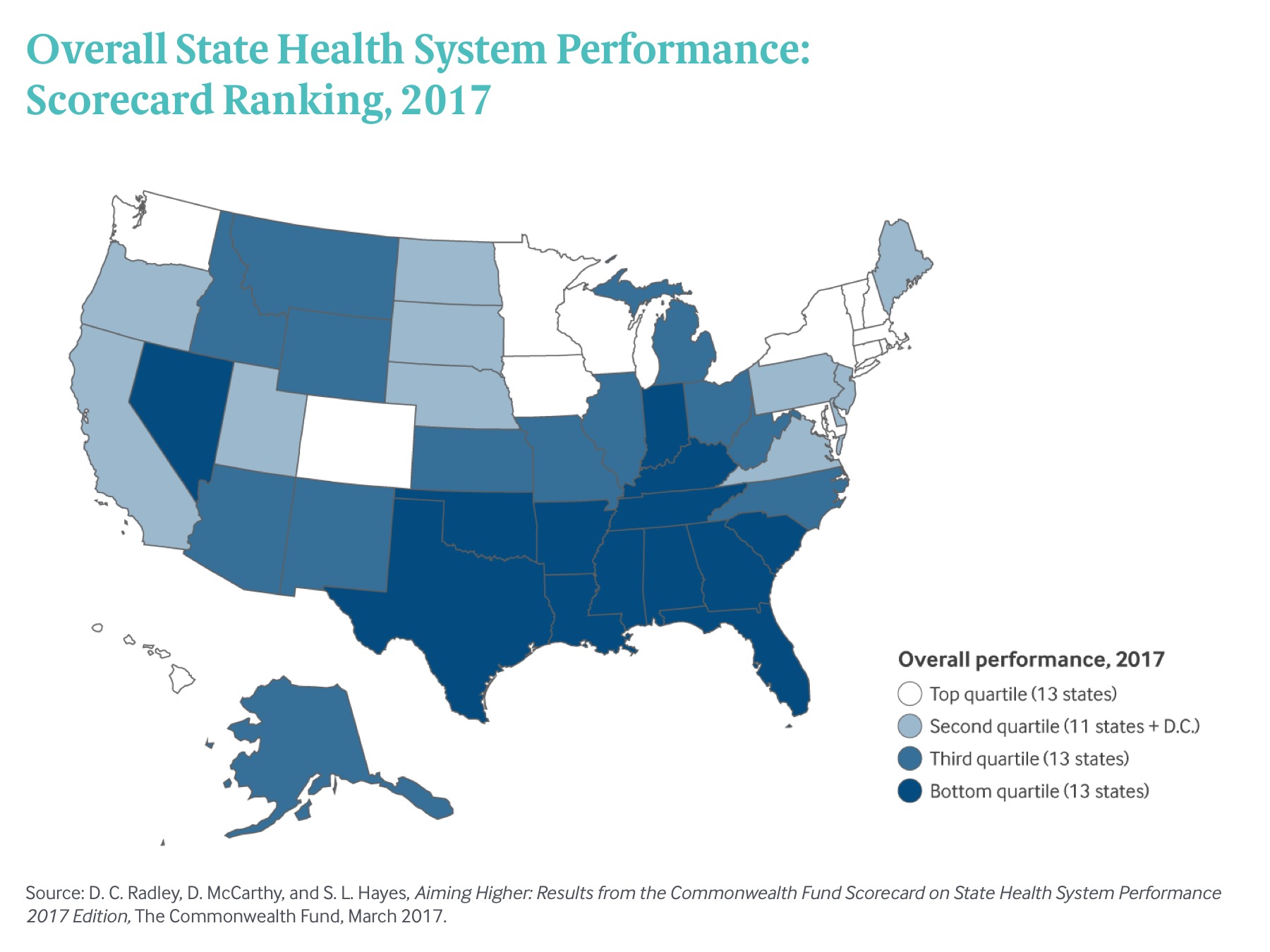
Vermont was the top-ranked state overall in this year’s Scorecard, followed by Minnesota, Hawaii, Rhode Island, and Massachusetts (Exhibit 1). California, Colorado, Kentucky, New York, and Washington made the biggest jumps in ranking, with New York moving into the top-performing group for the first time. Kentucky also stood out for having improved on more measures than any other state.

Exhibit 1Exhibit 1: Overall State Health System Performance: Scorecard Ranking, 2017

Using the most recent data available, the Scorecard ranks states on more than 40 measures of health system performance in five broad areas: health care access, quality, avoidable hospital use and costs, health outcomes, and health care equity. In reviewing the data, four key themes emerged:

  • There was more improvement than decline in states’ health system performance.
  • States that expanded Medicaid saw greater gains in access to care.
  • Premature death rates crept up in almost two-thirds of states.
  • Across all measures, there was a threefold variation in performance, on average, between top- and bottom-performing states, signifying opportunities for improvement.

By 2015, fewer people in every state lacked health insurance. Across the country, more patients benefited from better quality of care in doctors’ offices and hospitals, and Medicare beneficiaries were less frequently readmitted to the hospital. The most pervasive improvements in health system performance occurred where policymakers and health system leaders created programs, incentives, or collaborations to ensure access to care and improve the quality and efficiency of care. For example, the decline in hospital readmissions accelerated after the federal government began levying financial penalties on hospitals that had high rates of readmissions and created hospital improvement innovation networks to help spread best practices. (notes)

Still, wide performance variation across states, as well as persistent disparities by race and economic status within states, are clear signals that our nation is a long way from offering everyone an equal opportunity for a long, healthy, and productive life. Looking forward, it is likely that states will be challenged to provide leadership on health policy as the federal government considers a new relationship with states in public financing of health care. To improve the health of their residents, states must find creative ways of addressing the causes of rising mortality rates while also working to strengthen primary and preventive care.


Health Care and the 2018 Midterms, Attitudes Towards Proposed Changes to Medicaid

Kaiser Health Tracking Poll – February 2018: Health Care and the 2018 Midterms, Attitudes Towards Proposed Changes to Medicaid


KEY FINDINGS:
  • Medicaid continues to be seen favorably by a majority of the public (74 percent) and about half (52 percent) believe the Medicaid program is working well for most low-income people covered by the program.
  • When asked about proposed changes to the Medicaid program, attitudes are largely driven by party identification. A large majority of Democrats (84 percent) and most independents (64 percent) oppose lifetime limits for Medicaid benefits, while Republicans are more divided in their views with half (51 percent) believing Medicaid should only be available for a limited amount of time.

    Poll: Public split on whether adding work requirements for Medicaid beneficiaries aims at reducing spending (41%) or lifting people out of poverty (33%) 

  • Party identification also drives views on what individuals believe is the main reason behind some states imposing Medicaid work requirements. A larger share of Democrats and independents believe the main reason for these work requirements is to reduce government spending (42 percent and 45 percent, respectively) than believe it is to help lift people out of poverty (26 percent and 31 percent). On the other hand, a similar share of Republicans say it is to reduce government spending (40 percent) as say it is to help lift people out of poverty (42 percent). Individuals living in states pursuing Medicaid work requirements are also divided on the main reason for these limits, even when controlling for party identification.

    54% of the public now holds favorable views of the Affordable Care Act – the highest share in more than 80 tracking polls 

  • The February Kaiser Health Tracking Poll finds a slight increase in the share of the public who say they have a favorable view of the Affordable Care Act (ACA), from 50 percent in January 2018 to 54 percent this month. This is the highest level of favorability of the ACA measured in more than 80 Kaiser Health Tracking Polls since 2010. This change is largely driven by independents, with more than half (55 percent) now saying they have a favorable opinion of the law compared to 48 percent last month. Large majorities (83 percent) of Democrats continue to view the law favorably (including six in ten who now say they hold a “very favorable” view, up from 48 percent last month) while nearly eight in ten Republicans (78 percent) view the law unfavorably (unchanged from last month).
  • The majority of the public are either unaware that the ACA’s individual mandate has been repealed (40 percent) or are aware that it has been repealed but incorrectly think the requirement is not in effect in 2018 (21 percent). Few (13 percent) are aware the requirement has been repealed but is still in effect for 2018.
  • More than twice as many voters mention health care costs (22 percent) as mention repealing/opposing the ACA (7 percent) as the top health care issue they most want to hear 2018 candidates discuss in their campaigns. Health care costs are the top issue mentioned by Democratic voters (16 percent) and independent voters (25 percent), as well as one of the top issues mentioned by Republican voters (22 percent), followed by repealing or opposing the ACA (17 percent).

2018 Midterm Elections

With still a few months until the midterm elections are in full swing, the latest Kaiser Health Tracking Poll finds health care costs as the top health care issue mentioned by voters when asked what they want to hear 2018 candidates discuss. When asked to say in their own words what health care issue they most want to hear the candidates talk about during their upcoming campaigns, one-fifth (22 percent) of registered voters mention health care costs. This is followed by a series of other health care issues, such as Medicare/senior concerns (8 percent), repealing or opposition to the Affordable Care Act (7 percent), improve how health care is delivered (7 percent), increasing access/decreasing the number of uninsured (6 percent), or a single-payer system (5 percent). Health care costs is the top issue mentioned by Democratic voters (16 percent) and independent voters (25 percent), as well as one of the top issues mentioned by Republican voters (22 percent), followed by repealing or opposing the ACA (17 percent).

Figure 1: Health Care Costs Are Top Health Care Issue Voters Want 2018 Candidates to Talk About During Their Campaigns

Battleground Voters

Health care costs are also the top issue mentioned by voters living where there are competitive House, Senate, or Governor races. One-fourth (23 percent) of voters in areas with competitive elections mention health care costs when asked what health care issue they most want to hear candidates talk about. Fewer mention other health care issues such as improve how health care is delivered (9 percent) or increasing access/decreasing the number of uninsured (6 percent).

2018 Midterm Election Analysis

As part of Kaiser Family Foundation’s effort to examine the role of health care in the 2018 midterm elections, throughout the year we will be tracking the views of voters – paying special attention to those living in states or congressional districts in which both parties have a viable path to win the election. This group, referred to in our analysis as “voters in battlegrounds” is defined by the 2018 Senate, House, and Governor ratings provided by The Cook Political Report. Congressional and Governor races categorized as “toss-up” were included in this group. A complete list of the states and congressional districts included in the comparison group is available in Appendix A.

The Affordable Care Act

This month’s Kaiser Health Tracking Poll finds a slight increase in the share of the public who say they have a favorable view of the 2010 Affordable Care Act (ACA). The share of the public who say they hold a favorable view of the law has increased to 54 percent (from 50 percent in January 2018) while 42 percent currently say they hold an unfavorable view. This is the highest level of favorability of the ACA measured in more than 80 Kaiser Health Tracking Polls since 2010.  This change is largely driven by independents, with more than half (55 percent) now saying they have a favorable opinion of the law compared to 48 percent last month. Large majorities (83 percent) of Democrats continue to view the law favorably (including six in ten who now say they hold a “very favorable” view, up from 48 percent last month) while nearly eight in ten Republicans (78 percent) view the law unfavorably (unchanged from last month).

Figure 2: More of the Public Hold a Favorable View of the ACA

Public Awareness of the Repeal of the ACA’s Individual Mandate

The February Kaiser Health Tracking Poll finds a slight uptick (from 36 percent in January 2018 to 41 percent this month) in the share of the public who are aware that the ACA’s requirement that nearly all individuals have health insurance or else pay a fine, known commonly as the individual mandate, has been repealed. Yet, misunderstandings persist. The majority of the public (61 percent) are either unaware that this requirement has been repealed (40 percent) or are aware that it has been repealed but incorrectly think the requirement is not in effect in 2018 (21 percent of total). Few (13 percent) are aware the requirement has been repealed but is still in effect for 2018.

Figure 3: Confusion Remains on the Status of the ACA’s Individual Mandate

Medicaid

In recent months, President Trump’s administration has supported state efforts to make changes to their Medicaid programs, the government health insurance and long-term care program for low-income adults and children. Seven in ten Americans say they have ever had a connection to the Medicaid program either directly through their own health insurance coverage (32 percent) or their child being covered by the program (9 percent), or indirectly through a friend or family member covered by the program (29 percent).

Figure 4: Seven in Ten Americans Say They Have Ever Had A Connection to Medicaid

Majority of the Public Holds Favorable Views of Medicaid and Thinks the Program is Working Well

Overall, the majority of the public (74 percent) holds favorable views of Medicaid, including four in ten who have a “very favorable” view. About one-fifth of the public (21 percent) hold unfavorable views of the program. Unlike attitudes towards the ACA, opinions towards Medicaid are not drastically different among partisans and majorities across parties report favorable views. However, a larger share of Republicans do hold unfavorable views (29 percent) compared to independents (21 percent) or Democrats (13 percent).

Figure 5: Large Shares Across Parties Say They Have a Favorable Opinion of Medicaid

In addition, more believe the program is working well than not working well for most low-income people covered by the program. This holds true across partisans with about half saying the Medicaid program is “working well” and about one-third saying it is “not working well.”

Figure 6: Larger Shares Say Medicaid Is Currently Working Well for Most Low-Income People Covered by the Program

Support for Medicaid Expansion in Non-Expansion States

One of the major changes brought on by the ACA was the option for states to expand Medicaid to cover more low-income people. As of February 2018, 18 states have not expanded their Medicaid programs.

Figure 7: Status of Medicaid Expansion Among States

Among individuals living in states that have not expanded their Medicaid programs, most (56 percent) say they think their state should expand Medicaid to cover more low-income uninsured people while four in ten (37 percent) say their state should keep Medicaid as it is today. Slightly more than half of Republicans living in non-expansion states say their state should keep Medicaid as it is today (54 percent) while four in ten (39 percent) say their state should expand their Medicaid program. Majorities of Democrats (75 percent) and independents (57 percent) say their state should expand their Medicaid program.

Figure 8: Democrats and Independents Are More Likely to Want Their State to Expand Medicaid Than Republicans

Proposed Changes to Medicaid

SECTION 1115 WORK REQUIREMENT WAIVERS

In January, the Centers for Medicare and Medicaid Services (CMS) provided new guidance for Section 1115 waivers, which would allow states to impose work requirements for individuals to be covered by Medicaid benefits. As of February 21, CMS has approved work requirement waivers in two states (KY and IN) and eight other states have pending requests.1 When asked what they think the reasoning is behind these proposed changes to Medicaid, a larger share of the public (41 percent) believe the main reason is to reduce government spending by limiting the number of people on the program than say the main reason is to help lift people out of poverty (33 percent). There are differences among demographic groups with a larger share of Democrats and independents believing the main reason is to reduce government spending, while Republicans are more divided with similar shares saying the main reason is to lift people out of poverty (42 percent) as reduce government spending (40 percent).

Figure 9: Republicans Are Divided on the Main Reason Behind the Trump Administration Permitting Work Requirements

There are also differences between individuals living in states that have either filed a Medicaid waiver for a work requirement or have had a waiver approved and those living in states that do not have Medicaid work requirement waivers pending or approved.2 Individuals living in states with pending or approved Medicaid work requirements are divided on whether the main reason for these limits is to lift people out of poverty (37 percent) or reduce government spending (36 percent). This holds true even when controlling for other demographic variables such as party identification and income that may influence beliefs.

Figure 10: Those in States with Medicaid Work Requirements Are Divided on the Main Reason Behind Them

SECTION 1115 LIFETIME LIMIT WAIVERS

In addition to work requirement waivers, five states are currently seeking waivers from the Trump administration to impose Medicaid coverage limits. These “lifetime limits” would cap Medicaid health care benefits for non-disabled adults. When asked how they think Medicaid should work, two-thirds of the public say Medicaid should be available to low-income people for as long as they qualify, without a time limit, while one-third say it should only be available to low-income people for a limited amount of time in order to provide temporary help. The vast majority of Democrats (84 percent) and most independents (64 percent) say Medicaid should be available without lifetime limits, while Republicans are divided with similar shares saying they favor time limits (51 percent) as saying they do not favor such limits (47 percent). Seven in ten (71 percent) of individuals who have ever had a connection to Medicaid say they do not support lifetime limits compared to three in ten (28 percent) who say it should only be available for a limited amount of time in order to provide temporary help.

Figure 11: Majorities of Democrats and Independents Say Medicaid Should Be Available Without a Time Limit; Republicans Are Divided


The ACA at Eight: Resilient but Still at Risk

http://www.commonwealthfund.org/publications/blog/2018/mar/aca-at-eight?omnicid=EALERT1374267&mid=henrykotula@yahoo.com

Image result for The ACA at Eight: Resilient but Still at Risk


It’s Obamacare’s birthday. After eight years of relentless pounding, the Affordable Care Act (ACA) is still the law of the land. Its resilience reflects the fundamental decency of the American people who — when faced with the reality of taking coverage away from millions of their neighbors — refused to let that happen. They filled town hall meetings, they flooded the corridors of Congress, and support for the law surged to its current 54 percent.

That is not to say that the law’s future is assured. As part of its recent tax reform legislation, Congress eliminated financial penalties for not having health insurance — the teeth of the so-called individual mandate. The Congressional Budget Office (CBO) predicts that this will raise health insurance premiums in individual private markets by an average of 10 percent, and 13 million Americans could lose their health insurance. If Congress fails to enact recent bipartisan market stabilization proposals, these numbers could go even higher.

The current administration is also using executive authority to weaken the law. The U.S. Department of Health and Human Services has encouraged states to impose a range of new restrictions on Medicaid recipients — work requirements, premiums, copays — that may reduce the number of poor and near-poor Americans who enroll in this program.

The administration has also proposed new rules that would allow health insurers to sell plans that evade the ACA’s standards regarding preexisting conditions and minimum benefits. For example, the administration would permit insurers to market short-term plans — coverage limited to a year in duration — without the requirement that they accept all comers, and with various restrictions on benefits. These cheaper, less generous plans would appeal to healthier individuals, who would then likely choose not to purchase the more expensive, comprehensive insurance sold in ACA marketplaces. Only sicker individuals would buy ACA plans, raising their costs and making them unaffordable to millions who have come to depend on them. The net effect is to add choices for healthy Americans, but reduce options for the sick.

Efforts to curtail the ACA will likely increase the number of Americans without insurance, now at a historic low of 14 percent of working-age adults, according to the Commonwealth Fund’s Affordable Care Act Tracking Survey. These efforts will also likely increase health disparities between states. A number of the restrictions sought by the administration will go into effect only if states embrace them. States must request waivers to limit Medicaid benefits. So far, only Republican-led states are doing so. Similarly, states have discretion about whether to permit the sale of short-term plans. Many blue states are considering banning or regulating them.

Despite these threats, however, fundamental elements of the ACA remain in effect. Federal financial assistance for purchase of health insurance in ACA marketplaces remains available for individuals with incomes below 400 percent of the federal poverty level. This is one reason why 11.8 million people had signed up for ACA plans through the marketplaces by the end of January. Federal support for states to expand Medicaid persists. Thirty-four states and the District of Columbia have done so, resulting in 15 million more beneficiaries of that program.

Recent legislative and executive restrictions on the ACA will not totally reverse these gains. Paradoxically, some states that refused previously to expand Medicaid may decide to do so now that they may be able to impose work requirements, premiums, and copays, and thus give expansion a conservative stamp. This could actually increase the total number of Americans with some Medicaid coverage.

In fact, the continuing struggle over the ACA fits a decades-old pattern of steady, if erratic, expansion of health insurance coverage in the United States. Since the creation of Medicare and Medicaid 53 years ago, the federal government has periodically extended insurance to new populations: the disabled, those with end-stage renal disease, children. The federal government also massively expanded Medicare benefits to cover drugs. Once provided, these benefits have proved politically difficult to peel back — in a recent poll, 92 percent of Americans said they felt all of us should have the right to health care.

What does this mean for the ACA? While it will not achieve all its supporters’ goals, it will survive, and provide a new foundation upon which Americans can build if they choose, as they have in the past, to help their vulnerable neighbors deal with the scourge of illness. To paraphrase Martin Luther King, one might even say that the arc of history is long, but it bends toward health coverage.


With Some Republican Support, Virginia Edges Closer To Medicaid Expansion

https://khn.org/news/with-some-republican-support-virginia-edges-closer-to-medicaid-expansion/

Image result for virginia medicaid expansion

Virginia is among 18 states that have not expanded Medicaid under the Affordable Care Act. But this year, the state legislature is closer to enacting expansion than it has been in the past, and the issue will be the sticking point as the legislature goes into a special session next month to hash out its budget.

Republican Del. Barry Knight from the Virginia Beach area calls it “the 800-pound gorilla in the room.” He’s one of more than a dozen Republicans who voted to include Medicaid expansion in the House budget — along with a work requirement — this year.

It’s a big shift in the House position on the issue and comes after 15 seats flipped to Democrats in the so-called blue wave of last November’s election, which also saw the election of Democratic Gov. Ralph Northam.

“On the big-picture issues, I think it was a reawakening and a call to look at things from a different perspective,” said Republican Del. Chris Peace, from the Richmond area, who also voted in favor of expansion.

A December poll showed that over 80 percent of likely Virginia voters support an expansion.

“I think the House heard that message, loud and clear. I think the Senate still needs to listen a little bit,” Northam said.

The state Senate still has a strong bulwark against expansion, led by Senate Majority Leader Tommy Norment, who represents the Tidewater area in southeastern Virginia. Norment has come out against the House Republicans who want to expand. He reminds them that, despite a slim margin, Republicans are still in charge and could stop Medicaid expansion.

“I do think that the House of Delegates is waiting for that moment of lucidity and epiphany to realize that their majority is 51 to 49,” Norment said.

But opposition to President Donald Trump has energized Democratic voters, said Bob Holsworth, a former political science professor at Virginia Commonwealth University. He said he thinks expansion has a greater chance this year.

It could pass in the Senate, he said, because of a potential wildcard: Republican Sen. Emmett Hanger, from mostly rural central Virginia. Hanger has expressed support for some form of Medicaid expansion, and has a track record of voting independently, said Holsworth.

“What Hanger has said that’s very interesting … is that if he decides to support some version of Medicaid expansion, he says, ‘There are a number of other Republicans who are going to go over with me,’” said Holsworth.

However, Hanger said he isn’t happy about a tax on hospitals that has been incorporated into the House’s budget to help pay for the state’s share of expansion costs. The tax accounts for about three-quarters of the over $400 million Medicaid-related gulf between House and Senate budgets.

If legislators don’t come up with a budget that includes Medicaid expansion, Northam has a Plan B. He said he’ll introduce an amendment to add it back into the budget. In the amendment process, the lieutenant governor, Democrat Justin Fairfax, gets a vote if the Senate ties. Fairfax said he’d be happy to vote to expand coverage to up to 400,000 low-income Virginians.

“There are so many people that we can help, and we have the means to do it if we expand Medicaid. We just have to have the political will to do it,” Fairfax said.

Medicaid expansion in Virginia would especially benefit low-income adults without children.

“An adult who does not have children can have zero income — can be totally impoverished — and they cannot get Medicaid,” said Jill Hanken with the Virginia Poverty Law Center.

And a family of three with a total income of about $10,000 doesn’t qualify for Medicaid, she said.

“It’s hard to explain to them that they don’t have a choice, they’re not eligible for Medicaid,” she said, and they’re not eligible for subsidies for insurance on the exchange, so health insurance is out of reach. “And the reason is because Virginia hasn’t expanded Medicaid,” she said.

The special session begins April 11. The state needs a budget agreement by June 30 to prevent a government shutdown.