Here’s What a Bipartisan Health Care Deal Might Look Like

https://www.thefiscaltimes.com/2017/07/08/Here-s-What-Bipartisan-Health-Care-Deal-Might-Look

Image result for bipartisanship

Practically overnight, Senate Majority Leader Mitch McConnell (R-KY) placed the once-unthinkable notion of a bipartisan deal with the Democrats to salvage the Affordable Care Act well within the realm of possibility.

For months, McConnell, House Speaker Paul Ryan (R-WI) and President Trump vowed to move with alacrity to repeal and replace Obamacare with a far superior GOP health insurance plan that would bring down premium costs , provide tax relief for wealthier Americans and the health care industry, and phase out expanded Medicaid coverage for millions of poor and disabled people.

But with the Senate’s 52 Republicans still badly divided over how best to proceed and time running out before a long August recess, McConnell said Thursday during a speech in Kentucky that if his party cannot muster at least 50 votes to rewrite the Obamacare law, it would have no choice but to work with the Democrats to produce a more modest bill to support the law’s existing insurance market.

“No action is not an alternative ,” McConnell said during a speech at a Rotary Club lunch in Glasgow, Kentucky. “We’ve got the insurance markets imploding all over the country, including in this state.”

The Republicans have long argued that Obamacare is in a “death spiral,” with premiums going through the roof and more and more major health care insurers pulling out of the market after incurring huge losses on the ACA exchanges. The Trump White House, the Department of Health and Human Services (HHS) and the Internal Revenue Service have also taken executive actions that have undercut enrollment and insurer participation.

But the veteran Senate majority leader has begun facing up to the harsh political reality that as many as a dozen conservative and moderate Republicans currently oppose a bill that McConnell almost single-handedly drafted behind closed door. Now it will take a herculean effort to muster a minimum of 50 votes needed to pass the bill under expedited budget reconciliation rules that were designed to avert a filibuster.

Douglas Holtz-Eakin, a former Congressional Budget Office director and Republican economic adviser, said on Friday that McConnell “has done the [political] arithmetic right” and that there may be no choice but to cut a deal with Senate Minority Leader Chuck Schumer (D-NY).

“We know that the exchanges are melting down under current law,” Holtz-Eakin, president of the American Action Forum, said in an interview. “We know that the cost-sharing money [to subsidize insurers] has to come from somewhere or they will continue to melt down, and insurers will leave, and premiums will continue to skyrocket.”

However, he warned that such an agreement would have serious political ramifications for the GOP and could touch off a conservative backlash, especially in the House. “It’s going to be a really bad deal for Republicans, and House Republicans are going to have to eat it.”

Michael F. Cannon, director of health policy at the libertarian Cato Institute, said McConnell might have raised the idea of working with Democrats to force recalcitrant Republicans into line. However, he said it was high risk for a party that for the past seven years has promised to repeal and replace Obamacare.

“If he does pursue a bill with Democrats to bail out the exchanges, then it will cause a rift in his own party much bigger than the rift he sees right now,” Cannon cautioned.

Schumer on Thursday called McConnell’s comments encouraging, and that his caucus is “eager to work with Republicans to stabilize the markets and improve the law.” The minority leaders have said for weeks that the Democrats were ready to bargain with the GOP and the White House on virtually any issue provided the Republicans abandoned their effort to repeal former President Barack Obama’s signature program.

According to several policy experts, here are five areas where a bipartisan health care compromise might be struck:

  1. Cost sharing — One of the pillars of the Obamacare markets is the $7 billion a year in federal cost-sharing subsidies to insurance companies that allow them to help offset the cost of the monthly premiums and copayments of low and moderate income Americans who make between $12,000 and $48,000 a year. House Republicans challenged the constitutionality of those subsidies in court, and Congress and the Trump administration have agreed to continue the payments pending a final outcome of the case.
    But without more certainty of the future of those subsidies, many major insurance companies have begun pulling out of markets throughout the country. If both parties are concerned about stabilizing the Obamacare insurance markets and making sure they don’t go under, making the cost-sharing subsidies permanent would be a good place to start.
  2. Reviving Risk Corridors –Before the Republicans succeeded in turning off the spigot, an Obamacare reinsurance program or so-called “risk corridors” funneled billions of dollars to insurers to offset the unforeseen costs of their most expensive enrollee.
    Republicans led by Sen. Marco Rubio (R-FL) led an effort to kill off the program, arguing that it constituted an unjustifiable “bailout” of the insurance industry. But Republican and Democratic negotiators would likely have to reconsider reviving the program – and tax revenue to pay for it – to further stabilize the insurance market.
  3. Tax Repeal – The Senate GOP plan includes a tax cut of $700 billion over the coming decade, which would be achieved by repealing all the tax hikes in Obamacare passed to help finance the health insurance program. The cost of that massive tax relief for mainly wealthy Americans and the pharmaceutical, health care and insurance industries, would be offset by deep cuts in Medicaid for millions of poor and disabled Americans.
    Democrats are adamant about blocking wholesale cuts in Medicaid. However, they might be open to some horse trading to repeal some of the Obamacare taxes while preserving others, in order to prevent massive cuts in Medicaid.
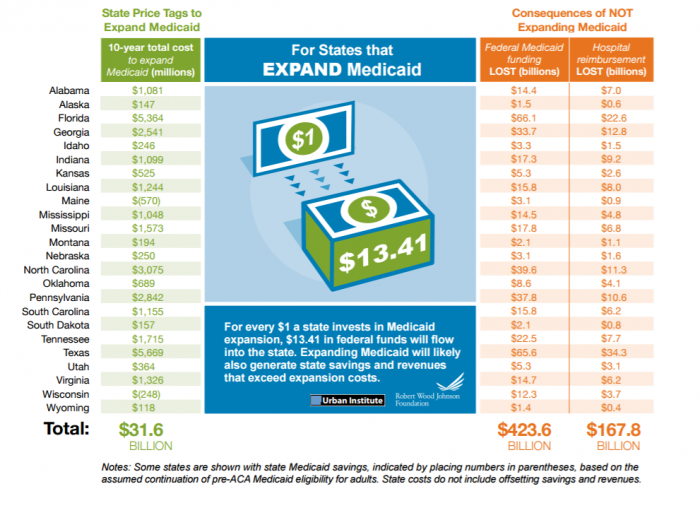
  4. Medicaid Spending– The Senate GOP bill would allow 31 states that expanded Medicaid to millions of childless, able-bodied, low-income adults to continue receiving bonus federal funding through 2013, before beginning to reduce it between 2021 and 2024.
    Democrats would be insistent on preserving expanded Medicaid even longer and would have considerable leverage in order to achieve that goal. Moreover, there is virtually no interest on their part in transforming Medicaid from an open-ended entitlement to a per-capita-cap block grant to the states. But amid growing concern about the long-term impact of growing entitlements on the debt, Democratic negotiators might be open to reforms to slow the rate of growth of Medicaid.
  5. Lowering premiums – There is little disagreement between the two parties on the need to bring down premiums and copayments that have literally priced many families out of the market, even with tax subsidies. Yet finding a compromise that satisfies the Democrats demands to preserve Obamacare levels of benefits – including a ban on insurers discriminating against people with preexisting medical conditions — and GOP insistence on allowing skimpier, less expensive policies for younger and healthier people – will be hard to do.
    “All of this adds up to huge new spending, but the Democrats would be in charge, and McConnell knows it,” Joe Antos, a health care expert with the conservative-leaning American Enterprise Institute, said. “They won’t get everything, but I don’t expect any compromise to look like a Republican bill. Nonetheless, if the Democrats aren’t too greedy, such a bill could pass in the Senate, but would be rejected in the House.”

AHCA could mean 725K fewer healthcare jobs by 2026

http://www.healthcaredive.com/news/ahca-could-mean-725k-fewer-healthcare-jobs-by-2026/445131/

Image result for fewer jobs

Dive Brief:

  • The American Health Care Act (AHCA), as it was passed in the House, would result in the loss of 924,000 jobs over 10 years and spark economic downturns in every state, according to research by the George Washington University Milken Institute School of Public Health and The Commonwealth Fund.
  • The healthcare sector would be hit the hardest, with 725,000 jobs lost by 2026. There would be fewer healthcare jobs immediately in 17 states. The states that would be most affected overall include New York, Pennsylvania and Florida.
  • The primary cause of the job disappearances and state economic downturns would be cuts to healthcare funding, such as more than $800 billion to Medicaid, and lower premium subsidies.

Dive Insight:

The analysis is of the House version of the bill, and the Senate is expected to make changes when it brings its own version up for a vote. But with those negotiations going on behind closed doors, there is not enough information to makes estimates based on the Senate bill.

The report is a warning call to the healthcare industry and another black mark on the increasingly unpopular AHCA. The bill is already opposed by most major industry groups. They balk at the huge cuts to Medicaid and the Congressional Budget Office estimates up to 23 million people would lose coverage.

The threat of jobs losses could become another rallying cry. In fact, healthcare executives shaken by the potential for repeal of the Affordable Care Act (ACA) are already scaling back hiring and new projects in the face of uncertainty. Former CMS Administrator Andy Slavitt said a poll he conducted found nearly 40% of executives said they are slowing hiring and 31% are cutting capital expenses.

Healthcare job growth spiked after the passage of the ACA, which the AHCA seeks to replace. The ACA helped create about 240,000 jobs in the industry, and employment increased from an average of 1.7% in 2010 to 2.5% from 2014 to 2016. But that trend has tempered. Healthcare has averaged 22,000 job gains a month so far this year. The average monthly gain in 2016 was 32,000.

The AHCA phases out Medicaid expansion, which has been an economic boon for states that decided to expand. The authors of the latest report said those states would be hit hardest in financial terms by the bill.

“Hospitals, health systems, clinics and pharmacies might be forced to close or lay off staff as federal funding for healthcare is cut and the number of uninsured patients grows,” the researchers wrote.

Healthcare Triage News: The Senate’s BCRA Bill – High Premiums, Huge Deductibles, AND Massive Medicaid Cuts

Healthcare Triage News: The Senate’s BCRA Bill – High Premiums, Huge Deductibles, AND Massive Medicaid Cuts

Image result for Healthcare Triage News: The Senate’s BCRA Bill – High Premiums, Huge Deductibles, AND Massive Medicaid Cuts


Medicaid Worsens Your Health? That’s a Classic Misinterpretation of Research

Medicaid Worsens Your Health? That’s a Classic Misinterpretation of Research

As a program for low-income Americans, Medicaid requires the poor to pay almost nothing for their health care. Republicans in Congress have made clear that they want to change that equation for many, whether through the health bill that is struggling in the Senate or through future legislation.

The current proposal, to scale back the Affordable Care Act’s Medicaid expansion and to cap spending each year, would give incentives to states to drop Medicaid coverage for millions of low-income Americans. It would offer tax credits toward premiums for private coverage, but those policies would come with thousands of dollars in new deductibles and other cost sharing. Despite the much higher out-of-pocket costs, some policy analysts and policy makers argue that low-income Americans would be better off.

To take one highly placed example, Seema Verma, the leader of the agency that administers Medicaid, recently cited studies questioning the program’s effectiveness and wrote that the health bill “will help Medicaid produce better results for recipients.”

What is the basis for the argument that poor Americans will be healthier if they are required to pay substantially more for health care? It appears that proponents like Ms. Verma have looked at research and concluded that having Medicaid is often no better than being uninsured — and thus that any private insurance, even with enormous deductibles, must be better. But our examination of research in this field suggests this kind of thinking is based on a classic misunderstanding: confusing correlation for causation.

It’s relatively easy to conduct and publish research that shows that Medicaid enrollees have worse health care outcomes than those with private coverage or even with no coverage. One such study that received considerable attention was conducted at the University of Virginia Health System.

For patients with different kinds of insurance — Medicaid, Medicare, private insurance and none — researchers examined the outcomes from almost 900,000 major operations, like coronary artery bypass grafts or organ removal. They found that Medicaid patients were more likely than any other type of patient to die in the hospital. They were also more likely to have certain kinds of complications and infections. Medicaid patients stayed in the hospital longer and cost more than any other type of patient. Private insurance outperformed Medicaid by almost every measure.

Other studies have also found that Medicaid patients have worse health outcomes than those with private coverage or even those with no insurance. If we take them to mean that Medicaid causes worse health, we would be justified in canceling the program. Why spend more to get less?

But that is not a proper interpretation of such studies. There are many other, more plausible explanations for the findings. Medicaid enrollees are of lower socioeconomic status — even lower than the uninsured as a group — and so may have fewer community and family resources that promote good health. They also tend to be sicker than other patients. In fact, some health care providers help the sickest and the neediest to enroll in Medicaid when they have no other option for coverage. Because people can sign up for Medicaid retroactively, becoming ill often leads to Medicaid enrollment, not the opposite.

Some of these differences can be measured and are controlled for in statistical analyses, including the Virginia study. But many other unmeasured differences can skew results, even in studies with such statistical controls. The authors of the U.V.A. surgical study and of studies like it know this, and say as much right in their papers. They practically shout that the correlations they find are not evidence of causation.

That hasn’t stopped policy makers and others in the media from asserting otherwise.

Other approaches to studying Medicaid more credibly demonstrate the value of the program. The most straightforward way is a prospective randomized trial, which gets around the subtle biases that plague studies that use only statistical controls. There has been exactly one randomized study of Medicaid, focused on an expansion of the program in Oregon.

Because demand for the program exceeded what Oregon could fund, in 2008 the state introduced a lottery for Medicaid eligibility. A now famous analysis took advantage of this lottery’s randomness, finding that Medicaid increased rates of diabetes detection and management, reduced rates of depression and lowered financial strain. It did not detect improvements in mortality or measures of physical health, but it did not have enough sick patients or enough time to detect differences we might have expected to see. In other words, it was not powered to detect changes in mortality or physical health.

Saying that this study proves Medicaid doesn’t work ignores this limitation. Regardless, there was nothing to indicate that having Medicaid worsened health.
Another way to tease out the causal effect of Medicaid is to look at variations in Medicaid eligibility rules across states. With respect to health outcomes, these state decisions are effectively random, so they act like a natural experiment. Older studies based on this approach, using data from the 1980s and 1990s, have not found that Medicaid causes worse health.

Findings from more recent studies looking at expansions in enrollment, in the 2000s and then under the Affordable Care Act in 2014, are consistent with older ones. One can argue that Medicaid can be improved upon, but the credible evidence to date is that Medicaid improves health. It is better than being uninsured.
Here’s another telling way to test the idea that Medicaid is harmful. Some of the studies that associate Medicaid with worse health, as compared with private insurance, also find the same association with Medicare. No one argues that Medicare is making people sick.

A very recent New England Journal of Medicine review by Ben Sommers, Atul Gawande and Kate Baicker found that Medicaid increases patients’ access to care and leads to earlier detection of disease, better medication adherence and improved management of chronic conditions. It also provides people with peace of mind — knowing that they will be able to afford care when they get sick.

Research is clear on how people react when asked to pay more for their health care, as the Senate would ask many of those now on Medicaid to do. As the Congressional Budget Office reported, many poor people would choose not to be covered, because even if they could afford the premiums with help from tax credits, deductibles and co-payments would still be prohibitively expensive. No studies prove that removing millions from Medicaid in this way would “produce better results for recipients,” at least as far as their health is concerned.


What happens when the federal government eliminates health coverage? Lessons from the past

http://theconversation.com/what-happens-when-the-federal-government-eliminates-health-coverage-lessons-from-the-past-79989?utm_medium=email&utm_campaign=Latest%20from%20The%20Conversation%20for%20July%201%202017%20-%2077496134&utm_content=Latest%20from%20The%20Conversation%20for%20July%201%202017%20-%2077496134+CID_7e419ab4ae6962d1afd6f9273e9cc417&utm_source=campaign_monitor_us&utm_term=What%20happens%20when%20the%20federal%20government%20eliminates%20health%20coverage%20Lessons%20from%20the%20past

Image result for aca

After much secrecy and no public deliberation, Senate Republicans finalized release their “draft” repeal and replace bill for the Affordable Care Act on June 22. Unquestionably, the released “draft” will not be the final version.

Amendments and a potential, albeit not necessary, conference committee are likely to make some adjustments. However, both the House version – American Health Care Act (AHCA) – and the Senate’s Better Care Reconciliation Act (BCRA) will significantly reduce coverage for millions of Americans and reshape insurance for virtually everyone. The Congressional Budget Office (CBO) is expected to provide final numbers early the week of June 26.

If successful, the repeal and replacement of the Affordable Care Act would be in rare company. Even though the U.S. has been slower than any other Western country to develop a safety net, the U.S. has rarely taken back benefits once they have been bestowed on its citizenry. Indeed, only a small number of significant cases come to mind.

My academic work has analyzed the evolution of the American health care system including those rare instances. I believe historical precedents can provide insights for the current debate.

Providing help to mothers and infants

The first major federal grant program for health purposes was also the first one to quickly be eliminated. The program was authorized under the Sheppard-Towner Maternity and Infancy Protection Act of 1921. It provided the equivalent of US$20 million a year in today’s dollars to states in order to pay for the needs of women and young children.

Sheppard-Towner, which provided funding to improve health care services for mothers and infants, was enacted after a long debate in Congress amid accusations of socialism and promiscuity. Interestingly enough, the act may have passed only due to pressure from newly voting-eligible women.

Jeanette Rankin, the original sponsor of the Shepard-Towner Act and the first woman elected to Congress, pictured in 1970. John Duricka/AP

Overall, the program was responsible for more than 3 million home visits, close to 200,000 child health conferences and more than 22 million pieces of health education literature distributed. It also helped to establish 3,000 permanent health clinics serving 700,000 expectant mothers and more than 4 million babies.

The program continued until 1929, when Congress, under pressure from the American Medical Association, the Catholic Church and the Daughters of the American Revolution, terminated the program. Without federal support, a majority of states either eliminated the programs or only provided nominal funding. Fortunately for America’s children and mothers, the Social Security Amendment of 1935 reestablished much of the original funding and expanded it over time.

Helping America’s farmers during the New Deal

America’s next major program confronted a similar fate. To address the challenges of rural America during the Great Depression, the federal government developed a variety of insurance and health care programs that offered extensive and comprehensive services to millions of farm workers, migrants and farmers.

Grandmother and sick baby of a migratory family in Arizona. These types of families were targeted for help by the Farm Security Administration. NARA/ Dorothea Lange

Some of these programs provided subsidies to farmers to form more than 1,200 insurance cooperatives nationwide. At times, the federal government’s Farm Security Administaton (FSA) provided extensive services directly to migrant farm workers through medical assistance on agricultural trains, mobile and roving clinics, migratory labor camps that included health centers staffed with qualified providers, full-service hospitals and Agricultural Workers Health Associations (AWHA).

In all cases, services were generally comprehensive and included ordinary medical care, emergency surgery and hospitalization, maternal and infant care, prescription drugs and dental care.

Although these services were accepted during wartime, the American Medical Association and the Farm Bureau opposed them, which ultimately led to their demise shortly after World War II. Millions of farmers lost their insurance.

Medicaid in the 1980s

Perhaps the most indicative expectations on what will happen in case congressional Republicans are able to pass their proposal hails from the Medicaid program itself.

In the early 1980s, Medicaid underwent a series of cuts and reductions leading to the first contracting in the program’s history. These involved both a reduction in federal funding and in eligibility, and an increase in state flexibility to run the program, as do the Republican proposals in Congress.

The cuts pale in comparison to those currently proposed by both the Senate and House. Nonetheless, the results was the first slowing of the Medicaid growth rate. However, this came at a steep cost for many Americans in the form of a significant reduction in enrollment, benefits and access even during a recessionary period.

Protecting America’s seniors

The 1980s also saw the creation and quick demise of another health care program. The Medicare Catastrophic Coverage Act of 1988 sought to fill in the gaps of the original Medicare program for America’s seniors. Specifically, it sought to provide them with protection from major medical costs and offer them a prescription drug benefit for the first time.

Similarly to the Affordable Care Act, the law had a redistributive foundation by requiring richer seniors to contribute more than poorer individuals. Also, similarly to the Affordable Care Act, it phased in benefits over a period of time.

Congress, confronted by affluent seniors who would have shouldered much of the financial burden of the program, quickly repealed much of the law before its provisions came into effect.

A Republican President, George W. Bush, was responsible for extending prescription drug benefits to seniors under Medicare Part D.Jason Reed/Reuters

It took more than a decade to provide America’s seniors with a prescription drug benefit through Medicare Part D, while only limited steps have been taken to protect seniors from major medical losses.

A serious setback looming?

While a latecomer, the United States has inched closer to the development of a comprehensive welfare state when it comes to health care. While the development has been incomplete, health benefits, once granted, have rarely been revoked except in those few cases described above.

The consequences of those rare cases are nonetheless instructive. States were unable to continue the program without federal support or offer a valid replacement. Indeed, the programs quickly faded away. With them, millions of Americans lost access to health care.

In all three previous cases, the federal government eventually renewed its financial support. However, at times it took time for a replacement program to emerge.

The current changes proposed by congressional Republicans, particularly to the Medicaid program, are tremendously more consequential than anything we have previously experienced.

Indeed, in scale and extent, the proposed changes are unprecedented and would significantly roll back, likely for the foreseeable future, America’s safety net.

Health Care Battle On Hill Has Veterans Defending Obamacare Benefits

http://khn.org/news/health-care-battle-on-hill-has-veterans-defending-obamacare-benefits/?utm_campaign=KFF-2017-The-Latest&utm_source=hs_email&utm_medium=email&utm_content=53790455&_hsenc=p2ANqtz–GlQENGi41hCiSoWvTZD1IqqTHGd493FYJnb349VBJ9TlHb_siA3-0CEAs13CgfyFyEbPoQ0NIua24-VTs-AcxGydnlQ

Air Force veteran Billy Ramos, from Simi Valley, Calif., is 53 and gets health insurance for himself and for his family from Medicaid — the government insurance program for low-income people. He says he counts on the coverage, especially because of his physically demanding work as a self-employed contractor in the heating and air conditioning business.

“If I were to get hurt on the job or something, I’d have to run to the doctor’s , and if I don’t have any coverage they’re going to charge me an arm and a leg,” he said. “I’d have to work five times as hard just to make the payment on one bill.”

There are about 22 million veterans in the U.S. But fewer than half get their health care through the Veterans Affairs system; some don’t qualify for various reasons or may live too far from a VA facility to easily get primary health care there. 

Many vets instead rely on Medicaid for their health insurance. Thirty-one states and the District of Columbia chose to expand Medicaid to cover more people — and many of those who gained coverage are veterans.

The GOP health care bill working its way through the Senate would dramatically reduce federal funding for Medicaid, including rolling back the expansion funding entirely between 2021 and 2024.

Air Force veteran Billy Ramos, now 53, in a 1982 photo from his basic training days as an airman in Texas, at Lackland Air Force Base. Now self-employed, Ramos relies on Medicaid for his family’s health insurance needs. (Courtesy of Billy Ramos)

Medicaid coverage recently has become especially important to Ramos — a routine checkup and blood test this year showed he’s infected with hepatitis C. California was one of the states that chose to expand Medicaid, and the program covers Ramos’ costly treatment to eliminate the virus.

“Right now, I’m just grateful that I do have [coverage],” he said. “If they take it away, I don’t know what I’m going to end up doing.”

The Senate health plan — which proposes deep cuts to federal spending on Medicaid — has veterans and advocates worried. Will Fischer, a Marine who served in Iraq, is with VoteVets.org, a political action group that opposes the Republican health plan.

“If it were to be passed into law, Medicaid would be gutted. And as a result, hundreds of thousands of veterans would lose health insurance,” Fischer said.

It’s too early to know just how many veterans might lose coverage as a result of the Medicaid reductions. First, states would have to make some tough decisions: whether to make up the lost federal funding, to limit benefits or to restrict who would get coverage.

But Dan Caldwell thinks those concerns are overblown. He’s a Marine who served in Iraq and is now policy director for the group Concerned Veterans for America.

“The people who are saying that this is going to harm millions of veterans are not being entirely truthful,” Caldwell said. “They’re leaving out the fact that many of these veterans qualify for VA health care or in some cases already are using VA health care.”

About a half-million veterans today are enrolled in the VA’s health care program as well as in some other source of coverage, such as Medicaid or Medicare. Andrea Callow, with the non-profit group Families USA, wrote a recent report showing that nearly 1 in 10 veterans are enrolled in Medicaid.

“Oftentimes veterans will use their Medicaid coverage to get primary care,” Callow said. “If, for example, they live in an area that doesn’t have a VA facility, they can use their Medicaid coverage to see a doctor in their area.”

Whether a particular veteran qualifies for coverage through the VA depends on a host of variables that she said leaves many with Medicaid as their only option.

But, Caldwell said, rather than fighting to preserve Medicaid access, veterans would be better served by efforts to reform the care the VA provides to those who qualify.

“We believe that giving veterans more health care choice and restructuring the VA so that it can act more like a private health care system will ultimately lead to veterans who use the VA receiving better health care,” he said.

The Urban Institute found that the first two years after the enactment of the Affordable Care Act saw a nearly 44 percent drop in the number of uninsured veterans under age 65 — the total went from 980,000 to 552,000. In large part, that was the result of the law’s expansion of Medicaid.

Medicaid’s Role in Financing Behavioral Health Services for Low-Income Individuals

Medicaid’s Role in Financing Behavioral Health Services for Low-Income Individuals

Image result for medicaid behavioral health

Behavioral health conditions affect a substantial number of people in the U.S. and are especially common among people with low incomes.1,2,3 Behavioral health conditions include mental illnesses, such as anxiety disorders, major depression, bipolar disorder, schizophrenia, and post-traumatic stress disorder, as well as substance use disorders (SUD), such as opioid addiction. These conditions range in severity, with some being more disabling than others.  People with behavioral health needs may require a range of services, from outpatient counseling or prescription drugs to inpatient treatment.

As a major source of insurance coverage for low-income Americans, and as the only source of funding for some specialized behavioral health services, Medicaid plays a key role in covering and financing behavioral health care. In 2015, Medicaid covered 21% of adults with mental illness, 26% of adults with serious mental illness (SMI), and 17% of adults with SUD.4 In comparison, Medicaid covered 14% of the general adult population.5 In total, approximately 9.1 million adults with Medicaid had a mental illness and over 3 million had an SUD in 2015. Nearly 1.8 million of these adults had both a mental illness and an SUD.6,7

Current Medicaid program financing guarantees federal financial support to states with no pre-set limit. The Better Care Reconciliation Act (BCRA), as proposed by the Senate, restructures federal Medicaid financing by changing it to a per capita cap or block grant, which would likely impact states’ ability to provide coverage for and access to behavioral health services for people who need them. This issue brief provides an overview of Medicaid’s role for people with behavioral health needs, including eligibility, benefits, service delivery, access to care, spending, and the potential implications of the BCRA.

Healthcare CEOs: Senate healthcare bill would have dire consequences

http://www.healthcarefinancenews.com/news/healthcare-ceos-senate-healthcare-bill-would-have-dire-consequences?mkt_tok=eyJpIjoiWkRZMVlqUTNZVE13WVRreCIsInQiOiJEOTJKXC9BRnluY1JjdkVVc0kwSlhFMGx5dmc4cnpDeW1GZGtsT25WOUFiSFdSeDdtYW1yNmRoQ2NQZk1vMnZheXJRUkQ3bW0xZzVNbkR4ZXBKNEFqR3ZOWCtYMFAwb3dlckZjVlFxc2tlWFJpYUY0SnIwc0doRVJYUFpSTkc4SEkifQ%3D%3D

Cleveland Clinic, Kaiser, NewYork-Presbyterian executives are all concerned over the Senate’s bill.

Healthcare CEOs made the rounds of news shows in this week to air their grievances with the Better Care Reconciliation Act, the Senate GOP bill intended to replace Obamacare.

The American Hospital AssociationAmerican Medical Association, AARP, and several other organizations have registered their opposition to the proposed bill.

But, it’s healthcare CEOs who are working to mitigate the anticipated changes who are anticipating how the proposed legislation would affect their organizations.

Among healthcare chief executives weighing in on the topic in recent days are Cleveland Clinic CEO Toby Cosgrove, MD, New York Presbyterian CEO Steven J. Corwin, MD, and Kaiser Permanente CEO Bernard Tyson.

Cleveland Clinic CEO Toby Cosgrove

With the anticipated greater numbers of uninsured patients coming into hospitals, “you’re going to have hospitals that are in very deep financial trouble,” Cosgrove told CNBC’s “Squawk Box” on Wednesday. “And this is particularly true of rural hospitals and safety net hospitals, which are very dependent on Medicare and Medicaid for their returns.”

As he sees it, legislators are not looking at the “root cause of the problem.” It’s not how you divide the money,” he said. “The problem really is the rising cost of healthcare.”

“I think if we came together and dealt with the root cause there’d be plenty of money to go around to look after people,” Cosgrove said. “But if we don’t deal with it now, we’re going to have the same problem going 10 years from now.”

“We’re really headed in the wrong direction,” Cosgrove said. We’re talking about payment reform; we’re not talking healthcare reform.”

Kaiser Permanente CEO Bernard J. Tyson

Bernard J. Tyson, chairman and CEO of Oakland, Calif.-based Kaiser Permanente, wrote in a LinkedIn post that although the ACA – also known as Obamacare – is an imperfect legislation, future healthcare reform must build on its progress, rather than undo it.

“We need to pause and ask policymakers to answer the most fundamental question: What does progress on healthcare look like for the people in America?”

In his view, it should cover more people, not fewer people; be affordable.

Without question, we must make healthcare more affordable; provide the best quality of care and best health outcomes.

Tyson points out that the U.S. has among the poorest health outcomes compared to the other developed nations. The healthcare industry can improve quality if “we commit to moving from a predominantly ‘sick care,’ episodic, fee-for-service model to a predominantly preventive model with incentives for value, integrated care and, most important, keeping people healthy.”

“The draft bill does not expand coverage; it does not do enough to protect people in need of care, nor does it provide enough assistance to those who need help in paying for health care and coverage,” he writes.

NewYork-Presbyterian CEO Steven J. Corwin

Speaking to Bloomberg on Tuesday, Steven J. Corwin, CEO of NewYork-Presbyterian said, “Just remember this: One in three children in this country is insured by Medicaid. One in three.”

Corbin noted that two-thirds of the expense of Medicaid are for people who are in nursing homes.

“So, you can work all your life, be a grandma, or ma, and then go through your assets, and then you have to be on Medicaid to go into a nursing home,” he said. “This is going to be devastating to so many people.”

Asked whether he would prefer having something concrete done in Congress or just see the proposed bill go away, Corbin said: “I’d like to see it go away. And, I’d like to see the Medicaid expansion remain, and I’d like to see the insurance market stabilized.”


What a Trump Presidency Means for Value-Based Care and the ACA

https://revcycleintelligence.com/features/what-a-trump-presidency-means-for-value-based-care-and-the-aca?elqTrackId=b434f9c1bb9342b9a07ae438e60e0219&elq=235b6caa09e94e4eb4db871c5d4f6292&elqaid=2897&elqat=1&elqCampaignId=2683


The future of the Affordable Care Act is up for debate after Donald Trump’s surprise victory, but value-based care is likely to remain a guiding force in the healthcare industry.

Love it or loathe it, the United States is headed for four years of drastic policy changes under a Donald Trump administration, giving lawmakers another good chance to repeal, replace, or revise the Affordable Care Act.

The landmark healthcare legislation was the centerpiece of one of the most contentious campaigns in American history.  Staring down anticipated premium hikes of up to 25 percent on the public health insurance exchanges, millions of concerned citizens voted for the candidate they felt was most likely to make positive changes to a system that has never quite managed to address their needs.

The impact of a Republican Congressional majority, a Republican President, and a vacant seat on a Supreme Court that already struck down one of the ACA’s major provisions is as of yet unknown, but a conservative twist to our national drama will certainly bring the future of the healthcare coverage framework into question.

For healthcare provider organizations, the plot will thicken even further.  Thanks to provisions that require payers to cover patients with preexisting conditions and adhere to premium caps that have reduced their profitability, the ACA has incentivized a quick shift towards value-based care.

Eager to trim costs, pay for fewer services, and attract as many patients as possible in a competitive and confusing marketplace, payers have incentivized providers to abandon the traditional fee-for-service reimbursement structure and look to population health management strategies as a way to stem the financial bleeding.

Will significant changes to the Affordable Care Act free up payers to return to more lucrative business practices, or will commercial insurers, Medicare, and Medicaid stay the course?

How can healthcare providers position themselves for success in what will undoubtedly be another turbulent episode in the healthcare saga, and what are the nation’s options for developing a new path forward while still delivering the best possible care to its patients?