Obamacare fight obscures America’s real health care crisis: Money

https://www.politico.com/story/2019/04/03/obamacare-health-care-crisis-1314382

Image result for obscure glass

The ceaseless battle over the 2010 law has made it difficult to address the high cost of American health care.

The Obamacare wars have ignored what really drives American anxiety about health care: Medical costs are decimating family budgets and turning the U.S. health system into a runaway $3.7 trillion behemoth.

Poll after poll shows that cost is the number one issue in health care for American voters, but to a large extent, both parties are still mired in partisan battles over other aspects of Obamacare – most notably how to protect people with pre-existing conditions and how to make insurance more affordable, particularly for people who buy coverage on their own.

That leaves American health care consumers with high premiums, big deductibles and skyrocketing out-of-pocket costs for drugs and other services. Neither party has a long-term solution — and the renewed fight over Obamacare that burst out over the past 10 days has made compromise even more elusive.

Democrats want to improve the 2010 health law, with more subsidies that shift costs to the taxpayer. Republicans are creating lower-cost alternatives to Obamacare, which means shifting costs to older and sicker people.

Neither approach gets at the underlying problem — reducing costs for both ordinary people and the health care burden on the overall U.S. economy.

Senate HELP Committee chair Lamar Alexander, the retiring Tennessee Republican with a reputation for deal-making, has reached out to think tanks and health care professionals in an attempt to refocus the debate, saying the interminable fights about the Affordable Care Act have “put the spotlight in the wrong place.”

“The hard truth is that we will never get the cost of health insurance down until we get the cost of health care down,” Alexander wrote, soliciting advice for a comprehensive effort on costs he wants to start by summer.

But given the partisanship around health care — and the fact there have been so many similar outreaches over the years for ideas, white papers and commissions — it’s hard to detect momentum. Truly figuring how to fix anything as vast, complex and politically charged as health care is difficult. Any serious effort will create winners and losers, some of whom are well-protected by powerful K Street lobbies.

And the health care spending conversation itself gets muddled. People’s actual health care bills aren’t always top of mind in Washington.

“Congress is looking at federal budgets. Experts are looking at national health spending and the GDP and value. And the American people look at their own out-of-pocket health care costs and the impact it has on family budgets,” said Drew Altman, the president and CEO of the Kaiser Family Foundation, which extensively tracks public attitudes on health.

But Congress tends to tinker around the edges — and feud over Obamacare.

“We’re doing nothing. Nothing. We’re heading toward the waterfall,” said former CBO director Doug Elmendorf, now the dean of the Harvard Kennedy School, who sees the political warfare over the ACA as a “lost decade,” given the high stakes for the nation’s economic health.

The solutions championed by the experts — a mix of pricing policies, addressing America’s changing demographics, delivering care more efficiently, creating the right incentives for people to use the right care and the smarter use of high-cost new technologies — are different than what the public would prescribe. The most recent POLITICO-Harvard T.H. Chan School of Public Health poll found the public basically wants lower prices, but not a lot of changes to how — or how much — they consume health care, other than spending more on prevention.

Lawmakers are looking at how to start chipping away at high drug prices, or fix “surprise” medical bills that hit insured people who end up with an out-of-network doctor even when they’re at an in-network hospital. Neither effort is insignificant, and both are bipartisan. While those steps would help lower Americans’ medical bills, health economists say they won’t do enough to reverse the overall spending trajectory.

Drug costs and surprise bills, which patients have to pay directly, “have been a way the public glimpses true health care costs,” said Melinda Buntin, chair of the Department of Health Policy at Vanderbilt University School of Medicine. “That information about how high these bills and these charges can be has raised awareness of health care costs — but it has people focused only on that part of the solution.”

And given that President Donald Trump has put Obamacare back in the headlines, the health law will keep sucking up an outsized share of Washington’s oxygen until and quite likely beyond the 2020 elections.

Just in the last week, the Justice Department urged the courts to throw out Obamacare entirely, two courts separately tossed key administration policies on Medicaid and small business health plans, and Trump himself declared he wants the GOP to be the “party of health care.” Facing renewed political pressure over the party’s missing Obamacare replacement plan, Trump last week promised Republicans would devise a grand plan to fix it. He backtracked days later and said it would be part of his second-term agenda.

Democrats say Trump’s ongoing assaults on the ACA makes it harder to address the big picture questions of cost, value and quality. “That’s unfortunately our state of play right now,” said Rep. Raul Ruiz (D-Calif.). “Basic health care needs are being attacked and threatened to be taken away, so we have to defend that.”

The ACA isn’t exactly popular; more than half the country now has a favorable view of it, but it’s still divisive. But for Republicans and Democrats alike, the new POLITICO-Harvard poll found the focus was squarely on health care prices — the cost of drugs, insurance, hospitals and doctors, in that order.

The Republicans’ big ideas have been to encourage less expensive health insurance plans, which are cheaper because they don’t include the comprehensive benefits under Obamacare. That may or may not be a good idea for the young and healthy, but it undoubtedly shifts the costs to the older and sicker. The GOP has also supported spending hundreds of millions less each year on Medicaid, which serves low-income people — but if the federal government pays less, state governments, hospitals and families will pay more.

Last week, courts blocked rules in two states that required many Medicaid enrollees to work in order to keep their health benefits, and also nixed Trump’s expansion of association health plans, which let trade groups and businesses offer coverage that doesn’t include all the benefits required under the ACA.

House Democrats last week introduced a package of bills that would boost subsidies in the Obamacare markets and extend that financial assistance to more middle-class people. The legislation would also help states stabilize their insurance markets — something that the Trump administration has also helped some states do through programs backstopping health insurers’ large costs.

These ideas may also bring down some people’s out-of-pocket costs, which indirectly lets taxpayers pick up the tab. These steps aren’t meaningless — more people would be covered and stronger Obamacare markets would stabilize premiums — but they aren’t an overall fix.

The progressive wing of the Democratic party backs “Medicare for All,” a brand new health care system that would cover everyone for free, including long-term care for elderly or disabled people. Backers say that the administrative simplicity, fairness, and elimination of the private for-profit insurance industry would pay for much of it.

The idea has moved rapidly from pipe dream to mainstream, but big questions remain even among some sympathetic Democrats about financing and some of the economic assumptions, including about how much of a role private insurance plays in Medicare today, and how much Medicare puts some of its costs onto other payers. Already a political stretch, the idea would face a lot more economic vetting, too.

The experts, as well as a smattering of politicians, define the health cost crisis more broadly: what the country spends. Health care inflation has moderated in recent years; backers of the Affordable Care Act say the law has contributed to that. But health spending is still growing faster than the overall economy. CMS actuaries said this winter that if current trends continue, national health expenditures would approach nearly $6 trillion by 2027 — and health care’s share of GDP would go from 17.9 percent in 2017 to 19.4 percent by 2027. There aren’t a lot of health economists who’d call that sustainable.

And ironically, the big fixes favored by the health policy experts — the ones that Alexander is collecting but most politicians are ignoring — might address many of the problems that keep aggravating U.S. politics. If there were rational prices that reflected the actual value of care provided for specific episodes of illness and treatment, instead of the fragmented system that largely pays for each service provided to patients, then no medical bill would be a surprise, noted Mark McClellan, who was both FDA and CMS chief under the President George W. Bush and now runs the Duke-Margolis Center for Health Policy.

“But taking those steps take time and will be challenging,” McClellan noted. “And they’ll be resisted by a lot of entrenched forces.”


Trump is reading the GOP base wrong on the Affordable Care Act

https://www.axios.com/trump-reading-base-wrong-aca-b6e2521c-d386-4c94-81e8-b018a6aaf3b1.html?utm_source=newsletter&utm_medium=email&utm_campaign=newsletter_axiosvitals&stream=top

Image result for Trump is reading the GOP base wrong on the Affordable Care Act


The only plausible explanation for President Trump’s renewed effort through the courts to do away with the Affordable Care Act, other than muscle memory, is a desire to play to his base despite widely reported misgivings in his own administration and among Republicans in Congress.

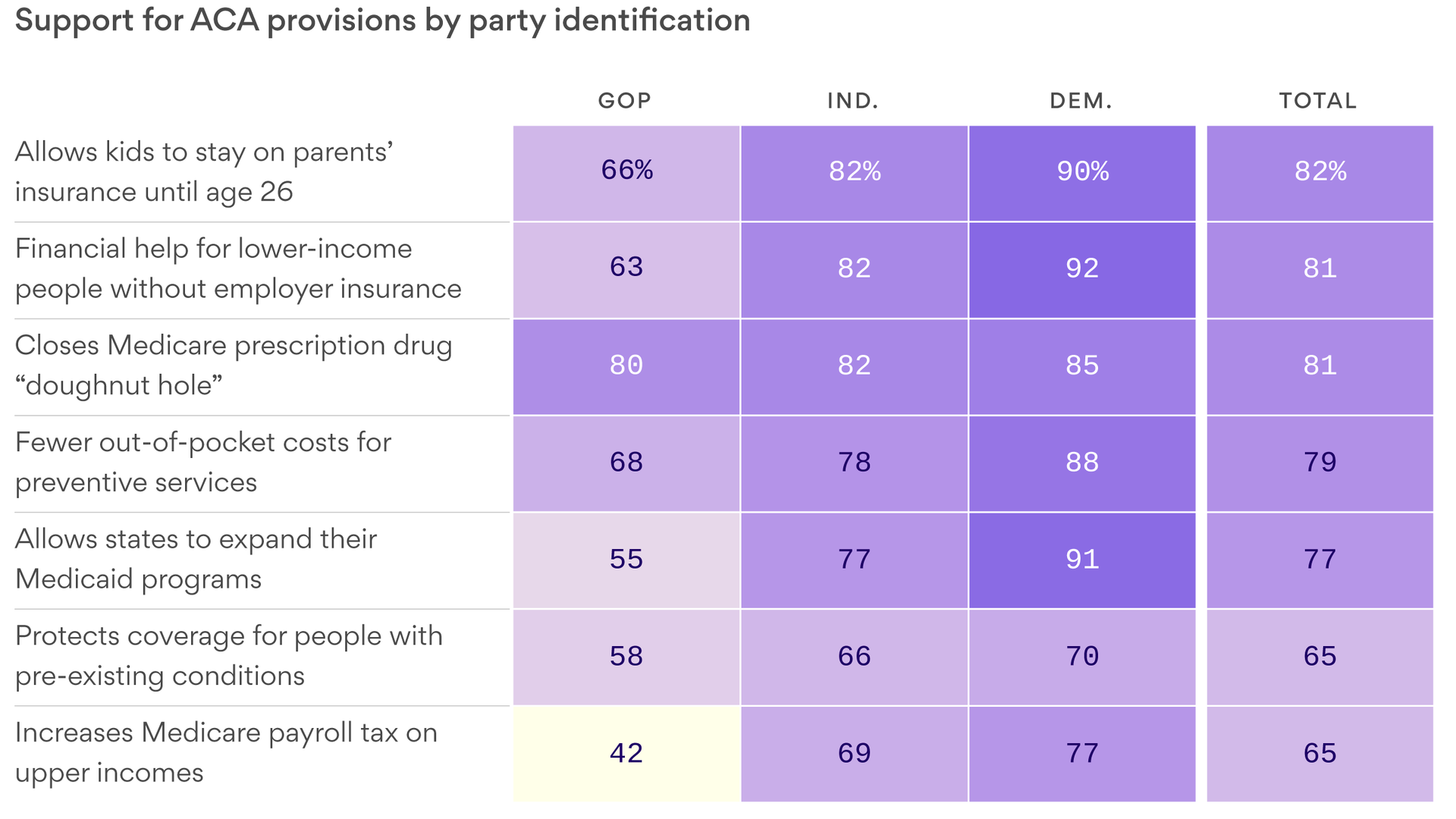
Reality check: But the Republican base has more complicated views about the ACA than the activists who show up at rallies and cheer when the president talks about repealing the law. The polling is clear: Republicans don’t like the ACA, but just like everyone else, they like its benefits and will not want to lose them.

The big picture: About three quarters of Republicans still have an unfavorable view of the ACA, and seven in 10 say repealing the law is a top health priority for Congress — higher than other priorities such as dealing with prescription drug costs. And yes, 7 in 10 Republicans still want to see the Supreme Court overturn the law.

But as the chart shows, majorities of Republicans like many elements of the ACA —especially closing the “donut hole” in Medicare prescription drug coverage (80%), eliminating copayments for preventive services (68%), keeping young adults under 26 on their parents’ plans (66%) and subsidies for low and middle-income households (63%).

  • Nearly half of Republicans want the Supreme Court to keep the protections for pre-existing conditions (49%), and even more show general support for the pre-existing conditions protections (58%).
  • During the repeal and replace debate in 2017, even Republicans were nervous to hear that these sorts of things would go away. The 2020 campaign would drive home to the public, and to Republicans, what they have to lose — and it would become especially real to them if the 5th Circuit Court of Appeals upholds the ruling striking down the ACA.

Maybe Republicans would forget about these lost benefits if they could agree on a replacement plan they liked? But there isn’t one, and many of the ideas thought to be elements of one — such as cutting and block granting both Medicaid and ACA subsidies — are non-starters with Democrats and moderate Republicans on Capitol Hill. They’re unpopular with the public, too. 

The bottom line: It is widely accepted that a renewed debate about repeal hands Democrats a powerful new political opportunity. Deeper in the polling, it’s also clear that’s it’s more of a mixed bag for Republicans than President Trump may realize.  


How Medi-Cal’s Fiscal Balancing Act Could Soon Become More Challenging

How Medi-Cal’s Fiscal Balancing Act Could Soon Become More Challenging

Many Californians know that Medi-Cal is our state’s health coverage program for residents with low incomes, including children, people with disabilities, and workers who may not get affordable health insurance through their jobs.

What many Californians don’t realize — call it Medi-Cal’s best-kept secret — is that even with the program’s rising enrollment and costs in recent years, Medi-Cal’s financial impact on our state’s General Fund (the account that receives most state tax revenues) has been relatively small. This matters because General Fund dollars support an array of vital services in addition to Medi-Cal, many of which — such as income supports and subsidized childcare for low-income working families — also promote Californians’ health and well-being. If Medi-Cal had claimed a larger share of General Fund revenues over the past decade, fewer state dollars would have been available to support other critical public supports and services.

This article first looks at how our state has expanded Medi-Cal to meet the health care needs of one in three Californians while minimizing the program’s impact on the General Fund. It then highlights key Medi-Cal financing issues on the horizon that could hamper state policymakers’ efforts to continue balancing Medi-Cal’s funding needs with those of other important public services. This article is adapted from a presentation I gave at the February 25 Medi-Cal Explained briefing hosted by the California Health Care Foundation.

As Medi-Cal Enrollment Doubled, State General Fund Support Rose Modestly

Medi-Cal, California’s Medicaid program, has seen enrollment and expenditures grow substantially since 2007–08 (PDF), the last fiscal year before the Great Recession sent California’s economy and state budget into a tailspin. Enrollment for the current fiscal year (2018–19) is expected to be 13.2 million, about double the 2007–08 level. Total Medi-Cal spending is anticipated to reach $98.5 billion, roughly $53 billion (114%) higher than in 2007–08. (All 2007–08 expenditures are adjusted for inflation.)

State General Fund dollars accounted for only $3 billion of this $53 billion increase in Medi-Cal spending between 2007–08 and 2018–19. This relatively small jump in General Fund support for Medi-Cal is remarkable in light of periodic concerns that the program is putting the squeeze on California’s General Fund budget. Instead, Medi-Cal’s spending growth has largely been supported with non-General Fund sources of revenue. Specifically, the remainder of the $53 billion spending increase between 2007–08 and 2018–19 — around $50 billion — came from federal funds ($35.3 billion) and other non-federal funds, such as state taxes paid by managed care organizations (MCOs) and fees paid by hospitals ($14.2 billion). Since 2007–08, federal funding for Medi-Cal has increased by 129%, while other non-federal funds have grown by more than 1,600%.

The substantial increase in non-General Fund support for Medi-Cal has been driven by several factors, including:

  • More generous federal cost-sharing. California and the federal government equally split the cost of services for most Medi-Cal enrollees. However, the Affordable Care Act (ACA) included more generous federal cost-sharing for certain beneficiaries. The federal government pays 93% of the cost for the Medi-Cal expansion population, which consists of low-income non-elderly adults who became newly eligible in 2014. In addition, federal dollars fund 88% of the cost for children who are enrolled in Medi-Cal as part of the Children’s Health Insurance Program (CHIP). Like a see-saw, higher federal cost-sharing leads to lower state cost-sharing, freeing up state General Fund dollars.
  • Creative financing. California has tapped into alternative in-state financing sources to support Medi-Cal, including local matching funds (such as from counties and public hospital systems), provider fees, and a tax on MCOs. These alternative sources of financing allow California to draw down more federal funding for Medi-Cal while minimizing the impact on the General Fund.
  • The 2016 state tobacco tax increase. Proposition 56 raised the state’s excise tax on cigarettes by $2 per pack and triggered an equivalent increase in the state tax on other tobacco products. Medi-Cal’s share of these revenues — roughly $1 billion per year — is primarily used to boost payments to doctors and other Medi-Cal providers, relieving the need for the General Fund to support such rate increases.

What about General Fund support for Medi-Cal as a percentage of the total General Fund budget? Medi-Cal’s share of the General Fund has increased by just seven-tenths of a percentage point over the past decade — from 13.63% in 2007–08 to an estimated 14.35% in 2018–19. Yes, Medi-Cal receives a slightly larger slice of the General Fund “pie” than it did 2007–08. But this increase has been modest given the substantial benefit experienced by millions of Californians newly covered by the program. As a result, more state dollars have been available for other public services and systems than if General Fund support for Medi-Cal had risen at a much faster pace.

Medi-Cal’s Big Financing Issues Create Uncertainty for Medi-Cal and the General Fund

Over the past decade, state policymakers have deftly balanced the needs of a growing Medi-Cal program with those of other public services and systems. However, Medi-Cal faces a number of near-term financing issues that could make this balancing act more challenging in the coming years. These financing issues include:

  • Reductions in federal cost-sharing. The federal government is scheduled to reduce its share of costs for CHIP-funded children as well as for adults enrolled in Medi-Cal starting in 2014 under the ACA. The state’s share of CHIP costs will increase in two steps, rising from 12% to 23.5% on October 1, 2019, and then to 35% on October 1, 2020. For the expansion population, the state’s share of cost will rise from 7% to 10% on January 1, 2020, where it will remain unless revised by Congress. Upon full implementation, these changes will increase annual state General Fund spending on Medi-Cal by more than $1 billion compared to 2018–19, according to estimates from the state’s nonpartisan Legislative Analyst’s Office (LAO).
  • The pending expiration of the MCO tax. California’s MCO tax expires on June 30, and Governor Gavin Newsom is not proposing to extend it. If the MCO tax expires, California would forgo a net annual General Fund benefit of $1.5 billion, based on the current structure of the MCO tax package. These dollars could help to pay for a number of state policy advances, including efforts to move California closer to universal health coverage. The governor “has not laid out a convincing rationale” for declining to seek an extension of the MCO tax, according to the LAO. If the tax were allowed to expire, annual state General Fund costs for Medi-Cal would ultimately increase by well over $1 billion but without any additional benefit to the Medi-Cal program. Instead, state General Fund dollars would simply replace lost MCO tax revenues in order to keep the program whole.
  • The pending expiration of two major federal waivers. California’s current Section 1915(b) waiver expires on July 1, 2020. Under this waiver, counties are allowed to deviate from standard Medicaid rules and provide or arrange for a broad array of “specialty mental health services” for eligible Medi-Cal beneficiaries. In addition, California’s Section 1115 Medi-Cal 2020 waiver expires at the end of 2020. Under this waiver, the federal government is providing the state with billions of dollars to help improve access to care as well as to transform how care is delivered. Will the Trump administration agree to renew these waivers without significantly reducing federal funding or imposing new requirements that California would find objectionable? Time will tell.
  • The next recession. Medi-Cal could face spending cuts when the next recession comes and policymakers seek ways to close budget shortfalls. Fortunately, California has been building up its reserves. The state expects to have more than $15 billion in its constitutional reserve, the Budget Stabilization Account, by the end of 2019–20. In addition, Governor Newsom wants to add $700 million to the state’s new Safety Net Reserve for Medi-Cal and CalWORKs. (The balance now is $200 million.) These reserves will reduce the need for state budget cuts during the next downturn, although Medi-Cal would not be guaranteed a specific share of the funds. State reserves will be crucial to shoring up Medi-Cal’s budget because the federal government may do little to help states pay for their rising Medicaid costs when the next recession arrives.

One of the biggest challenges — and opportunities — that California lawmakers and the governor face each year is allocating the state’s limited General Fund revenues among many vital priorities. The financing issues that Medi-Cal is facing — and how these issues are resolved — will help to determine whether policymakers can continue improving the Medi-Cal program while also ensuring that other vital public services are adequately funded.


Congress Warns Against Medicaid Cuts: ‘You Just Wait for the Firestorm’

Image result for Congress Warns Against Medicaid Cuts: ‘You Just Wait for the Firestorm’

WASHINGTON — If President Trump allows states to convert Medicaid into a block grant with a limit on health care spending for low-income people, he will face a firestorm of opposition in Congress, House Democrats told the nation’s top health official on Tuesday.

The official, Alex M. Azar II, the secretary of health and human services, endured more than four hours of bipartisan criticism over the president’s budget for 2020, which would substantially reduce projected spending on Medicaid, Medicare and biomedical research. Democrats, confronting Mr. Azar for the first time with a House majority, scorned most of the president’s proposals.

But few drew as much heat as Mr. Trump’s proposed overhaul of Medicaid. His budget envisions replacing the current open-ended federal commitment to the program with a lump sum of federal money for each state in the form of a block grant, a measure that would essentially cap payments and would not keep pace with rising health care costs.

Congress rejected a similar Republican plan in 2017, but in his testimony on Tuesday before the Health Subcommittee of the House Energy and Commerce Committee, Mr. Azar refused to rule out the possibility that he could grant waivers to states that wanted to move in that direction.

Under such waivers, Mr. Azar said, he could not guarantee that everyone now enrolled in Medicaid would keep that coverage.

“You couldn’t make that kind of commitment about any waiver,” Mr. Azar said. He acknowledged that the president’s budget would reduce the growth of Medicaid by $1.4 trillion in the coming decade.

Representative G. K. Butterfield, Democrat of North Carolina, said that “block-granting and capping Medicaid would endanger access to care for some of the most vulnerable people” in the country, like seniors, children and the disabled.

Mr. Trump provoked bipartisan opposition by declaring a national emergency to spend more money than Congress provided to build a wall along the southwestern border. If the president bypasses Congress and allows states to convert Medicaid to a block grant, Mr. Butterfield said, he could face even more of an outcry.

“You just wait for the firestorm this will create,” Mr. Butterfield said, noting that more than one-fifth of Americans — more than 70 million low-income people — depend on Medicaid.

As a candidate, Mr. Trump said he would not cut Medicare, but his new budget proposes to cut more than $800 billion from projected spending on the program for older Americans in the next 10 years. Mr. Azar said the proposals would not harm Medicare beneficiaries.

“I don’t believe any of the proposals will impact access to services,” Mr. Azar said. Indeed, he said, the cutbacks could be a boon to Medicare beneficiaries, reducing their out-of-pocket costs.

After meeting an annual deductible, beneficiaries typically pay 20 percent of the Medicare-approved amount for doctor’s services and some prescription drugs administered in doctor’s offices and outpatient hospital clinics.

Mr. Azar defended a budget proposal to impose work requirements on able-bodied adults enrolled in Medicaid. Arkansas began enforcing such requirements last year under a waiver granted by the Trump administration. Since then, at least 18,000 Arkansans have lost Medicaid coverage.

Mr. Azar said he did not know why they had been dropped from Medicaid. It is possible, he said, that some had found jobs providing health benefits.

Representative Joseph P. Kennedy III, Democrat of Massachusetts, said it would be reckless to extend Medicaid work requirements to the entire country without knowing why people were falling off the rolls in Arkansas.

If you are receiving free coverage through Medicaid, Mr. Azar said, “it is not too much to ask that you engage in some kind of community engagement.”

Representative Fred Upton, Republican of Michigan, expressed deep concern about Mr. Trump’s proposal to cut the budget of the National Cancer Institute by $897 million, or 14.6 percent, to $5.2 billion.

Mr. Azar said the proposal was typical of the “tough choices” in Mr. Trump’s budget. He defended the cuts proposed for the National Cancer Institute, saying they were proportional to the cuts proposed for its parent agency, the National Institutes of Health.

The president’s budget would reduce funds for the N.I.H. as a whole by 12.6 percent, to $34.4 billion next year.

Mr. Azar was also pressed to justify Mr. Trump’s proposal to cut federal payments to hospitals serving large numbers of low-income patients. Representative Eliot L. Engel, Democrat of New York, said the cuts, totaling $26 billion over 10 years, would be devastating to “safety net hospitals” in New York and other urban areas.

Mr. Azar said that the Affordable Care Act, by expanding coverage, was supposed to “get rid of uncompensated care” so there would be less need for the special payments.

While Democrats assailed the president’s budget, Mr. Azar relished the opportunity to attack Democrats’ proposals to establish a single-payer health care system billed as Medicare for all.

Those proposals could eliminate coverage provided to more than 20 million people through private Medicare Advantage plans and to more than 155 million people through employer-sponsored health plans, he said.

But Mr. Azar found himself on defense on another issue aside from the president’s budget: immigration. He said he was doing his best to care for migrant children who had illegally entered the United States, were separated from their parents and are being held in shelters for which his department is responsible.

He said he was not aware of the “zero tolerance” immigration policy before it was publicly announced in April 2018 by Attorney General Jeff Sessions. If he had known about the policy, Mr. Azar said, “I could have raised objections and concerns.”

Representative Anna G. Eshoo, Democrat of California and the chairwoman of the subcommittee, summarized the case against the president’s budget.

“The Trump administration,” she said, “has taken a hatchet to every part of our health care system, undermining the Affordable Care Act, proposing to fundamentally restructure Medicaid and slashing Medicare. This budget proposes to continue that sabotage.”


Trump continues his war on Americans’ health care to pay for his tax cuts

https://www.americanprogress.org/issues/economy/news/2019/03/11/467108/trumps-fy-2020-budget-exposes-false-promises-misplaced-priorities/

Image result for medicare cuts

After repeatedly trying and failing to repeal the ACA legislatively, President Trump and congressional Republicans have resorted to attacking and weakening the law through executive action, federal waivers to the states to undermine Medicaid expansion, and budget proposals to gut funding levels.

Once again, Trump’s budget proposes massive cuts—$777 billion over 10 years—from repealing the ACA and slashing Medicaid.

Like in his previous two budgets, Trump goes beyond these two measures to attack traditional Medicaid, seeking to restrict federal funding on a per-beneficiary basis or transition to block grant funding. Both of these things would lead to a significant decrease in federal funding and could cause millions of people to lose their health care coverage.

Like in last year’s budget, he encourages states to take Medicaid away from jobless and underemployed Americans, including laid-off workers, people who are going to school, and those who are taking care of children or family members. Medicaid is a lifeline for millions of Americans—including children, veterans, people with disabilities, and individuals affected by the opioid crisis. Tearing down this vital program will make it more difficult for people to access the health care they need to find work, including by preventing people with disabilities from accessing the long-term services and supports they need to participate in the labor market.

After he repeatedly promised to protect Medicare as a candidate, Trump makes changes to Medicare that would shrink the program by $845 billion over the coming decade.


Trump’s 2020 budget proposal: 5 healthcare takeaways

https://www.beckershospitalreview.com/finance/trump-s-2020-budget-proposal-5-healthcare-takeaways.html

Image result for medicaid cuts

President Donald Trump released his $4.75 trillion budget for fiscal year 2020 on March 11. The proposal, titled “A Budget for a Better America: Promises Kept. Taxpayers First,” calls for reductions to Medicare and Medicaid over 10 years and includes provisions related to drug pricing and many other health-related issues.

Below are five healthcare-related proposals in the president’s budget:

1. Discretionary funding for HHS. The budget requests $87.1 billion in discretionary spending for HHS, a 12 percent decrease from 2019 funding levels.

2. Efforts to curb HIV. Keeping with President Trump’s promise in his State of the Union address to end the spread of HIV in the U.S. over the next decade, the budget plan calls for HHS to receive $291 million next year to help curb the spread of the virus. A large portion of the funding — $140 million — would go to the CDC to improve diagnosis and testing for HIV in areas of the U.S. where the virus is continuing to infect people not getting proper treatment.

3. Broad overhaul of Medicaid. Under the budget, nearly $1.5 trillion would be cut from Medicaid over 10 years. However, the budget seeks $1.2 trillion over the next decade for block grants or per-person caps that would start in 2021, according to The Washington Post. The budget plan would also end funding for Medicaid expansion.

4. Medicare funding changes. Under the budget, Medicare spending would be reduced by an estimated $800 billion over 10 years. The budget would reduce the growth of various Medicare provider payments and includes changes aimed at addressing waste and abuse in healthcare and lowering drug prices, according to The Washington Post.

5. Medical research. The plan includes a proposal to cut $897 million from the National Cancer Institute’s budget and an additional $1 billion in cuts to other institutes that do medical research, according to Politico.

Read the full budget plan here.


Segment 3 – Healthcare Reform Successes & Failures

Segment 3 – Healthcare Reform Successes & Failures

Slide15

In Segment 2, we looked at the history of medical care in the U.S. until 1965, the year Congress enacted Medicare and Medicaid.

In Segment 3 we will look at reform movements, starting with Medicare and Medicaid. We will look at why later reforms failed and where that leaves us now.

By the early 1960s, nearly all employees were covered by Blue Cross/Blue Shield.

But problems emerged. First, low-wage workers were often not covered by their small businesses, and elderly retirees were not covered. Costs were going up because pre-paid insurance increased patient demand for services. Harry Truman had proposed national health insurance after he surprisingly was re-elected in 1948. But the AMA launched a multi-million-dollar publicity campaign to deride the plan as “Communism” and “socialized medicine.” Truman’s public insurance plan failed.

The next attempt at reform was successful – the 1965 passage of Medicare and Medicaid. Lyndon Johnson succeeded because coverage targeted the uninsured poor-and- elderly, leaving the rest of the private for-profit health system unaffected.

Senator Teddy Kennedy tried in 1971 to extend Johnson’s success to build a single-payer system, and won support from President Nixon. But this plan was derailed by the Watergate scandal.

The next attempt came from Bill and Hillary Clinton. After Clinton took office in 1992, Hillary and expert panels devised a plan for universal coverage including essential benefits and pre-existing conditions with mandated employer insurance and expanded Medicaid. This plan failed because the insurance industry launched a stinging publicity campaign featuring a down-home couple named “Harry and Louise.” Americans also balked at the tax increases needed to fund it.

The Clinton’s failure made it necessary to find another solution to rising costs. Managed care, which had first appeared in 1973, became that solution. And it did work, slowing growth to under 6%. But around the year 2000 came a backlash over mammograms and so-called “drive-by” deliveries, which undermined the ability of managed care to control costs.

What do we make of this history? Here are the main take-aways that help us understand our present health system. First, there has always been a tension between the profit motive in the free marketplace and a health promotion motive. Second, Americans have given special treatments to the health industry in return for medical advances. And third, powerful vested interests (doctors, hospitals, insurance, drug companies) have often used polemics and ideological arguments to defend their favored status, not necessarily actual health outcome data.

Slide09

So, this leaves the US with the largest, most expensive healthcare system in the world. In 2011 shown here it took in payments of 2.7 trillion dollars, mostly private insurance, Medicare, Medicaid and out-of-pocket. The figure for 2015 was 3.2 trillion dollars, representing 1/6 of the entire economy of the entire Gross Domestic Product. Government’s share of payments was almost 50% in 2016.

Slide10

This graph shows the dollars spent in 2011 – mostly on hospitals, doctors, drugs, long-term care. Remember that 25% of this pie graph actually goes to administrative costs, not medical services.

Slide11

In defense of U.S. healthcare, in 2012 then-House-Speaker John Boehner and then Senate Minority Leader Mitch McConnell famously said, “the U.S. has the finest health care system in the world,” and further that “wealthy foreigners flock to the U.S. because of its cutting edge facilities.”

2017-10-13-boehner-mcconnell.png

However, the World Health Organization rates the U.S. 15th in performance (life expectancy and delays in care), and only 37th in overall attainment (including financial and service fairness).

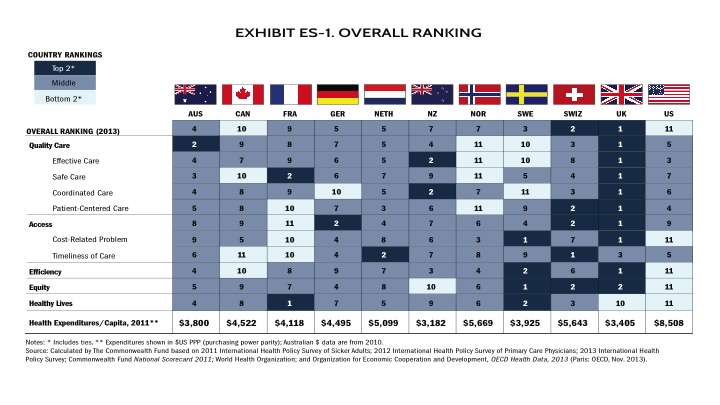
In 2015 the Kaiser Foundation compared the US with 10 other developed countries. Here are their results showing areas in which US is better, equal or lacking.

Here are the Commonwealth Fund’s 20-11 rankings – US is in the middle of the pack for most areas but dead last on several others and overall rank.

Slide14Source: http://www.commonwealthfund.org/publications/fund-reports/2014/jun/mirror-mirror

What about “foreigners flocking-for-care”? This pertains to highly specialized treatments available only in certain centers such as Mayo, Cleveland Clinic or Hopkins. Some centers in Florida and Texas do market to wealthy foreigners, who pay the full charge in cash, not discounted insurance rates like the rest or us. Boehner and McConnell pointed to Canadians coming to Michigan hospitals, but the Commonwealth study found that Canada is worst in timeliness and 10th worst overall, just ahead of the US in 11th place, so not surprising.

The further truth is that, according to Centers for Disease Control, 3/4 million Americans go abroad each year for medical treatments, such as for holistic care or dental care, but mostly seeking lower cost.

In the next Segment we will talk about cost, namely how the rising cost of healthcare is affecting our economy, our politics, our society – and some say our very existence.

I’ll see you then.


Nursing Homes Are Closing Across Rural America, Scattering Residents

Harold Labrensz spent much of his 89-year life farming and ranching the rolling Dakota plains along the Missouri River. His family figured he would die there, too.

But late last year, the nursing home in Mobridge, S.D., that cared for Mr. Labrensz announced that it was shutting down after a rocky history of corporate buyouts, unpaid bills and financial ruin. It had become one of the many nursing homes across the country that have gone out of business in recent years as beds go empty, money troubles mount and more Americans seek to age in their own homes.

For Mr. Labrensz, though, the closure amounted to an eviction order from his hometown. His wife, Ramona, said she could not find any nursing home nearby to take him, and she could not help him if he took a fall at home. So one morning in late January, as a snowstorm whited out the prairie, Mr. Labrensz was loaded into the back of a small bus and sent off on a 220-mile road trip to a nursing home in North Dakota.

“He didn’t want to go,” said Mrs. Labrensz, 87, who made the trip with her husband. “When we stopped for gas, he said, ‘Turn this thing around.’ ”

More than 440 rural nursing homes have closed or merged over the last decade, according to the Cowles Research Group, which tracks long-term care, and each closure scattered patients like seeds in the wind. Instead of finding new care in their homes and communities, many end up at different nursing homes far from their families.

In remote communities like Mobridge, an old railroad town of 3,500 people, there are few choices for an aging population. Home health aides can be scarce and unaffordable to hire around the clock. The few senior-citizen apartments have waiting lists. Adult children have long since moved away to bigger cities.

“How often have you heard somebody say, ‘If I go to a nursing home, just shoot me?’” said Stephen Monroe, a researcher and author who tracks aging in America. “In the rural areas, you don’t have options. There are no alternatives.”

The relocations can be traumatic for older residents, and the separation creates agonizing complications for families. Relatives say they have to cut back visits to one day a week. They spend hours on the road to see their spouses and parents.

“Before, I could just drop by five days a week,” said the Rev. Justin Van Orman, a Lutheran pastor who moved back to Mobridge to be closer to his 79-year-old father, Robert. “He knew I was there.”

Not long after Mr. Van Orman’s father moved from Mobridge to a new nursing home about 50 miles away, Mr. Van Orman got a call saying his father had fallen out of bed. Mr. Van Orman had to decide: Should he upend his day to check on him, or wait and take the nursing home’s word that his father was O.K.?

Similar scenes are playing out in other heavily rural states. Five nursing homes closed in Nebraska last year, with more at risk of closing. Six shut down in Maine — a record, according to the Bangor Daily News.

Thirty-six rural nursing homes across the country have been forced to close in the last decade because they failed to meet health and safety standards. But far more have collapsed for financial reasons, including changing health care policies that now encourage people to choose independent and assisted living or stay in their own homes with help from caregivers.

Some nursing homes cannot find people to do the low-paying work of caring for frail residents. Others are losing money as their occupancy rates fall and more of their patients’ long-term care is covered by Medicaid, which in many states does not pay enough to keep the lights on.

South Dakota chips in less than any other state in the nation to pay for long-term care for residents on Medicaid, said Mark B. Deak, executive director of the South Dakota Health Care Association. He added that the state’s low payment level — a product of South Dakota’s fiscal conservatism and distrust of government-run health care — has now created a crisis.

Five South Dakota nursing homes have shut down in the past three years, and dozens more are losing money because the majority of their residents rely on Medicaid. At current reimbursement rates, nursing homes in the state lose about $58 a day for each resident on Medicaid, Mr. Deak said. It adds up to $66 million a year in losses statewide.

“The state has not held up its obligation to seniors,” Mr. Deak said. “How many more nursing homes closing is it going to take?”

Gov. Kristi Noem has proposed a 5 percent increase in the state’s Medicaid reimbursement rate. Mr. Deak said that would not be nearly enough to cover the losses.

The 89-bed Mobridge Care and Rehabilitation Center was rated overall as “below average” by Medicare’s Nursing Home Compare program, though for patient care, the home received four out of five stars in the agency’s assessment. The brown brick building was getting old, and had been damaged by a bad summer storm in 2018.

The nursing home had been part of a chain that switched hands and foundered financially, ultimately ending up in court-appointed receivership. In November, the receiver told a South Dakota judge that the chain’s operations were bleeding money, and that it needed to close down the two homes in the chain that were deepest in the red. Mobridge was one.

The South Dakota Department of Health did not object, and the judge agreed to the closure. Word began to spread through the home and through town: The residents had about two months to find somewhere else to go.

Black Hills Receiver, which had taken over operation of the nursing home, said in a November statement announcing the closure that it was working with residents, their families and employees “to make this transition as smooth as possible.” The company declined an interview request.

On paper, South Dakota and other rural states still have enough long-term care beds for people who need round-the-clock care. The problem is where they are. When a nursing home closes in a small town, the available beds are often so far away that elderly spouses cannot make the drive, and the transferred residents become cut off from the friends, church groups and relatives they have known all their lives.

Even the closest town can feel as though it is a world away when a blizzard rakes across the prairie and turns the two-lane road out of Mobridge into a billowing scarf of snow.

For six days this winter, Loretta Leonard could not make the 20-mile drive to see her husband, Dick, who is 91 and suffers from severe dementia, at his new nursing home. When he was living close by at the Mobridge home, she often visited him twice a day, sitting down at the piano to play the old polkas and hymns and Depression-era tunes their daughters sang growing up.

“He always knew me,” Ms. Leonard, 88, said. “Sometimes I wonder whether he knows me anymore.”

The part-time bus driver for the Mobridge nursing home began keeping a list as he dropped people at their new homes: “Residents Who Left.” One resident was moved to Aberdeen, 100 miles east. A husband and wife went 73 miles down Highway 12 to Ipswich. Roommates said goodbye. Fast friends landed in different homes. One person ended up in Nebraska.

“Like cattle,” said Nadine Alexander, a certified nursing assistant who worked at the Mobridge nursing home for 29 years. “They were just hauling them out.”

On the snowy day that Harold Labrensz left Mobridge for his new nursing home in North Dakota, not even the bus driver wanted to make the trip. For seven hours, they crept north along icy roads before arriving.

Mrs. Labrensz chose the facility because it was close to her son’s home, and she was able to find a small efficiency apartment just across the street from the nursing home. They spent 68 years together working their land, fishing and raising a family, and Mrs. Labrensz said she wanted to stay close.

“We spent our whole life together,” she said.

She was also close by when, three days after arriving in North Dakota, Mr. Labrensz died. The date was Jan. 31 — the same day that, 220 miles away, the Mobridge nursing home officially closed its doors.


The Fiscal Case for Medicaid Expansion

https://www.commonwealthfund.org/blog/2019/fiscal-case-medicaid-expansion

Fiscal Case for Medicaid Expansion 21x9

After a two-and-a-half-year lull in which no state took up the Affordable Care Act’s (ACA) provision to expand Medicaid eligibility to more Americans living in poverty, 2019 has already ushered in an expansion in Virginia. And as many as six more states are waiting in the wings. In November, voters in Idaho, Nebraska, and Utah overwhelmingly approved state ballot initiatives to expand Medicaid. And in January, new governors supportive of expansion took office in Kansas and Wisconsin. The prospect of Medicaid expansion in these five states plus Maine, where implementation is finally under way following a 2017 ballot referendum, means that as many as 300,000 uninsured Americans may gain coverage this year.

But concerns about the cost of expanding eligibility for Medicaid have been a roadblock to implementation in these states, along with the dozen others that have yet to expand the program. Here, we look at the cost to states of expanding eligibility for Medicaid, and what expansion means in practice for state budgets.

The Federal Government Pays 90 Percent of the Total Cost of Medicaid Expansion

Beginning in 2014, the ACA offered states the option to expand eligibility for Medicaid to individuals with incomes up to 138 percent of the federal poverty level, or roughly $17,000 per year for a single person. (Previously, the federal government required Medicaid be available only to children, parents, people with disabilities, and some people over age 65, and gave states considerable discretion at setting income eligibility levels.) While Medicaid is a jointly funded partnership between the federal government and the states, the ACA provided 100 percent federal funding to cover the costs of newly eligible enrollees until the end of 2016 in states that took up the expansion. The federal government currently pays 93 percent of the total costs, and this year alone will provide an estimated $62 billion to fund expansion, according to the Congressional Budget Office.

In 2020, the federal share will drop to 90 percent where, barring a change to the law, it will stay. This leaves states on the hook for at most 10 percent of the total cost of enrollees in the new eligibility category — considerably less than the roughly 25 percent to 50 percent of the cost that states pay for enrollees eligible for Medicaid under pre-ACA criteria.

States Realize Savings from Expansion

Opponents of Medicaid expansion in states that have yet to implement it worry that even a 10 percent contribution to the cost of extending Medicaid coverage to more people will result in a large increase in state spending. But the experience of a long list of states suggests otherwise. That’s because expansion allows states to realize savings by moving adults who are in existing state-funded health programs into expansion coverage. Expansion also allows states to reduce their spending on uncompensated care as uninsured people gain coverage.

The table below offers a snapshot of what this looked like in Montana, where Medicaid expansion took effect in January 2016. In FY2017, the total cost of Medicaid expansion was $576.9 million. Because the federal match was 95 percent to 100 percent during this time, the state’s share was $24.5 million. But the state then experienced a series of offsets, or savings it realized from not spending money on separate health-related programs fully funded by the state, such as substance use disorder programs. The state also realized savings when some groups who were previously covered under existing Medicaid were moved to the expansion population, which has a higher federal matching rate. Taken together, these offsets added up to $25.2 million, leaving Montana with a surplus of $700,000 in FY2017. One study found that Arkansas and Kentucky amassed enough surplus because of offsets during the first two years of expansion, when the federal government was footing the entire bill, to cover the costs of expansion through FY2021.

Net Costs Are a Minuscule Portion of States’ Overall Budgets

It’s also worth noting that even if Montana had been responsible for 10 percent of the total cost in FY2017, or $57.7 million, after offsets were applied, the net cost to the state — or the amount it actually spent on Medicaid expansion — would have been $32.5 million, only about 1 percent of Montana’s general fund expenditures of $236.5 billion in FY2017. In Nebraska1 and in Kansas, two of the states that may be among the next to implement expansion, estimates have shown that the state cost after offsets is less than 1 percent of the general fund.

Paying the Balance

Of the 32 states that, along with the District of Columbia, have implemented Medicaid expansion, nine are using taxes — on cigarettes; alcohol; or hospital, provider, or health plan fees — to help pay for it. The ballot initiative approved by voters in Utah in November increased the state’s sales tax by 0.15 percent with the requirement that the new revenue be used to pay for the cost of expansion there. (Even so, earlier this week, Utah Governor Gary Herbert signed into law a bill approved by the Republican-led legislature that will scale back the full Medicaid expansion that voters approved.)

States that expand Medicaid also realize economic benefits beyond increased federal funds. For example, a Commonwealth Fund-supported study found that as a result of new economic activity associated with Medicaid expansion in Michigan, including the creation of 30,000 new jobs mostly outside the health sector, state tax revenues are projected to increase $148 million to $153 million a year from FY2019 through FY2021.

A U.S. Senate bill cosponsored by Senator Doug Jones (D–Ala.), who has advocated for his state to adopt expansion, could help reassure states skittish about expanding because of the impact on their budget. The legislation would grant states, regardless of when they adopt expansion, the same levels of federal matching funds that states that expanded the program in 2014 received (100% federal funding for the first three years, phasing down over three more years to 90%).

Indeed, a national study confirmed that during the two years when the federal government paid all of the costs for newly eligible enrollees, Medicaid expansion did not lead to any significant increases in state spending on Medicaid or to reductions in spending on other priorities such as education. But even at a lesser percent match, the fiscal case for expansion is compelling.

A future To the Point post will examine the broader economic benefits associated with Medicaid expansion.


1 big thing: Everything will be a fight

https://www.axios.com/newsletters/axios-vitals-d6671137-65fb-49a1-a603-d7e53ab977de.html?utm_source=newsletter&utm_medium=email&utm_campaign=newsletter_axiosvitals&stream=top

Manny Pacquiao Fight GIF - Find & Share on GIPHY

Insurers and hospitals came out swinging yesterday against Democrats’ proposal to let people older than 50 buy into Medicare — a reminder that almost any expansion of public health coverage will provoke a battle with the health care industry.

Between the lines: Politically, an age-restricted Medicare buy-in is about as moderate as it gets for Democrats in the age of “Medicare for All.”

  • It is not a proposal for universal coverage, and it’s a far cry from trying to eliminate private insurance. It would be optional, only a relatively small slice of people would have the option, and they would need to pay a monthly premium.

Yes, but: Being on the more moderate end of the political spectrum does not shield you from a fight.

  • Expanding Medicare would hurt hospitals’ bottom lines, because Medicare pays hospitals less than private insurance does.
  • That’s why the Federation of American Hospitals said yesterday that the idea “would harm more Americans than it would help.”
  • The buy-in plan would primarily compete with employer-based health coverage (that’s what people between 50 and 65 are likely to have). And America’s Health Insurance Plans said the idea “is a slippery slope to government-run health care for every American.”

The bottom line: Any proposal that would compete with (never mind eliminate) private coverage, particularly employer coverage, will meet this kind of resistance.

That’s why Medicaid is the public program Democrats and industry can agree to love. Expanded access to Medicaid has rarely been an alternative to commercial insurance — it’s usually an alternative to being uninsured.

  • The uninsured were the primary beneficiaries of the Affordable Care Act’s Medicaid expansion, and the Medicaid buy-in proposals now popping in the states are aimed at the people who are most likely to be foregoing private ACA coverage because of its cost.