On Medicare But At Risk: A State-Level Analysis of Beneficiaries Who Are Underinsured or Facing High Total Cost Burdens

http://www.commonwealthfund.org/publications/issue-briefs/2016/may/on-medicare-but-at-risk

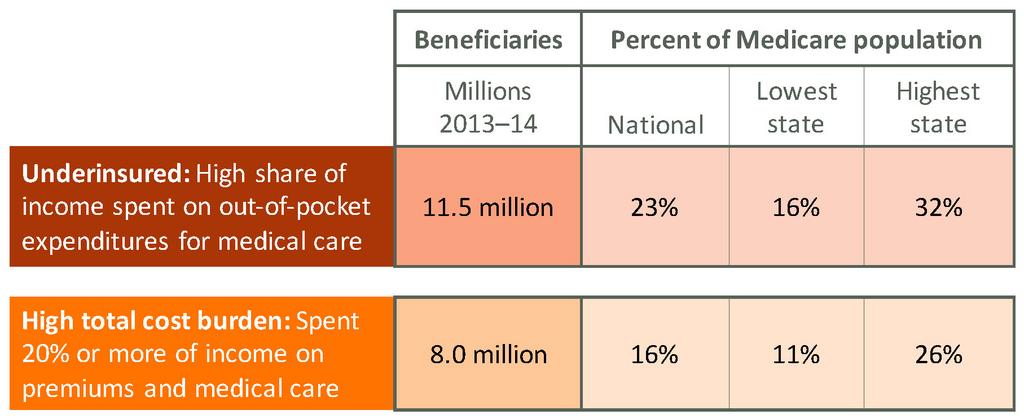
Medicare provides essential health coverage for older and disabled adults, yet it does not limit out-of-pocket costs for covered benefits and excludes dental, hearing, and longer-term care. The resulting out-of-pocket costs can add up to a substantial share of income. Based on U.S. Census surveys, nearly a quarter of Medicare beneficiaries (11.5 million) were underinsured in 2013–14, meaning they spent a high share of their income on health care. Adding premiums to medical care expenses, we find that 16 percent of beneficiaries (8 million) spent 20 percent or more of their income on insurance plus care. At the state level, the proportion of beneficiaries underinsured ranged from 16 percent to 32 percent, while the proportion with a high total cost burden ranged from 11 percent to 26 percent. Low-income beneficiaries were most at risk. The findings underscore the need to assess beneficiary impacts of any proposal to redesign Medicare.

The Opportunities and Challenges of the MSSP ACO Program: A Report From the Field

https://www.aledade.com/new-journal-article-a-report-from-the-field/

table

The trillion dollar shift in healthcare payment “from volume to value” is well underway with both public and private payers and purchasers pushing provider organizations to participate in outcome-based risk contracts, stepping up from pay-for-performance and medical home models to a variety of accountable care and bundled payment programs.

But what are we to take away from the mixed results of these programs — from the lack of savings in the Comprehensive Primary Care demonstration, to the dropouts from the Pioneer program, the recently released underwhelming results from the first year of the Bundled Payment for Care Improvement Initiative, or the 2015 results from the Medicare Shared Savings Program?

One approach would be for partisans for each of these approaches to search for positive nuggets in the results from their preferred program, while heaping scorn on the other “competing” reforms.

Another would be to retreat altogether from the aspirations of achieving better care at lower cost, towards either resignation towards ever-escalating health care costs or more likely to (altogether regretful!) rationing of access to good healthcare for the most vulnerable in our society.

A third path would be to acknowledge that there is no magic bullet for “transforming healthcare” overnight, and that the work of redesigning our delivery systems to meet the expectations of the outcome-based payment models will be slow, hard, and uneven. We would accept that there are likely multiple payment reforms that will need to be implemented alongside each other, targeting different healthcare markets and different participants. (Capitated payments for truly integrated delivery networks. Mandatory bundled payments for proceduralists and hospitals. Accountable care for independent physician networks). And each model will need to be iterated and tweaked and incrementally improved.

That is what I choose to believe.

We are publishing today in the new issue of the American Journal of Managed Care, “A Report From the Field,” the detailed description of what our two ACO “freshman” accomplished in 2015, and openly discussing the challenges we faced, what we are doing differently now, and some policy changes that can put more wind to the backs of those in these trenches.

Here are a few of the key findings:

http://www.ajmc.com/journals/issue/2016/2016-vol22-n9/The-Opportunities-and-Challenges-of-the-MSSP-ACO-Program-A-Report-From-the-Field

Conclusions:

We have learned that, given the right support and incentives, independent primary care practices can embrace population health and practice redesign. These efforts can begin to bear fruit in improved patient access, quality of care, and appropriate utilization in the short term. We strongly believe that the benefits of the program to patients and the taxpayer are not limited to those ACOs that received shared savings distributions. However, lack of recognition of these contributions may stifle continued innovation and physician engagement with alternative payment models. Aledade is committed to navigating these challenges and we are committed to sharing our learning so that more independent physician-led ACOs can succeed in their mission to profitably deliver better care at lower cost. We also hope that policy makers and commercial payers continue to work to remove the unintended policy headwinds ACOs must presently overcome. – See more at: http://www.ajmc.com/journals/issue/2016/2016-vol22-n9/the-opportunities-and-challenges-of-the-mssp-aco-program-a-report-from-the-field/P-5#sthash.3V1BtAtZ.dpuf


We’re closer to a publicly funded health care system than you think

http://blog.academyhealth.org/were-closer-to-a-publicly-funded-health-care-system-than-you-think/

Image result for We’re closer to a publicly funded health care system than you think

Every time health care reform comes up for debate, I see people arguing about whether a publicly or privately funded system would be better. The Affordable Care Act, in an attempt to forestall this debate, decided to split the baby, and give half of its newly insured beneficiaries public insurance (Medicaid) and half private insurance (insurance exchanges). But this isn’t really true. Yes, the half of people getting expanded Medicaid are getting public insurance, but the vast majority of people getting private insurance are also getting public funds (subsidies) in order to purchase their private insurance.

In other words, even though we expanded private insurance, we’re doing it with taxpayer dollars. Overall, the reduction in the uninsured was due to mostly public spending, with relatively little private spending overall. This isn’t rare in the US health care system. A recently released policy brief from the UCLA Center for Health Policy Research, “Public Funds Account for Over 70 Percent of Health Care Spending in California“, explains this quite well.

If you just look at a simple analysis of Medicaid, Medicaid, and CHIP, you might find that about 45% (or less than half) of total US health care spending is public. But that ignores a ton of health care spending that is also paid for with public funds outside those programs. In an effort to document the different, researchers looked at health care spending in California. They included four major public funding categories:

  1. Payments for public health insurance programs (like Medicare and Medicaid)
  2. Government payments for health insurance coverage for public employees (like me at Indiana University, for instance)
  3. Tax subsidies for employer-sponsored insurance and those purchasing exchange plans who earn less than 400% of the poverty line
  4. County health care expenditures


Cost Control Efforts Working ‘So Far’ in MA

http://www.healthleadersmedia.com/quality/cost-control-efforts-working-so-far-ma?spMailingID=9530189&spUserID=MTMyMzQyMDQxMTkyS0&spJobID=1001355843&spReportId=MTAwMTM1NTg0MwS2#

Health policy veteran Stuart Altman, PhD, is hopeful, but not optimistic, about healthcare delivery reforms and thinks hospitals will be forced to bring costs down because patients won't tolerate any more cost shifting.

Health policy veteran Stuart Altman, PhD, is hopeful, but not optimistic, about healthcare delivery reforms and thinks hospitals will be forced to bring costs down because patients won’t tolerate any more cost shifting.

health care expenditures 2013-2015

Each year, we put together a cost trend report that outlines what forces are at play in the state in terms of raising spending and we have hearings every October. We are trying to play an interesting role which is not be regulatory, but really to be in the face of the healthcare system in terms of saying, “Hey  be careful. Don’t go the extra mile on in spending or pricing.”

We want to do it in a way that doesn’t destroy or even hurt the health system.  In any attempt to do that, some of the forces within the health industry scream.

But, for the most part, the hospitals have been supportive of our efforts. If we were to squeeze too hard, they would react more negatively. Everyone is engaged in a very interesting balancing act. We are trying getting the system to work more efficiently… and they are trying to control costs without destroying themselves. So far it’s working.

CBO: Hospitals’ future finances depend on increasing productivity

http://www.healthcaredive.com/news/cbo-hospitals-future-finances-depend-on-increasing-productivity/426036/

  • A new analysis from the Congressional Budget Office (CBO) has recognized that changes in laws and regulations, prompted primarily by the ACA–notablyreduced Medicare payment updates and expanded insurance coverage–can be expected to significantly impact hospitals’ future finances.
  • To help provide a sense of the impacts, the CBO’s working paper predicted hospitals’ profit margins, and the share of hospitals that could lose money in 2025 under several different scenarios.
  • The researchers noted that they provided a wide range of estimates due to “substantial uncertainty” around the predictions and how hospitals will respond to the pressures of the federal healthcare law.

This is how the presidential election is shaping the ongoing drug price debate

This is how the presidential election is shaping the ongoing drug price debate

Change Capsule Pill Filled with Word on Balls

In this year’s presidential campaign, health care has taken a back seat. But one issue appears to be breaking through: the rising cost of prescription drugs.

The blockbuster drugs to treat hepatitis C as well as dramatic price increases on older drugs, most recently the EpiPen allergy treatment, have combined to put the issue back on the front burner.

Democrat Hillary Clinton just issued a lengthy proposal to address what her campaign calls “unjustified price hikes for long-available drugs.” That’s in addition to a broader proposal to address high drug prices the campaign put out last fall.
Republican Donald Trump, meanwhile, has said little about health care since announcing his candidacy in 2015, but he has several times called for a change in law to allow Medicare to negotiate drug prices for the population it serves.

Here are five reasons why this issue is back — and why it is so difficult to solve.

Failure to Improve Is Still Being Used, Wrongly, to Deny Medicare Coverage

For months, physical therapists worked with Mrs. Kirby, a retired civil servant who is now 75, trying to help her regain enough mobility to go home. Then her daughter received an email from one of the therapists saying, “Edwina has reached her highest practical level of independence.”

Translation: Mrs. Kirby wouldn’t receive Medicare coverage for further physical therapy or for the nursing home. If she wanted to stay and continue therapy, she’d have to pay the tab herself.

Medicare beneficiaries often hear such rationales for denying coverage of skilled nursing, home health care or outpatient therapy: They’re not improving. They’ve “reached a plateau.” They’re “stable and chronic,” or have achieved “maximum functional capacity.”

Deanna Kirby wasn’t buying it. “I knew they couldn’t refuse you, even if you’re not improving,” she said.

She’s right. A federal judge last month ordered the federal Centers for Medicare and Medicaid Services to do a better job of informing health care providers and Medicare adjudicators that the so-called improvement standard was no longer in effect.


Marin hospital could be first in state to allow medical marijuana

http://www.sfgate.com/business/article/Marin-hospital-could-be-first-in-state-to-allow-9216208.php

Dr. Larry Bedard poses outside of the Marin General Hospital in Greenbrae, California on Wednesday, September 7,  2016. Photo: Gabriella Angotti-Jones, The Chronicle

If Dr. Larry Bedard has his way, Marin General Hospital would become the first acute-care medical center in California to allow patients to openly consume medical marijuana in the hospital.

Patients wouldn’t be allowed to smoke it, since smoking is prohibited. But Bedard, a retired emergency physician at Marin General who now serves on the Marin Healthcare District board, says he knows of no other legally prescribed drug that cannot openly be used by patients in a hospital.

“I know that it happens that it’s being used in the hospital, but it’s ‘don’t ask, don’t tell,’” Bedard said. “It’s kind of wink-and-nod medicine.”

The doctor is taking steps toward bringing it out into the open by introducing a resolution at Tuesday’s board meeting for Marin Healthcare District, which governs Marin General. The resolution, if approved, would direct the hospital’s administrative and medical staff to review and research the clinical and legal implications of using medical marijuana in the hospital and report back to the board.

Bedard initially planned to introduce a resolution to allow patient use in the hospital but stepped back from that last month after the Drug Enforcement Agency declined to remove marijuana from its list of dangerous drugs, keeping it in the same category as such drugs as heroin and LSD.

Brooklyn surgeon in Medicare billing scheme convicted of fraud, faces 40 years in prison

http://www.nydailynews.com/new-york/nyc-crime/brooklyn-surgeon-convicted-medicare-fraud-faces-40-years-article-1.2731355

Dr. Syed Ahmed faces over 40 years in prison.

A Brooklyn surgeon is facing more than 40 years in prison after a federal jury convicted him of a massive Medicare fraud that included claims he’d performed 600 procedures on one person.

Dr. Syed Ahmed was found guilty of all six counts late Thursday night in Brooklyn Federal Court. The jury had deliberated about four hours.

Prosecutors alleged that Ahmed, a specialist in weight loss surgery and wound treatment, billed Medicare for over $7 million in procedures, many of which were not performed on patients, prosecutors alleged.

Assistant U.S. Attorney Patricia Notopoulos told the jury that Ahmed billed Medicare for 5,000 surgeries over a three-year period, including 600 alleged procedures on an elderly woman.

Campaign 2016 Healthcare Election Issues

http://connect.kff.org/poll-health-care-issues-in-the-2016-elections-the-publics-views-on-zika-and-electronic-medical-records?ecid=ACsprvsNwVqzoYoktjeMadLmMP_j5z4aIEIDLtV7mAYMiD8KEFvV0TCbNnPbhhL1Z-Bec8iS2pPQ&utm_campaign=KFF-2016-August-Tracking-Poll&utm_source=hs_email&utm_medium=email&utm_content=33682024&_hsenc=p2ANqtz-8xtyy8YqJQ7WAY3Hy2-UCQDhQKjYlvB05qHdtEnzbB4uaWO2JZQtkeD0o1C6GXU8BopN7QM81MUjiM3NFIn_7Xlb8t-A&_hsmi=33682024

Chart_1_-_Poll_Alert.png

Two thirds of voters (66%), including large shares of Democrats, Republicans, and independents, identify access and affordability of health care and the future of Medicare, an issue not being widely discussed on the campaign trail, as top priorities for the presidential candidates to talk about during the campaign. Smaller majorities of voters say the same about Medicaid’s future (54%), prescription drug costs (53%), and the future of the 2010 health care law (52%).