Here come the Millennials!

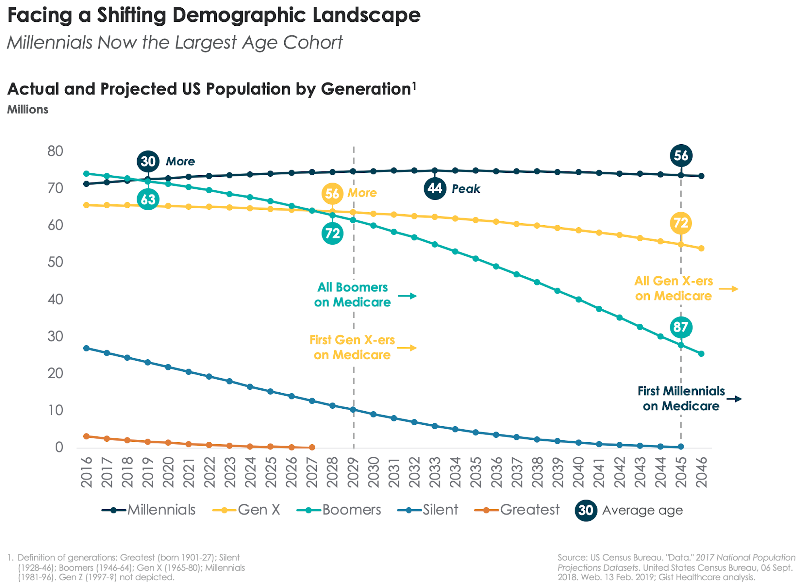
We spend an awful lot of time in healthcare talking about the Baby Boomers. No surprise, America has spent decades—six-and-a-half of them, to be exact—contending with the impact of this historically large generation on nearly every aspect of our national life. From politics to economics to culture, the Baby Boom reshaped almost every facet of our society, and healthcare has been no exception. The fact that over 10,000 Boomers join the Medicare ranks every day means they’ll have a transformative effect on how healthcare is delivered and paid for—up to and including the sustainability of the Medicare program itself. So it may come as a shock to Boomers to learn that, starting in 2019, it’s no longer All About Them. This year America passes a new milestone: Baby Boomers are now outnumbered by Millennials. As the chart below shows, Boomers (whose average age is now 63), will be surpassed this year by America’s new Largest Generation. Born between 1981 and 1996, the Millennials are now 30 years old on average, and there are 72.5M of them, compared to 72.0M Boomers—a gap that will continue to widen. (Thanks to immigration, we have another 14 years until we hit “peak” Millennial, according to Census Bureau projections.)

This demographic achievement alone ought to earn Millennials a participation trophy—obviously, not their first. (Forgive the sarcasm…we’re Gen X-ers, it’s what we do.) But this changing demographic landscape brings big implications for healthcare. Boomers are just entering their peak “senior care” consumption years now, and we’ll have a quarter-century or more of very expensive care to fund for a generation that is by all indications more riven with chronic disease but more likely to live into very old age than previous cohorts. That creates the imperative for population health approaches that allow care for seniors to be delivered in lower-acuity settings. At the same time, however, Millennials are really just entering the healthcare system. For the next several years, most of their care needs will be driven by having babies and caring for growing families. But just as the last of the Boomers get their Medicare cards in 2029, the Millennials will begin to enter their “upkeep” years—demanding a variety of diagnostics, surgeries, and procedures to keep them thriving. Who will pay for all of that specialty care, and where will it be delivered? Today’s health system planners would do well to begin to look ahead to future capacity needs, and economic models.

The Millennials bring dramatically different service expectations as well. This is a generation raised in the era of Amazon. One-click purchases, same-day delivery, frictionless transactions, personalized offerings, low institutional loyalty—all of that will shape the way this generation thinks about consuming healthcare, with huge implications for providers. This is a high-information generation, whose adult years have seen a pervasive shift from physical to digital commerce, and they’ll expect healthcare to follow that trend. Ask today’s pediatric providers how different the Millennials are as parent-consumers—you’ll quickly get the picture. Even as physicians, hospitals and others scramble to retool care delivery to more efficiently manage the swelling ranks of seniors, they’ll need to keep a close eye on the preferences of Millennials, upon whom their future fortunes will rely, and who won’t tolerate the hurry-up-and-wait ethos that still pervades American medicine.

(Spoiler alert: waiting in the wings is Gen Z, digital natives born in 1997 and after. Guess what? There’s even more of them!)


Analysis: Nurse force to grow 36% by 2030, thanks to millennials

http://www.healthcaredive.com/news/analysis-nurse-force-to-grow-36-by-2030-thanks-to-millennials/506539/

Dive Brief:

  • Millennials are becoming registered nurses at nearly twice the rate of baby boomers, but that still won’t necessarily prevent a nursing shortage as boomers retire, a new analysis in Health Affairs concludes.
  • The number of younger RNs nearly doubled to 834,000 in 2015, after dropping to 440,000 in 2000 when Generation Xers were joining the workforce.
  • The number of millennials entering the space has leveled off recently, however, suggesting only modest growth over the next decade. Still, millennials will dominate the nurse workforce in the 2020s, the article says.

Dive Insight:

The average age of the nursing workforce in 2005 was 44, spurring widespread predictions of a nursing shortage as baby boomers retired from the field, according to the authors.

They attribute millennials’ embrace of nursing to several factors. The profession offers stable lifetime earnings and low unemployment as well as opportunities for advancement and relocation. And it can be parlayed in myriad ways across the healthcare industry.

“Considering the acceleration in retirement of the baby boomers and the stabilization of the entering cohort sizes among millennials, we expect the nurse workforce to grow 36%, to just over four million RNs, between 2015 and 2030, a rate of 1.3% annual per capita growth,” the authors write. “This is a rate of per capita growth similar to that observed from 1979 to 2000, but half the rate observed in the rapid-growth years of 2000-15.”

Whether that growth rate is enough to meet demand as baby boomer nurses retire is hard to gauge.

While nursing may be enjoying a surge in popularity, as professions go, retention is a growing problem. In a recent Medscape poll, about one in five nurses said they would not make the same career choice again. Nurses with more than 21 years in the profession were more likely to be dissatisfied than those who were new to the practice.

To retain nurses, hospitals need to provide opportunities for upward mobility and changing roles. They also need to address clinician burnout associated with increasing regulatory and administrative tasks. Allowing nurses to practice at the top of their licenses can also increase workplace satisfaction — not to mention helping address the problem of physician burnout.

Here’s Why 24 Million People Still Don’t Have Health Insurance

http://www.thefiscaltimes.com/2016/08/19/Here-s-Why-24-Million-People-Still-Don-t-Have-Health-Insurance

Despite its seemingly endless political and financial travails, Obamacare has taken a big bite out of the number of uninsured Americans since it was enacted in 2010. An estimated 20 million more people are now covered by private health insurance obtained through subsidized government exchanges or expanded Medicaid for the poor.

But as the curtain begins to ring down on President Obama’s administration, roughly 20 million to 24 million people still lack health insurance, a huge piece of unfinished business that will be left to the next president and a new Congress to address. And that raises two interesting questions: precisely who are the uninsured today and why haven’t they been able to obtain coverage?

A national survey by the Commonwealth Fund conducted last February through April finds “notable shifts” in the demographic composition of the uninsured since the Affordable Care Act first took effect in 2014.

A quick snapshot of the detailed findings tells the stories of millions of people either purposefully rejecting health care insurance, not qualifying for a federal program, or being unaware of their options to acquire coverage.

Healthcare 2015: Why Millennials Avoid Seeing Doctors And What This Means For Rising Healthcare Costs

http://www.ibtimes.com/healthcare-2015-why-millennials-avoid-seeing-doctors-what-means-rising-healthcare-2065473

RTR3JV6Z

Millennials tend to lead healthy lives, but they also put off seeing doctors and use healthcare in ways that are markedly different from previous generations.