This Tweet Captures the State of Health Care in America Today

Image result for This Tweet Captures the State of Health Care in America Today

A nightmarish accident on a Boston subway platform on Friday — described in gory detail by a local reporter, Maria Cramer, as it unfolded and quickly retweeted by thousands — is one you might expect to see in an impoverished country.

In the face of a grave injury, a series of calculations follow: The clear and urgent need for medical attention is weighed against the uncertain and potentially monumental expense of even basic services, like a bandage or a ride to the hospital, and that cost, in turn, weighed against all the known expenses of living that run through any given head on any given day.

This discord, between agony and arithmetic, has become America’s story, too.

The United States spends vastly more on health care than other industrialized countries, nearly 17 percent of the nation’s gross domestic product in 2014, according to a report by the Commonwealth Fund, compared with just 10 percent of G.D.P. in Canada and Britain. But that disparity is not because Americans use more medical services — it’s because health care is far more expensive here than in other countries. One 2010 study by the Organization for Economic Cooperation and Development found that hospital costs were 60 percent higher in the United States than in 12 other nations.

And that cost is often passed on to patients, either in the form of deductibles and other out-of-pocket expenses or through ever-soaring insurance premiums.

The Affordable Care Act has improved access to health care, especially for lower-income families that now qualify for Medicaid or subsidies to buy private health insurance. Wider access, however, has not come cheaply for most people. As a result, many Americans, including those who are insured, have determined that they must avoid going to the hospital, visiting doctors or filling prescriptions that they need. A 2017 Kaiser Family Foundation survey found that 43 percent of people with insurance said that they struggled affording their deductibles, and 27 percent said that they put off getting care because of cost. Turning to GoFundMe and other crowdsourcing websites has become the norm in medical crises.

Whether the woman on the train platform received the medical attention she needed is unknown. Ms. Cramer said on Monday that she had not been able to get an update on the woman’s condition yet. Ms. Cramer went on to tweet that after several minutes had passed, an ambulance still had not arrived. Instead, fellow passengers tried to help. “One man stood behind her so she could lean against him,” she wrote. “Another pressed cold water bottles to her leg.”

Health care is a complicated problem, one exacerbated by the gridlock in Washington. But the trade-offs that everyday people are being asked to make, the calculations they are being forced to undertake in the scariest of situations, suggest that far too many of America’s politicians have placed too little value on the well-being of its citizens. Nothing will change until their fellow citizens step into the ballot box and insist on something better.


More Americans Paid for ACA Plans This Year — and More Are Getting Priced Out

https://www.thefiscaltimes.com/2018/07/03/More-Americans-Paid-ACA-Plans-Year-and-More-Are-Getting-Priced-Out


President Trump has declared that Obamacare is finished, dead, gone, essentially repealed. And yet, despite the administration’s efforts to undermine the law’s marketplaces, the number of Americans who enrolled in and started paying for Affordable Care Act plans grew slightly this year, according to reports released Monday by the Centers for Medicare and Medicaid Services (CMS).

At the same time, rising premiums are taking a toll, forcing many middle-income Americans — individuals making more than about $48,000 a year, or families of four making more than about $100,000 — to drop coverage. “Taken together, these reports show that state markets are increasingly failing to cover people who do not qualify for federal subsidies even as the Exchanges remain relatively stable,” CMS said.

Here’s a look at what the new reports show:

* While the total number of people who picked a plan for 2018 fell, the number of people who paid for coverage rose from 10.3 million in February 2017 to 10.6 million this past February, an increase of about 3 percent. “The increase is striking because it happened even though federal health officials last year slashed ACA funding to grass-roots groups that help consumers sign up for coverage, cut advertising and other outreach activities by 90 percent, and shortened the enrollment period by half,” writes Amy Goldstein at The Washington Post.

* CMS argued that, based on historical trends, a “significant number” of people will wind up dropping coverage during the year even after making their initial payments. Of the 10.3 million who paid for their plans as of March 15, 2017, only 8.9 million were still in those plans by the end of the year. “This is likely caused by consumers struggling to pay premiums as costs continue to increase,” the CMS report said.

* A larger share of enrollees has been getting federal subsidies. In 2014, the first year Affordable Care Act plans became available, 55 percent of those enrolled in individual market plans on or off the new Obamacare exchanges got financial help, according to Bloomberg. Last year, 62 percent did. In all, more than 8 million people got subsidies last year, while 5 million bought individual plans without financial help. “When premiums rise a lot, a lot more people become eligible for subsidies,” Matthew Fiedler, a fellow at the U.S.C.-Brookings Schaeffer Initiative for Health Policy, told The New York Times.

* As insurance prices rose by an average of 21 percent last year, signups among people who did not qualify for subsidies fell by 1.3 million — a drop of 20 percent compared with 2016. Subsidized enrollees fell by just 3 percent. “These reports show that the high-price plans on the individual market are unaffordable and forcing unsubsidized middle-class consumers to drop coverage,” CMS Administrator Seema Verma said in a statement. Trump administration policies may have played a part in the decline, too, and some people may have stopped buying their own insurance because they found jobs with employer coverage. “But it’s reasonable to think that most of the attrition can be attributed to the spike in prices, as the Trump administration concludes,” writes Margot Sanger-Katz of The New York Times.

What it all means: “The individual health insurance market under the ACA is financially sustainable as subsidies rise to match premium increases,” Larry Levitt of the Kaiser Family Foundation tweeted. “However, the lack of affordable insurance for middle-class people ineligible for subsidies does not seem politically sustainable.”


Preexisting Conditions Can Define Your Future

http://www.philly.com/philly/health/health-costs/pre-existing-condition-protections-aca-lawsuit-20180628.html

Image result for preexisting conditions


How Policy, Business Decisions in Iowa Led to Higher Premiums

https://www.commonwealthfund.org/blog/2018/policy-decisions-iowa?omnicid=EALERT%%jobid%%&mid=%%emailaddr%%

Map of Iowa where premiums are higher due to policy decisions

This year, Iowa’s legislature took the extraordinary step of abdicating the state’s authority to regulate health insurance products. The bill, enacted in April, exempts health plans offered by the state’s Farm Bureau from state and federal insurance regulation, including Affordable Care Act (ACA) provisions designed to protect people with preexisting conditions and provide a minimum standard of benefits.

Proponents argue that such a law is needed to provide individual market consumers with cheaper health plan options than available under the ACA. Critics point out that younger, healthier consumers are most likely to benefit from these plans. And while details haven’t been provided yet, the Farm Bureau plans are expected to be medically underwritten, and not cover the ACA’s minimum set of benefits. As a result, older Iowans, those with preexisting conditions, and those who need comprehensive coverage are unlikely to find these plans affordable or attractive. And many could be denied enrollment outright. As enrollment in the ACA-compliant individual market becomes older and sicker, marketplace consumers who do not qualify for the ACA’s income-related premium subsidies will face increasingly higher premiums.

Iowa’s Farm Bureau statute is making a bad situation worse for the state’s individual market. Thanks to a number of decisions by state policymakers and the dominant insurance company – Wellmark Blue Cross Blue Shield – premiums in the state’s individual market are already among the highest in the country, with an average annual marketplace plan premium in excess of $10,000 in 2018.

A Study of Market Failure: Iowa’s Individual Health Insurance Market

The current dismal state of the ACA individual market in Iowa was not a foregone conclusion. In 2014, when the marketplaces launched, Iowa had four insurers competing in the ACA’s marketplace. In 2018, only one insurer is selling ACA-compliant health plans; it agreed to do so only after implementing an average 50 percent increase to unsubsidized premiums.

Iowa’s marketplace enrollment has also lagged that of other states. As of 2016, only 20 percent of eligible Iowans had enrolled (by comparison, that number was 40 percent in Illinois, 43 percent in Missouri, and 57 percent in Maine). Iowa is an outlier for a critical reason. Wellmark BlueCross BlueShield declined to participate in the marketplace for the first three years, entered only briefly in 2017 and then declined to participate in 2018, but is returning to the market in 2019. The insurer also maintained a large block of pre-ACA grandfathered and transitional, or “grandmothered,” health plans (see table).

Because the enrollees in these plans must pass a health screen before being allowed to enroll, they are relatively healthy. Because Wellmark was able to hang on to these healthy enrollees, the pool of people available for the ACA-compliant market was much smaller and sicker than it otherwise would have been.

Affordable Care Act Grandfathered and Grandmothered Health Plans
Grandfathered health plans Policies in effect before the March 2010  enactment of the ACA;  not subject to ACA standards and protections. Although these policies can be renewed indefinitely as long as they do not undergo substantial changes, they can’t be newly issued.
Grandmothered (transitional) health plans Policies issued after the ACA’s 2010 enactment but before 2014. Policies are not required to meet critical ACA protections.

Grandfathered and Grandmothered Policies: Policy and Business Choices with Long-Term Consequences

Due to the transitional nature of the individual market and the high administrative costs of maintaining grandfathered health plans, many insurers — other than Wellmark — discontinued these products over time. And unlike several states that prohibited these policies in order to ensure a healthier, more stable individual market, Iowa’s leadership embraced the Obama administration’s decision to allow the renewal of grandmothered health plans. Iowa stands out even among states that did not ban such plans:  an estimated 38,000 people remained in grandmothered policies as late as 2018. Indeed, approximately 60 percent of Iowans buying insurance on their own stayed with pre-ACA grandfathered or grandmothered health plans.

Left with a smaller and sicker pool of enrollees than they had projected, it is therefore not surprising that the insurers remaining in the market needed significant premium increases. The premium hike implemented in 2018 likely drove as many as 26,000 Iowans to drop their coverage this year.

Enrollment and Premiums Had Iowa Taken a Different Path

What if Iowa had taken a different path? If Wellmark had, like many other insurers, discontinued its grandfathered policies, and if the state had prohibited grandmothered plans, the individual market would be a lot healthier than it is today. In fact, doing so would have added up to 85,000 people to Iowa’s ACA-compliant market, according to a new estimate by Wakely Consulting Group. Those added enrollees, because they are relatively healthy, would have reduced average premiums for ACA-compliant plans by up to 18 percent (see table).1

Enrollment and Premiums in ACA-Compliant Market Due to Improved Risk Pool
  Without Grandfathered Plans Without Grandmothered Plans Without Grandfathered or Grandmothered Plans
Total change in ACA-compliant enrollment +25,000 to 40,000 +30,000 to 45,000 +55,000 to 85,000
Change in premiums -5% to -12% -5% to -12% -8% to -18%

Analysis by Wakely Consulting Group. Numbers have been rounded.

Looking Ahead

Iowa’s experience offers important lessons. The more the individual market is segmented between healthy and the less-healthy consumers, the more likely unsubsidized enrollees are to face unaffordable premiums. Federal proposals such as those to expand the availability of short-term and association health plans, to the extent they are not limited by state policies, could result in more state individual markets resembling Iowa’s. The primary losers in such a scenario are the working middle-class consumers: entrepreneurs who run their own businesses, freelancers and consultants, farmers and ranchers, and early retirees who earn too much to qualify for the ACA’s premium subsidies.

State leaders can protect these families by adopting policies that will expand the risk pool and maintain a balance between healthy and less-healthy enrollees. A number of states have already done so, through state-level reinsurance programs, expanded annual enrollment opportunities, and limits on short-term and association health plans. It’s not too late for other states to follow their lead.


The High Toll of High-Deductible Health Care Plans

http://www.thefiscaltimes.com/2018/06/27/High-Toll-High-Deductible-Health-Care-Plans

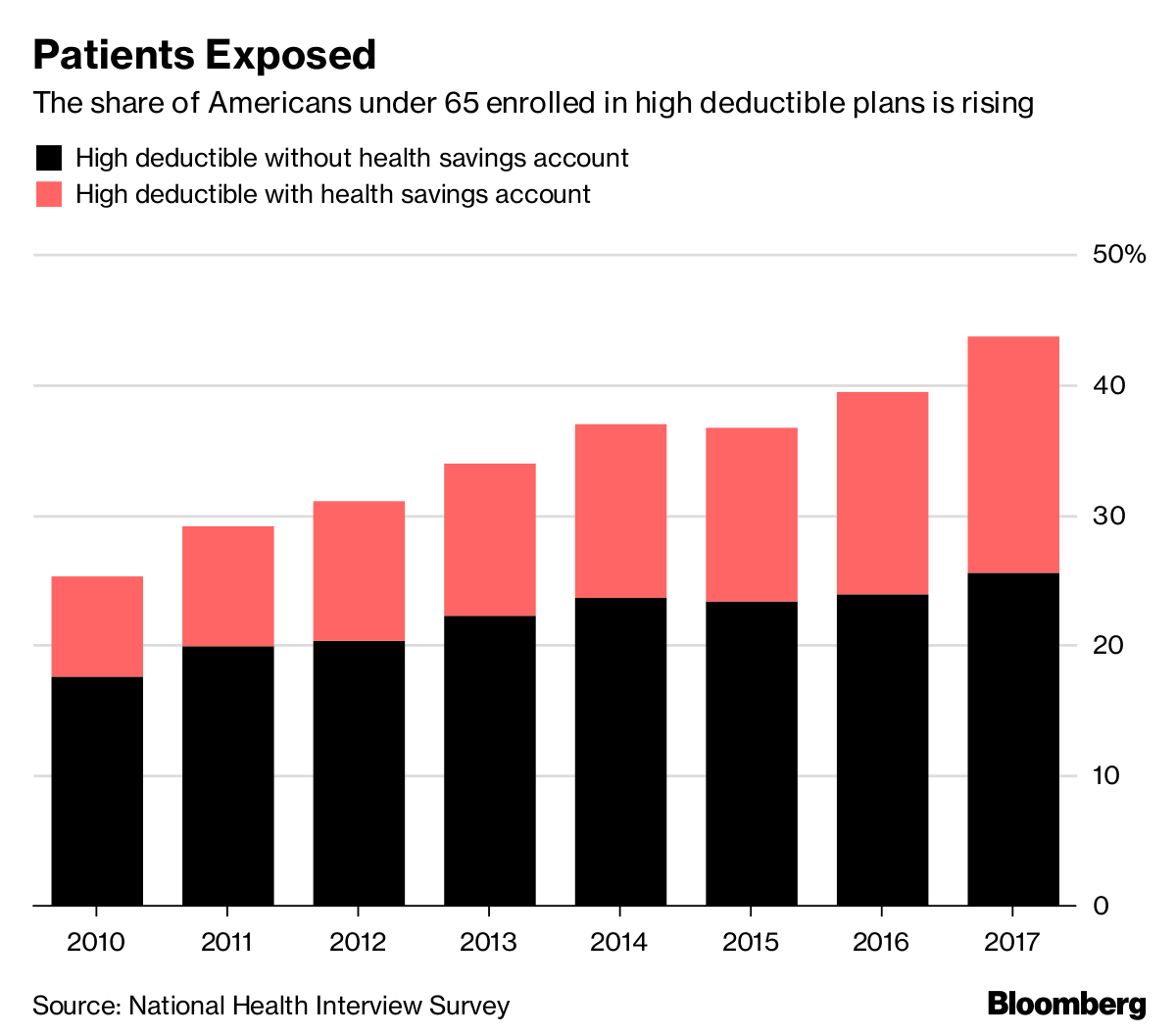
Bloomberg looks at an important trend in health care coverage: the rise of employer-based high-deductible plans that mean many patients and families simply can’t afford to get sick.

Some companies are now rethinking those policies, Bloomberg’s John Tozzi and Zachary Tracer report, after realizing that their goal of reducing costs by getting patients to have more “skin in the game” instead led workers to delay or forgo care, including medications. Patients didn’t become “better” health-care consumers. They simply cut back on what they thought they couldn’t afford — potentially driving up costs in the long run.

“High-deductible plans do reduce health-care costs, but they don’t seem to be doing it in smart ways,” said Neeraj Sood, director of research at the Leonard D. Schaeffer Center for Health Policy and Economics at the University of Southern California.

The trend: Nearly 40 percent of large employers offer only high-deductible plans, up from 7 percent in 2009, according to a survey by the National Business Group on Health cited by Bloomberg. And half of all covered workers now have a deductible of at least $1,000 for an individual, up from 34 percent in 2012 and 22 percent in 2009, according to the Kaiser Family Foundation. Nearly one in four covered workers has a deductible of $2,000 or more.

The key quote: “Why did we design a health plan that has the ability to deliver a $1,000 surprise to employees?” Shawn Leavitt, a senior human resources executive at Comcast, said at a recent conference, according to Bloomberg. “That’s kind of stupid.”

Why it matters: As employers move away from simply shifting more and more costs to their workers, Axios’ Sam Baker notes, they’re also paying more attention to bringing down underlying health care prices .


Getting Ready for Health Reform 2020: What Past Presidential Campaigns Can Teach Us

https://www.commonwealthfund.org/publications/fund-reports/2018/jun/getting-ready-health-reform-2020-presidential?omnicid=EALERT%%jobid%%&mid=%%emailaddr%%

Getting Ready for Health Reform 2020

Abstract

  • Issue: The candidates for the 2020 presidential election are likely to emerge within a year, along with their campaign plans. Such plans will include, if not feature, health policy proposals, given this issue’s general significance as well as the ongoing debate over the Affordable Care Act.
  • Goal: To explain why campaign plans matter, review the health policy components of past presidential campaign platforms, and discuss the likely 2020 campaign health reform plans.
  • Methods: Review of relevant reports, data, party platforms, and policy documents.
  • Findings and Conclusions: Proposals related to health care have grown in scope in both parties’ presidential platforms over the past century and affect both agendas and assessments of a president’s success. Continued controversy over the Affordable Care Act, potential reversals in gains in coverage and affordability, and voters’ concern suggest a central role for health policy in the 2020 election. Republicans will most likely continue to advance devolution, deregulation, and capped federal financing, while Democrats will likely overlay their support of the Affordable Care Act with some type of Medicare-based public plan option. The plans’ contours and specifics will be developed in the months ahead.

This report is the first in a series on health reform in the 2020 election campaign. Future papers will delve into key reform design questions that candidates will face, focusing on such topics as: ways to maximize health care affordability and value; how to structure health plan choices for individuals in ways that improve system outcomes; and how the experience of other nations’ health systems can inform state block-grant and public-plan proposals.

Introduction

During the 2020 presidential campaign, which begins in earnest at the end of 2018, we are sure to hear competing visions for the U.S. health system. Since 1988, health care has been among the most important issues in presidential elections.1 This is due, in part, to the size of the health system. In 2018, federal health spending comprises a larger share of the economy (5.3%) than Social Security payments (4.9%) or the defense budget (3.1%).2 Moreover, for the past decade, partisan disagreement over the Affordable Care Act (ACA) has dominated the health policy debate. If health care plays a significant role in the 2018 midterm elections, as some early polls suggest it will,3 the topic is more likely to play a central role in the 2020 election.

This report on health reform plans focuses on policies related to health insurance coverage, private insurance regulation, Medicare and Medicaid, supply, and tax policy. It explains why campaign plans are relevant, their history since 1940, the landscape for the 2020 election, and probable Republican and Democratic reform plans. The Republican campaign platform is likely to feature policies like those in the Graham-Cassidy-Heller-Johnson amendment: a state block grant with few insurance rules, replacing the ACA’s coverage expansion. The Democratic platform will probably defend, improve, and supplement the ACA with some type of public (Medicare-like) health plan. The exact contours and details of these plans have yet to be set.

Importance of Campaign Plans

Campaign promises, contrary to conventional wisdom, matter.4 During elections, they tell voters each party’s direction on major topics (e.g., health coverage as a choice or a right in 1992). In some cases, candidates or party platforms include detailed policies (reinsurance in Republicans’ 1956 platform, prospective payment in Democrats’ 1976 platform). Campaign plans tend to be used to solidify party unity, especially in the wake of divisive primaries (2016, e.g.).5 Election outcomes are affected by such factors as the state of the economy, incumbency, and political competition rather than specific issues.6 That said, some exit polls suggest that candidates’ views on health policy can affect election outcomes.7

Campaign plans also help set the agenda for a president, especially in the year after an election. Lyndon B. Johnson told his health advisers, “Every day while I’m in office, I’m gonna lose votes. . . . We need . . . [Medicare] fast.”8 Legislation supported by his administration was introduced before his inauguration and signed into law 191 days after it (Exhibit 1). Bill Clinton, having learned from his failure to advance health reform in his first term, signed the bill that created the Children’s Health Insurance Program (CHIP) 197 days after his second inauguration. Barack Obama sought to sign health reform into law in the first year of his first term, but the effort spilled into his second year; he signed the ACA into law on his 427th day in office. These presidents, along with Harry Truman, initiated their attempts at health reform shortly after taking office.

In addition, campaign plans are used by supporters and the press to hold presidents accountable. For instance, candidate Obama’s promises were the yardstick against which his first 100 days,9 first year,10 reelection prospects,11 and presidency were measured.12 Though only 4 percent of likely voters believe that most politicians keep their promises, analyses suggest that roughly two-thirds of campaign promises were kept by presidents from 1968 through the Obama years.13

Health as a Campaign Issue (1912–2016)

The United States has had public health policies since the country’s founding, with its policy on health coverage, quality, and affordability emerging in the twentieth century. Teddy Roosevelt supported national health insurance as part of his 1912 Bull Moose Party presidential bid.14 Franklin Delano Roosevelt included “the right to adequate medical care and the opportunity to achieve and enjoy good health” in his 1944 State of the Union address, although it was not mentioned in the 1944 Democratic platform.15 Harry Truman is generally credited with being the first president to embrace comprehensive reform. He proposed national health insurance in 1945, seven months after F.D.R.’s death, and campaigned on it in 1948 as part of a program that would become known as the Fair Deal, even though it was not a plank in the Democratic platform. Legislation was blocked, however, primarily by the American Medical Association (AMA), which claimed that government sponsoring or supporting expanded health coverage would create “socialized medicine.”16 Health policy became a regular part of presidential candidates’ party platforms beginning about this time (Exhibit 2).

After Truman’s failure, the next set of presidential candidates supported expanding capacity (e.g., workforce training, construction of hospitals and clinics) and making targeted coverage improvements. In 1960, John F. Kennedy campaigned on a version of Medicare legislation: extending Social Security to include hospital coverage for seniors. It was opposed by the AMA as well, whose spokesman, the actor Ronald Reagan, claimed socialized medicine would eventually limit freedom and democracy.17 It took the death of Kennedy, the landslide Democratic victory in 1964, and persistence by Lyndon B. Johnson to enact Medicare and Medicaid, in 1965. This was about 20 years after Truman introduced his proposal; President Johnson issued the first Medicare card to former President Truman.

Shortly after implementation of Medicare and Medicaid, how best to address rising health care costs became a staple subject in presidential campaigns. Between 1960 and 1990, the share of the economy (gross domestic product) spent on health care rose by about 30 percent each decade, with the public share of spending growing as well (Exhibit 3). In his 1968 campaign, Richard Nixon raised concerns about medical inflation, and subsequently proposed his own health reform, which included, among other policies, a requirement for employers to offer coverage (i.e., an employer mandate).18 Nixon’s proposal was eclipsed by Watergate, as Jimmy Carter’s health reform promises were tabled by economic concerns. Presidents and candidates in the 1980s set their sights on incremental health reforms.19

In 1991, comprehensive health reform helped Harris Wofford unexpectedly win a Pennsylvania Senate race. In 1992, it ranked as the second most important issue to voters.20 Democratic candidates vied over health reform in the 1992 primaries, with Bill Clinton embracing an employer “pay or play” mandate. George H. W. Bush developed his own plan, which included premium tax credits and health insurance reforms. Five days after his inauguration, President Clinton tasked the first lady, Hillary Clinton, with helping to develop health care legislation in the first 100 days. Yet, mostly because he prioritized economic and trade policy, Clinton did not address a joint session of Congress until September and did not send his bill to Congress until November of 1993. Key stakeholders (including the AMA and the Health Insurance Association of America) initially supported but ultimately opposed the legislation. In September 1994, the Senate Democratic leadership declared it could not pass a bill.21 Less than two months later, Democrats lost their majorities in the House and the Senate, and did not regain them for over a decade. This created a view that comprehensive reform of the complex health system was politically impossible.22 Indeed, presidential candidates in 1996, 2000, and 2004 did not emphasize major health policies. That said, by 2004, health system problems had escalated and, at least on paper, the candidates’ plans addressing them had expanded.23

In 2008, health reform was a dominant issue in the Democratic primaries and platform. Hillary Clinton supported a requirement for people who could afford it to have coverage (i.e., the individual mandate). Barack Obama limited his support to a requirement that all children be insured. Both candidates supported an employer mandate.24 John McCain countered with a plan whose scope exceeded those of many Republican predecessors: it would cap the tax break for employer health benefits and use the savings to fund premium tax credits for the individual market.25 Attention to health reform waned during the general election, as the economy faltered. Even so, the stage was set for a legislative battle. President Obama opened the door to his rivals’ ideas at a White House summit in March 2009.26 After more than a year of effort, he signed the Affordable Care Act into law.27 Obama said that he did so “for all the leaders who took up this cause through the generations — from Teddy Roosevelt to Franklin Roosevelt, from Harry Truman, to Lyndon Johnson, from Bill and Hillary Clinton, to one of the deans who’s been fighting this so long, John Dingell, to Senator Ted Kennedy.”28

Nonetheless, the partisan fight over the ACA extended into the 2012 and 2016 presidential elections. Despite the ACA’s resemblance to his own 2006 reform plan for Massachusetts, Mitt Romney, as the 2012 Republican presidential candidate, vowed to repeal the ACA before its major provisions were implemented; Republicans would subsequently replace it with conservative ideas (mostly to be developed). Four years later, even though the health system landscape had dramatically changed following the ACA’s implementation, the Republicans’ position had not altered.29 Candidate Donald Trump joined his primary rivals in pledging to “repeal and replace Obamacare” (he also embraced unorthodox ideas such as Medicare negotiation for drug prices). Democratic candidate Hillary Clinton proposed a wide array of improvements to the ACA rather than a wholesale replacement of it with a “Medicare for All” single-payer proposal, as did her Democratic primary rival, Bernie Sanders.30 The intra-party differences among primary candidates in 2016 increased attention to the party platforms relative to previous elections.31 But despite continued voter interest (Exhibit 4), differences in health policy were not credited with determining the outcome of the 2016 election.

Setting the Stage for 2020

President Trump’s attempt to fulfill his campaign promise to repeal and replace the ACA dominated the 2017 congressional agenda. In January 2017, the Republican Congress authorized special voting rules toward this effort, while President Obama was still in office. On the day of his inauguration, Trump signed an executive order to reduce the burden of the law as his administration sought its prompt repeal.32 Yet among other factors,33 the lack of a hammered-out, vetted, and agreed-upon replacement plan crippled the Republicans’ progress.34 Speaker Paul Ryan had to take his bill off the House floor on March 24, 2017, because it lacked the necessary votes; the House passed a modified bill on May 4. Senator Mitch McConnell’s multiple attempts in June and July to secure a majority in favor of his version of a health care bill failed on July 26, when Senator John McCain cast the deciding vote against it. In September, Senators Lindsey Graham, Bill Cassidy, Dean Heller, and Ron Johnson failed to get 50 cosponsors for their amendment, the prerequisite for its being brought to the Senate floor.35 The Republicans subsequently turned to tax legislation and, in it, zeroed out the tax assessment associated with the ACA’s individual mandate. At the bill’s signing on December 22, Trump claimed that “Obamacare has been repealed,”36 despite evidence to the contrary.37

A different type of legislative effort began in mid-2017: bipartisan attempts to improve the short-run stability of the ACA’s individual market. This was in part necessitated by the Trump administration’s actions pursuant to the Inauguration Day executive order: reductions in education efforts, marketing funding, and premium tax credits, among others.38 On October 12, 2017, the president signed a second ACA executive order, directing agencies to authorize the sale of health plans subject to fewer regulatory requirements.39 On the same day, his administration halted federal funding for cost-sharing reductions, a form of subsidy, claiming the ACA lacked an appropriation to make such payments. Concerns that these actions would increase premiums, reduce insurer participation, and discourage enrollment prompted coalitions of bipartisan lawmakers to introduce bills. Most notable was a bill by Senators Lamar Alexander and Patty Murray; their proposal, released October 18, 2017, had 12 Republican cosponsors and implicit support from all Democrats, giving it the 60 votes needed in the Senate to overcome a filibuster.40 Yet the version that Senator McConnell ultimately brought to the floor for a vote, in March 2018, included changes that repelled Democrats, preventing its passage.41 Partisans on both sides have blamed this failure, in part, for emerging increases in health insurance premiums.

Indeed, benchmark premiums in the health insurance marketplaces rose by an average of over 30 percent in 2018 and are projected to increase by 15 percent in 2019, largely because of policy changes.42 Some data suggest that the growth in health care costs may be accelerating as well.43 This may have contributed to an increase in the number of uninsured Americans. One survey found that the number of uninsured adults, after falling to a record low in 2016, had risen by about 4 million by early 2018.44 These statistics could heighten candidates’ interest in health policy in 2020.

Public opinion, too, could help health reform gain traction. Tracking polls suggest that concerns about health care persist, with 55 percent of Americans worrying a great deal about the availability and affordability of health care, according to a poll from March 2018.45 Interestingly, while the partisan differences of opinion on the ACA continue, overall support for the ACA has risen, reaching a record high in February 2018 (Exhibit 5).

This concern about health care has entered the 2018 midterm election debate. It is currently a top midterm issue among registered voters, a close second to jobs and the economy.46 Some House Republicans who formerly highlighted their promise to repeal and replace the ACA no longer do so in light of the failed effort of 2017.47 Democrats, in contrast to previous elections, have embraced the ACA, unifying around its defense in the face of Republican “sabotage.”48 The debate also has been rekindled by Trump’s decision to abandon legal defense of key parts of the ACA.49 Regardless of what happens in the courts, this signifies his antipathy toward the law. Barring a midterm surprise, the next Congress is unlikely to succeed where the last one failed. As such, “repeal and replace” would be a repeat promise in Trump’s reelection campaign.

Likely 2020 Campaign Plans

Against this backdrop, presidential primary candidates and the political parties will forge their health care promises, plans, and platforms. Common threads from past elections are likely to be woven into the 2020 debate. The different parties’ views of the balance between markets and government have long defined their health reform proposals.50 Republicans will most likely still be against the ACA as well as uncapped Medicare and Medicaid spending, and for market- and consumer-driven solutions. Democrats will most likely blame Republicans’ deregulation for rising health care costs; defend the ACA, Medicare, and Medicaid; and advocate for a greater role for government in delivering health coverage and setting payment policy. Potential policies for inclusion in candidates’ plans have been introduced in Congress (Exhibit 6). But major questions remain, such as: how will these campaign plans structure choices for individuals and employers, promote efficient and high-quality care, and learn from the experience of local, state, national, and international systems?

Likely Republican Campaign Plan: Replace the ACA with Devolution and Deregulation

President Trump has indicated he will run for reelection in 2020.51 His fiscal year 2019 budget included a proposal “modeled closely after the Graham-Cassidy-Heller-Johnson (GCHJ) bill.” It would repeal federal financing for the ACA’s Medicaid expansion and health insurance marketplaces, using most of the savings for a state block grant for health care services. It would also impose a federal per-enrollee spending cap on the traditional Medicaid program. States could waive the ACA’s insurance reforms.52 The congressional bill also would repeal the employer shared responsibility provision (i.e., the employer mandate) and significantly expand tax breaks for health savings accounts, among other policies.53 The framework for this proposal — repealing parts of the ACA, replacing them with state block grants, reducing regulation, and expanding tax breaks — is similar to the 2016 Republican platform.

Trump may continue to express interest in lowering prescription drug costs. In 2016 and early 2017, he supported letting Medicare negotiate drug prices54 — a policy excluded from the 2016 Republican platform and his proposals as president. His 2019 budget seeks legislation primarily targeting insurers and other intermediaries that often keep a share of negotiated discounts for themselves.55 On May 11, 2018, he released a “blueprint” to tackle drug costs, including additional executive actions and ideas for consideration. Polls suggest that prescription drug costs rank high among health care concerns.56

One policy initiative in the recent Republican platforms but not embraced by the president is Medicare reform. The idea of converting Medicare’s defined benefit into a defined contribution program and raising the eligibility age to 67 was supported by Vice President Mike Pence when he was a member of Congress and by Speaker of the House Paul Ryan.57 Major Medicare changes were excluded from the 2017 ACA repeal and replace proposals. In contrast, versions of Medicaid block grant proposals appeared in various bills, including the GCHJ amendment, as well as numerous Republican presidential platforms.

Historically, presidents running for reelection have limited competition in primaries. Those challengers, by definition, emphasize their differences with the incumbent, which may include policy. It may be that John Kasich will run on maintaining the ACA Medicaid expansion but otherwise reforming the program (his position as governor of Ohio throughout 2017). Or, Rand Paul could campaign on his plan to repeal even more of the ACA than the Republicans’ 2017 bills attempted to do. Incumbents tend to have slimmer campaign platforms than their opponents in general and primary elections, since their budget proposals, other legislative proposals, and executive actions fill the policy space (see Reagan, Clinton, George W. Bush, Obama). Exceptions include George H. W. Bush, who in 1992 developed a plan given voters’ concerns about health; and Nixon, who offered a proposal for health reform at the end of his first term.

Likely Democratic Campaign Plan: Improve the ACA and Add a Public Plan

It is possible and maybe probable that the ultimate Democratic Party platform in 2020 will resemble that of 2016: build on the ACA and include some sort of public plan option. Legislation has been introduced during this congressional session that builds on the law by extending premium tax credits to higher-income marketplace enrollees (e.g., Feinstein, S. 1307), lowering deductibles and copayments for middle-income marketplace enrollees (e.g., Shaheen, S. 1462), providing marketplace insurers with reinsurance (e.g., Carper, S. 1354), and strengthening regulation of private market insurance (e.g., Warren, S. 2582). Some proposals aim to increase enrollment following the effective repeal of the individual mandate, by, for example, raising federal funding for education and outreach, and testing automatic enrollment of potentially eligible uninsured people (e.g., Pallone, H.R. 5155). These proposals would have different effects on health insurance coverage, premiums, and federal budget costs.58

The Democrats will inevitably discuss a public plan in their platform, although the primary contenders will most likely disagree on its scale (e.g., eligibility) and design (e.g., payment rates, benefits).59 In September 2017, Senator Bernie Sanders introduced the Medicare for All Act (S. 1804). It would largely replace private insurance and Medicaid with a Medicare-like program with generous benefits and taxpayer financing. “Medicare for more” proposals have also been introduced: Medicare Part E (Merkley, S. 2708), an option for individuals and small and large businesses; Medicare X (Bennet, S. 1970), which is available starting in areas with little insurance competition or provider shortages; and a Medicare buy-in option, for people ages 50 to 65 (Higgins, H.R. 3748). A Medicaid option (Schatz, S. 2001), similar to Medicare Part E, offers a public plan choice to all privately insured people, aiming to capitalize on the recent popularity of that program. Publicly sponsored insurance plans have long been included in Democratic presidents’ platforms, although the government’s role has ranged from regulating the private plans (Carter, Clinton) to sponsoring them (Truman, Obama). It may be that the candidate who prevails in the primaries will determine whether the Democratic platform becomes “Medicare for all” or “Medicare for more.”

This may be the extent of Medicare policies in the 2020 Democratic platform. Relatively high satisfaction and low cost growth in Medicare have limited Democratic interest in Medicare policy changes in recent years. Similarly, Democrats have not introduced or embraced major reforms of Medicaid. However, the public concern about prescription drug costs has fueled Democratic as well as Republican proposals, some of which target the drug companies (e.g., addressing “predatory pricing,” allowing Medicare rather than prescription drug plans to negotiate the prices for the highest-cost drugs).60

Discussion

Predictions about presidential campaigns have inherent limits, as many experts learned in the 2016 election. Events concerning national security (e.g., conflict), domestic policy (e.g., a recession), or the health system (e.g., a disease outbreak) could alter the policy choices of presidential candidates. New ideas could emerge, or candidates could take unconventional approaches to improving the health system. And, while campaign plans have relevance, the long history of attempts at health reform underscores that by no means are promises preordained.

That said, perennial policies and recent political party differences will likely figure in 2020. Republican presidential candidates, with few exceptions, have adopted a small government approach to health reform: shifting control to states, cutting regulation, preferring tax breaks and block grants over mandatory federal funding, and trusting markets to improve access, affordability, and quality. Democratic presidential candidates have supported a greater government role in the health system, arguing that market solutions are insufficient, and have defended existing programs like Medicare, Medicaid, and, now, the ACA. Some will probably support the government’s taking a primary role in providing coverage given criticism of the efficacy and efficiency of private health insurers. The direction and details of the campaign plans for 2020 will be developed in the coming months and year. Given such plans’ potential to shape the next president’s agenda, now is the time to scrutinize, modify, and generate proposals for health reform.


Sky-High Deductibles Broke the U.S. Health Insurance System

https://www.bloomberg.com/news/features/2018-06-26/sky-high-deductibles-broke-the-u-s-health-insurance-system

Image result for Sky-High Deductibles Broke the U.S. Health Insurance System


Image result for Sky-High Deductibles Broke the U.S. Health Insurance System


Should States Allow Insurers to Offer Bare-Bones Health Plans With Fewer Mandated Benefits?

Health insurance is complicated. In many states, it’s about to get worse.

Image result for skinny health plans


Health insurance is complicated. In many states, it’s about to get worse.

That’s the opening of a piece of mine in the Wall Street Journal (gated, unfortunately) about what states should do in response to the Trump administration’s anticipated relaxation of rules governing short-term plans.

Where states allow short-term plans without restriction, the plans will be a lot cheaper than those sold on the exchanges because they don’t have to comply with the ACA. But that low price comes with big tradeoffs.

Short-term plans don’t have to sell to all comers, nor do they have to cover pre-existing conditions. Sick people will have no real choice but to buy insurance on the exchanges. To cover the medical costs of a relatively sicker group of people, exchange insurers will have to increase their premiums.

People who earn less than four times the poverty level will be shielded from the price increases because the ACA caps premiums at no more than about 10% of income. The federal government, however, has to pick up the rest of the tab-so as prices go up, federal outlays will, too, squandering an estimated $38.7 billion over 10 years.

Hurt worst will be people who earn more than four times the poverty level. Federal actuaries estimate that they’ll pay 6% more on account of the short-term rule by 2022. That will come on top of price increases associated with Congress’s repeal of the individual mandate. In 2019 alone, the Urban Institute predicts that insurance prices will grow, on average, by about 18%.

Beyond that, people who buy short-term plans may be surprised to discover just how stingy they are. Insurance is complicated: people rarely read, much less understand, all the fine print. And there’s a lot of fine print.

Squeeze On Affordable Health Insurance For 50- To 64-Year-Olds

https://www.forbes.com/sites/howardgleckman/2018/06/21/the-trump-administrations-squeeze-on-affordable-health-insurance-for-50-64-year-olds/#4ea0538b1d94

Image result for high health premiums

In a series of recent decisions, the Trump Administration is taking steps that will sharply raise insurance premiums for people aged 50 to 64, just before they become eligible for Medicare. While these steps are likely to make coverage less expensive for young, healthy consumers, they will inevitably raise costs for middle-aged people with chronic conditions. For many, insurance will become unaffordable. And that lack of coverage will eventually result in higher costs for Medicare.

Trump is taking three major steps that will affect the availability of Affordable Care Act health insurance for middle-aged consumers.  

Repealing but not replacing

First, at the urging of the Trump Administration, Congress last year repealed the tax penalty that has to be paid by those without health insurance, effective for tax year 2019. The penalty is the ACA’s mechanism to push people to buy insurance. The logic: By broadening the pool of those with ACA insurance to include those less likely to incur significant medical costs, the individual mandate would keep premiums relatively low for everyone.

Then, early this month, the Trump Administration refused to defend the remaining provisions of the ACA in federal court. In the case Texas v. the federal Department of Health and Human Services, 20 red states argued that, absent the now-repealed individual mandate, the rest of the ACA will be unconstitutional. Thus, all its other provisions, including several important to those older consumers, also would be thrown out. They include premium limits for those 50-64, minimum benefit requirements,  and the ban on insurance companies rejecting potential purchasers due to pre-existing conditions.

Pre-existing conditions

Prior to the ACA, in a practice known as age-rating, 60-year-olds could pay premiums that were 11 times higher than younger buyers. The ACA capped that ratio at 3:1. AARP estimates that bumping it up to 5:1 would raise annual premiums for a 60-year-old by more than $3,000, or 22%.

Similarly, allowing carriers to underwrite for pre-existing conditions would make insurance widely unavailable for people aged 50 to 64. AARP estimates that 25 million people, or 40% of those 50 to 64, have a condition that could disqualify them from non-group insurance.

The Urban Institute’s Health Policy Center estimates that tossing out the remaining provisions of the ACA would result in 17 million people losing commercial insurance and another 15 million losing Medicaid and children’s health care under the CHIP program.

By Urban colleagues project that even those remaining  in the private individual insurance market “would likely have policies that cover fewer benefits and require more out-of-pocket spending for services.”

Rare agreement

The Texas lawsuit, and the Administration’s refusal to defend the law in court, has generated an outpouring of opposition. It created a rare moment when consumer groups, hospitals, and doctors agreed on a health policy issue.

But the story doesn’t end there. This week, the Trump Administration took one more step towards dismantling the ACA in a way that will likely harm pre-Medicare consumers: The Department of Labor adopted new rules opening the door to low cost, low-benefit health plans.  These will now be widely available to small businesses and, importantly, self-employed individuals.

The Congressional Budget Office estimates that 4 million people will buy these policies, sold by association health plans (AHPs). The consulting firm Avalere Health estimates that individual AHP premiums will be an average of $9,700 cheaper than ACA coverage, and that 1 million people will shift from marketplace plans to AHP policies. But it predicts premiums will rise by 3.5 percent for more comprehensive ACA insurance, largely because the remaining consumers will be older and sicker than AHP buyers.

President Trump promotes these plans as a less costly alternative to ACA coverage. This week he told the National Federation of Independent Business, “You’re going to save massive amounts of money and have much better health care. You’re going to save a fortune and you’re going to be able to give yourselves and your employees tremendous health care.”

Low cost, few benefits

But the plans do not include any minimum benefit requirements. Thus, they can exclude coverage for pregnancies, mental health issues, or drugs or hospital care. Carriers won’t be able to exclude buyers on the basis of pre-existing conditions but can adjust premiums based on age or sex. And, because they often exclude benefits important to those with chronic conditions, such as medications, they don’t need to underwrite: Those consumers simply won’t buy these policies.

Priced out of ACA coverage and uninterested in limited insurance that won’t cover their needs, it is easy to imagine many of those in their early 60s simply going without coverage (and care) until they become eligible for Medicare at age 65. That will not only put their health at risk, it will raise Medicare costs. Medicare spends about one-third more on medical care for those who join the program without having had insurance in the year before enrolling.

The result of all this: Trump is creating two separate individual health insurance markets, one for young and healthy people, and one for older and sick people.  Some young people may buy low-cost policies that will serve them well—until they get sick. Many older people won’t buy insurance at all, risking their health and, very likely, raising costs to government.


Perceptions of Affordability Among Individual Market Enrollees in California in 2017

Perceptions of Affordability Among Individual Market Enrollees in California in 2017

Image result for california healthcare foundation

In 2017 researchers at The Mongan Institute, Massachusetts General Hospital, and Harvard Medical School sought to answer the following questions: How affordable do Californians in the individual health insurance market perceive their insurance to be? How affordable do they perceive their out-of-pocket costs for medical care to be? How frequently do they report delaying or avoiding medical care because of costs? How frequently do they report cutting back on other necessities (like food, rent, other basics) or borrowing money to pay for care?

Researchers surveyed adult (age 18+) individual market enrollees in 2017 who selected qualified health plans through Covered California or outside of the Covered California marketplace (N = 2,912). The survey was conducted in English and Spanish, and respondents could complete the survey by telephone, web, or paper. The survey was fielded between May and October 2017 with a response rate of 42%.

Key Findings

1. On average, 40% of enrollees reported having some difficulty paying their monthly insurance premiums. Sicker enrollees and African American enrollees were more likely to report having difficulty.

2. On average, 31% of enrollees reported difficulty paying out-of-pocket costs when using health care. Similar to premium affordability, sicker enrollees and African American enrollees were more likely to report having difficulty.

3. Almost one in four enrollees (24%) who reported needing care delayed/avoided care due to costs.

4. Close to one in three (32%) enrollees reported some sort of financial stress due to health care costs: They reported cutting necessities, borrowing money, or both. This was more common among lower-income enrollees, African American enrollees, and sicker enrollees.