Congress Warns Against Medicaid Cuts: ‘You Just Wait for the Firestorm’

Image result for Congress Warns Against Medicaid Cuts: ‘You Just Wait for the Firestorm’

WASHINGTON — If President Trump allows states to convert Medicaid into a block grant with a limit on health care spending for low-income people, he will face a firestorm of opposition in Congress, House Democrats told the nation’s top health official on Tuesday.

The official, Alex M. Azar II, the secretary of health and human services, endured more than four hours of bipartisan criticism over the president’s budget for 2020, which would substantially reduce projected spending on Medicaid, Medicare and biomedical research. Democrats, confronting Mr. Azar for the first time with a House majority, scorned most of the president’s proposals.

But few drew as much heat as Mr. Trump’s proposed overhaul of Medicaid. His budget envisions replacing the current open-ended federal commitment to the program with a lump sum of federal money for each state in the form of a block grant, a measure that would essentially cap payments and would not keep pace with rising health care costs.

Congress rejected a similar Republican plan in 2017, but in his testimony on Tuesday before the Health Subcommittee of the House Energy and Commerce Committee, Mr. Azar refused to rule out the possibility that he could grant waivers to states that wanted to move in that direction.

Under such waivers, Mr. Azar said, he could not guarantee that everyone now enrolled in Medicaid would keep that coverage.

“You couldn’t make that kind of commitment about any waiver,” Mr. Azar said. He acknowledged that the president’s budget would reduce the growth of Medicaid by $1.4 trillion in the coming decade.

Representative G. K. Butterfield, Democrat of North Carolina, said that “block-granting and capping Medicaid would endanger access to care for some of the most vulnerable people” in the country, like seniors, children and the disabled.

Mr. Trump provoked bipartisan opposition by declaring a national emergency to spend more money than Congress provided to build a wall along the southwestern border. If the president bypasses Congress and allows states to convert Medicaid to a block grant, Mr. Butterfield said, he could face even more of an outcry.

“You just wait for the firestorm this will create,” Mr. Butterfield said, noting that more than one-fifth of Americans — more than 70 million low-income people — depend on Medicaid.

As a candidate, Mr. Trump said he would not cut Medicare, but his new budget proposes to cut more than $800 billion from projected spending on the program for older Americans in the next 10 years. Mr. Azar said the proposals would not harm Medicare beneficiaries.

“I don’t believe any of the proposals will impact access to services,” Mr. Azar said. Indeed, he said, the cutbacks could be a boon to Medicare beneficiaries, reducing their out-of-pocket costs.

After meeting an annual deductible, beneficiaries typically pay 20 percent of the Medicare-approved amount for doctor’s services and some prescription drugs administered in doctor’s offices and outpatient hospital clinics.

Mr. Azar defended a budget proposal to impose work requirements on able-bodied adults enrolled in Medicaid. Arkansas began enforcing such requirements last year under a waiver granted by the Trump administration. Since then, at least 18,000 Arkansans have lost Medicaid coverage.

Mr. Azar said he did not know why they had been dropped from Medicaid. It is possible, he said, that some had found jobs providing health benefits.

Representative Joseph P. Kennedy III, Democrat of Massachusetts, said it would be reckless to extend Medicaid work requirements to the entire country without knowing why people were falling off the rolls in Arkansas.

If you are receiving free coverage through Medicaid, Mr. Azar said, “it is not too much to ask that you engage in some kind of community engagement.”

Representative Fred Upton, Republican of Michigan, expressed deep concern about Mr. Trump’s proposal to cut the budget of the National Cancer Institute by $897 million, or 14.6 percent, to $5.2 billion.

Mr. Azar said the proposal was typical of the “tough choices” in Mr. Trump’s budget. He defended the cuts proposed for the National Cancer Institute, saying they were proportional to the cuts proposed for its parent agency, the National Institutes of Health.

The president’s budget would reduce funds for the N.I.H. as a whole by 12.6 percent, to $34.4 billion next year.

Mr. Azar was also pressed to justify Mr. Trump’s proposal to cut federal payments to hospitals serving large numbers of low-income patients. Representative Eliot L. Engel, Democrat of New York, said the cuts, totaling $26 billion over 10 years, would be devastating to “safety net hospitals” in New York and other urban areas.

Mr. Azar said that the Affordable Care Act, by expanding coverage, was supposed to “get rid of uncompensated care” so there would be less need for the special payments.

While Democrats assailed the president’s budget, Mr. Azar relished the opportunity to attack Democrats’ proposals to establish a single-payer health care system billed as Medicare for all.

Those proposals could eliminate coverage provided to more than 20 million people through private Medicare Advantage plans and to more than 155 million people through employer-sponsored health plans, he said.

But Mr. Azar found himself on defense on another issue aside from the president’s budget: immigration. He said he was doing his best to care for migrant children who had illegally entered the United States, were separated from their parents and are being held in shelters for which his department is responsible.

He said he was not aware of the “zero tolerance” immigration policy before it was publicly announced in April 2018 by Attorney General Jeff Sessions. If he had known about the policy, Mr. Azar said, “I could have raised objections and concerns.”

Representative Anna G. Eshoo, Democrat of California and the chairwoman of the subcommittee, summarized the case against the president’s budget.

“The Trump administration,” she said, “has taken a hatchet to every part of our health care system, undermining the Affordable Care Act, proposing to fundamentally restructure Medicaid and slashing Medicare. This budget proposes to continue that sabotage.”



The “Medicare for All” Continuum: A New Comparison Tool for Congressional Health Bills Illustrates the Range of Reform Ideas

https://www.commonwealthfund.org/blog/2019/medicare-all-continuum

Medicare for all paperwork

Several 2020 Democratic presidential candidates have called for “Medicare for All” as a way to expand health coverage and lower U.S. health care costs. Replacing most private insurance with a Medicare-like system for everyone has instilled both hope and fear across the country depending on people’s perspective or financial stake in the current health care system. But a closer look at recent congressional bills introduced by Democrats reveals a set of far more nuanced approaches to improving the nation’s health care system than the term Medicare for All suggests. To highlight these nuances, a new Commonwealth Fund interactive tool launched today illustrates the extent to which each of these reform bills would expand the public dimensions of our health insurance system, or those aspects regulated or run by state and federal government.1

The U.S Health Insurance System Is Both Public and Private

The U.S. health insurance system comprises both private (employer and individual market and marketplace plans) and public (Medicare and Medicaid) coverage sources, as the table below shows. In addition, both coverage sources are paid for by a mix of private and taxpayer-financed public dollars.

Most Americans get their insurance through employers, who either provide coverage through private insurers or self-insure. Employers and employees share the cost through premiums and cost-sharing such as deductibles, copayments, and coinsurance. But the federal government significantly subsidizes employer coverage by excluding employer premium contributions from employees’ taxable income. In 2018 this subsidy amounted to $280 billion, the largest single tax expenditure.

About 27 million people are covered through regulated private plans sold in the individual market, including the Affordable Care Act’s marketplaces. This coverage is financed by premiums and cost-sharing paid by enrollees. The federal government subsidizes these costs for individuals with incomes under $48,560.

For 44 million people, Medicaid or the Children’s Health Insurance Program is their primary source of coverage. These public programs are financed by federal and state governments, and small individual premium payments and cost-sharing in some states. In most states, these benefits are provided through private insurers.

Medicare covers 54 million people over age 65 and people with disabilities. The coverage is financed by the federal government along with individual premiums and significant cost-sharing. About 20 million people get their Medicare benefits through private Medicare Advantage plans and most beneficiaries either buy supplemental private insurance or qualify for additional coverage through Medicaid to help lower out-of-pocket costs and add long-term-care benefits.

Millions Still Uninsured or Underinsured, Health Care Costs High

The coverage expansions of the ACA — new regulation of private insurance such as requirements to cover preexisting conditions, subsidies for private coverage on the individual market, and expanded eligibility for Medicaid — lowered the number of uninsured people and made health coverage more affordable for many. But 28 million people remain uninsured and at least 44 million are underinsured. In addition, overall health care and prescription drug costs are much higher in the United States than in other wealthy countries. U.S. health care expenditures are projected to climb to nearly $6 trillion by 2027.

The Medicare for All Continuum

To address these problems, some Democrats running for president in 2020 are supporting Medicare for All. Meanwhile, in Congress, Democrats have introduced a handful of bills that might be characterized as falling along a continuum, with Medicare for All at one end.

As our new Commonwealth Fund interactive tool illustrates, the bills range from adding somewhat more public sector involvement into the system, to adding substantially more public sector involvement. The bills may be broadly grouped into three categories:

  • Adding public plan features to private insurance. These include increasing regulation of private plans such as requiring private insurers who participate in Medicare and Medicaid to offer health plans in the ACA marketplaces, and enhancing federal subsidies for marketplace coverage.
  • Giving people a choice of public plans alongside private plans. These bills include offering a Medicare-like public plan option through the marketplaces, extending that option to employers to offer to their employees, giving people ages 50 to 64 the option to buy in to Medicare, and giving states the option to allow people to buy in to Medicaid. These bills also bring the federal government’s leverage into provider rate-setting and prescription drug price negotiation.
  • Making public plans the primary source of coverage in the U.S. These are Medicare-for-All bills in which all residents are eligible for a public plan that resembles the current Medicare program, but isn’t necessarily the same Medicare program we have today. The bills vary by whether people would pay premiums and face cost-sharing, the degree to which they end current insurance programs and limit private insurance, how provider rates are set, whether global budgets are used for hospitals and nursing homes, and how long-term care is financed. All of the bills in this category allow people to purchase supplemental coverage for benefits not covered by the plan.

Looking Forward

Many Democratic candidates who have called for Medicare for All are cosponsors of more than one of these bills. The continuum of approaches suggests both the possibility of building toward a Medicare for All system over time, or adopting aspects of Medicare for All without the disruption that a major shift in coverage source might create for Americans. We will continue to update the tool as new bills are introduced or refined. Users also can view a comparison tool of other wealthy countries’ health systems, which shows where select countries fall on a continuum ranging from regulated systems of public and private coverage to national insurance programs.


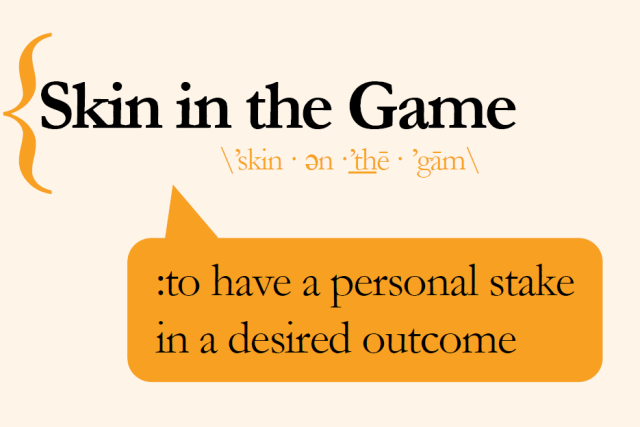
“Skin in the game” doesn’t work

https://www.healthaffairs.org/doi/abs/10.1377/hlthaff.2018.05018?stream=top&utm_campaign=newsletter_axiosvitals&utm_medium=email&utm_source=newsletter&journalCode=hlthaff

Image result for skin in the game

Making people pay more of their health care bill out of pocket does not make them smarter shoppers, according to a new study published in Health Affairs, which corroborates earlier research.

The big picture: Part of the idea behind those ever-increasing insurance deductibles is that patients who have to put more of their own money on the line will become better consumers, comparison-shopping for the highest-quality, lowest-cost services.

  • But it doesn’t seem to work that way in the real world.

What they’re saying: In the Health Affairs survey of people with high-deductible plans …

  • Just 25% had talked to their provider about how much something would cost.
  • 14% had compared prices at multiple facilities.
  • 14% had compared quality metrics for multiple facilities.
  • 7% had tried to negotiate a price.

Between the lines: People don’t do these things because they don’t even think of it, or assume it won’t work. Or, to borrow some truly glorious academic-speak: “Perceptions of futility were common impediments to engagement.”

  • separate study, also published in Health Affairs, did find one effect of high deductibles: They seem to make women more likely to delay treatment for breast cancer.

Yes, but: There’s some evidence that if patients try to avail themselves of comparison-shopping tools, they can achieve real savings, at least for MRIs and other imaging procedures.


Stand-alone ERs are crazy expensive

https://www.unitedhealthgroup.com/content/dam/UHG/PDF/2017/Freestanding-ER-Cost-Analysis.pdf?utm_source=newsletter&utm_medium=email&utm_campaign=newsletter_axiosvitals&stream=top

Image result for freestanding emergency room

Freestanding emergency departments, which provide emergency medical care but are physically separate from hospitals, charge many times more than other providers for the same care, according to a new analysis by UnitedHealth Group.

  • (Standard disclaimers apply: Yes, the nation’s biggest insurer has some skin in the game here on ER costs. But there’s also plenty of other evidence that ER costs are indeed very high.)

How it works: Freestanding ERs often don’t provide treatment for common emergencies like trauma, strokes and heart attacks, per my colleague Caitlin Owens.

  • Only 2.3% of visits to freestanding emergency departments are for actual emergency care.
  • The number of these facilities increased from 222 in 2008 to 566 in 2016.
  • In Texas, the average cost of treating common conditions at a freestanding emergency department is 22 times greater than treatment at a doctor’s office, and 19 times more than at an urgent care center.
  • If the location of care was changed to one of these cheaper alternatives, it’d save more than $3,000 per visit.
  • Freestanding emergency departments are disproportionately located in affluent areas that have access to other providers, and in Texas, less than one in four receive ambulances.

The bottom line: It is much, much cheaper to go see your family doctor if you have a fever — the most common diagnosis at Texas freestanding emergency departments.


Health care spending is more than just the parts you see

https://www.axios.com/understanding-health-care-spending-46e21c47-79ee-474b-80ff-778a705cdcae.html

Illustration of a red cross spinning to reveal money

People focus on the health costs that are most tangible and sometimes outrageous to them: their deductibles, and drug costs, and surprise medical bills, and the annual increase in the share of the premium they pay. But there’s more that gets less attention because it’s not as visible to them.

Why it matters: To really understand how Medicare for All or any other big change in health care financing would affect them, people need to understand how they would impact their overall family health budgets. Few people think about the other health costs they pay: their taxes to support health care, or what their employers are paying towards premiums (which is depressing their wages).

Between the lines: Consider this hypothetical example of a total family health “budget”:

  • The Browns, a family of four with at least one member in poor health and a $50,000 income, have standard employer coverage much like 156 million other Americans. They spend $9,250 per year (19% of their income) on health.
  • This includes $3,950 (8% of their income) in out-of-pocket health spending, $3,900 (8% of their income) in health insurance premiums, and, although they are almost certainly not aware of it, approximately $1,400 (3% of their income) in state and federal taxes that fund health programs.
  • The Browns are not taxed on the contributions their employer makes toward health insurance premiums, which economists generally say offset wages. Their employer is contributing an additional $13,050 to their health insurance premiums, as well as $750 in Medicare payroll taxes.
  • When combined, the Brown’s spending on health care and the money spent by their employer on their behalf totals a considerable $23,050. And remember, they make $50,000.

A few ideas that could help people learn more about their health total care spending and how reform proposals might affect their health spending:

  • The IRS and states could include a simple pie chart on everyone’s tax forms, showing taxpayers where their tax dollars go today.
  • Along with estimating the impact of health reform legislation on the federal budget, or the number of uninsured, the CBO could estimate its impact on typical family budgets, taking into account all of the forms of health spending families have today. Organizations like ours could do this as well.

What to watch: This could be particularly important when analyzing Medicare for All proposals, since they would so significantly alter the financing of health care by shifting it from premiums and out-of-pocket costs to taxes.

  • A Medicare for All plan would likely reduce what the nation spends on health care by lowering payment rates to providers and creating administrative efficiencies. The average family would likely pay less, but how much is hard to say without more details.
  • However, by changing the financing so significantly, there would likely be both winners and losers. Low-income people and sick people might pay less, and higher-income people and those who are healthy could pay more.

The bottom line: We can only get a clear picture of how family finances would be affected by Medicare for All, or any other significant overhaul of the health care system, by looking at the totality of what they pay now.


Insurers don’t pay full price for medicines, why do you?

https://www.letstalkaboutcost.org/

Image result for health insurance drug discounts

A new study found net prices for medicines grew just 1.5% last year. Unfortunately, it doesn’t feel that way for you. Forty percent of a medicine’s list price is given as a rebate or discount to the government and middlemen, like insurers and pharmacy benefit managers (PBMs).

These rebates and discounts exceed $150 billion annually, but insurers don’t always share these savings with you.

Visit LetsTalkAboutCost.org to find out more.


Soaking the Sick to Make the Rich Even Richer

https://www.realclearhealth.com/articles/2019/02/13/pbms_soaking_the_sick_to_make_the_rich_even_richer_110866.html?utm_source=morning-scan&utm_medium=email&utm_campaign=mailchimp-newsletter&utm_source=RC+Health+Morning+Scan&utm_campaign=db14e4ebca-MAILCHIMP_RSS_EMAIL_CAMPAIGN&utm_medium=email&utm_term=0_b4baf6b587-db14e4ebca-84752421

Related image


Congressional Democrats have quickly lined up to oppose the Trump Administration’s proposal to eliminate regulations that make it illegal for drug companies to reduce – or eliminate – what Medicare consumers pay for prescriptions under the Part D program.

Instead, they are pushing plans to give health insurers and the pharmacy benefit management (PBM) companies they run and own even more control over what medicine consumers can choose and how much they cost.  In doing so, Democrats are backing a government-sanctioned drug pricing cartel that extorts nearly a quarter of trillion dollars a year from prescription drug rebates, discounts, and patients (in the form of out-of-pocket costs), and shares a pittance with the patients who need medicines the most. Eighty percent of drug benefits are managed by the 3 largest PBMs, which in turn are owned by or in part by the 3 largest insurance companies.

Current Medicare regulations makes it illegal for any firm other than PBMs to handle drug prices and distribution.  Specifically, PBMs are given free rein to determine what medicines patients can and can’t use.  This power allows them to reduce the list price of drugs by obtaining rebates in exchange for encouraging the use of some treatments while discouraging the use of other medicines.  PBMs either require patients to try drugs that generate the most rebates first or force people to pay part or all of the list price of medicines that don’t generate much money.

As a result, of $140 billion Medicare Part D spent on medicines, $64 billion was pocketed by PBMs and health plans.  And of the $460 billion all Americans spent on drugs in 2018 nearly $166 billion went to discounts and rebates.

Parroting the PBM/insurer talking points, Nancy Pelosi’s health policy advisor, Wendell Primus, said prices – not rebates – are the cause of high drug costs, and savings from rebates negotiated by pharmacy benefit managers go toward reducing insurance premiums.

In fact, PBMs keep Part D premiums artificially low by collecting rebates and other fees at the retail counter. Because Medicare starts paying for 80 percent of drug costs after seniors shell out over $4500 at the pharmacy, plumping up the retail price with rebates means PBMs and insurers reduce premiums by shifting more cost to the government and ultimately by forcing seniors to pay more for medicines.

Moreover, PBMs are using rebates extracted from the medicines the most seriously ill patient uses to subsidize the drug spending and premiums of everyone else. People with cancer, HIV, Parkinson’s, autoimmune diseases are only 2 percent of the population. But in 2017 the drugs they use generated $53 billion, or 32 percent of all rebates and discounts.

These rebates could be used to reduce out-of-pocket costs of even the most expensive drugs to 50 dollars or less.  Instead PBMs and plans actually make seniors pay a large percentage of the retail cost of the rebated drugs  In fact, as rebates have increased, plans have made more consumers of these so-called specialty drugs to pay up to 50 percent of the retail price of medicines instead of a small copay.  Nearly 25 percent of all consumers now pay full price for drugs. As an IQVIA report found: “people who use specialty medicines are 10 times more likely to pay full price for the most expensive medicine. On average, they are 10 times more likely to pay over $2500.”

In 2017, 2 percent of the most vulnerable consumers paid PBMs and health plans $16 billion in out-of-pocket costs.  Soaking the sick to make the rich even richer.  The quickest way to cut the cost of medicines to what they are in Europe is to eliminate the PBM protection racket and give drug companies the freedom to dramatically reduce the out-of-pocket cost for the most expensive medicines.  To be sure, a growing number of drug firms and insurers are working together to eliminate out-of-pocket costs as part of programs to improve health by reducing barriers to access.  Indeed, because PhRMA and BIO have stated that consumers should pay less, the Trump proposal is truly a ‘put up or shut up’ moment for the industry.

Under the current rules, it doesn’t pay for PBMs and insurers to choose a drug with lower out-of-pocket costs, and drug companies have no incentive to tie out-of-pocket costs to better care.  Under current rules, patients are unable to afford the medicines that keep them alive. The Trump proposal would change all that.  It’s up to Democrats to explain why, instead of cutting drug costs dramatically and directly, they want to line the pockets of big corporations with money from the sickest patients.


‘Outrageous giveaway to Big Pharma’: A political ‘bomb’ over drug prices may threaten NAFTA 2.0

https://www.japantimes.co.jp/news/2019/02/13/business/outrageous-giveaway-big-pharma-political-bomb-drug-prices-may-threaten-nafta-2-0/#.XGR6YlVKi1s

Image result for big pharma

The clash over free trade in North America has long been fought over familiar issues: low-paid Mexican workers. U.S. factories that move jobs south of the border. Canada’s high taxes on imported milk and cheese.

But as Democrats in Congress consider whether to back a revamped regional trade pact being pushed by President Donald Trump, they’re zeroing in on a new point of conflict: drug prices. They contend that the new pact would force Americans to pay more for prescription drugs, and their argument has dimmed the outlook for one of Trump’s signature causes.

The president’s proposed replacement for the 25-year-old North American Free Trade Agreement is meant to win over Democrats by incentivizing factories to hire and expand in the United States. Yet the pact would also give pharmaceutical companies 10 years’ protection from cheaper competition in a category of ultra-expensive drugs called biologics, which are made from living cells.

Shielded from competition, critics warn, the drug companies could charge exorbitant prices for biologics.

“This is an outrageous giveaway to Big Pharma,” Rep. Rosa DeLauro, a Connecticut Democrat, said in an interview. “The government guarantees at least 10 years of market exclusivity for biologic medicine. It’s a monopoly. It’s bad policy.”

The objections of DeLauro and other Democrats suddenly carry greater potency. The need to curb high drug prices has become a rallying cry for voters of all political stripes. Trump himself has joined the outcry. The revamped North America trade deal must be approved by both chambers of Congress, and Democrats have just regained control of the House.

Rep. Earl Blumenauer of Oregon, the new chairman of the House Ways and Means subcommittee on trade, told The Associated Press that “I don’t think candidly that it passes out of my trade subcommittee” with the biologics provision intact.

“The biologics are some of the most expensive drugs on the planet,” Blumenauer said.

Still, the politics of NAFTA 2.0 are tricky for Democrats and not necessarily a sure-fire winner for them.

The original NAFTA, which took effect in 1994, tore down most trade barriers separating the United States, Canada and Mexico. Like Trump, many Democrats blamed NAFTA for encouraging American factories to abandon the United States to capitalize on lower-wage Mexican labor and then to ship goods back into the U.S., duty-free.

Having long vilified NAFTA, Trump demanded a new deal — one far more favorable to the United States and its workers. For more than a year, his top negotiator, Robert Lighthizer, held talks with Canada and Mexico. Lighthizer managed to insert into the new pact provisions designed to appeal to Democrats and their allies in organized labor. For example, 40 percent of cars would eventually have to be made in countries that pay autoworkers at least $16 an hour — that is, in the United States and Canada and not in Mexico — to qualify for duty-free treatment.

The new deal also requires Mexico to encourage independent unions that will bargain for higher wages and better working conditions.

Late last year, the three countries signed their revamped deal, the U.S.-Mexico-Canada Agreement. But it wouldn’t take effect until their three legislatures all approved it. In the meantime, the old NAFTA remains in place.

The question now is: Are Democrats prepared to support a deal that addresses some of their key objections to NAFTA and thereby hand Trump a political victory? Some Democrats have praised the new provisions that address auto wages, though many say they must be strengthened before they’d vote for the USMCA.

Protection for drug companies is another matter. Many Democrats had protested even when the Obama administration negotiated eight years of protection for biologics— from cheap-copycat competitors called “biosimilars” — in a 12-country Pacific Rim trade pact called the Trans-Pacific Partnership, or TPP.

Trump abandoned the TPP in his first week in office. But the pharmaceutical industry is a potent lobby in Washington, and Trump’s negotiators pressed for protection for U.S. biologics in the new North American free trade deal. They ended up granting the drug companies two additional years of protection in the pact.

Top biologics include the anti-inflammatory drug Humira, the cancer fighter Rituxan and Enbrel, which is used to treat rheumatoid arthritis.

The administration and drug companies argue that makers of biologics need time to profit from their creations before biosimilars sweep in, unburdened by the cost of researching and developing the drugs. Otherwise, they contend, the brand-name drug companies would have little incentive to invest in developing new medicines.

They note that a 2015 law authorizing presidents to negotiate trade deals requires American officials to push other countries toward U.S.-level protections for intellectual property such as biologic drugs. (The same law, somewhat contradictorily, directs U.S. negotiators to “promote access to medicines.”)

Supporters also note that existing U.S. law gives makers of biologics 12 years’ protection. So the new pact wouldn’t change the status quo in the United States, though it would force Mexico to expand biologics’ monopoly from five years and Canada from eight years. In fact, supporters of the biologics monopoly argue that the pact might cut prices in the United States because drug companies would no longer face pressure to charge Americans more to compensate for lower prices in Canada and Mexico.

But critics say that expanding biologics’ monopoly in a trade treaty would prevent the United States from ever scaling back the duration to, say, the seven years the Obama administration once proposed.

“By including 10 years in a treaty, we are locking ourselves in to a higher level of monopoly protection for drugs that are already taking in billions of dollars a year,” said Jeffrey Francer, general counsel for the Association for Accessible Medicines, which represents generic drug companies. “The only way for Congress to change it is to back out of the treaty. … Does the United States want to be in violation of its own treaty?”

For Democrats, higher drug prices are shaping up as a powerful political argument against approving the president’s new North American trade deal. In December, Stanley Greenberg, a leading Democratic pollster and strategist, conducted focus groups in Michigan and Wisconsin with Trump voters who weren’t affiliated with the Republican Party. Some had previously voted for Barack Obama. Others called themselves political independents. They’re the kinds of voters Democrats hope to attract in 2020.

Greenberg said he was “shocked” by the intensity of their hostility to drug companies — and to the idea that a trade pact would shield those companies from competition.

“It was like throwing a bomb into the focus group,” said Greenberg, who is married to DeLauro. He said the voters’ consensus view was essentially: “The president was supposed to go and renegotiate (NAFTA) so that it worked for American workers. But it must be that these lobbyists are working behind the scenes” to sneak in special-interest provisions.

That perception gives Democrats reason to reject the new pact as the 2020 election approaches.

“Democrats have no incentive to do this,” said Philip Levy, a senior fellow at the Chicago Council on Global Affairs and a White House economist under President George W. Bush. “Before you know it, the presidential election season is going to be upon us.”

U.S. trade rules are designed to force Congress to give trade agreements an up-or-down vote — no nitpicking allowed. Still, there are ways to bypass those restrictions. Congressional Democrats could, for example, push the administration to negotiate so-called side letters with Canada and Mexico to address their concerns. President Bill Clinton did this with the original NAFTA.

“Lighthizer and his team are very creative,” said Blumenauer, chair of the House trade subcommittee. “This is something that can be handled.”


Health Insurance Coverage Eight Years After the ACA

https://www.commonwealthfund.org/publications/issue-briefs/2019/feb/health-insurance-coverage-eight-years-after-aca

Fewer Uninsured Americans and Shorter Coverage Gaps, But More Underinsured

What does health insurance coverage look like for Americans today, more than eight years after the Affordable Care Act’s passage? In this brief, we present findings from the Commonwealth Fund’s latest Biennial Health Insurance Survey to assess the extent and quality of coverage for U.S. working-age adults. Conducted since 2001, the survey uses three measures to gauge the adequacy of people’s coverage:

  • whether or not they have insurance
  • if they have insurance, whether they have experienced a gap in their coverage in the prior year
  • whether high out-of-pocket health care costs and deductibles are causing them to be underinsured, despite having continuous coverage throughout the year.

As the findings highlighted below show, the greatest deterioration in the quality and comprehensiveness of coverage has occurred among people in employer plans. More than half of Americans under age 65 — about 158 million people — get their health insurance through an employer, while about one-quarter either have a plan purchased through the individual insurance market or are enrolled in Medicaid.1Although the ACA has expanded and improved coverage options for people without access to a job-based health plan, the law largely left the employer market alone.2

Survey Highlights

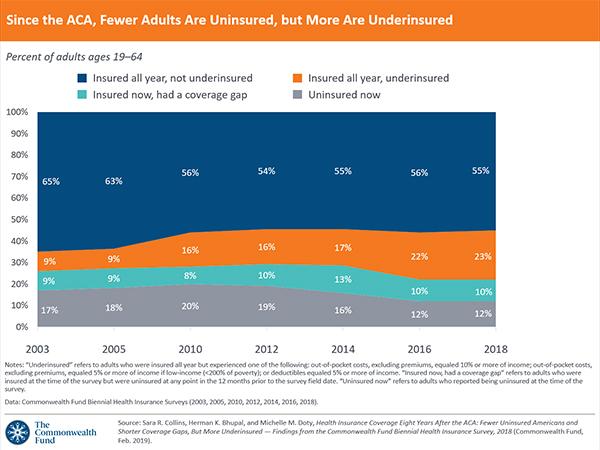
  • Today, 45 percent of U.S. adults ages 19 to 64 are inadequately insured — nearly the same as in 2010 — though important shifts have taken place.
  • Compared to 2010, many fewer adults are uninsured today, and the duration of coverage gaps people experience has shortened significantly.
  • Despite actions by the Trump administration and Congress to weaken the ACA, the adult uninsured rate was 12.4 percent in 2018 in this survey, statistically unchanged from the last time we fielded the survey in 2016.
  • More people who have coverage are underinsured now than in 2010, with the greatest increase occurring among those in employer plans.
  • People who are underinsured or spend any time uninsured report cost-related problems getting care and difficulty paying medical bills at at higher rates than those with continuous, adequate coverage.
  • Federal and state governments could enact policies to extend the ACA’s health coverage gains and improve the cost protection provided by individual-market and employer plans.

The 2018 Commonwealth Fund Biennial Heath Insurance Survey included a nationally representative sample of 4,225 adults ages 19 to 64. SSRS conducted the telephone survey between June 27 and November 11, 2018.3 (See “How We Conducted This Study” for more detail.)

WHO IS UNDERINSURED?

In this analysis, we use a measure of underinsurance that accounts for an insured adult’s reported out-of-pocket costs over the course of a year, not including insurance premiums, as well as his or her plan deductible. (The measure was first used in the Commonwealth Fund’s 2003 Biennial Health Insurance Survey.*) These actual expenditures and the potential risk of expenditures, as represented by the deductible, are then compared with household income. Specifically, we consider people who are insured all year to be underinsured if:

  • their out-of-pocket costs, excluding premiums, over the prior 12 months are equal to 10 percent or more of household income; or
  • their out-of-pocket costs, excluding premiums, over the prior 12 months are equal to 5 percent or more of household income for individuals living under 200 percent of the federal poverty level ($24,120 for an individual or $49,200 for a family of four); or
  • their deductible constitutes 5 percent or more of household income.

The out-of-pocket cost component of the measure is only triggered if a person uses his or her plan to obtain health care. The deductible component provides an indicator of the financial protection the plan offers and the risk of incurring costs before someone gets health care. The definition does not include other dimensions of someone’s health plan that might leave them potentially exposed to costs, such as copayments or uncovered services. It therefore provides a conservative measure of underinsurance in the United States.

Compared to 2010, when the ACA became law, fewer people today are uninsured, but more people are underinsured. Of the 194 million U.S. adults ages 19 to 64 in 2018, an estimated 87 million, or 45 percent, were inadequately insured (see Tables 1 and 2).

Despite actions by the Trump administration and Congress to weaken the ACA, our survey found no statistically significant change in the adult uninsured rate by late 2018 compared to 2016 (Table 3). This finding is consistent with recent federal surveys, but other private surveys (including other Commonwealth Fund surveys) have found small increases in uninsured rates since 2016 (see “Changes in U.S. Uninsured Rates Since 2013”).

While there has been no change since 2010, statistically speaking, in the proportion of people who are insured now but have experienced a recent time without coverage, these reported gaps are of much shorter duration on average than they were before the ACA. In 2018, 61 percent of people who reported a coverage gap said it has lasted for six months or less, compared to 31 percent who said they had been uninsured for a year or longer. This is nearly a reverse of what it was like in 2012, two years before the ACA’s major coverage expansions. In that year, 57 percent of adults with a coverage gap reported it was for a year or longer, while one-third said it was a shorter gap.

There also has been some improvement in long-term uninsured rates. Among adults who were uninsured at the time of the survey, 54 percent reported they had been without coverage for more than two years, down from 72 percent before the ACA coverage expansions went into effect. The share of those who had been uninsured for six months or less climbed to 20 percent, nearly double the rate prior to the coverage expansions.

Of people who were insured continuously throughout 2018, an estimated 44 million were underinsured because of high out-of-pocket costs and deductibles (Table 1). This is up from an estimated 29 million in 2010 (data not shown). The most likely to be underinsured are people who buy plans on their own through the individual market including the marketplaces. However, the greatest growth in the number of underinsured adults is occurring among those in employer health plans.

WHY ARE INSURED AMERICANS SPENDING SO MUCH OF THEIR INCOME ON HEALTH CARE COSTS?

Several factors may be contributing to high underinsured rates among adults in individual market plans and rising rates in employer plans:

  1. Although the Affordable Care Act’s reforms to the individual market have provided consumers with greater protection against health care costs, many moderate-income Americans have not seen gains. The ACA’s essential health benefits package, cost-sharing reductions for lower- income families, and out-of-pocket cost limits have helped make health care more affordable for millions of Americans. But while the cost-sharing reductions have been particularly important in lowering deductibles and copayments for people with incomes under 250 percent of the poverty level (about $62,000 for a family of four), about half of people who purchase marketplace plans, and all of those buying plans directly from insurance companies, do not have them.4
  2. The bans against insurers excluding people from coverage because of a preexisting condition and rating based on health status have meant that individuals with greater health needs, and thus higher costs, are now able to get health insurance in the individual market. Not surprisingly, the survey data show that people with individual market coverage are somewhat more likely to have health problems than they were in 2010, which means they also have higher costs.
  3. While plans in the employer market historically have provided greater cost protection than plans in the individual market, businesses have tried to hold down premium growth by asking workers to shoulder an increasing share of health costs, particularly in the form of higher deductibles.5 While the ACA’s employer mandate imposed a minimum coverage requirement on large companies, the requirement amounts to just 60 percent of typical person’s overall costs. This leaves the potential for high plan deductibles and copayments.
  4. Growth in Americans’ incomes has not kept pace with growth in health care costs. Even when health costs rise more slowly, they can take an increasingly larger bite out of incomes.

It is well documented that people who gained coverage under the ACA’s expansions have better access to health care as a result.6 This has led to overall improvement in health care access, as indicated by multiple surveys.7 In 2014, the year the ACA’s major coverage expansions went into effect, the share of adults in our survey who said that cost prevented them from getting health care that they needed, such as prescription medication, dropped significantly (Table 4). But there has been no significant improvement since then.

The lack of continued improvement in overall access to care nationally reflects the fact that coverage gains have plateaued, and underinsured rates have climbed. People who experience any time uninsured are more likely than any other group to delay getting care because of cost (Table 5). And among people with coverage all year, those who were underinsured reported cost-related delays in getting care at nearly double the rate of those who were not underinsured.

There was modest but significant improvement following the ACA’s coverage expansions in the proportion of all U.S. adults who reported having difficulty paying their medical bills or said they were paying off medical debt over time (Table 4). Federal surveys have found similar improvements.8 However, those gains have stalled.

Inadequate insurance coverage leaves people exposed to high health care costs, and these expenses can quickly turn into medical debt. More than half of uninsured adults and insured adults who have had a coverage gap reported that they had had problems paying medical bills or were paying off medical debt over time (Table 6). Among people who had continuous insurance coverage, the rate of medical bill and debt problems is nearly twice as high for the underinsured as it is for people who are not underinsured.

Having continuous coverage makes a significant difference in whether people have a regular source of care, get timely preventive care, or receive recommended cancer screenings. Adults with coverage gaps or those who were uninsured when they responded to the survey were the least likely to have gotten preventive care and cancer screenings in the recommended time frame.

Being underinsured, however, does not seem to reduce the likelihood of having a usual source of care or receiving timely preventive care or cancer screens — provided a person has continuous coverage. This is likely because the ACA requires insurers and employers to cover recommended preventive care and cancer screens without cost-sharing. Even prior to the ACA, a majority of employer plans provided predeductible coverage of preventive services.9

Conclusion and Policy Implications

U.S. working-age adults are significantly more likely to have health insurance since the ACA became law in 2010. But the improvement in uninsured rates has stalled. In addition, more people have health plans that fail to adequately protect them from health care costs, with the fastest deterioration in cost protection occurring in the employer market. The ACA made only minor changes to employer plans, and the erosion in cost protection has taken a bite out of the progress made in Americans’ health coverage since the law’s enactment.

Both the federal government and the states, however, have the ability to extend the law’s coverage gains and improve the cost protection of both individual-market and employer plans. Here is a short list of policy options:

  • Expand Medicaid without restrictions. The 2018 midterm elections moved as many as five states closer to joining the 32 states that, along with the District of Columbia, have expanded eligibility for Medicaid under the ACA.10 As many as 300,000 people may ultimately gain coverage as a result.11 But, encouraged by the Trump administration, several states are imposing work requirements on people eligible for Medicaid — a move that could reverse these coverage gains. So far, the U.S. Department of Health and Human Services (HHS) has approved similar work-requirement waivers in seven states and is considering applications from at least seven more. Arkansas imposed a work requirement last June, and, to date, more than 18,000 adults have lost their insurance coverage as a result.
  • Ban or place limits on short-term health plans and other insurance that doesn’t comply with the ACA. The Trump administration loosened regulations on short-term plans that don’t comply with the ACA, potentially leaving people who enroll in them exposed to high costs and insurance fraud. These plans also will draw healthier people out of the marketplaces, increasing premiums for those who remain and federal costs of premium subsidies. Twenty-three states have banned or placed limits on short-term insurance policies. Some lawmakers have proposed a federal ban.
  • Reinsurance, either state or federal. The ACA’s reinsurance program was effective in lowering marketplace premiums. After it expired in 2017, several states implemented their own reinsurance programs.12  Alaska’s program reduced premiums by 20 percent in 2018. These lower costs particularly help people whose incomes are too high to qualify for ACA premium tax credits. More states are seeking federal approval to run programs in their states. Several congressional bills have proposed a federal reinsurance program.
  • Reinstate outreach and navigator funding for the 2020 open-enrollment period. The administration has nearly eliminated funding for advertising and assistance to help people enroll in marketplace plans.13 Research has found that both activities are effective in increasing enrollment.14 Some lawmakers have proposed reinstatingthis funding.
  • Lift the 400-percent-of-poverty cap on eligibility for marketplace tax credits. This action would help people with income exceeding $100,000 (for a family of four) better afford marketplace plans. The tax credits work by capping the amount people pay toward their premiums at 9.86 percent. Lifting the cap has a built in phase out: as income rises, fewer people qualify, since premiums consume an increasingly smaller share of incomes. RAND researchers estimate that this policy change would increase enrollment by 2 million and lower marketplace premiums by as much as 4 percent as healthier people enroll. It would cost the federal government an estimated $10 billion annually.15 Legislation has been introduced to lift the cap.
  • Make premium contributions for individual market plans fully tax deductible. People who are self-employed are already allowed to do this.16
  • Fix the so-called family coverage glitch. People with employer premium expenses that exceed 9.86 percent of their income are eligible for marketplace subsidies, which trigger a federal tax penalty for their employers. There’s a catch: this provision applies only to single-person policies, leaving many middle-income families caught in the “family coverage glitch.” Congress could lower many families’ premiums by pegging unaffordable coverage in employer plans to family policies instead of single policies.17

REDUCE COVERAGE GAPS

  • Inform the public about their options. People who lose coverage during the year are eligible for special enrollment periods for ACA marketplace coverage. Those eligible for Medicaid can sign up at any time. But research indicates that many people who lose employer coverage do not use these options.18 The federal government, the states, and employers could increase awareness of insurance options outside the open-enrollment periods through advertising and education.
  • Reduce churn in Medicaid. Research shows that over a two-year period, one-quarter of Medicaid beneficiaries leave the program and become uninsured.19 Many do so because of administrative barriers.20 By imposing work requirements, as some states are doing, this involuntary disenrollment is likely to get worse. To help people stay continuously covered, the federal government and the states could consider simplifying and streamlining the enrollment and reenrollment processes.
  • Extend the marketplace open-enrollment period. The current open-enrollment period lasts just 45 days. Six states that run their own marketplaces have longer periods, some by as much as an additional 45 days. Other states, as well as the federal marketplace, could extend their enrollment periods as well.

IMPROVE INDIVIDUAL-MARKET PLANS’ COST PROTECTIONS

  • Fund and extend the cost-sharing reduction subsidies. The Trump administration eliminated payments to insurers for offering plans with lower deductibles and copayments. Insurers, which by law must still offer reduced-cost plans, are making up the lost revenue by raising premiums. But this fix, while benefiting enrollees who are eligible for premium tax credits, has distorted both insurer pricing and consumer choice.21 In addition, it is unknown whether the administration’s support for the fix will continue in the future, creating uncertainty for insurers.22 Congress could reinstate the payments to insurers and consider making the plans available to people with higher earnings.
  • Increase the number of services excluded from the deductible.Most plans sold in the individual market exclude certain services from the deductible, such as primary care visits and certain prescriptions.23As the survey data suggest, these types of exclusions appear to be important in ensuring access to preventive care among people who have coverage but are underinsured. In 2016, HHS provided a standardized plan option for insurers that excluded eight health services — including mental health and substance-use disorder outpatient visits and most prescription drugs — from the deductible at the silver and gold level.24 The Trump administration eliminated the option in 2018. Congress could make these exceptions mandatory for all plans.

IMPROVE EMPLOYER PLANS’ COST PROTECTIONS

  • Increase the ACA’s minimum level of coverage. Under the ACA, people in employer plans may become eligible for marketplace tax credits if the actuarial value of their plan is less than 60 percent, meaning that under 60 percent of health care costs, on average, are covered. Congress could increase this to the 70 percent standard of silver-level marketplace plans, or even higher.
  • Require deductible exclusions. Congress could require employers to increase the number of services that are covered before someone meets their deductible. Most employer plans exclude at least some services from their deductibles.25 Congress could specify a minimum set of exclusions for employer plans that might resemble the standardized-choice options that once existed for ACA plans.
  • Refundable tax credits for high out-of-pocket costs. Congress could make refundable tax credits available to help insured Americans pay for qualifying out-of-pocket costs that exceed a certain percentage of their income.26
  • Protect consumers from surprise medical bills. Several states have passed laws that protect patients and their families from unexpected medical bills, generally from out-of-network providers.27A bipartisan group of U.S. senators has proposed federal legislation to protect consumers, including people enrolled in employer and individual-market plans.

Health care costs are primarily what’s driving growth in premiums across all health insurance markets. Employers and insurers have kept premiums down by increasing consumers’ deductibles and other cost-sharing, which in turn is making more people underinsured. This means that policy options like the ones we’ve highlighted above will need to be paired with efforts to slow medical spending. These could include changing how health care is organized and providers are paid to achieve greater value for health care dollars and better health outcomes.28 The government also could tackle rising prescription drug costs29 and use antitrust laws to combat the growing concentration of insurer and provider markets.30


Since the ACA, Fewer Adults Are Uninsured, but More Are Underinsured

https://www.commonwealthfund.org/chart/2019/aca-fewer-adults-are-uninsured-more-are-underinsured

Image result for Since the ACA, Fewer Adults Are Uninsured, but More Are Underinsured