

Click to access PDF%20WebinarBattleOverACA12192016Adams.pdf

Click to access PDF%20WebinarBattleOverACAResources.pdf
Pre-existing Conditions and Medical Underwriting in the Individual Insurance Market Prior to the ACA

Before private insurance market rules in the Affordable Care Act (ACA) took effect in 2014, health insurance sold in the individual market in most states was medically underwritten.1 That means insurers evaluated the health status, health history, and other risk factors of applicants to determine whether and under what terms to issue coverage. To what extent people with pre-existing health conditions are protected is likely to be a central issue in the debate over repealing and replacing the ACA.
This brief reviews medical underwriting practices by private insurers in the individual health insurance market prior to 2014, and estimates how many American adults could face difficulty obtaining private individual market insurance if the ACA were repealed or amended and such practices resumed. We examine data from two large government surveys: The National Health Interview Survey (NHIS) and the Behavioral Risk Factor Surveillance System (BRFSS), both of which can be used to estimate rates of various health conditions (NHIS at the national level and BRFSS at the state level). We consulted field underwriting manuals used in the individual market prior to passage of the ACA as a reference for commonly declinable conditions.
The Affordable Care Act guarantees access to health insurance in the individual market and ends other underwriting practices that left many people with pre-existing conditions uninsured or with limited coverage before the law. As discussions get underway to repeal and replace the ACA, this analysis quantifies the number of adults who would be at risk of being denied if they were to seek coverage in the individual market under pre-ACA rules. What types of protections are preserved for people with pre-existing conditions will be a key element in the debate over repealing and replacing the ACA.
We estimate that at least 52 million non-elderly adult Americans (27% of those under the age of 65) have a health condition that would leave them uninsurable under medical underwriting practices used in the vast majority of state individual markets prior to the ACA. Results vary from state-to-state, with rates ranging around 22 – 23% in some Northern and Western states to 33% or more in some southern states. Our estimates are conservative and do not account for a number of conditions that were often declinable (but for which data are not available), nor do our estimates account for declinable medications, declinable occupations, and conditions that could lead to other adverse underwriting practices (such as higher premiums or exclusions).
While most people with pre-existing conditions have employer or public coverage at any given time, many people seek individual market coverage at some point in their lives, such as when they are between jobs, retired, or self-employed.
There is bipartisan desire to protect people with pre-existing conditions, but the details of replacement plans have yet to be ironed out, and those details will shape how accessible insurance is for people when they have health conditions.
http://www.rwjf.org/content/dam/farm/reports/issue_briefs/2017/rwjf434339
Before the Affordable Care Act (ACA), the landscape of the individual market looked much different than it does today, particularly for those in less than perfect health. For the most part, what state you lived in determined how easily you could purchase a health plan, the price you would pay, and what the plan would cover. Rules for insurers in the individual market varied from state to state, but in most states, if you had a pre-existing condition, you could be denied coverage, pay more, or have coverage for your pre-existing condition excluded from your health plan. As Congress debates repeal of the ACA and its protections for people with pre-existing conditions, many policymakers have called for greater state flexibility in insurance regulation than currently exists under the ACA. It therefore is helpful to understand the range of consumer protections in the states before the ACA, and why the ACA included the insurance reforms it did. This issue brief summarizes state rules for the individual market on the eve of the Affordable Care Act.

A conservative group funded by the Koch brothers is pushing for high-risk pools and a freeze on Medicaid expansions as lawmakers try to coalesce around a replacement for ObamaCare.
Freedom Partners began circulating a memo on Capitol Hill Monday with specific reforms it thinks lawmakers should pass, including: the creation of high-risk pools at the state level to cover people with pre-existing conditions; the elimination of the ObamaCare mandate, which required everyone buy insurance or pay a penalty; and the expansion of access to health savings accounts, so people can save and pay for healthcare with pre-tax dollars.
The recommendations fall in line with what top Republicans in Congress have indicated they support.

About 27 percent of people under 65 are thought to have some sort of pre-existing condition that will most likely leave them without individual insurance if the law is repealed, according to a recent study. The guarantee of coverage has already become a rallying cry for people who want to keep the law.
The issue “is the third rail” for the Republicans, said Michael Turpin, a longtime health industry executive.
Before the law, a fairly typical life event — like a divorce or the loss of a job — and a relatively minor medical condition could upend a person’s health coverage options. Stories of sick people unable to get coverage when they needed it most were legion.
Mr. Trump insists he wants to keep the pre-existing requirement for insurers, and other top Republicans say people who want coverage should not be turned away. Details about how they will cover people with existing medical conditions have not yet emerged, but many lawmakers have started pushing an idea — known as high-risk pools — that left many people uncovered or with strict limits to their coverage in the past.
The challenge for lawmakers is this: How do you get insurers to cover people who will definitely need costly medical care — and do so without making insurance too expensive for everyone?

Much of the recent attention on the future of the Affordable Care Act (ACA) has focused on the fate of the 22.5 million people likely to lose insurance through a repeal of Medicaid expansion and the loss of protections and subsidies in the individual insurance market. Overlooked in the declarations of who stands to lose under plans to “repeal and replace” the ACA are those enrolled in employer-sponsored health plans — the primary source of coverage for people under 65.
Job-based plans offered to employees and their families cover 150 million people in the United States. If the ACA is repealed, they stand to lose critical consumer protections that many have come to expect of their employer plan.
It’s easy to understand the focus on the individuals who gained access to coverage thanks to the health reform law. ACA drafters targeted most of the law’s insurance reforms at the individual and small-group markets, where consumers and employers had the greatest difficulty finding affordable, adequate coverage prior to health reform. The ACA’s market reforms made coverage available to those individuals with pre-existing conditions who couldn’t obtain coverage in the pre-ACA world, and more affordable for those low- and moderate-income families who couldn’t afford coverage on their own.
Less noticed, but no less important, the ACA also brought critical new protections to people in large employer plans. Although most large employer plans were relatively comprehensive and affordable before the ACA, some plans offered only skimpy coverage or had other barriers to accessing care, leaving individuals—particularly those with costly, chronic health conditions—with big bills and uncovered medical care. For that reason, the ACA extended several meaningful protections to employees of large businesses.
You’ve seen the headlines and you’ve heard the slogans: Obamacare is on the chopping block and President-elect Donald Trump is going to replace it with “something terrific.”
But what are the new president and Congress really going to do? How much of the current law will really go away? And what could “Trumpcare” look like?
In case it’s been a while since you read about the Affordable Care Act and the GOP replacement plans, here’s a refresher on the biggest Obamacare issues.
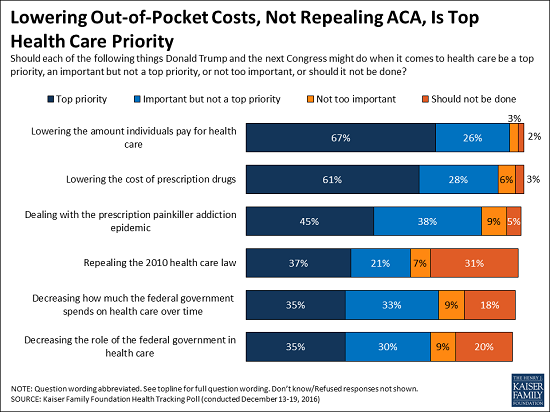
As Congress begins to work on repealing and replacing the Affordable Care Act, the latest Kaiser Health Tracking Poll finds that one in five Americans (20%) support repeal alone, while three quarters either oppose repeal altogether (47%) or want to wait to repeal the law until the replacement plan’s details are known (28%).
Overall, the poll finds that nearly equal shares say that the next Congress should vote to repeal the law (49%) and that it should not vote to repeal it (47%), which mirrors the public’s overall views of the 2010 law (46% view it unfavorably, 43% favorably).
The debate surrounding repeal could influence the public’s views, as the poll finds that some people shift their opinions after hearing counter-arguments. For example, after hearing pro-repeal arguments about the law’s costs to individuals and the government, the share of the public supporting repeal grows as large as 60 percent, while anti-repeal arguments about people losing coverage and the impact on people with pre-existing conditions decreases support for repeal to as low as 27 percent.
When asked directly about their family’s health care costs, similar shares of the public say repealing the Affordable Care Act would make their situation worse (28%) as say it would make it better (27%). Most say their own ability to get and keep health insurance (55%) and the quality of their own health care (57%) will stay about the same if Congress votes to repeal the law.


 HENRY KOTULA