WHY IT MATTERS: Health Care

http://bigstory.ap.org/article/a6c6a83bd9f7435ca6f79423f1240c4d/why-it-matters-health-care

About 9 in 10 Americans now have health insurance, more than at any time in history. But progress is incomplete, and the future far from certain. Millions remain uninsured. Quality is still uneven. Costs are high and trending up again. Medicare’s insolvency is two years closer, now projected in 2028. Every family has a stake.

Patients from all over the world come to America for treatment. U.S. research keeps expanding humanity’s ability to confront disease. But the U.S. still spends far more than any advanced country, and its people are not much healthier.

Obama’s progress reducing the number of uninsured may be reaching its limits. Premiums are expected to rise sharply in many communities for people covered by his namesake law, raising concerns about the future.

The health care overhaul did not solve the nation’s longstanding problem with costs. Total health spending is picking up again, underscoring that the system is financially unsustainable over the long run. Employers keep shifting costs to workers and their families.

No one can be denied coverage anymore because of a pre-existing condition, but high costs are still a barrier to access for many, including insured people facing high deductibles and copayments. Prescription drug prices — even for some generics — are another major worry.

The election offers a choice between a candidate of continuity — Clinton — and a Republican who seems to have some core beliefs about health care, but lacks a coherent plan.

If the presidential candidates do not engage the nation in debating the future of health care, it still matters.

Health Sector Economic Indicators – Price Brief

Click to access CSHS-Price-Brief_July_2016.pdf

Health care prices in May 2016 were 1.5% higher than in May 2015, the third consecutive month at this rate. The May 2016 12­month moving average was 1.2% for the fourth straight month. Year-over-year hospital price growth rose modestly to 1.0% from 0.8% in April. Physician and clinical services prices rose only 0.3% in May, down from 0.6% growth in April. Drug price growth fell to 3.3% from 4.0% in April.

How Health Care Factors Into the Presidential Campaign

http://blogs.wsj.com/washwire/2016/04/06/how-health-care-factors-into-the-presidential-campaign/?utm_campaign=KFF-2016-Drew-WSJ-April-6-health-presidential-campaign&utm_medium=email&_hsenc=p2ANqtz-_jUVxiLFykqI9M8jDv5Egwn6DLgLg0exdZlssEVDrrjrflOw4n1yiezfjQ19MmdVixjXyflQ8-vsKKmjB4zlsq1x0Zlg&_hsmi=28151425&utm_content=28151425&utm_source=hs_email&hsCtaTracking=0e6c294a-87bf-418b-9e9b-27c7bd1c5e89%7C19877ff1-2138-41ce-953d-d8c504e9aee8

Healthcare Voter Poll

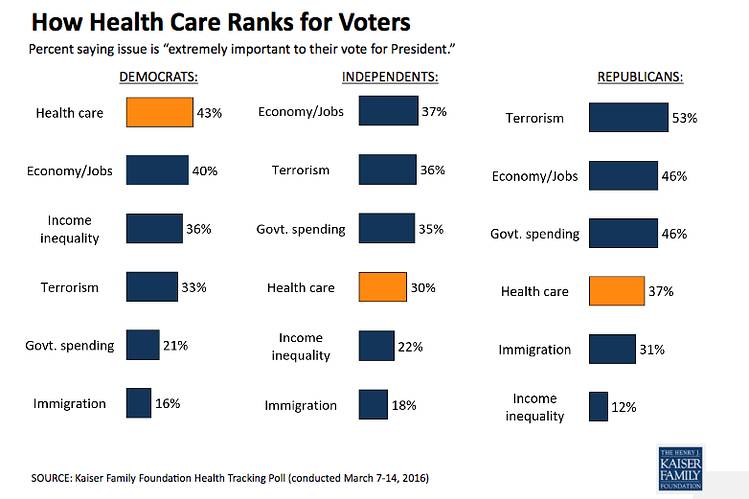
Health care has faded into the background of the election campaign as Donald Trump himself has become the issue on the Republican side and the debate between Hillary Clinton and Bernie Sanders over health care has shifted to other topics. This doesn’t mean that health will be the No. 1 or No. 4 factor when Democrats and Republicans vote in November. As the chart also shows, issue priorities are closely bunched, and my experience has been that voters cast ballots in presidential elections on the basis of their overall views of the candidates rather than candidates’ specific positions on issues.

When people say health care is an extremely important voting issue, they aren’t always thinking of the ACA. Among Republicans who say health is “extremely important” to their vote, about equal shares are thinking about the ACA as are thinking about issues such as access to care and health-care costs. Nor are Democrats always intending to support the ACA when they cite health as a voting issue. They are more likely to cite improving access or addressing costs generally as their reason for naming health a top voting issue.

3 costly healthcare megatrends to watch in 2016

http://www.beckershospitalreview.com/finance/3-costly-healthcare-megatrends-to-watch-in-2016.html

Cystall Ball

CEOs and CFOs: 10 things demanding your attention this year

http://www.beckershospitalreview.com/finance/ceos-and-cfos-10-things-demanding-your-attention-this-year.html

Balance

Medical schools of the future

http://video.cnbc.com/gallery/?video=3000482408

a84a4-leadershipjacobson2b28229

Bernard Tyson, Kaiser Permanente CEO, shares his plan to reshape the way physicians are educated and improve diversity in the medical community.

California Doles Out Millions to Insurers for Hepatitis C Drugs

http://ww2.kqed.org/stateofhealth/2016/01/27/california-doles-out-millions-to-insurers-for-hepatitis-c-drugs/

‘Dollars that were intended for a wide array of medical services started being gobbled up by just one drug.’Charles Bacchi, California Association of Health Plans

CEOs and CFOs: 10 things demanding your attention this year

http://www.beckershospitalreview.com/finance/ceos-and-cfos-10-things-demanding-your-attention-this-year.html

target_small