


Radiologists Take On Bigger Role in Diagnosing

Mention precision medicine, and genomics quickly comes to the top of mind. While genomics and clinically oriented analysis are extremely valuable in implementing precision medicine as the next step in population health management, they are really only a small part of the big picture.
Increasingly, the value of environmental, social and lifestyle factors that live outside the medical system is also getting recognized in the effective implementation of personalized medicine in this country. The federal government’s Precision Medicine Initiative (PMI) that calls for $215 million in fiscal year 2016 to support research in this area focuses not just on genetics and biology, but also behavior and environment — “with the goal of developing more effective ways to prolong health and treat disease.”
http://www.medpagetoday.com/PublicHealthPolicy/MilitaryMedicine/58259

Under the proposal, which was published last week in the Federal Register, “an APRN [advanced practice registered nurse] working within the scope of VA employment would be authorized to [practice at the top of his or her license] without the clinical oversight of a physician, regardless of State or local law restrictions on that authority.”

Rosemary Myers and her husband came to the oncology clinic with no major treatment decisions to make. Her breast cancer had metastasized to her brain many months ago, but after the metastasis was removed surgically, it had not shown signs of recurrence in any follow-up tests. So today’s visit wasn’t going to involve talking about chemotherapy or radiation; it wasn’t going to center upon end-of-life decision-making. Myers (a pseudonym) was here to see if her doctor could improve her quality of life. Eventually, that quality-of-life discussion would focus on the cost of Myers’ care.
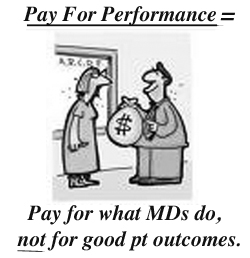
Healthcare Triage News: Pay for Performance in Medicine: It Doesn’t Work

“Pay-for-performance” is an umbrella term for initiatives aimed at improving the quality, efficiency, and overall value of health care. These arrangements provide financial incentives to hospitals, physicians, and other health care providers to carry out such improvements and achieve optimal outcomes for patients.

Study findings may drive efforts to curb improper prescription practices.

New report finds prevalence of 5% drug-resistant bacteria in District.
Researchers estimate more than 250K deaths a year caused by medical mistakes.

 HENRY KOTULA