

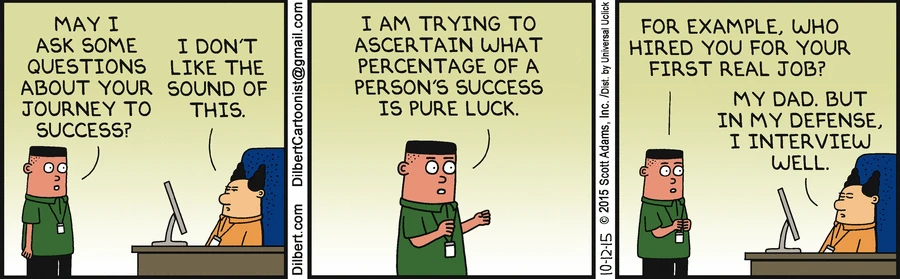
Cartoon – Your Journey to Success

EQ is often cited as the difference between winners and losers. Use these quotes to up your game.
As far as I know, my MBA program didn’t teach any classes in emotional intelligence. While I got a solid education, I can’t help but think that I might have been served better by taking a course or two in EQ. After all, study after study has shown that emotional intelligence is the different between a successful CEO and an also-ran.
Here are some of the best quotes to inspire you to become a more emotionally intelligent leader:
What’s your favorite quote about emotional intelligence that needs to be added to this list? What inspires you to develop your EQ further on an ongoing basis?
Fearful Leaders Hoard Control – Courageous Leaders Give Power

Feeling powerful expands possibility, elevates engagement, and enables initiative. Feeling powerless creates weakness, dependence, and fear.
People who feel powerful see opportunity.
People who feel powerless feel threat.
Control freaks make others feel powerless.
Control freaks:
The smile of a control freak is arrogant sympathy in disguise. They feel sorry for all the lesser people.
#1. Prepare people to feel powerful.
#2. Describe the playing field.
#3. Honor expressions of power.
More suggestions:
#1. Generate options. The more options you have the safer the path forward seems.
#2. Give choice. After generating options, ask others to make choices.
Choice is an expression of power.
#3. Practice attunement.
Courageous leaders give power to others. Fearful leaders hoard control.
How might leaders make others feel powerful?

Yes, be thankful for your successes. Your successes mean you’re having an impact on the world around you.
Don’t hide your successes. Celebrate your successes and be thankful for them.
Hold up… You mean leaders should be thankful for failures? Oh yeah, leaders need to be thankful for failure.
Failure is an opportunity to learn and grow. You can examine your failures and see why they didn’t succeed.
Learn and grow from your failures. They’re a great stepping stone to your next success.
If you’re a leader, you’re influencing other people. These could be team members, customers, even your vendors.
Your influence is guiding and leading people. Be thankful for the influence you have on others.
Your team is a valuable part of your leadership. From leaders in training to the people working on the ground floor of your organization, these are the people who are the foundation.
Without your team, there’d be a lot more work for you, the leader, to take on.
Be thankful for your team members. They take a huge weight off of your shoulders.
Sometimes it can be hard to be thankful for the organization you work for. There comes a lot of stress and frustration when you lead an organization.
There are times when you feel unappreciated. You begin to wonder why you’re there when no one values the work you do.
This shouldn’t negate the thankfulness you feel towards the organization. You have the opportunity to guide, build, and lead the organization in a new direction.
Be thankful for the organization you work in.
Sadly, I’ve seen families get passed over by leaders more often than not. The leaders dedicate themselves to leading an organization yet forget to lead the most important organization they chose to join: Their family.
Your family is part of your mission. You chose them. And they’re a godsend.
Be thankful for your family every day. One day they may not be there.


The Wall Street Journal’s lead editorial on June 23 featured an article by Kay S. Hymowitz entitled, “Is there Anything Grit Can’t Do?” The article is about the work of Angela Lee Duckworth. In my article about career advancement, I talked about hard work, paying a price and the perseverance necessary for career success. Here we have another excellent example of a researcher that has dedicated themselves to the study of a specific topic. If you do not believe a researcher in academia can become the undisputed authority on a subject, check out Dr. Duckworth’s CV. For those of you interested in further study of this topic, the list of grants, articles and presentations in Dr. Duckworth’s CV reads like the literature review in a dissertation. In the case of Dr. Duckworth, her expertise flies in the face of a lot of conventional ‘wisdom’ and political correctness.
The ideology of indoctrination of children in too many failed government schools vacillates between victim-hood and entitlement insuring the continuing institutionalization of poverty. In my opinion, public education has deteriorated markedly over the past thirty years. The US Department of Education was founded in 1979. In federal fiscal 1980, the department’s budget was $14 billion. By FFY 2015, the bureaucracy’s budget had ballooned to $73.8 billion. I do not know anyone that thinks that public education is any better for this spectacular increase in investment. I have heard Eric Von Hessler and others advocate for the elimination of the Department of Education in its entirety as a means of balancing the federal budget. I think a lot of people would agree that education is better-managed locally and not from a central federal government bureaucracy. Too few young people are being taught that the thing that has the greatest potential to make a positive difference in their life is drive or ‘grit’ as described by Dr. Duckworth and not the narrative of the NEA. There are probably not very many people who have done a more thorough job than Dr. Duckworth understanding how to help children and adults succeed.


 HENRY KOTULA