Humility is the New Smart: Are You Ready?

https://www.leadershipnow.com/leadingblog/2017/06/humility_is_the_new_smart_are.html?utm_source=feedburner&utm_medium=email&utm_campaign=Feed%3A+LeadingBlog+%28Leading+Blog%29

Humility is the New Smart

SMART used to be a quantity game. “I know more than you. I get more things right.” But Ed Hess and Katherine Ludwig say that in the new Smart Machine Age, that’s losing game. The new smart is about quality. Specifically, the quality of your thinking, your listening, and your relating and collaborative skills.

Are you ready?

The Smart Machine Age (SMA) will revolutionize how most of us live and work. In Humility is the New Smart, the authors state that “smart technologies will become ubiquitous, invading and changing many aspects of our professional and personal lives and in many ways challenging our fundamental beliefs about success, opportunity, and the American Dream.” This means that the “number and types of available jobs and required skills will turn our lives and our children’s lives upside down.”

New skills will be needed. Uniquely human skills. Those skills, while uniquely human, are not what we are typically trained to do and require a deal of messy personal development. We will need to become better thinkers, listeners, relators, and collaborators, while working to overcome our culture of obsessive individualism in order to thrive in the SMA. Humility is the mindset that will make all of this possible.

Most of today’s adults have had no formal training in how to think, how to listen, how to learn and experiment through inquiry, how to emotionally engage, how to manage emotions, how to collaborate, or how to embrace mistakes as learning opportunities.

In short, say the authors, we need to acquire and continually develop four fundamental NewSmart behaviors:

Quieting Ego

Quieting Ego has always been the challenge for us humans. As they observe, “Even if we don’t consider ourselves part of the ‘big me’ cultural phenomenon, for many of us to feel good about ourselves we have to constantly be ‘right,’ self-enhance, self-promote, and conceal our weaknesses, all of which drive ego defensiveness and failure intolerance that impedes higher-level thinking and relating.” This tendency negatively affects our behavior, thinking, and ability to relate to and engage with others.

Managing Self—Thinking and Emotions

We need to get above ourselves to see ourselves impartially. We all struggle “to self-regulate our basic humanity—our biases, fears, insecurities, and natural fight-flee-or-freeze response to stress and anxiety.” We need to be willing to treat all of our “beliefs (not values) as hypotheses subject to stress tests and modification by better data.”

Negative emotions cause narrow-mindedness. Positive emotions on the other hand, have been scientifically linked to “broader attention, open-mindedness, deeper focus, and more flexible thinking, all of which underlie creativity and innovative thinking.”

Reflective Listening

Because we are limited by our own thinking, we need to listen to others to “open our minds and, push past our biases and mental models, and mitigate self-absorption in order to collaborate and build better relationships.” The problem is “we’re just too wired to confirm what we already believe, and we feel too comfortable having a cohesive simple story of how our world works.” Listening to others helps to quiet our ego.

Otherness

To create these new behaviors and mindsets, it should become obvious that we need to enlist the help of others. “We can’t think, innovate, or relate at our best alone.” As Barbara Fredrickson observed, “nobody reaches his or her full potential in isolation.” Jane Dutton out it this way: “It seems to be another fact that no man can come to know himself except as the outcome of disclosing himself to another.”

The NewSmart Organization

Optimal human performance in the SMA will require an emphasis on the emotional aspects of critical thinking, creativity, innovation and engaging with others. “The work environment must be designed to reduce fears, insecurities, and other negative emotions.

To do this it means “providing people a feeling of being respected, held in positive regard, and listened to. It means creating opportunities for people to connect and build trust. “It means allocating time and designing work environments that bring people together to relate about nonwork matters.” Finally, it means getting to know employees and helping them to get the “right training or opportunities to develop and provide feedback.”

The NewSmart organization needs to be a safe place to learn. “Feeling safe means that you feel that your boss your employer, and your colleagues will do you no harm as you try to learn.”
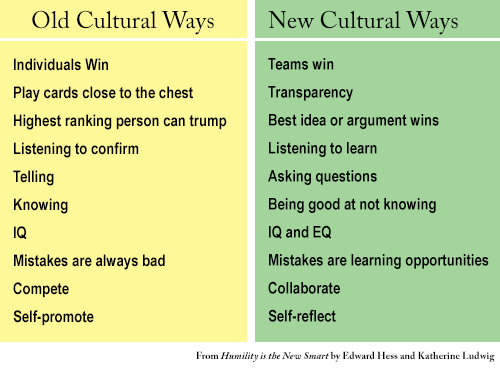
The New Smart

Democrats to slow-walk Senate business over health care bill

https://www.usatoday.com/story/news/politics/2017/06/19/democrats-halt-senate-business-over-health-care-bill/103012262/?utm_campaign=KHN%3A%20First%20Edition&utm_source=hs_email&utm_medium=email&utm_content=53324518&_hsenc=p2ANqtz-8NpDGDFUkQIuhKz8d8GWAlDDWC2mqcN0hJfp_LlAcTnc81nyyDtb3Ah782Ee3PptGo5xWZ8yPbj1T7bkeh-DIp55enpQ&_hsmi=53324518

Image result for Democrats to slow-walk Senate business over health care bill

Democrats will begin slow-walking Senate business on Monday as part of their opposition to Republican attempts to overturn the Affordable Care Act.

Senate Minority Leader Chuck Schumer of New York said Democrats will object to requests for “unanimous consent” to set aside rules and expedite proceedings. The procedural move is a tactic the minority party can use to draw out the legislative process for days, forcing Republicans to jump through procedural hurdles to get anything done.

The goal, he said, is to refer the GOP health care bill to a committee where it can be debated and amended publicly. Republicans are writing their bill “under the cover of darkness because they’re ashamed of it,” he said.

“This is a bill that would likely reorder one-sixth of the American economy and have life-and-death consequences for millions of Americans, and it’s being discussed in secret with no committee hearings, no debate, no amendments, no input from the minority,” he said. “This is the most glaring departure from normal legislative procedure that I have ever seen.”

The move coincides with a new #AmericaSpeaksOut campaign Senate Democrats launched Monday urging Americans to “speak out against Trumpcare and share their stories.” They also plan to hold the Senate floor tonight with speeches about health care.

The House passed its Obamacare repeal bill in May, but Senate Republicans have been drafting their own bill behind closed doors.

In a letter, Democrats provided some Senate Republican leaders with a list of all 31 potential Senate rooms “to assist” Republicans in scheduling a hearing.

They wrote that Democrats, by comparison, held about 100 hearings and meetings, accepted more than 150 amendments sponsored or cosponsored by GOP senators and spent 25 days in floor debate during the drafting of the Affordable Care Act.

The move by Democrats to slow Senate business will not impact consideration of President Trump’s nominee to lead the Federal Emergency Management Agency, Brock Long, who is expected to be confirmed Tuesday, according to a Senate Democratic aide. Schumer said Democrats would not object to requests for unanimous consent on honorary resolutions, either.

The greater impact likely will be the interruption of the legislative process and routine Senate business.

Speaking on the Senate floor, Schumer asked Senate Majority Leader Mitch McConnell of Kentucky to hold an all-senators meeting to discuss a bipartisan way forward on lowering the cost of health care, raising the quality of care and stabilizing the insurance marketplaces.

McConnell responded that senators would meet on the Senate floor with an unlimited amendment process. He said there would be “ample opportunity” to read and amend the bill when Schumer asked whether Democrats would have more than 10 hours to review it.

“I rest my case,” Schumer said.

Republicans blame Democrats for refusing to negotiate on a health care bill.

“Democrats for MONTHS have stated they have no interest in working with Republicans on fixing Obamacare,” Michael Reed, the Republican National Committee’s research director and deputy communications director, wrote in a statement. “Now, Democrat efforts to feign outrage over health care negotiations should be seen for what it is — a pure partisan game aimed at placating the far-left.”

McConnell, in a Senate floor speech, said Obamacare has increased costs and reduced choice, causing Americans to drop coverage. He said the entire Senate Republican conference has been “active and engaged” for months on legislation that would stabilize insurance markets, remove mandates to buy insurance, and preserve access to care for those with pre-existing conditions.

“We believe we can and must do better than Obamacare’s status quo,” he said.

The House-passed health care bill, called the American Health Care Act, would lead to 23 million fewer people having health insurance by 2026, according to the Congressional Budget Office. If the Senate is able to pass health care legislation, the two chambers will have to come to a compromise to get a final bill to Trump’s desk.

As Democrats prepared for battle over the Senate bill, conservative House Republicans planned to send a letter to McConnell warning against letting the legislation get too moderate if he wants to keep support from the House after it passed the Senate.

The letter from the Republican Study Committee, which has more than 150 members, states that its members have “serious concerns regarding recent reports suggesting that the Senate’s efforts to produce a reconciliation bill repealing the Affordable Care Act are headed in a direction that may jeopardize final passage in the House of Representatives,” according to a copy of the draft obtained by USA TODAY.

Broward Health fires another auditor

http://www.beckershospitalreview.com/finance/broward-health-fires-another-auditor.html

Image result for financial statement disclosures

Fort Lauderdale, Fla.-based Broward Health will terminate a contract with its outside CPA at the end of this month after a 29-year working relationship. The fired audit director sees the break-up as the health system’s attempt to curb independent examination of the public system, according to the Sun Sentinel.

Joel Mutnick, audit director for Plantation, Fla.-based Fiske & Co., abstained from a vote to approve a draft of the firm’s audit since the documentation did not disclose several key events, including the suicide of late CEO Nabil El Sanadi, MD, in January 2016, the governor’s suspension of two board members and the lawsuit filed against the board by Pauline Grant, interim CEO who was fired in December 2016.

The audit covered the year ending June 30, 2016. Mr. Mutnick served on the committee of Broward board members and executives that supervised a third-party annual audit of the five-hospital system.

“They didn’t like not having control of me,” Mr. Mutnick told the Sun Sentinel. “Clearly they didn’t like the idea of me turning down the financial statements because of their inadequate disclosure. I don’t think they liked an outside auditor telling them or questioning the financial statement results.”

The chairman of Broward Health’s audit committee, Chris Ure, refused accounts that Mr. Mutnick’s departure involved his voting record or his independence. Mr. Ure said the committee is operating under new bylaws that impose term limits on members to strengthen independence and fresh perspectives, according to the Sun Sentinel. Under those new bylaws, Mr. Ure said outside members will no longer be paid.

Last September, Broward Health cut ties with KPMG after the accounting firm refused a contract addendum that would have extensively restricted its inquiry powers into Broward’s activities. Broward officials said they added the addendum over concerns KPMG would be unable to certify the system’s financial statements by the end of the year, due to the length of KPMG’s possible investigation into corruption allegations against the system.

Bringing Device Makers into the Hospital: Good Business or Ethical Risk?

http://www.medpagetoday.com/hospitalbasedmedicine/generalhospitalpractice/64239

Image result for Ethical Risk?

Medical device powerhouse Medtronic is testing the waters of hospital management, having begun operating a cardiac catheterization lab within a major U.S. hospital earlier this year.

UH Cleveland is the first U.S. facility to outsource its cath lab to a device maker – a new business model that’s met with some success in Europe, reportedly saving hospitals money while expanding Medtronic’s business portfolio.

With hospitals facing pressure to cut costs without sacrificing quality of care, they may be enticed to turn to well-heeled device and drug manufacturers willing to take over certain operations, and perhaps give their own products a boost in the process.

But such arrangements raise questions about how much control hospitals can retain over the operations — which run in their facilities and under their names — and how much freedom physicians will have to use devices from rival manufacturers.

Medtronic as Management

Medtronic launched its Hospital Solutions business in 2013, and its first foray into cath lab management came in 2014, when it acquired the Italian firm NGC Medical. It took over several outsourced catheterization labs in Italy, with the expectation of expanding NGC’s business outside that country.

Ron ten Hoedt, a Medtronic senior vice president and president for Europe, the Middle East, Africa & Canada, once said in a company meeting that Medtronic “needs to switch from a medical device company to a healthcare company,” according to a 2013 PriceWaterhouseCoopers report.

“If we want to be a part of the solution of the delivery of healthcare, then we need to risk-share, and we need to go into this market in a completely different way and with a completely different model,” ten Hoedt said.

Physician Concerns

Can doctors really remain unswayed in the hospital while working side by side with device company employees? Interventionalists said that freedom from pressure to use certain devices will be key to an ethical arrangement.

An anonymous source reported initial fears from UH Cleveland’s catheterization and electrophysiology lab operators that Medtronic would force them to use its durable goods when the deal was first proposed. They said their fears were assuaged, however, when it was clear that UH Cleveland was not going to push them to use Medtronic devices.

Morton Kern, MD, an interventionist and Chief of Medicine at VA Long Beach Health Care System in California, said doctors who work under this new management “will have to use their best judgment for which equipment to select.”

“If the equipment is equivalent, then it shouldn’t make a difference,” he said. “There is the perception that it could be a conflict, but it depends on who’s doing the ordering and the contracting. If it’s Medtronic, it doesn’t sound so kosher.”

“If there is separation between church and state, then there shouldn’t be a conflict of interest,” he added. “I don’t care who runs my lab as long as it works well and the equipment is current. From the doctor’s point of view, it should be invisible.”

Medical device powerhouse Medtronic is testing the waters of hospital management, having begun operating a cardiac catheterization lab within a major U.S. hospital earlier this year.

UH Cleveland is the first U.S. facility to outsource its cath lab to a device maker – a new business model that’s met with some success in Europe, reportedly saving hospitals money while expanding Medtronic’s business portfolio.

With hospitals facing pressure to cut costs without sacrificing quality of care, they may be enticed to turn to well-heeled device and drug manufacturers willing to take over certain operations, and perhaps give their own products a boost in the process.

But such arrangements raise questions about how much control hospitals can retain over the operations — which run in their facilities and under their names — and how much freedom physicians will have to use devices from rival manufacturers.


Invisible Risk Sharing Program

Too little, too late

Image result for invisible law

In their latest amendment to the American Health Care Act, House Republicans have created something called an “invisible risk sharing program.” The amendment is befuddling. The invisible program is a minor tweak that won’t improve the AHCA’s dismal coverage numbers. It’s not even really a program. If there’s any prospect at all of salvaging Republican-style repeal and replace, this newest amendment isn’t it.

The statutory text is spare. It appropriates $15 billion over nine years—or $1.67 billion each year—and tells the Secretary of Health and Human Services to use the money “to provide payments to health insurers with respect to claims for eligible individuals for the purpose of lowering premiums for health insurance coverage offered in the individual market.” The Secretary can supplement that funding with any money from the AHCA’s high-risk pools that states don’t find a way to use.

Beyond that, however, the statute tells us next to nothing about how the program is supposed to work. Hilariously, a section of the statute titled “Details of Program” contains no details. It says, for example, that the program should include “[a] definition for eligible individuals,” but leaves the defining up to HHS. So too with “[t]he identification of health conditions” that, if an eligible person has them, would qualify her insurer for extra payments.

Oh, and the program is supposed to be in place in time for the 2018 plan year.

Read generously, this newest amendment tells HHS to create a kind of reinsurance program for insurers who enroll high-cost individuals. The statute doesn’t use the word “reinsurance,” maybe because Republicans have spent years railing against the risk corridor and reinsurance programs as insurer bailouts. But if those were bailouts, then this is too.

Judging from the title, the program is supposed to look something like the proposal pioneered by Maine and described in this Health Affairs post. But Republicans are delusional to think that the Secretary can establish and implement a complex reinsurance-style program in time for the 2018 plan year. Insurers that want to participate on the exchanges have to submit bids to HHS by June 21. Even if the AHCA passed tomorrow—which it won’t—there’s no chance that Secretary Price could ramp it up in time.

Nor does the amendment explain how the new program is supposed to interact with the ACA’s risk adjustment program, which the AHCA leaves in place. The point of risk adjustment is to equalize risk across insurers: those with healthier-than-average enrollees have to pay into a central kitty, and those with sicker-than-average enrollees get some of that money. But if insurers get “invisible” risk sharing money for high-cost individuals, should they get less in risk adjustment money? The amendment doesn’t say.

In any event, the money is too insubstantial to make much of a difference. Sure, $1.67 billion per year sounds like a lot of money. But $1.67 billion is chump change compared to the subsidy reductions that are contemplated under the AHCA. It’s like using a band-aid to treat a gunshot wound.


SOLUTION SATURDAY: DEALING WITH MR. IRRATIONAL

Solution Saturday: Dealing with Mr. Irrational

second chances after repeated offenses

Stop:

Stop doing things that haven’t worked. More of the same will yield more disappointment and frustration.

His vision:

I’m not sure “Irrational’s” behavior is irrational to him. He’s behaving in ways that make sense to him.

The fact that his first year went well indicates he knows how to perform within your culture.

Identify wants:

Clarify what your team member wants for himself, colleagues, and your organization. You may believe you know what he wants, but it’s worth a conversation or two.

How do behaviors reflect and align with wants?