GOP may have no choice but to try health care again after taxes

https://www.axios.com/gop-may-have-no-choice-but-to-try-health-care-again-after-taxes-2513940879.html

Image result for market instability and uncertainty


Republicans have been asking themselves what they’ll turn to next, after their tax overhaul wraps up. If they repeal the Affordable Care Act’s individual mandate, there’s a good chance the answer will be health care — whether they like it or not.

What they’re saying: President Trump has said several times that he wants to take another crack at repeal-and-replace after the tax bill. GOP leaders in the House and Senate have not echoed that plan. But if Republicans do end up repealing the individual mandate, Insurance markets will begin to feel the effects quickly, leading to almost immediate nationwide upheaval that will be impossible to ignore — especially in an election year.

  • This year saw a lot of chaos — insurers pulling out of markets, coming back in, changing their premiums at the last minute — due in large part to changes that would pale in comparison to something on the scale of repealing the individual mandate.
  • “I think next year will be even crazier” if the coverage requirement goes away, the Kaiser Family Foundation’s Larry Levitt says.

The timing: The disruption caused by repealing the individual mandate would start early next year and intensify again just before next year’s midterm elections.

  • The Senate’s tax bill would eliminate the ACA’s penalty for being uninsured, starting on Jan. 1, 2019. That might seem like a long way away, but it’s not.
  • Insurers will start deciding this coming spring whether they want to participate in the exchanges in 2019 — and if so, where. Without the mandate, insurers would likely begin to pull back from state marketplaces early next year, likely leaving many parts of the country with no insurance plans to choose from.
  • Insurers will then have to finalize their 2019 premiums next fall. Those rates would likely be substantially higher (10% higher, on average, according to the Congressional Budget Office) without the mandate in place — and that news would hit just before next year’s midterms.

The bottom line: All this fallout would be impossible to ignore, putting more pressure on Congress to return to health policy whether it wants to or not — and reopening all the same internal divisions that have stymied every other health care bill.

Flashback: “You can make an argument that Obamacare is falling of its own weight — until we repeal the individual mandate,” Sen. Lindsey Graham said two weeks ago. “Then there is absolutely no excuse for us not to replace Obamacare because we changed a fundamental principle of Obamacare. So I hope every Republican knows that when you pass repeal of the individual mandate, it’s no longer their problem, it becomes your problem.”

Healthcare Triage News: Lots of Children Are About to Lose Their Health Coverage

Healthcare Triage News: Lots of Children Are About to Lose Their Health Coverage

Image result for Health Triage: Lots of Children Are About to Lose Their Health Coverage

Budget authorization for the Children’s Health Insurance Program in the US ran out a couple of months ago, and there’s no reauthorization in sight. A LOT of kids are insured through this program.

Stabilization Bill Couldn’t Fix the Damage of Repealing Obamacare’s Mandate

https://www.bloomberg.com/news/articles/2017-11-29/obamacare-stabilization-bill-can-t-fix-harms-of-mandate-repeal

Image result for Healthcare and Tax Cuts


  • CBO has estimated 4 million would lose coverage in 2019
  • Stabilization bill would have no impact on predictions: CBO

Passing a bipartisan Obamacare stabilization bill wouldn’t do much to cushion the blow from repealing the health law’s requirement that all individuals buy health insurance, the Congressional Budget Office said.

 The CBO has estimated that scrapping the mandate would result in 4 million people losing health coverage in 2019 and premiums in the individual market to increase by 10 percent. On Wednesday, the nonpartisan Congressional agency said a stabilization proposal backed by some Republican Senators would have no impact on its calculations.
The CBO’s conclusion could have an impact on the fate of the Senate tax overhaul bill that is expected to get a vote this week. Senate Republicans included the repeal of the Affordable Care Act’s individual mandate in their tax proposal. And several Senators concerned about their states’ health insurance markets, including Susan Collins of Maine and Lisa Murkowski of Alaska, had pushed forward the stabilization bill as a way to mitigate the blow.
President Donald Trump endorsed the proposal, known as the Bipartisan Health Care Stabilization Act, on Tuesday.

“The effects on premiums and the number of people with health insurance coverage would be similar to those referenced above,” the CBO said Wednesday.

The CBO projection comes with caveats. It compares the effect of the stabilization bill to a baseline in which Obamacare’s cost-sharing reduction subsidies are paid. The Trump administration has halted the payments, which lower deductibles and out-of-pocket costs for low-income people, and the funds are the subject of a legal dispute.

“I find it baffling,” Collins said Wednesday. She and Murkowski voted against earlier Republican efforts to repeal the ACA, blocking them.

The CBO report also doesn’t evaluate the effect of giving insurers additional funding, an approach that’s also under discussion. Collins introduced a bill with Senator Bill Nelson of Florida to give states seed money for high-risk pools “which would ensure that people with pre-existing conditions are protected and also to lower premiums,” she said on Tuesday. Alexander specified that Collins’s bill would provide $3 billion to $5 billion to states to set up the high-risk pools. Collins said on Tuesday that Trump also supporters her proposal.

Marketplace Confusion Opens Door To Questions About Skinny Plans

Marketplace Confusion Opens Door To Questions About Skinny Plans

Consumers coping with the high cost of health insurance are the target market for new plans claiming to be lower-cost alternatives to the Affordable Care Act that fulfill the law’s requirement for health coverage.

But experts and regulators warn consumers to be cautious and are raising red flags about one set of limited benefit plans marketed to individuals for as little as $93 a month. Offered through brokers and online ads, the plans promise to be an “ACA compliant, affordable, integrated solution that help … individuals avoid the penalties under [the health law].”

Legal and policy experts have raised concerns that the new plans could leave buyers incorrectly thinking they are exempt from paying a penalty for not having coverage. Additionally, they say, plans sold to individuals must be state-licensed.

Apex Management Group of Oak Brook, Ill., and Pennsylvania-based Xpress Healthcare have teamed up to offer the plans, and executives from both companies say they don’t need state approval to sell them.

In California, Insurance Commissioner Dave Jones has already asked for an investigation.

“Generally speaking, any entity selling health insurance in the state of California has to have a license,” Jones said earlier this month. “I have asked the Department of Insurance staff to open an investigation with regard to this company to ascertain whether it is in violation of California law if they are selling it in California.”

Asked about a possible investigation, Apex owner Jeffrey Bemoras recently emailed a statement saying the firm is not offering the plans to individuals in California.

Bruce Benton, spokesman for the California Association of Health Underwriters, which represents the state’s health insurance agents, said his organization has not heard of Apex or Xpress and does not know of anybody who is selling their skinny plans in California.

These skinny plans — sold for the first time to individuals in other states across the country — come amid uncertainty over the fate of the ACA and whether President Donald Trump’s administration will ease rules on plans in the individual market. Dozens of brokers are offering the plans.

“The Trump administration is injecting a significant amount of confusion into the implementation of the ACA,” said Kevin Lucia, project director at Georgetown University’s Health Policy Institute. “So it doesn’t surprise me that we would have arrangements popping up that might be trying to take advantage of that confusion.”

David Shull, Apex’s director of business development, said “this is not insurance” and the plans are designed to meet the “bulk of someone’s day-to-day needs.”

In his email, Bemoras wrote that “Apex Management group adheres closely to all state and federal rules and regulations surrounding offering a self-insured MEC [minimal essential coverage] program.” He added: “We are test marketing our product in the individual environment, [and] if at some point it doesn’t make sense to continue that investment we will not invest or focus in on that market.”

Price-Tag Appeal, But What About Coverage?

The new plans promise to be a solution for individuals who say that conventional health insurance is too expensive. Those looking for alternatives to the ACA often earn too much to qualify for tax subsidies under the federal law.

Donna Harper, an insurance agent who runs a two-person brokerage in Crystal Lake, Ill., found herself in that situation. She sells the Xpress plans — and decided to buy one herself.

Harper says she canceled her BlueCross BlueShield plan, which did meet the ACA’s requirements, after it rose to nearly $11,000 in premiums this year, with a $6,000 annual deductible.

“Self-employed people are being priced out of the market,” she said, noting the new Xpress plan will save her more than $500 a month.

The Xpress Minimum Essential Coverage plans come in three levels, costing as little as $93 a month for individuals to as much as $516 for a family. They cover preventive care — including certain cancer screenings and vaccinations — while providing limited benefits for doctor visits, lab tests and lower-cost prescription drugs.

There is little or no coverage for hospital, emergency room care and expensive prescription drugs, such as chemotherapy.

Harper said she generally recommends that her clients who sign up for an Xpress plan also buy a hospital-only policy offered by other insurers. That extra policy would pay a set amount toward in-patient care — often ranging from $1,500 to $5,000 or so a day.

Still, experts caution that hospital bills are generally much higher than those amounts. A three-day stay averages $30,000, according to the federal government’s insurance website. And hospital plans can have tougher requirements. Unlike the Xpress programs, which don’t reject applicants who have preexisting medical conditions, most hospital-only plans often do. Harper says she personally was rejected for one.

“I haven’t been in the hospital for 40 years, so I’m going to roll the dice,” she said.  And if she winds up in the hospital? “I’ll just pay the bill.”

About 100 brokers nationwide are selling the plans, and interest “is picking up quick,” said Edward Pettola, co-owner and founder of Xpress, which for years has sold programs that offer discounts on dental, vision and prescription services.

Caveat Emptor

Experts question whether the plans exempt policyholders from the ACA’s tax penalty for not having “qualified” coverage, defined as a policy from an employer, a government program or a licensed product purchased on the individual market.

The penalty for tax year 2017 is the greater of a flat fee or a percentage of income. The annual total could range from as little as $695 for an individual to as much as $3,264 for a family.

Trump issued an executive order in October designed to loosen insurance restrictions on lower-cost, alternative forms of coverage, but the administration has not signaled its view on what would be deemed qualified coverage.

Responding to questions from KHN, officials from Apex and Xpress said their plans are designed to be affordable, not to mimic ACA health plans.

“If that is what we are expected to do, just deliver what every Marketplace plan or carriers do, provide a Bronze, Silver Plan, etc. it would not solve the problem in addressing a benefit plan that is affordable,” the companies said in a joint email on Nov. 14. “Individuals are not required to have an insurance plan, but a plan that meets minimum essential coverage, the required preventive care services.”

Bemoras, in a separate interview, said his company has been selling a version of the plan to employers since 2015.

“As we see the political environment moving and wavering and not understanding what needs to be done, the individual market became extremely attractive to us,” Bemoras said.

Still, experts who reviewed the plans for KHN said policies sold to individuals must cover 10 broad categories of health care to qualify as ACA-compliant, including hospitalization and emergency room care, and cannot set annual or lifetime limits.

The Xpress/Apex programs do set limits, paying zero to $2,500 annually toward hospital care. Doctor visits are covered for a $20 copayment, but coverage is limited to three per year. Lab tests are limited to five services annually. To get those prices, patients have to use a physician or facility in the PHCS network, which says it has 900,000 providers nationwide. Low-cost generics are covered for as little as a $1 copay, but the amount patients pay rises sharply for more expensive drugs.

“I’m very skeptical,” said attorney Alden J. Bianchi of Mintz Levin, who advises firms on employee benefits. “That would be hard [to do] because in the individual market, you have to cover all the essential health benefits.”

The details can be confusing, partly because federal law allows group health plans — generally those offered by large employers — to provide workers with self-funded, minimal coverage plans like those offered by Apex, Bianchi said.

Apex’s Shull said in a recent email that the firm simply wants to offer coverage to people who otherwise could not afford an ACA plan.

“There will be states that want to halt this. Why, I do not understand,” he wrote. “Would an individual be better off going without anything? If they need prescriptions, lab or imaging services subject to a small copay, would you want to be the one to deny them?”

Some consumers might find the price attractive, but also find themselves vulnerable to unexpected costs, including the tax liability of not having ACA-compliant coverage.

Harper, the broker who signed up for one of the plans, remains confident: “As long as Xpress satisfies the [mandate], which I’m told it does, my clients are in good hands. Even if it doesn’t, I don’t think it’s a big deal. You are saving that [the tax penalty amount] a month.”


Healthcare bankruptcies more than triple in 2017

https://www.beckershospitalreview.com/finance/healthcare-bankruptcies-more-than-triple-in-2017.html

Image result for hospital bankruptcies

Regulatory changes, the rise of high-deductible health plans and advances in technology are a few of the factors that have taken a toll on healthcare companies’ finances, and these challenges may lead many hospitals and other medical companies to restructure their debt or file for bankruptcy in the coming year, according to Bloomberg.

Although hospitals are expected to face financial challenges in the year ahead, many healthcare companies are already struggling. According to data compiled by Bloomberg, healthcare bankruptcy filings have more than tripled in 2017. Healthcare bankruptcies are on the rise as filings across the broader economy have fallen since 2010, according to the report.

The challenges in the healthcare sector may hit rural hospitals the hardest due to the reduction in Disproportionate Share Hospital payments.

The ACA calls for annual ggregate reductions to DSH payments from fiscal year 2014 through fiscal year 2020. Subsequent legislation delayed the start of the reductions until fiscal year 2018, which began Oct. 1, and pushed the end date back to fiscal year 2025.

David Neier, a partner at Winston & Strawn, told Bloomberg the cuts to DSH payments may “single-handedly throw hospitals into immediate financial distress.”


Skyrocketing out-of-pocket spending outpaces wage growth

https://www.healthcaredive.com/news/skyrocketing-out-of-pocket-spending-outpaces-wage-growth/506734/

Dive Brief:

  • In the latest study to show how out-of-pockets costs could create barriers to care, the Kaiser Family Foundation (KFF) found that out-of-pocket spending is outpacing wage growth.
  • The average deductible for people with employer-based health insurance increased from $303 in 2006 to $1,505 in 2017.
  • Researchers also found that average payments for deductibles and coinsurance skyrocketed faster than overall cost for covered benefits. That’s happened while average copayments have decreased.

Dive Insight:

KFF researchers reviewed health benefit claims from the Truven MarketScan Commercial Claims and Encounters Database to calculate the average that members pay for deductibles, copayments and coinsurance. What they found should not surprise anyone in healthcare or with employer-based health insurance — deductibles and overall out-of-pocket health costs are rising.

The organization found patient cost-sharing “rose substantially faster than payments for care by health plans as insurance coverage became a little less generous” between 2005 and 2015.

Deductibles went from accounting for less than 25% of cost-sharing payments in 2005 to almost half in 2015. The average payments toward deductibles rose 229% from $117 to $386 and the average payments toward coinsurance increased 89% from $134 to $253 in that period.

On the plus side, copayments fell by 36% from $218 to $139 as payers and employers have moved more costs to healthcare utilization.

Overall, patient-cost sharing increased by 66% from an average of $469 in 2005 to $778 in 2015. Average payments by health plans also increased 56% from $2,932 to $4,563.

While out-of-pocket health costs have skyrocketed, wages in the same period increased by 31%.

The KFF study comes on the heels of a JPMorgan Chase Institute report that found Americans are struggling with out-of-pocket costs. In many cases, JPMorgan Chase Institute found that people are delaying healthcare payments until they get “liquid assets.” In fact, healthcare payments spike in March and April when Americans get tax refunds.

In another recent study on the topic, HealthFirst Financial Patient Survey said more than 40% of respondents are “very concerned” or “concerned” about whether they could pay out-of-medical bills over the next two years. More than half said they are worried that they might not be able to afford a $1,000 bill, 35% were concerned about a $500 bill and 16% said they’re worried about paying a bill less than $250.

Those amounts are usually well below health plan deductibles. The Kaiser Family Foundation/Health Research & Educational Trust 2017 Employer Health Benefits Survey recently found that health plan deductibles often exceed $3,000.

That could be a problem not just for those individuals. Providers and hospitals are already struggling with sagging reimbursements and payer cost-saving measures and policies. More bad debt would only make matters worse.


Increases in cost-sharing payments have far outpaced wage growth

Increases in cost-sharing payments continue to outpace wage growth

Image result for Deductibles account for less than a quarter of cost-sharing payments in 2005, but almost half in 2015


Rising cost-sharing for people with health insurance has drawn a good deal of public attention in recent years.  For example, the average deductible for people with employer-provided health coverage rose from $303 to $1,505 between 2006 and 2017.

While we can get a sense of employees’ potential exposure to out-of-pocket costs by looking at trends in deductibles, many employees will never reach their deductibles and other employees may have costs that far exceed their deductibles.  In addition to deductible payments, some employees also have copayments (set dollar amounts for a given service) or coinsurance payments (a percentage of the allowed amount for the service).  To look at what workers and their families actually spend out-of-pocket for services covered by their employer-sponsored plan, we analyzed a sample of health benefit claims from the Truven MarketScan Commercial Claims and Encounters Database to calculate the average amounts paid toward deductibles, copayments and coinsurance.

We find that, between 2005 and 2015, average payments for deductibles and coinsurance rose considerably faster than the overall cost for covered benefits, while the average payments for copayments fell.  As can be seen in the chart below, over this time period, patient cost-sharing rose substantially faster than payments for care by health plans as insurance coverage became a little less generous.

Deductible spending has risen while copayment spending has fallen

The MarketScan claims database contains information about health benefit claims and encounters for several million individuals each year provided by large employers.  The advantage of using claims information to look at out-of-pocket spending is that we can look beyond the plan provisions and focus on actual payment liabilities incurred by enrollees. A limitation of these data is that they reflect cost sharing incurred under the benefit plan and do not include balance-billing payments that beneficiaries may make to health care providers for out-of-network services or out-of-pocket payments for non-covered services.  We use a sample of between 933,000 and 14.8 million enrollees per year to analyze the change from 2005 to 2015 in average health costs for covered benefits overall, the average amount paid by health benefit plans, and the average amounts attributable to deductibles, copayments, and coinsurance.  The analysis of costs for each year was limited to enrollees with more than six months of coverage during that year.

From 2005 to 2015, the average payments by enrollees towards deductibles rose 229% from $117 to $386, and the average payments towards coinsurance rose 89%, from $134 to $253, while average payments for copays fell by 36%, from $218 to $139.  Overall, patient cost-sharing rose by 66%, from an average of $469 in 2005 to $778 in 2015. During that period, average payments by health plans rose 56%, from $2,932 to $4,563. This reflects a modest decline in the average generosity of insurance – large employer plans covered 86.2% of covered medical expenses on average in 2005, decreasing to 85.4% in 2015.  Wages, meanwhile, rose by 31% from 2005 to 2015.

Individuals in the top 15 percent of health spenders (who together account for 75.1% of total health benefit costs for the sample), had substantially higher out-of-pocket costs, averaging $2,766 in 2015, including $1,302 in coinsurance payments, $1,006 in deductible spending, and $458 in copays. The growth in cost-sharing for this group was similar to the sample overall.  As of 2015, 6.5% of all enrollees had deductible payments that exceeded $1,500 and 8.4% had overall cost-sharing payments that exceeded $2,500.

Deductibles account for less than a quarter of cost-sharing payments in 2005, but almost half in 2015

The relatively high growth in payments toward deductibles is evident in the changes over time in the distribution of cost sharing payments: deductibles accounted for 25% of cost sharing payments in 2005, rising to 50% in 2015.  Conversely, copayments accounted for nearly half (46%) of cost sharing payments in 2005, falling to 18% in 2015.  The increase in coinsurance over the period from 29% of total employee cost-sharing in 2005 to 33% in 2015 may reflect the strong growth over the period in plans that qualify a person to establish a health savings account; these plans are more likely to have coinsurance than copayments for physician services.  Patients are more sensitive to the actual price of health care with deductibles and coinsurance than they are with copays, which are flat dollar amounts.  The other difference between a copay and a deductible is that copays may add up over time, while a deductible may need to be met at once, causing affordability challenges.

While average payments towards deductibles are still relatively low in the context of total household budgets, they have increased quite rapidly. Deductibles are the most visible element of an insurance plan to patients, which may help explain why consumers continue to show concern about their out-of-pocket costs for care. Although health insurance coverage continues to pay a large share of the cost of covered benefits, patients in large employer plans are paying a greater share of their medical expenses out-of-pocket. And, while health care spending has been growing at fairly modest rates in recent years, the growth in out-of-pocket costs comes at a time when wages have been largely stagnant.

Next U.S. Restructuring Epidemic: Sick Health-Care Companies

https://www.bloomberg.com/news/articles/2017-11-27/next-u-s-restructuring-epidemic-sick-health-care-companies

  • Rural hospitals seen as among hardest hit by regulatory change
  • Technological shifts and urgent care reshaping industry

A growing number of health-care companies may face near-death experiences of their own.

 A wave of hospitals and other medical companies are likely to restructure their debt or file for bankruptcy in the coming year, following the recent spate of failing retailers and energy drillers, according to restructuring professionals. Regulatory changes, technological advances and the rise of urgent-care centers have created a “perfect storm” for health-care companies, said David Neier, a partner in the New York office of law firm Winston & Strawn LLC.
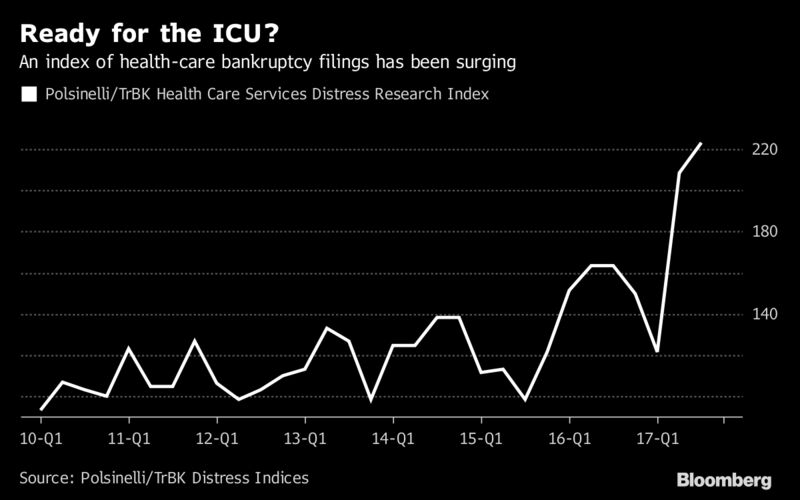
Some signs are already there: Health-care bankruptcy filings have more than tripled this year according to data compiled by Bloomberg, and an index of Chapter 11 filings by companies with more than $1 million of assets has reached record highs in four of the last six quarters, according to law firm Polsinelli PC. Junk bonds from companies in the industry have dropped 1.4 percent this month, a steeper decline than the broader high-yield market, according to Bloomberg Barclays index data.
The pain for the sector comes as bankruptcy filings across the broader economy have plunged since 2010.
Hospitals, including private rural ones, may be among the hardest hit, Winston & Strawn’s Neier said. The Affordable Care Act, known as Obamacare, reduced payments to hospitals that serve a large number of poor and uninsured patients, known as “disproportionate share hospitals,” on the theory that more patients would be insured under the law. Congress delayed those cuts several times, but didn’t do so for the current fiscal year, which may “single-handedly throw hospitals into immediate financial distress — many operate on less than one day’s cash,” he said in an interview.

“Smaller hospitals have already been struggling for years,” said Kristin Going, a partner in the New York office of Drinker, Biddle & Reath LLP. Both lawyers declined to discuss specific companies. Since 2010, a growing number of patients have enrolled in high-deductible health plans that force them to shoulder more of costs when they get treatment, according to the U.S. Centers for Disease Control and Prevention. That has translated into more bad debt from customers for hospitals and other providers.

Some publicly traded hospital companies that were already under pressure from high debt loads have been further buffeted by this year’s hurricanes. Community Health Systems Inc., with $1.9 billion in debt maturing in 2019, has suffered doctor revolts over crumbling, cash-strapped facilities, as well as losses linked to the storms in Texas and Florida earlier this year. A representative for Community Health didn’t return a call seeking comment.

Signs of Distress

Jorian Rose, partner in the New York office of Baker & Hostetler LLP, said many health-care restructurings are already going on under the radar right now. Rose, Going and Neier are members of the Turnaround Management Association, a group for bankruptcy and restructuring professionals.

The Polsinelli Health Care Services Distress Research index, which tracks bankruptcy filings for companies with more than $1 million in assets, shows that activity has surged 123 percent since the fourth quarter of 2010. By comparison, the law firm said, the general index that tracks Chapter 11 filings in the U.S. is down nearly 58 percent from 2010. The Affordable Care Act, which Republican lawmakers have been looking to repeal, replace, defund, or otherwise change, was cited as one of the systemic changes rocking the sector.

Since 1997, health-care cases have made up only 5.25 percent of all U.S. bankruptcy filings, according to Bloomberg data. Year to date, they already comprise 7.25 percent of all filings. Emergency-room operator Adeptus Health, cancer-care provider 21st Century Oncology, and cancer treatment specialist California Proton Treatment are the largest filings. Those statistics exclude pharmaceutical company Concordia, which is restructuring in Canada, and Preferred Care Inc., one of the U.S.’s largest nursing home groups, operating 108 assisted living facilities.

Problems for the sector aren’t limited to U.S. companies. Israeli drugmaker Teva Pharmaceutical Industries Ltd., saddled with debt that’s more than double its market value, is putting together a “detailed restructuring plan” after the company has slashed its profit forecasts, cut its dividend, signaled it may sell new shares, and reduced its goal for paying down debt this year. It announced a management shakeup on Monday.

Distress among health-care companies can spread to other parts of the economy. Quality Care Properties Inc., for example, is a real estate investment trust with a struggling tenant, HCR Manorcare Inc. Moody’s Investors Service said in an October report that if HCR Manorcare files for bankruptcy, Quality Care could also need to amend the terms of its own debt. Representatives for HCR Manorcare and Quality Care didn’t return calls seeking comment.

Is a Medicare option for all the only practical means to solve the healthcare insurance crisis?

https://www.beckershospitalreview.com/payer-issues/is-a-medicare-option-for-all-the-only-practical-means-to-solve-the-healthcare-insurance-crisis.html

Image result for health insurance options

From a healthcare consumer perspective, it increasingly strikes one that the healthcare insurance market is a story of haves and have-nots.

The haves include those that work for companies of a certain size, at which the companies can access insurance at very expensive but somewhat rationalized costs (think $16,000 to $20,000 per family per year, with employees contributing roughly $5,500), people on Medicare, and — crazily enough — people on Medicaid. (Again, the concept of a “have” here solely relates to the availability of healthcare coverage. It is by no means meant to understate the challenge of being in such poverty to be eligible for Medicaid.)

The have-nots include a vast number of people trying to buy insurance directly from insurance companies. Here, one increasingly hears that whether one is rich or poor, the costs are horrendous. Family costs for PPO plans seem to fall in the $20,000 to $25,000 range for many families, and even higher for those with preexisting conditions.

From a provider perspective, Medicare is a mixed bag depending on the type of provider. From a hospital’s perspective, it seems to be fine overall. From a physician’s perspective,  many seem to find it woefully inadequate.

One of the great challenges of the ACA is it set up an additional healthcare system of subsidies around insurance markets, mandates and so forth. It added complexity and costs, but also helped provide an additional basket of coverage for a good deal of uninsured Americans.

Regardless of political perspectives, rather than building another healthcare finance system, it seems that a simple approach would be to build on an existing system that, while imperfect, seems to work fairly well.

As an ardent capitalist at heart, the idea over the years of expanding a government program of any sort, including Medicare, has always led me to a negative conclusion. I.e., would it cause the kind of regression in our healthcare system that exists in systems in England or Canada, where care is famously inadequate or requires waiting months for certain types of care?

In contrast, at some point, does the cost of healthcare for those who don’t work for a large company and aren’t eligible for Medicare or Medicaid make the system so expensive that there is good reason to offer a Medicare option for such people? This demographic makes up a large part of the population, and it seems that the private insurance market is offering them only very expensive choices for health plans.

Much of my sense of the cost of private healthcare insurance comes anecdotally — from listening to diverse family and extended family around the Thanksgiving table, for instance. That stated, I do sense the cost of insurance for a family has moved from quite expensive to extremely and back-breakingly expensive. Sadly, I’m losing confidence that the core free market can fix it.


The GOP’s Strategy for Killing Obamacare Now Looks Like This

https://www.bloomberg.com/news/articles/2017-11-22/the-gop-s-strategy-for-killing-obamacare-now-looks-like-this

The mandate to buy health insurance is the broccoli of Obamacare—the part you have to accept if you want the goodies, like affordable coverage of people with costly pre-existing conditions. Now Senate Republicans are saying you don’t have to eat your broccoli anymore. They eliminate the penalty for lack of coverage in their version of the $1.5 trillion tax cut bill, which they aim to vote on after Thanksgiving.

Could removing the penalty, which effectively kills the individual mandate, possibly make sense? Health-care economists describe the mandate as a necessary evil. Without it, they say, healthy people will roll the dice and choose to go uncovered, leaving insurance pools made up of sicker, older people who are costlier to cover. But the impact of the requirement is regressive. Well-off families generally get health insurance through their employers, so those who pay the tax for noncoverage tend to be poorer, some working two or three jobs to make ends meet.

For Senate Republicans, killing the individual mandate is a beautiful twofer. First, it’s a way to limit the red ink from their tax package. The Joint Committee on Taxation estimates ending the mandate would save $318 billion over 10 years, because the people who dropped coverage wouldn’t get subsidies. Savings would continue after 2027. That’s crucial because under the Byrd rule, a measure can pass the Senate with a simple majority only if it doesn’t add to deficits beyond 10 years. Second, gutting the mandate would partially fulfill Republicans’ long-standing objective of getting rid of Obamacare entirely.

The downside for Republicans is that the repeal gambit has breathed new life into the pro-Obamacare coalition, which argues that Republicans are financing tax cuts for the rich by reducing the number of people with health insurance. “Adding ACA repeal to the corporate tax giveaway has fanned the flames of resistance into a roaring inferno,” says Ben Wikler, the Washington director of MoveOn.org, a liberal activist group. The Congressional Budget Office said on Nov. 8 that repealing the mandate would increase the number of uninsured Americans by 13 million and raise premiums by 10 percent “in most years” of the next decade.

Within hours of Senate Republicans’ announcing their intentions to kill the mandate, a coalition of trade groups for doctors, hospitals, and insurers urged them not to, warning that doing so would raise premiums. In Virginia, a CNN exit poll showed health care was voters’ top issue by more than 2 to 1. Democrat Ralph Northam won voters most concerned about health care 77 percent to 23 percent en route to his decisive election as their next governor.

This leaves Republicans in an awkward spot. While they crave the savings that come from repealing the mandate, they don’t love the reason why—namely, millions fewer people would be insured. That’s something they’ve always insisted wouldn’t happen. As recently as July, two White House officials wrote a Washington Post op-ed ridiculing the notion that millions of people “value their insurance so little that they will simply drop coverage next year following the repeal of the individual and employer mandates.”

Republicans are trying to have it both ways. Utah Senator Orrin Hatch, chairman of the Senate Finance Committee, said that dropping the mandate wouldn’t cut Medicaid. The CBO predicts that of the 13 million people who drop coverage, 5 million will be current Medicaid recipients. Senator Claire McCaskill, a Missouri Democrat, balked. “Where do you think the $300 billion is coming from?” she asked Hatch. “Is there a fairy that’s dropping it on the Senate?”

It’s not just the Republicans who have a complicated relationship with the mandate. Democrats need it to make Obamacare hang together, yet they know it’s unpopular and regressive. Seventy-nine percent of the 6.7 million households that paid the mandate tax for 2015 had incomes under $50,000, and 37 percent made below $25,000, according to Internal Revenue Service data. Republicans tweak Obamacare’s defenders by arguing that if financially hard-pressed families want to drop their policies—and lose the government subsidies that go with them—that’s their right.

Democrats say the mandate gets people to do something that’s in their best interest and keeps emergency rooms from being swamped by uninsured sick people. (Republicans used to make this argument.) But the mandate is also a way to get healthy families to subsidize less-healthy ones, rather than just cover their own risks. That’s what makes it unpopular. “That’s sort of the trap,” says Christopher Pope, a senior fellow at the conservative Manhattan Institute.

Also, the mandate probably isn’t as effective as Democrats have argued. In its Nov. 8 report, the CBO said that for its next estimate, it’s changing its model for how people behave. While results won’t be ready until after Congress wants to finish the tax bill, it said, the effects “would probably be smaller than the numbers reported in this document.” In other words, it won’t reduce coverage as much—or save as much money. It could be that Obamacare needs to rely less on the stick (mandates) and more on the carrot (subsidies that hold down the cost of premiums).

A new CBO estimate that played down the impact of mandate repeal could work out quite nicely for the Republicans. They could point to the Joint Committee on Taxation’s current high estimate for savings to pay for the tax cut, and then next year’s lower estimate of coverage losses from the CBO to claim that eliminating the mandate wasn’t so harmful after all. “Politics is a funny business,” says Pope. “You use whatever weapon you can grab hold of.”

BOTTOM LINE – By dropping Obamacare’s individual mandate, Senate Republicans can raise billions to pay for their tax cuts—and undercut a key part of the health-care law.