The Health 202: The rate of people without health insurance is creeping upward

https://www.washingtonpost.com/news/powerpost/paloma/the-health-202/2018/09/13/the-health-202-the-rate-of-people-without-health-insurance-is-creeping-upward/5b99569b1b326b47ec95958c/?utm_term=.ae9e8af79dd2


THE PROGNOSIS

New Census Bureau data on the number of uninsured Americans is either a testament to the resiliency of the Affordable Care Act or a sign that President Trump’s anti-ACA rhetoric and policies are starting to work.

As our colleague Jeff Stein reported Wednesday, there was a slight uptick in the number of Americans without health insurance in 2017 compared to 2016, even though that number essentially remained statistically flat. Still, the fact that uninsured rate went up at all, by about 400,000 people, marks the first time since the ACA’s implementation that the uninsured rate didn’t drop. 

Supporters of the ACA worry the news marks the beginning of a trend, especially when some of Trump administration policies intended to circumvent the ACA go into effect next year.

Ahead of open enrollment last year, the Trump administration dramatically decreased funding for any Obamacare outreach or advertising, limited resources for “navigators” who help people find an insurance plan, and shortened the window for people to sign up for insurance from three months to six weeks in states that use a federally run marketplace.

“Even with all of that, health coverage stayed steady. But at the same time, we’d like to see further progress in the rate of the uninsured,” said Judith Solomon of the Center on Budget and Policy Priorities.

It’s part of a pattern to weaken the 2010 health-care law known as Obamacare. After the GOP Congress failed to repeal and replace the ACA last summer, the Trump administration moved to dilute the law in other ways: including signing off on a plan to eliminate the individual mandate penalty next year; allowing individuals to buy skimpier, short-term health plans without certain coverage requirements under Obamacare; and seeking to allow states to put conditions on Medicaid coverage.

Some of the most prominent health care organizations in the country came together this morning to voice their disapproval of those short-term plans — including the American Cancer Society Cancer Action Network, the American Heart Association, Planned Parenthood Federation of America, the National Women’s Law Center, the , American Academy of Family Physicians, the American Academy of Pediatrics and Families USA.

“The Administration’s decision to expand short-term health plans will leave cancer patients and survivors with higher premiums and fewer insurance options,” said Dr. Gwen Nichols, chief medical officer of the Leukemia & Lymphoma Society.

The groups’ statements, compiled and released by Sen. Tammy Baldwin (D-Wis.), are in support of the senator’s effort to have Congress rescind the White House regulation. Nearly every Democratic senator has signed a resolution of disapproval to overturn it.

The census data reflects trends that started last year, when the administration’s policies had yet to be implemented. Fourteen states saw their uninsured populations rise in 2017. The only three states that didn’t see a spike in that number were New York, California and Louisiana. The first two aren’t surprising given those states’ robust efforts to enroll their own residents, while Louisiana expanded Medicaid in June 2016 so its decrease represents those low-income individuals who now have government coverage.

Medicaid expansion in most of the 33 states and D.C. that have done so under the ACA has predictably decreased the number of people without coverage. The uninsured rate last year in states with an expanded Medicaid program was 6.6 percent compared to 12.2 percent in non-expansion states — a gap that has only continued to grow since 2013.

To be fair, as Larry Levitt, senior vice president at the Kaiser Family Foundation, pointed out on Twitter: the uninsured rate started leveling off before the Trump administration started its work. But Levitt suggested the uninsured rate may really rise in 2019 when elimination of the individual mandate penalty takes effect. Moreover, states are increasingly taking the White House up on its suggestion to add work requirements to their Medicaid programs — in just the first three months of it being implemented in Arkansas, more than 4,000 people were jettisoned from the rolls for failure to comply.

Matthew Fiedler, a health-policy expert at the Brookings Institution, agreed with Levitt’s assessment, noting that the bulk of the people who were uninsured pre-ACA have already been enrolled  in the program. He contended that if policy had remained static, there would likely have been a modest decline instead of similar increase in the uninsured rate — though not a dramatic one. The real effects, he said, of the Trump administration’s efforts to chip away at the ACA are still to come. 

“I don’t think the right takeaway is that none of the policy changes will have a negative effect. I think they will going forward, we just haven’t seen that yet,” he said. “I think if your goal is to evaluate the ACA, I think the right takeaway is that there was a lot of progress, but more policy progress to be made.”

Of course, Democrats and Republicans have disparate views on how to get there. Democrats are now pushing for a public option or a universal health care system in which the government would foot the bill for many health-care costs. A lot of them feel  the ACA “got us roughly 40 percent there and established a framework for lawmakers to make that progress going forward,” Fiedler said. That’s why we’re now seeing so many Democratic candidates and lawmakers embracing some iteration of a “Medicare for all” program.  

Republicans still criticize the ACA as vast government overreach and are vowing they will take another stab at repealing it should they maintain the congressional majorities after the November midterms.

“We made an effort to fully repeal and replace ObamaCare and we’ll continue,” Vice President Pence said while campaigning for Baldwin’s opponent, Leah Vukmir, if the GOP performs well in the midterms.

One additional interesting data point from the census is ages at which there was the greatest increases or decreases in the uninsured rate. As highlighted in the chart above, rates of those without insurance rose at ages 18 and 19 — when children are no longer eligible for the Children’s Health Insurance Program; and for those between ages 25 and 26 — when children no longer qualify for their parents’ insurance. The uninsured rate dropped, however, for those aged 64 and 65 — when adults are eligible for Medicare.

The greatest spike in those without insurance was documented for 26 year olds. That’s likely because young adults are typically healthier and feel less urgency to pay for insurance when they lose coverage under their family’s plan.

As noted by the New York Times’ Margot Sanger Katz on Twitter, these stats show just how crucial government programs and laws have been in providing health coverage to Americans:

Why Protections for Pre-Existing Conditions Are Such a Potent Political Issue

http://www.thefiscaltimes.com/2018/09/05/Why-Protections-Pre-Existing-Conditions-Are-Such-Potent-Political-Issue


The Affordable Care Act provisions preventing insurers from discriminating against patients with pre-existing medical conditions have become a popular — and politically potent — element of the law, and the new Kaiser Family Foundation tracking poll shows why: Six in 10 Americans say that they or someone in their household suffers from a pre-existing condition such as asthma, diabetes or high blood pressure.

It’s no surprise then that the tracking poll also finds that 75 percent of Americans now say that it is “very important” to keep the provision prohibiting insurance companies from denying a person coverage because of his or her medical history. Another 15 percent say it is “somewhat important” this provision stays in place. Similarly, 72 percent say it is “very important” that the provision to keep insurance companies from charging sick people more remains law. Another 19 percent say it is “somewhat important.”

In addition, more than 60 percent of Americans are “very worried” or “somewhat worried” that they will lose insurance coverage if the Supreme Court overturns the Affordable Care Act’s protections for people with pre-existing conditions. And 75 percent are “very worried” or somewhat worried” that they or a family member will have to pay more for coverage.

Democrats have been hammering the administration and Republicans for their willingness to have a court invalidate protections for those with pre-existing conditions.

As part of their effort to push back on that line of attack, 10 Republican senators last month introduced new legislation that they say would prevent insurance companies from denying coverage to people with pre-existing conditions, or charging those people more, no matter what happens in the Texas court case. Critics have said that the GOP bill’s protections don’t go as far as Obamacare’s. Republicans have responded by saying they’d be willing to look at changes to make the legislation more comprehensive.


Public blames everyone for high health costs

Kaiser Health Tracking Poll – Late Summer 2018: The Election, Pre-Existing Conditions, and Surprises on Medical Bills

Health care costs remain a leading issue ahead of this year’s midterms, and voters have plenty of blame to go around, according to the Kaiser Family Foundation’s latest tracking poll.

  • Kaiser asked its respondents whether certain factors are a “major reason” health care costs are rising. (There could be multiple “major reasons.”)
  • Blame for the potential political culprits — the ACA and the Trump administration — was split about evenly.
  • But there’s a broader bipartisan agreement that industry is to blame: At least 70% faulted drug companies, hospitals and insurers. Doctors caught a break, at 49%.

Partisanship reigns, though, on the question of whether President Trump will help.

  • A mere 13% of Democrats are at least somewhat confident that Americans will pay less for prescription drugs under the Trump administration, compared with a whopping 83% of Republicans. Independents generally share Democrats’ skepticism.
  • Roughly a quarter of Democrats and two-thirds of Republicans, think Trump’s public criticism of drug companies will help bring down prices.

Surprise hospital bills haven’t attracted the same political uproar as prescription drug costs, but the Kaiser poll provides more reason to believe they could be the next big controversy.

  • 67% said they’re “very worried” or “somewhat worried” about being unable to pay a surprise medical bill, while 53% fear they won’t be able to pay their deductible and 45% are afraid of the tab for their prescription drugs.
  • 39% experienced a surprise bill in the past year.


Fewer Americans Without Health Plans Since Obamacare Debut

https://www.bloomberg.com/news/articles/2018-08-29/fewer-americans-without-health-insurance-since-obamacare-debut

Image result for Fewer Americans Without Health Plans Since Obamacare Debut

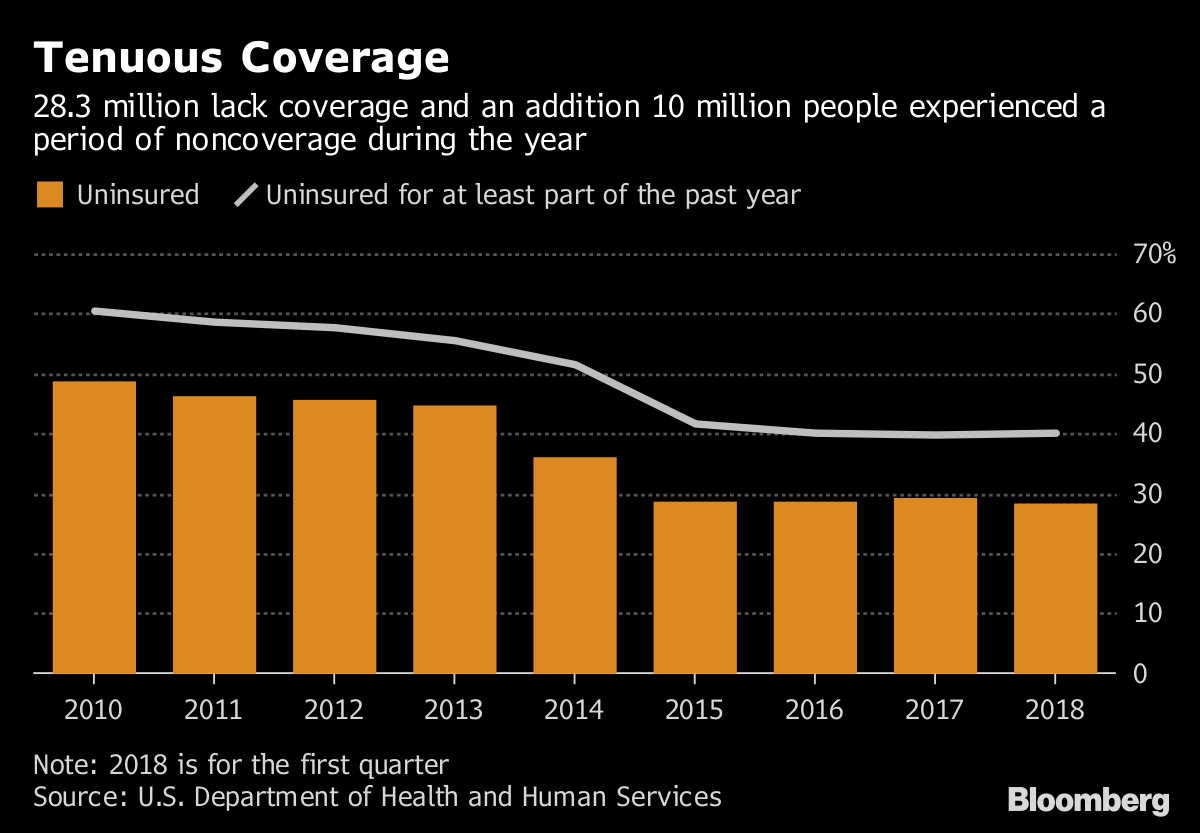
Fewer Americans lack health insurance — but the gap remains wide, especially in some pro-Trump states.

The number of uninsured declined to 28.3 million in the first quarter, down from 29.3 last year — and 48.6 million in 2010, the year the Affordable Care Act was signed into law by then-President Barack Obama, according to data from the federal Centers for Disease Control and Prevention.

The distribution, however, is uneven with data for south central states — Arkansas, Louisiana, Oklahoma and Texas — showing almost a quarter of adults lacking health care coverage. President Donald Trump, who has opposed Obamacare, won those four states in the 2016 presidential election.

The CDC data also show:

  • Even with the reduction, one in eight Americans between 18 to 64 remained uninsured.
  • Of those with insurance, about one in five were covered by public plans and seven in ten were covered by private plans. Children fared better, with more than 95 percent covered by public or private plans.
  • About one in four Hispanics lacked coverage while 14.1 percent of non-Hispanic blacks, 8.9 percent of non-Hispanic whites and 6.1 percent of non-Hispanic Asians lacked coverage.
  • The number of people under age 65 covered under the Health Insurance Marketplace declined by about 1 million to 9.7 million.
  • The number of adults who lacked health insurance for more than one year declined from 32 million in 2010 to 14.9 million in the first quarter of this year.


ACA court case causing jitters in D.C. and beyond

http://www.modernhealthcare.com/article/20180831/NEWS/180839976

Image result for 2018 midterm elections


For months, congressional Republicans have ignored the Texas-led lawsuit seeking to overturn the Affordable Care Act. With the midterm elections looming, talk of the case threatened to reopen wounds from failed attempts to repeal the law. Not to mention that legal experts have been panning the basis of the suit.

But that’s all changing as the ACA faces its day in court … again. The queasy feeling of uncertainty that surrounded the law just one year ago is back. The level of panic setting in for the industry and lawmakers is pinned to oral arguments set for Sept. 5 in Texas vs. Azar. Twenty Republican state attorneys general, led by Ken Paxton of Texas, are seeking a preliminary injunction to halt enforcement of the law effective Jan. 1. Their argument is built around the Supreme Court’s 2012 ruling in which Chief Justice John Roberts said the law is constitutional because it falls under Congress’ taxing authority. The AGs have seized on the congressional GOP’s effective elimination of the individual mandate penalty in the 2017 tax overhaul as grounds to invalidate the law. 

They have the Trump administration on their side, in part. The Justice Department in June filed a brief arguing that the individual mandate as well as such consumer protection provisions as barring insurance companies from denying coverage to people with pre-existing conditions are unconstitutional. But the department stopped short of suggesting that the entire law be vacated.

Conservative U.S. District Judge Reed O’Connor will hear the case in Austin, Texas. O’Connor has already ruled against an ACA provision that prohibited physicians from refusing to perform abortions or gender-assignment surgery based on religious beliefs, and he is considered a wild card.

Even ACA supporters who downplay the legal standing of the case are bracing for the possibility that O’Connor will side with the plaintiffs, who ultimately see a path to the Supreme Court.

Republicans, meanwhile, are trying to head off a potential political storm. A coalition of Senate Republicans led by Sen. Thom Tillis of North Carolina introduced a bill to codify guaranteed issue for people with pre-existing conditions into HIPAA laws. But they left out the key mandate that insurers can’t exclude coverage of treatment for pre-existing conditions. That omission left health insurers scratching their heads and Democrats came out swinging, with Democratic Sen. Claire McCaskill of Missouri dubbing the measure “a cruel hoax.”

The politics around coverage protections will really start to matter for Republicans should O’Connor signal support for the plaintiff states, according to Rodney Whitlock, a Washington healthcare strategist and former GOP Senate staffer. “It ups the pressure considerably,” he said. “There’s no question it complicates things for Republicans if a decision comes down in October.”

Insurers are on the lookout for signs of what could happen next. If O’Connor’s decision comes down before open enrollment starts on Nov. 1, the GOP will feel increasing pressure to do something substantive, according to an industry official who asked not to be identified.

Although a ruling striking down the law wouldn’t necessarily impact the individual market in 2019, it would spark the kind of massive uncertainty that insurers hate and complained of last year during the GOP repeal-and-replace efforts.

America’s Health Insurance Plans filed an amicus brief urging the court to deny the request for a preliminary injunction, citing the massive impact such a move would have on insurers in the individual market, Medicaid managed care and Medicare Advantage plans.

“It creates a lot of impetus for federal or state action,” the insurance official said, noting that insurers would have to rely on HHS to interpret how the law’s regulations would apply going forward. If mounting court decisions start to drastically affect the law’s mandates, it would fall to HHS how to manage complicated questions around how to follow ACA rules.

HHS and Justice Department officials declined to comment. CMS Administrator Seema Verma in August told McCaskill when pressed at a Senate committee hearing that she would support legislation to protect pre-existing conditions, but she declined to specify how the CMS would respond administratively if the suit succeeds.

For now, lawmakers aren’t showing any willingness to take a bipartisan approach. The House GOP plans to introduce a companion bill to the Senate measure, Tillis told Modern Healthcare last week. Meanwhile Democrats have made hay over the fact that the protections in his legislation are incomplete. Tillis said leaving out the prohibition of coverage exclusions was not intentional and GOP senators would look again at the bill if the lawsuit advances.

He added that he envisions the legislation as just one piece that could build into a bigger overhaul effort, and wants to see protections of other popular provisions such as allowing people up to age 26 to stay on their parents’ health insurance.

“It’s similar to what we talked about last year,” Tillis said, referencing the 2017 repeal-and-replace efforts. “Any sort of court challenge that would cause a precipitous voiding of Obamacare would leave a lot of people in the lurch, and one of those areas is pre-existing conditions.”

Sen. Bill Cassidy (R-La.), who spearheaded the last major GOP effort to repeal and replace the ACA last year, also said he would want to look at more comprehensive legislation if the lawsuit advances. “I certainly would,” Cassidy said. “I can’t speak for all, but I do think there would be a drive to.”

How Republicans will move past messaging and into action remains to be seen, Whitlock said.

“If you think of the seminal moments of 2017, you think of pre-existing conditions and the Jimmy Kimmel test,” Whitlock said, referencing the talk show host’s attack on the repeal-and-replace effort following emergency heart surgery for his newborn son. “This was a big deal because people were concerned. It is a very important issue, and it’s also one that Republicans have tried to say in every bill that they’re trying to protect. They have been successful to varying degrees in making that case. But with the Texas lawsuit, there’s no protecting it. It says, throw out the entire ACA root and branch.”

And as nomination hearings for Supreme Court nominee Brett Kavanaugh get underway Sept. 4, Democrats will keep using the GOP’s dilemma as a cudgel. McCaskill, for instance, is leveraging the issue in her neck-and-neck race against Missouri Attorney General Josh Hawley, who is part of the lawsuit.

“How do you have a pre-existing conditions bill that says we’re not going to protect someone with a pre-existing condition?” she told reporters last week. “It’s embarrassing, it’s the Potomac two-step. Do they think nobody’s paying attention? They’re just trying to cover themselves politically, isn’t it obvious?”

And then there’s the other political dilemma for Republicans who want to show they can secure Obamacare’s protections: convincing their base that they still fundamentally oppose Obamacare even if they don’t want to talk about repeal-and-replace anymore.

“You can be sure there are folks out there who really desperately don’t want to see the Texas side laughed out of court,” Whitlock said. “It destroys the whole narrative about the lawsuit. It’s this bizarre dynamic where an obscure lawsuit that has no legal basis whatsoever leaves the opportunity to talk about” repeal.

He added: “There are people who are flat-earthers on ACA, still preaching complete and total repeal.”


New Accumulator Adjustment Programs Threaten Chronically Ill Patients

https://www.healthaffairs.org/do/10.1377/hblog20180824.55133/full/?utm_term=Read%20More%20%2526gt%3B%2526gt%3B&utm_campaign=Health%20Affairs%20Sunday%20Update&utm_content=email&utm_source=Act-On_2018-08-05&utm_medium=Email&cm_mmc=Act-On%20Software-_-email-_-Individual%20Mandate%20Litigation%3B%20Housing%20And%20Equitable%20Health%20Outcomes%3B%20Simplifying%20The%20Medicare%20Plan%20Finder%20Tool-_-Read%20More%20%2526gt%3B%2526gt%3B

Related image

For too many Americans with chronic illnesses, such as HIV, arthritis, and hemophilia, insurance companies and their pharmacy benefit managers (PBMs) are erecting access barriers to innovative and life-saving prescription medicines. A new and growing trend—called accumulator adjustment programs—threatens to exacerbate the problem by significantly increasing out-of-pocket spending for patients. On top of it, patients are not even aware of this sudden and very costly change.

Patients with chronic illnesses already jump through hoops to receive their drugs. First, they have to ensure that their medicines are covered by their plan. Then they often have to work through a series of utilization management steps, such as prior authorization and step-therapy.

On top of those hurdles, more and more patients are facing high deductibles for prescription drugs or are being asked to pay a percentage of the cost of a drug, which is called coinsurance, instead of a nominal copayment. Coinsurance and deductibles often require patients to pay cost sharing based on the list price, which does not reflect the rebates that the PBMs receive from the drug companies.

When patients are still satisfying their deductible or are paying high coinsurance, they can face out-of-pocket spending of thousands of dollars to fill one prescription. If they cannot afford these costs, they will leave the pharmacy counter empty-handed and risk becoming sick or getting sicker. Drug manufacturers offer coupons to prevent this and make cost sharing for these drugs affordable. Historically, commercial insurance plans have applied the value of these coupons to a patient’s annual deductible and out-of-pocket maximum; reaching these limits translates into lower out-of-pocket spending for the rest of the year.

Now, however, accumulator adjustment programs are currently being pushed by PBMs, such as Express Scripts and CVS Caremark, to insurers including United HealthcareMolina, and BlueCross BlueShield of Texas and Illinois, and to large employers such as WalmartHome Depot, and Allstate. These programs change the calculus for patients by no longer applying the copay coupons to patient deductibles and out-of-pocket maximums. Patients must spend more out of pocket to reach their deductible; sometimes thousands of dollars more. For too many patients, this makes the drugs they depend on unaffordable.

While there has been an ongoing debate between the insurance industry and the drug companies regarding who is responsible for the high cost of some medications, this new practice has nothing to do with the actual cost of the drug. The only thing that has changed is how much the insurance company, employer, or PBM is requiring patients to pay for their drug. And these entities are beginning to implement accumulator adjustment programs without adequately informing beneficiaries, who will be shocked to learn that the cost-sharing assistance they have been relying on no longer applies toward their deductible or out-of-pocket costs.

People living with HIV and hepatitis have long relied on these copay coupons to afford the cost of their medications. The impact on a countless number of peoples’ lives has been profound. But this new practice will increase patient out-of-pocket spending, leaving patients at risk of hitting a “cost cliff” mid-year. This cliff could cause disruptions to patients’ care as medication becomes prohibitively expensive. For people living with HIV, hepatitis, and so many other health conditions, the resulting decision can literally mean life or death.

While some may claim that coupons are being used to incentivize brand-name drugs over generics, the fact is 87 percent of the coupons are for drugs that have no generic equivalent. The 13 percent of branded drugs programs in which generic equivalent products are available accounted for only 0.05 percent of all prescriptions filled.

There is a relatively new drug regimen, known as pre-exposure prophylaxis (or PrEP), that when taken regularly, prevents HIV. Because there is no generic alternative, most patients can’t afford the high coinsurance and rely on manufacturer copay assistance to reach their deductible and lighten the burden. This new practice of no longer applying the copay coupons to patient deductibles and out-of-pocket maximums by the insurance companies and PBMs are making access to this remarkable treatment more difficult and will have a significant impact on our efforts to prevent HIV in the United States.

But it does not have to be like this. The growing practice of not counting copay coupons toward a beneficiary’s deductible most likely stems from PBMs, insurers, and human resources professionals, who sign off on these plans, failing to fully comprehend the impact these programs will have on vulnerable patient populations and the overall health care system.

Patient groups and employees across the country should reach out to their health insurance providers and workplace plan managers to check whether their plan is implementing this new troubling practice. And if they are, people need to speak up and push back. These new insurance practices are not acceptable and bad for the health of our country.


Senators Consider Dueling Bills Over Texas Individual Mandate Litigation

https://www.healthaffairs.org/do/10.1377/hblog20180828.283008/full/?utm_term=Read%20More%20%2526gt%3B%2526gt%3B&utm_campaign=Health%20Affairs%20Sunday%20Update&utm_content=email&utm_source=Act-On_2018-08-05&utm_medium=Email&cm_mmc=Act-On%20Software-_-email-_-Individual%20Mandate%20Litigation%3B%20Housing%20And%20Equitable%20Health%20Outcomes%3B%20Simplifying%20The%20Medicare%20Plan%20Finder%20Tool-_-Read%20More%20%2526gt%3B%2526gt%3B

Litigation in Texas over the constitutionality of the individual mandate and, with it, the entire Affordable Care Act (ACA) is receiving more and more attention in Congress. On August 23, 2018, Republican Senators released new legislation that they believe would help blunt the impact of a ruling for the plaintiffs in Texas v. United States. The stated aim of the bill is to “guarantee” equal access to health care coverage regardless of health status or preexisting conditions. However, in the event that the court agrees with the plaintiffs—or even just the Trump administration—the legislation leaves significant gaps.

At the same time, Democratic Senators had their efforts to potentially intervene in the litigation rebuffed during the debate over a recent appropriations bill for the Departments of Labor, Health and Human Services (HHS), Education, and Defense. With a hearing on Texas scheduled for September 5, 2018—the same time as hearings are set to begin in Congress over the confirmation of D.C. Circuit Judge Brett Kavanaugh to the Supreme Court—attention on the case is only likely to increase.

Brief Background On Texas

In Texas, 20 Republican state attorneys general and two individual plaintiffs challenge the constitutionality of the individual mandate, which was zeroed out by Congress beginning in 2019. Without the penalty, the plaintiffs argue that the mandate is unconstitutional. Because the mandate cannot be severed from the rest of the law, they believe the entire ACA should also be struck down.

In June, the Department of Justice (DOJ) declined to defend the constitutionality of the individual mandate alongside the ACA’s provisions on guaranteed issue (42 U.S.C. §§ 300gg-1, 300gg-4(a)), community rating (42 U.S.C. §§ 300gg(a)(1), 300gg-4(b)), and the ban on preexisting condition exclusions and discrimination based on health status (42 U.S.C. § 300gg-3). These provisions collectively ensure that individuals with preexisting conditions cannot be charged more for their coverage or denied coverage or benefits based on health status or other factors.

The plaintiffs have asked Judge Reed O’Connor of the federal district court in the Northern District of Texas to enjoin HHS and the Internal Revenue Service (IRS) from enforcing the ACA and its implementing regulations—or, at a minimum, to strike down the law’s guaranteed issue and community rating provisions alongside the mandate. Judge O’Connor is considering ruling on the merits of the case (instead of issuing a preliminary injunction) and has scheduled a hearing on the motion for a preliminary injunction for September 5.

As noted above, the hearing will coincide with confirmation hearings for Judge Kavanaugh. Texas will likely be a focal point in the Kavanaugh proceedings because of the possibility that the case will reach the Supreme Court and because previous decisions suggest that Judge Kavanaugh believes that a President can decline to enforce laws that he or she believes to be unconstitutional.

The New Republican Legislation

Recognizing the potential impact of the Texas lawsuit, 10 Republican Senators released new legislation on August 23. The bill is sponsored by Senators Thom Tillis (NC), Lamar Alexander (TN), Chuck Grassley (IA), Dean Heller (NV), Bill Cassidy (LA), Lisa Murkowski (AK), Joni Ernst (IA), Lindsey Graham (SC), John Barrasso (WY), and Roger Wicker (MS). It is tied directly to the Texas litigation: Press releases acknowledge the September 5 hearing and state that “protections for patients with pre-existing conditions could be eliminated” if Judge O’Connor rules in favor of the plaintiffs.

The legislation would amend the Health Insurance Portability and Accountability Act of 1996 (HIPAA). Although HIPAA offered significant new protections at the time it was passed, these protections were limited in terms of ensuring that people with preexisting conditions could access affordable, comprehensive coverage, particularly in the individual market. HIPAA established a minimum set of federal protections for certain consumers—for example, those who lost their group coverage—facing certain situations, such as job lock because of a new preexisting condition exclusion period. HIPAA also required guaranteed issue in the small group market and guaranteed renewability in the individual and group markets.

As mentioned, the DOJ has declined to defend the ACA’s provisions on guaranteed issue (42 U.S.C. §§ 300gg-1, 300gg-4(a)) and community rating (42 U.S.C. §§ 300gg(a)(1), 300gg-4(b)), and the ban on preexisting condition exclusions and discrimination based on health status (42 U.S.C. § 300gg-3). Thus, their position in the lawsuit implicates parts of four provisions of federal law: 42 U.S.C. §§ 300gg, 300gg-1, 300gg-3, and 300gg-4.

The legislation introduced by Republican Senators would restore only two of the four provisions that stand to be invalidated in Texas: 42 U.S.C. § 300gg-1 (guaranteed issue) and most of § 300gg-4 (guaranteed issue and rating based on health status). So the bill would prohibit the denial of coverage and rating based on health status, but it would not prohibit preexisting condition exclusions or rating based on other factors, such as age, gender, tobacco use, or occupation. This means that many individuals, including those with preexisting conditions, could still face higher premiums, higher out-of-pocket costs, and the denial of benefits because of a preexisting condition even after paying premiums for many months.

Implications 

The protections offered by the restoration of the two provisions included in the Senate GOP bill, § 300gg-1 and most of § 300gg-4, are largely illusory without the other parts of the ACA—community rating and the ban on preexisting condition exclusions—that are at risk in the lawsuit. Assuming the at-risk provisions are struck down and the new legislation is adopted, consumers would still face significant gaps. For instance, a woman with a history of cancer could purchase a policy under the new bill, but she could be charged more based on her gender and age, potentially pricing her out of the market. In addition, her policy could have a preexisting condition exclusion, meaning that any recurrence of cancer—or any other health condition—might not be covered at all; this could lead to much higher out-of-pocket costs and far less financial protection.

If Congress were to enact this bill today, it would largely be duplicative of existing law (and would do nothing to disturb the ACA). If Congress were to enact this bill in response to the Texas litigation, its effect would depend on how (if at all) a court would invalidate the ACA provisions in Texas. Would a court strike the entire provisions, including what was adopted under HIPAA and other federal laws? Or would a court simply strike the amendments that were made by the ACA?

If the latter, the new legislation might do even less than its authors think, because much of the bill is, in fact, devoted to readopting existing federal law that may not be at issue in Texas. These provisions were adopted before the ACA and touch on, for instance, genetic information nondiscrimination and long-standing exceptions to guaranteed issue.

No Vote On Manchin Resolution To Potentially Intervene In Texas

In July, Democratic Senators led by Joe Manchin (WV) introduced a resolution with the goal of intervening in Texas to defend the ACA’s protections for people with preexisting conditions. The resolution would authorize the Senate Legal Counsel to move to intervene in the case on behalf of the Senate and defend the ACA. During last week’s debate over an HHS appropriations bill, Senate leadership blocked a vote on the amendment.


The uninsured rate remains plateaued

https://www.cdc.gov/nchs/data/nhis/earlyrelease/Insur201808.pdf?utm_source=newsletter&utm_medium=email&utm_campaign=newsletter_axiosvitals&stream=top-stories

Image result for The uninsured rate remains plateaued


The Centers for Disease Control and Prevention is out with its latest health insurance coverage data this morning, and the nation’s uninsured rate isn’t really changing a whole lot.

By the numbers: As of March 2018, 8.8% of all Americans, or about 28.3 million people, had no health insurance.

  • Those numbers are almost identical to the CDC’s 2017 report, when 28.1 million people were uninsured as of March 2017.
  • It’s also worth noting that 47% of people younger than 65 are in a high-deductible plan, up from 42.3% recorded at the same point last year.

The big picture: The federal and state exchanges established by the ACA are treading water when it comes to enrollment, and no new states have expanded Medicaid. (Notably, Maine Gov. Paul LePage is still resisting his state’s voter-approved Medicaid expansion.)

The bottom line: Don’t expect the uninsured rate to fluctuate a lot until more states expand Medicaid or the ACA exchanges get more federal support.

Looking ahead: The U.S. Census Bureau will unveil its 2017 health insurance numbers on Sept. 12.


California Legislature bans short-term health insurance

https://www.sfchronicle.com/business/article/Defying-Trump-California-legislature-bans-13169686.php

Image result for california legislature


The California Legislature has passed a bill banning the sale of short-term health insurance plans — a type of insurance the Trump administration is seeking to expand.

The bill, SB910, authored by State Sen. Ed Hernandez (D-West Covina), was approved by the Senate on Monday and the Assembly last week. It will need the signature of Gov. Jerry Brown to become law.

Short-term plans are generally cheaper but do not need to cover all the benefits required under the Affordable Care Act, such as preventive care, essential health benefits and protections for people with pre-existing conditions. An estimated 10,000 people in California are currently enrolled in such plans.

The U.S. Department of Health and Human Services this month finalized a rule extending the amount of time consumers can be on short-term plans from three months to almost 12 months, after which they can be renewed for up to three years. However, the HHS rule allows states to regulate the sale of such plans on their own terms.

California had long capped the amount of time consumers could be on short-term plans to six months; the Obama administration limited it even further, to three months. Hernandez’s bill eliminates the sale of such plans altogether, for any amount of time.

If Brown signs the bill, California would join a handful of states, including New Jersey, Massachusetts and New York, that have severely restricted or banned short-term plans, according to the California Health Care Foundation.

If the bill becomes law, it would take effect in January 2019. Californians would still be able to buy short-term coverage — if they are in between jobs, for instance — through the state insurance exchange Covered California, or directly from health insurers like Blue Shield or Kaiser. These plans do comply with Affordable Care Act consumer protections like essential health benefits. Consumers would be able to do this at any time during the year, not just during annual enrollment, because losing job-based coverage counts as a qualifying life event.


It’s not just the uninsured — it’s also the cost of health care

https://www.axios.com/not-just-uninsured-cost-of-health-care-cdcb4c02-0864-4e64-b745-efbe5b4b7efc.html

Image result for It's not just the uninsured — it's also the cost of health care

We still have an uninsured problem in the U.S., but we have a far broader health care affordability problem that hits sick people especially hard.

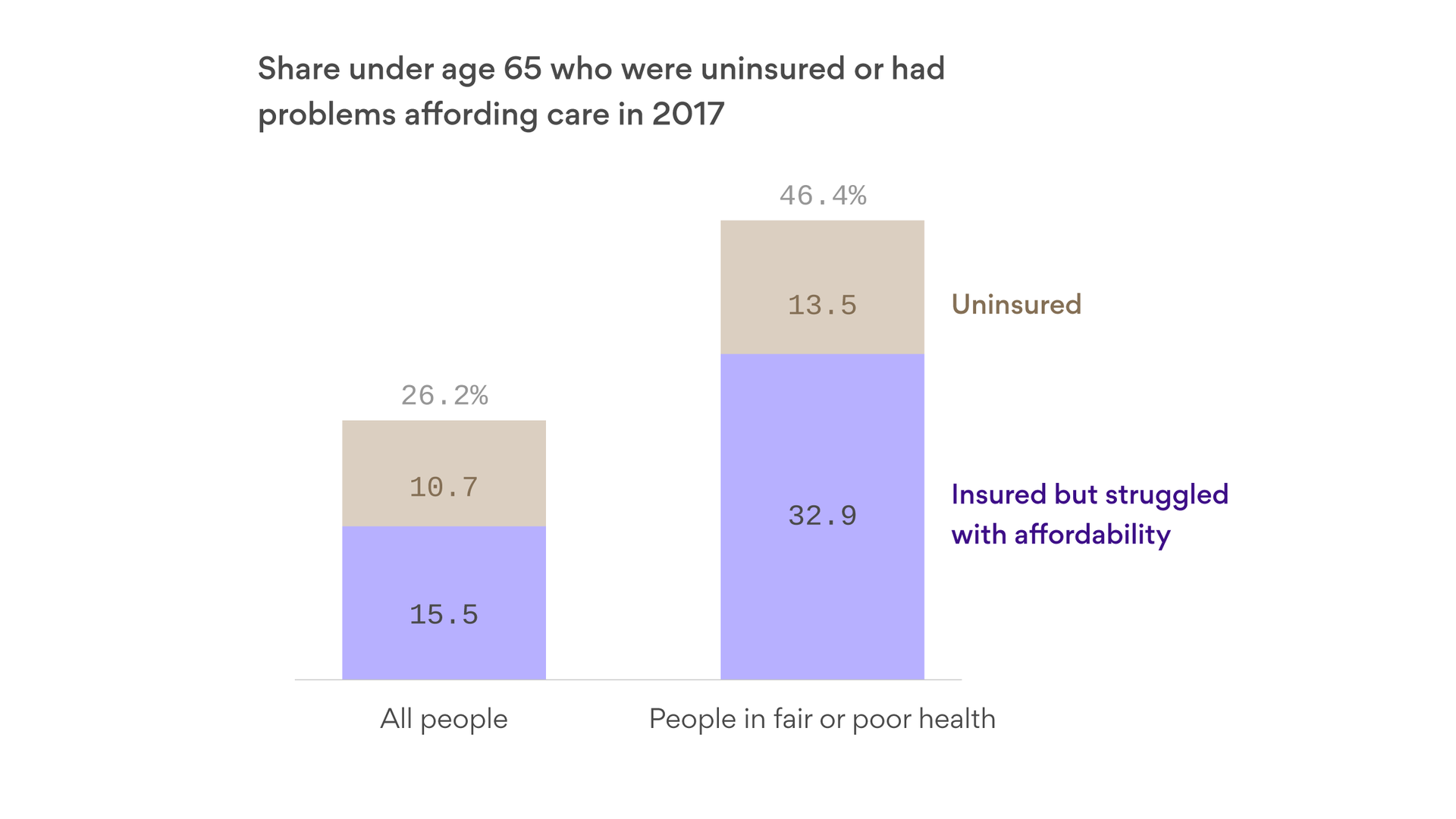
Why it matters: It’s time to think more broadly about who’s having trouble paying for the health care they need. The combination of lack of insurance and affordability affects about a quarter of the non-elderly population at any one time, but almost half of people who are sick.


Now that the Affordable Care Act has expanded health coverage, the percentage of the non-elderly population that is uninsured is now just under 11%, the lowest level ever recorded. But as the chart shows:

  • Another 15.5% who have insurance either skipped or delayed care because of the cost or reported that they or someone in their family faced problems paying their bills in 2017.
  • That brings the total percentage of non-elderly people with insurance and affordability problems to 26.2%.


More striking: nearly half of all people in fair or poor health — 46.4% — are uninsured or have affordability problems despite having coverage.

  • That includes 13.5% who were uninsured and in fair or poor health — arguably the worst off in the entire system — and another 32.9% percent who have insurance but said they or a family member have had a problem affording care in the last year.


It’s not surprising that people who are sicker and need more care would have more problems paying for it. But arguably an insurance system should work best for people who need it the most.


All this says a lot about current health care politics.

  • It helps explain why so many people name health their top issue, despite the progress that has been made in covering the uninsured. And everyone who’s sick and can’t afford medical care has family members and friends who see what they are going through, creating a political multiplier effect.
  • It is also why health care is substantially an economic issue as well as an issue of access to care. When people have trouble paying medical bills, it’s a hard hit to their family budgets — causing many people to take a second job, roll up more debt, borrow money, and forego other important family needs.


For as long as I have been in the field, we have used two measures more than any others to gauge the performance of the health system: the number of Americans who are uninsured and the percentage of GDP we spend on health. Both measures remain valid today.

The bottom line: If we want a measure that captures how people perceive the system when the number of uninsured is down and overall health spending has moderated, we need better ways of counting up the much larger share of the population who are having problems affording care.

And whatever big policy idea candidates are selling, from single payer on the left to health care choices on the right, the candidate who connects that idea to the public’s worries about paying their medical bills is the one who will have found the secret sauce.