


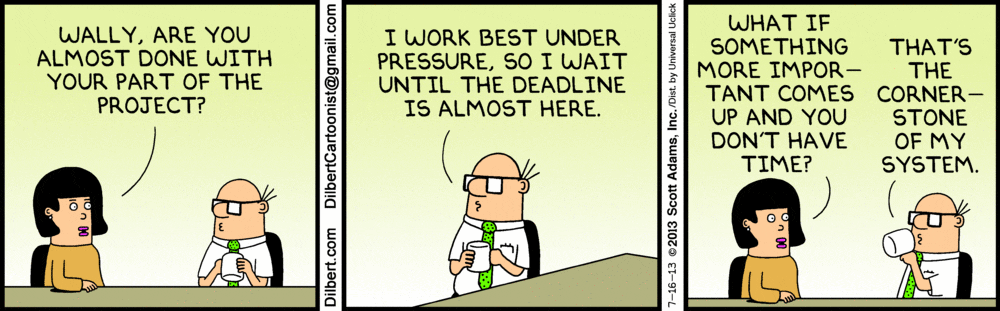
Cartoon – KPI Effectiveness


Here are the questions to ask of yourself and your team:
This problem-solving discussion will increase everyone’s level of awareness for making and keeping commitments as well as surface problems that keep them from doing so.
Getting to a higher level of completion on action items leads not only to exponential progress toward goals, but also to a tremendous sense of accomplishment — both personally and for the group.

In every senior position I held, I made extensive use of task forces to develop options, recommendations, and specific plans for implementation. I relied on such ad hoc groups to effect change instead of using existing bureaucratic structures because asking the regular bureaucratic hierarchy (as opposed to individuals within it) if the organization needs to change consistently yields the same response: it almost never provides bold options or recommendations that do more than nibble at the status quo.
– Robert M. Gates

As a friend once told me, “Government is about compromise.” That friend was Tommy Thompson, a four-term governor of Wisconsin who went on to serve in George W. Bush’s cabinet as secretary of health and human services.
With the failure of the American Health Care Act, recently proposed by Republicans in the U.S. House of Representatives, it is clear that the Affordable Care Act (ACA) will continue to serve millions of Americans for the foreseeable future. Of course, the ACA (or Obamacare) remains a flawed law. But rather than allow it to “implode” or “collapse,” as some suggest it will (e.g., President Trump), a group of Republican and Democratic leaders in Washington should take action and fix the broken elements of the ACA for the good of the millions of Americans who depend on it. It is time for a compromise.
What might such a bipartisan agreement look like? Here are some ideas.

More of leadership is caught than taught. I believe this: do you? If you do, what are the implications?
One is the seeming contradiction with the core premise of my book, Leaders Made Here. Does this idea of “catching leadership” undermine the entire premise that organizations can intentionally and strategically create a leadership culture? I don’t think so. However, the truth in this statement underscores why existing leaders have a vital role in creating and maintaining a leadership culture.
The process for creating a leadership culture has five tenets. In my previous posts, we reviewed Define It, Teach It, Practice It, and Measure It. Today, let’s focus on the final piece of the puzzle – Model It.
People always watch the leader(s). You know this is true, even when you wish it weren’t. People watch your every move. How you spend your time, how you treat people, the questions you ask, the way you respond to input and criticism.
How does your individual behavior impact the challenge of creating leadership culture? Here are a few thoughts . . .

If Republicans are unable to revive last week’s failed effort to repeal and replace the Affordable Care Act (ACA), the nation will need to turn back to ensuring the long-term success of the law. Decisions made by the Trump administration and Congress as well as state policymakers over the next few years will help determine how many people the ACA covers, how affordable the coverage is, and its cost to federal and state governments. Such decisions include whether and how the administration will use its executive authority to sustain, or undermine, the law’s key provisions, and how Congress might ensure the stability of individual health insurance markets nationwide.
Policymakers will need to keep in mind what’s at stake: the health and well-being of real people with real health care problems. The ACA has enabled more than 30 million Americans to get health insurance or to purchase more valuable coverage. Provisions of the law aimed at improving the delivery system have reduced the number of people treated in hospitals who have to be readmitted for more care, and have contributed to a slowdown in the rate of growth in health care costs. As elected and executive branch officials contemplate their choices, they should consider these human benefits—and the consequences of jeopardizing them.

Moody’s Investors Service has maintained its stable outlook on the U.S. for-profit hospital sector for 2017, as it expects higher reimbursement rates from private payers to drive revenue growth.
Over the next 12 to 18 months, Moody’s expects for-profit hospitals to benefit from a 1 to 2 percent rise in patient volumes. The debt rating agency said the increase will be driven by higher demand for healthcare services due to decreasing unemployment and an aging population. However, programs that aim to reduce utilization and cost of care will offset this positive trend, according to Moody’s.
The debt rating agency expects higher private payer rates to drive revenue growth at for-profit hospitals. Moody’s said this growth will be constrained by cuts to laboratory and outpatient reimbursement and reduced Medicaid disproportionate share hospital payments.
“Positive same-facility revenue growth and flat margins drive our stable outlook for the U.S. for-profit hospital sector,” said Moody’s Senior Vice President Jessica Gladstone. “Margins will hold steady as company-specific actions offset multiple industry challenges, including higher wage and benefits expense stemming from nursing shortages and increased physician employment.”
Many for-profit hospital operators are divesting less-profitable facilities and integrating acquisitions, which will benefit their margins, according to Ms. Gladstone.
 HENRY KOTULA