

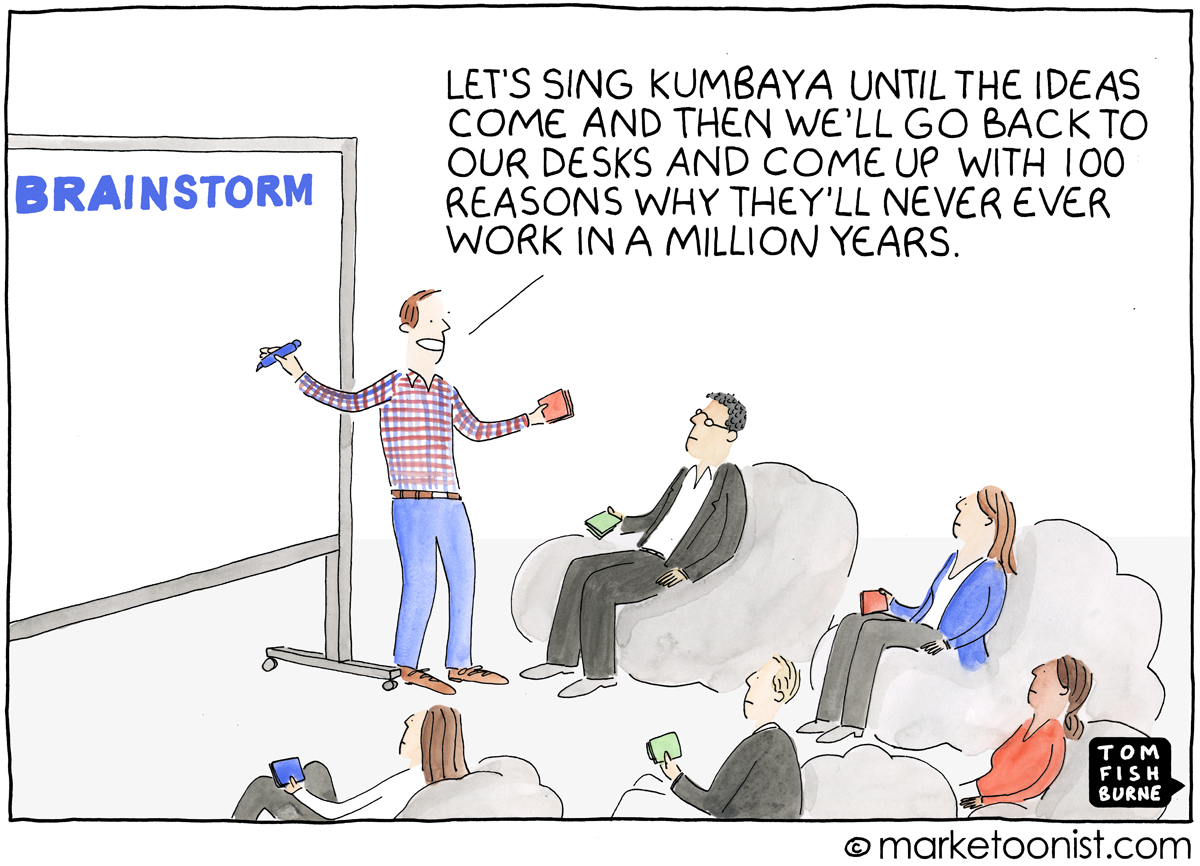
Cartoon – Let’s Sing Kumbaya


Success demands singleness of purpose.
~ Vince Lombardi, arguably the greatest football coach of all time
Extraordinarily successful people, companies, and teams always have one product/service/idea they’re most known for or that makes them the most money. They may have other important things too, but only one of them is the most important.
Having clarity on a single purpose — especially one that combines your top passion and skill — is the simplestand smartest thing you can do to propel yourself toward the success you want. This principle shows up consistently in the lives of successful people and companies because it’s a fundamental truth.
It is those who concentrate on but one thing at a time who advance in this world.
~ Og Mandino
Technological innovations, cultural shifts, and competitive forces often require that your ONE Thing evolve or transform. The most successful leaders and organizations are always asking, “What’s our ONE Thing?” If you don’t currently know what your ONE Thing is, then your ONE Thing is to find out. And as a leader, you need to engage your team to find out, get clear, and stay focused.In this episode, Jesse shares what he’s learned from chapter 3 of the book The ONE Thing and provides examples of applying the lessons.
https://www.healthaffairs.org/do/10.1377/hblog20180208.408967/full/

There has long been an imperative to find ways to reduce health care spending, but the advent of public exchanges pressured the industry to find ways to offer health insurance at a more affordable premium. Health plans hoping to participate in public exchanges responded by creating insurance offerings that gave patient members access to a smaller pool of providers—limited or narrow networks. These smaller networks give payers leverage in negotiations and may eliminate more expensive providers. They have also caught the attention of employers and other health care purchasers and are growing in prevalence in the commercial market.
But what exactly are limited or narrow networks, and are they what we want them to be? We set out to understand how health plans form limited networks, postulating that the criteria to select providers for participation in limited networks across health plans would be fairly consistent. We thought we might be able to conclude, for example, that a limited network is one in which health plans exclude providers whose prices are one standard deviation above the mean or that don’t meet minimum quality thresholds.
In addition, we wanted to learn how health plans determine who among certain provider types is eligible to participate (primary care physicians, specialists, hospitals). Is there a consistent process for selecting providers? Does the health plan, for example, generally start by selecting primary care physicians and then assess the hospitals with which those physicians are affiliated?
Catalyst for Payment Reform (CPR) reached out to a dozen health plans, diverse in size and geography, to learn more about how they form narrow networks. We began by querying them about their use of cost and quality thresholds to select providers for their limited network products.
Across health plans, CPR found no consistent formula for selecting providers by type, below a certain price point, or above a specific level of quality. We learned that health plans primarily consider which hospital or provider group will agree to a certain price (based on a premium analysis), whether excluding others is feasible given each provider’s market power or “must have” status, and whether exclusions create access issues. It is notable that among the health plans we spoke to, none used provider quality as the primary selection criterion. Health plans may consider quality while developing a limited network, but it is secondary to other criteria.
Local market characteristics significantly influence how payers define a network. The design of a limited network depends on the number of providers available as well as the level of competition among them. If a health plan develops a limited network with few providers, consumers may have to travel significant distances to receive care. When there are more provider options, competition helps health plans find a provider group willing to offer a better price. The selected provider group assumes it will make up the potential lost revenue with an increase in patient volume. Therefore, health plans perceive the presence of competition among providers as critical to the development of a limited network product. In circumstances in which health plans have greater market power, they may also consider whether providers are willing to take on some financial risk—now or in the future.
CPR’s search also revealed wide variation in the types of providers health plans focus on when they begin narrowing their networks. While most start with the hospital and then select affiliated primary care physicians and specialists, others start with the primary care physicians and look at affiliated hospitals. Some health plans include all primary care physicians in the limited network and then tier the hospitals and specialists based on cost and sometimes quality criteria. The only consistency we found was that there is no consistency! The only commonality among the narrow networks we examined was that they all contained fewer providers than a given health plan’s broadest network.
Employer and other health care purchasers’ awareness about the variation in quality and payment amounts has steadily grown, as has their need for savings. Purchasers also recognize that threatening to exclude providers from a pool of patients will strengthen their negotiating position as well as that of other payers. The latest survey data suggest that narrow networks are becoming more prevalent—a trend that is likely to continue.
According to the Henry J. Kaiser Family Foundation’s 2017 Employer Health Benefits Survey, 12 percent of benefit-offering firms with 50–999 workers, 23 percent of firms with 1,000–4,999 workers, and 31 percent of firms with 5,000 or more workers offer a high-performance or tiered network. In addition, 6 percent of firms offering benefits said that they or their insurer eliminated a health system from a network to reduce the plan’s cost during the past year.
Furthermore, the 2017 Willis Towers Watson Best Practices in Health Care Employer Survey found that more than half of employers with more than 1,000 employees said that they might add high-performance networks by 2019.
In markets where providers lack competition, they may easily push back on the formation of narrow networks. But in markets where there is competition, providers will likely want to be included instead of risk a loss of patient volume. For providers entering into new delivery models and accepting new forms of payment, they may see narrow networks positively, giving them a greater ability to manage and coordinate patient care as there is less “leakage” of patients to a broad pool of providers. In turn, participating providers may be more willing to take on financial risk for their patients if they know it is easier to control where they seek care, minimizing exposure to particularly high-priced providers.
The experience with the public exchanges suggest that consumers are willing to make the tradeoff of choice for affordability. By seeking care from a defined group of providers, consumers pay lower out-of-pocket costs and have a straightforward benefit design that clearly distinguishes between in- and out-of-network providers and accompanying cost sharing. Consumers may save further by receiving care from high-value providers who are more likely to provide effective and efficient care the first time.
Some of the employers in CPR’s membership that offer limited or narrow networks, such as an accountable care organization product, find they are meeting or exceeding their enrollment expectations—an indicator that certain consumers will choose price over choice.
Americans are willing to make tradeoffs for now, but they may become skeptical if there isn’t an explicit effort to ensure quality and the perception grows that narrow networks are only about cutting costs. With more experience, Americans may find that physicians with targeted expertise (for example, subspecialists in oncology) or individual members of a care team (for example, anesthesiologists) may not be included in the narrow network, preventing access or resulting in surprise bills for consumers.
Through their use of limited networks, payers may be indicating to health care providers that affordable care will be rewarded with more patients (quality of care could also be a criterion). In markets where providers perceive a higher volume of patients as favorable, the introduction and presence of these networks can send a strong economic signal to providers to improve efficiency and lower prices. It may be too early to identify patterns in how health plans design limited networks; perhaps a standard formula will never materialize. As CPR learned, viable approaches depend on market-specific nuances.
https://www.healthaffairs.org/do/10.1377/hblog20180212.852840/full/

During his first year in office, President Donald Trump spoke often about the problem of high drug prices but took no action on the subject. President Trump’s new budget proposal and a newly released white paper from the White House Council of Economic Advisors (CEA) aim to change that by laying out a strategy for action moving forward. These documents are, of course, aspirational, but they do provide a window into the administration’s priorities, and they should be evaluated to consider whether the administration has a possibility of achieving its stated goals.
In this post, I review several of the key elements of those proposals, considering their impact on a range of relevant dimensions. I discuss what’s included in the proposals, and, as importantly, what’s left out.
The bulk of the proposed reforms would act on the Medicare and Medicaid programs. For Medicare, the Trump administration’s proposals are largely targeted at 1) assisting beneficiaries with high out-of-pocket costs and 2) realigning incentives to alter prescribing and reimbursement practices.
First, the administration is advancing a set of proposals to assist Medicare Part D beneficiaries with high out-of-pocket costs. Both the white paper and budget proposal argue that plans should be required to share with beneficiaries at the point-of-sale some amount of the rebates the plan negotiates with drug manufacturers. In November, the Centers for Medicare and Medicaid Services (CMS) already requested public comments on the implementation of this proposal, and it seems as if the budget document’s inclusion of the proposal is evidence that the administration is hoping to move it forward.
However, like many of the other reforms in the budget proposal and white paper, there are few details proposed. In CMS’s November proposal, the agency modeled a set of scenarios in which insurers pass through 33 percent, 66 percent, 90 percent, or 100 percent of their negotiated rebates. Each scenario comes with a set of advantages for beneficiaries, but also costs for the federal government. That is, CMS anticipated that reducing cost-sharing for particular high-cost beneficiaries would increase premiums for all beneficiaries, and therefore increase CMS’ overall spending through premium subsidies. How much the proposal would increase overall spending depends on the amount of rebates being passed through.
The budget proposal simply says that sponsors must pass through “at least one-third” of total rebates, so it does not provide further clarity on this proposal. However, it states that this proposal will cost the government $42.2 billion over 10 years. That estimate lies between CMS’s November estimates for 33 percent ($27.3 billion in spending) and 66 percent ($55.1 billion in spending), so it is possible that the administration has in mind a pass-through provision at 50 percent or so.
Another proposal aimed at out-of-pocket costs would establish an out-of-pocket maximum for patients who enter the Medicare Part D catastrophic phase. Currently, patients who reach the catastrophic phase of the Part D benefit are responsible for 5 percent of the costs of their prescription drugs, with no upper limit. The budget proposal would reduce their payments to 0 percent, although it is light on the details as to how this would be accomplished. The Henry J. Kaiser Family Foundation estimated that just over one million Part D enrollees have out-of-pocket costs above this threshold, and those patients would likely be the primary beneficiaries of this proposal. At the same time, however, the budget proposes to exclude manufacturer discounts from patient out-of-pocket cost calculations, which would likely slow the rate at which patients move into the catastrophic phase.
Second, the Trump administration proposes a number of changes to drug classification and reimbursement that would both enable plan sponsors to negotiate more effectively and alter prescribing behavior. The budget proposal would change current Part D plan formulary rules, requiring sponsors to cover just one drug per class, rather than two. The proposal also mentions increased use of utilization management tools for the six protected classes of drugs, suggesting that the general coverage requirement for those classes would remain as-is. This proposal is projected to save $5.5 billion over ten years.
More interestingly, both the budget proposal and CEA white paper suggest the possibility of moving a set of Part B drugs (those administered in an outpatient setting) into Part D coverage. Medicare Part B does not presently have a number of the tools that enable Part D plan sponsors to negotiate discounts with drug manufacturers, and Secretary Alex Azar spoke during his confirmation hearing about the need to “take the learnings from Part D and apply them to Part B.” This proposal would accomplish that goal, just through the reverse mechanism: by shifting drugs from Part B into Part D. The budget proposal envisions giving the authority to do this to the Secretary, noting that “[t]he Secretary will exercise this authority when there are savings to be gained from price competition.” As such, it does not provide any particular budgetary impact.
The budget proposes two other changes to Part B reimbursement. At present, when a physician is reimbursed for providing a drug under Part B, she is reimbursed based on the Average Sales Price (ASP) of the drug plus 6 percent. There is widespread concern that this reimbursement system encourages physicians to prescribe and administer more expensive drugs than may be medically necessary. The Obama administration proposed a demonstration project that would have moved from the current ASP+6 percent system to a system of ASP+2.5 percent+a flat fee for prescribing the product. After extensive criticism from a range of stakeholders, the administration shelved the initiative. Now, the administration is proposing to reduce payment rates for new drugs (for which the ASP information is not yet available, and so for which the only price available is the Wholesale Acquisition Cost (WAC)). Instead of paying 106 percent for these new products, the administration would pay 103 percent of the WAC during the period before ASP information has yet to be provided. This proposal is quite narrow in its scope, applying only to new drugs and only during the brief period before ASP information is available; it is therefore unlikely to save much money.
The Trump administration is also proposing to establish an inflation limit for the reimbursement of Part B drugs more generally. Instead of continually updating the ASP+6 percent figure if the ASP increases, this proposal would limit the growth of the reimbursement to the Consumer Price Index for all Urban Consumers. CMS would therefore pay “pay the lesser of (1) the actual ASP +6 percent or (2) the inflation-adjusted ASP +6 percent.” At present, Medicaid is protected from price increases when the Average Manufacturer Price (AMP) for a drug increases faster than inflation. The Department of Health and Human Services Office of Inspector General has proposed that CMS and Congress consider extending this provision to Medicare Part D, but as yet Congress has not moved to do so. This budget proposal can be thought of as proposing a similar constraint on Part B pricing.
The Medicaid portion of the budget proposal puts forth an idea which is potentially ground-breaking, but which is also potentially a sign of the administration’s recalcitrance to move on drug pricing (depending on the details). Specifically, the administration is proposing “new statutory demonstration authority to allow up to five states more flexibility in negotiating prices with manufacturers, rather than participate in the Medicaid Drug Rebate Program, and to make drug coverage decisions that meet state needs.” The idea is something like this: at present, state Medicaid programs must cover essentially all drugs approved by the U.S. Food and Drug Administration (FDA), which limits their ability to extract discounts. To be sure, Medicaid programs are already entitled by statute to large discounts off of the AMP, and to the inflation clawback as noted above. But many state Medicaid programs are worried that pharmaceutical spending has become an unsustainable part of their budget and are seeking ways to control their costs in this area. This proposal might empower them to do so.
Here’s the thing: Massachusetts has already submitted an 1115 waiver to CMS along these lines. Massachusetts is seeking 1) to pay for a single drug in each therapeutic class (as noted above, this is a reform the administration is proposing to make to Medicare Part D), and 2) to exclude entirely from coverage drugs “with limited or inadequate evidence of clinical efficacy,” likely to be those approved through the FDA’s accelerated approval process. This budget proposal may be a sign that the administration is interested in approving Massachusetts’ waiver. However, the fact that the budget explicitly calls for new statutory authority to do so suggests that the administration may not think it has the legal authority to approve Massachusetts’ waiver, as is. And given Congress’ inability to act thus far on drug pricing, the administration may be seeking to hide behind Congress’ inaction here.
Yet the call for new statutory authority is puzzling. At present, pharmaceutical coverage is an optional benefit under the Medicaid program. States do not have to cover drugs and therefore are not required to participate in the Medicaid Drug Rebate Program, although all have chosen to do so, and choosing to do so comes with a set of requirements. But it is not clear to me why CMS could not conduct this demonstration at present, under the Center for Medicare and Medicaid Innovation’s (CMMI) existing authority.
A potential clue may lie in the administration’s statement that the demonstration would “exempt prices negotiated under the demonstration from best price reporting.” Having written recently on the topic of the Medicaid best-price rule and innovative contracting for pharmaceuticals, it is not clear to me exactly why this is a sticking point. The Medicaid best price rule entitles Medicaid to the “best price” available for a particular drug for a particular set of providers. The statute contains large carve-outs—for instance, discounts provided to the Department of Veterans Affairs or to Medicare Part D are exempt from the best-price calculation. But it is strange to talk about needing to exempt Medicaid programs from the best-price rule when the best-price rule was intended to benefit Medicaid itself. I imagine that the administration sees the 340B program as a potential concern here, but again it is not obvious why CMMI could not waive the best-price rule as part of its existing authority.
As I have written here previously, FDA Commissioner Scott Gottlieb has been at the forefront of the Trump administration’s efforts on drug pricing. He has taken a number of actions to promote generic competition, and although it will take some time to observe their benefits, the FDA’s existing legal authority to address drug pricing issues is quite narrowly circumscribed. The CEA white paper and budget proposal largely acknowledge this point, with the white paper lauding the actions the FDA has taken thus far on expediting review of generic drug applications, providing guidance on the development of complex generics, and other similar activities.
President Trump’s budget proposal calls for Congress to give the FDA more power to promote generic competition, by “ensur[ing] that first-to-file generic applicants who have been awarded a 180-day exclusivity period do not unreasonably and indefinitely block subsequent generics from entering the market beyond the exclusivity period.” More specifically, the concern is that first-to-file generic applicants—perhaps those whose initial applications may be rejected—can unduly delay generic entry while they remedy the deficiencies in their application. The administration projects that this reform will save the government $1.8 billion in Medicare savings over 10 years.
Other pieces of legislation have called for reform of the 180-day exclusivity period in different ways. Last year, Democrats in both the House and Senate introduced the Improving Access to Affordable Prescription Drugs Act, which included provisions preventing generic entrants from receiving the statutory 180-day exclusivity benefit if they had engaged in pay-for-delay conduct (Sections 402 and 403). But the idea in the president’s budget proposal may dovetail nicely with the FDA’s efforts to improve first-cycle approval rates for abbreviated new drug application products, as well.
Perhaps what’s most notable about the budget proposal and the CEA white paper is not what’s included, but rather what is missing. Gone are some of President Trump’s older arguments that Medicare should negotiate drug prices, or that drug importation should be permitted more widely. Some of the more significant cost-saving provisions from President Obama’s budget, like a reform that would have put low-income patients back on Medicaid prices, are also absent.
A key set of missing proposals are those which would directly assist privately insured patients. The budget’s focus on Medicare and Medicaid may well have a positive impact on the more than 100 million Americans enrolled in those programs. But for the roughly half of Americans (closer to 160 million) with employer-sponsored insurance, these reforms will provide no assistance. Growing numbers of Americans with employer-sponsored insurance are enrolled in high-deductible plans, and many of them may face the same affordability concerns that Medicare beneficiaries are facing.
You could imagine proposals that would address the drug pricing problem more broadly, rather than just within the publicly-insured population. The above-mentioned Improving Access to Affordable Prescription Drugs Act would have addressed the problem of drug pricing for a broader segment of the population. As I’ve explained here, the Act would have taxed companies which engage in large, year-over-year list price increases. It would also have capped patient out-of-pocket costs in Affordable Care Act-regulated plans, at $250 per month for an individual or $500 per month for a family.
More generally, even these proposals which would affect drug companies directly would have a minimal impact on their bottom lines. This set of proposals is largely very friendly to the pharmaceutical industry and is primarily aimed at curtailing patients’ financial burdens and tweaking incentives for stakeholders at the margin.
In this blog post, I have covered just a handful of the many different drug pricing-related proposals included in the new budget proposal and in the CEA white paper. As usual, observers should stay tuned to the actions CMS and the FDA take on this front, as they will show whether the administration is serious about these proposals or is merely posturing.
http://www.healthcareitnews.com/news/machine-learning-big-idea-hospitals-need-business-plans-first

Elizabeth Clements, business architect at Geisinger Health, will be hosting a session at HIMSS18 on March 7.
Don’t get lost in the complexity of large-scale use cases.
Machine learning has the potential to transform healthcare through new knowledge discovery and improved productivity, but many health systems do not have a business plan in place to support advanced analytics beyond research and development.
As health systems consider how best to leverage machine learning and artificial intelligence, it will require a shift in IT strategy to focus on not just data, but managing the model itself. This means, among other things, defining the value of machine learning and providing a framework for evaluation and application.
Health systems need to keep things simple when moving into machine learning, said Elizabeth Clements, business architect at Geisinger Health.
“When working with new technology and developing a service from scratch, it can be easy to get lost and slow progress down with the complexity of a large use-case,” Clements said. “If you keep your scope narrow and define near-term goals, you will find you are able to make more meaningful progress in a short amount of time.”
And healthcare professionals dealing with machine learning must themselves learn how to partner with the business.
“Understanding the current and future state use of the machine learning solution is critical,” Clements said. “If you don’t consciously determine how much you want or need human intervention with the model, it will make your solution much more difficult to implement and gain buy-in.”
Clements said a simple framework for thinking about machine learning in the context of the business is needed. That includes understanding its value and use-cases before embarking on this type of analytics advancement, as well as knowing the basic challenges and how to design a program that takes those into account.
“Machine learning is the next wave of advanced processing technology offering us new avenues for information discovery and productivity enhancement,” she said. “It has the potential to transform how we conduct business; however, it will require a shift in our IT strategy.”
It is not just about the data or the application, it is also about the model itself. IT leaders should consider how to complement their existing IT and data scientist teams with new skill sets and consider how machine learning can advance existing task execution, she added.
Clements will be speaking in the HIMSS18 session, “Managing Machine Learning: Insights and Strategy,” at 11:30 a.m. March 7 in the Venetian, Palazzo D.

The White House budget for fiscal 2019 seeks major savings by repealing ObamaCare and endorsed a Senate GOP bill as the best way to do so.
“The Budget supports a two-part approach to repealing and replacing Obamacare, starting with enactment of legislation modeled closely after the Graham-Cassidy-Heller-Johnson (GCHJ) bill as soon as possible,” the White House said in its budget request.
The legislation from Sens. Lindsey Graham (R-S.C.), Bill Cassidy (R-La.), Ron Johnson (R-Wis.) and Dean Heller (R-Nev.) would replace ObamaCare with a series of block grants to states.
The budget proposes over $90 billion in savings over 10 years if the policies in the Graham-Cassidy bill were enacted. Combined with other provisions like Medicaid changes, the White House projects there would be nearly $675 billion in savings over a decade tied to repealing ObamaCare.
Advocacy groups were quick to denounce the proposal, which is unlikely to gain traction in Congress.
“By asking Congress to revive the deeply unpopular Graham-Cassidy repeal bill that ended protections for Americans with pre-existing conditions, gutted Medicaid, ripped away coverage from millions, and raised costs for millions more, while also proposing drastic cuts to Medicare, Trump has chosen to ignore the American public’s overwhelming preference for a bipartisan path forward on health care,” said Protect Our Care campaign director Brad Woodhouse.
Republican leaders have signaled that they are not interested in diving back into the contentious ObamaCare repeal fight this year. The Senate last year failed to pass a repeal bill, and there is no indication that the votes have shifted since then.
A number of Republicans have even discussed taking bipartisan actions to stabilize ObamaCare markets and try to bring down premiums through actions such as funding known as reinsurance.
Graham has said he will continue fighting for his bill and is not completely alone. Sen. Ted Cruz (R-Texas) is also calling for Congress to not give up on repeal this year.



 HENRY KOTULA