Hospitals are germy, noisy places. Some acutely ill patients are getting treated at home instead.

https://www.washingtonpost.com/national/health-science/hospitals-are-germy-noisy-places-some-acutely-ill-patients-are-getting-treated-at-home-instead/2018/03/30/5fcb5006-2155-11e8-badd-7c9f29a55815_story.html?utm_term=.e3db8d812c05

Phyllis Petruzzelli spent the week before Christmas struggling to breathe. When she went to the emergency department on Dec. 26, the doctor at Brigham and Women’s Faulkner Hospital near her home in Boston said she had pneumonia and needed hospitalization. Then the doctor proposed something that made Petruzzelli nervous. Instead of being admitted to the hospital, she could go back home and let the hospital come to her.

As a “hospital-at-home” patient, Petruzzelli learned, doctors and nurses would come to her home twice a day and perform any needed tests or bloodwork.

A wireless patch would be affixed to her skin to track her vital signs and send a steady stream of data to the hospital. If she had any questions, she could talk via video chat anytime with a nurse or doctor.

Hospitals are germy and noisy places, putting acutely ill, frail patients at risk for infection, sleeplessness and delirium, among other problems. “Your resistance is low,” Petruzzelli said the doctor told her. “If you come to the hospital, you don’t know what might happen. You’re a perfect candidate for this.”

So Petruzzelli, who is now 71, agreed. That afternoon, she arrived home in a hospital vehicle. A doctor and nurse were waiting at the front door. She settled on the couch in the living room, with her husband, Augie, and dog, Max, nearby. The doctor and nurse checked her IV, attached the monitoring patch to her chest, and left.

When David Levine, the doctor, arrived the next morning, he asked Petruzzelli why she had been walking around during the night. Far from feeling uncomfortable that her nocturnal trips to the bathroom were being monitored, “I felt very safe and secure,” Petruzzelli said. “What if I fell while my husband was out getting me food? They’d know.”

After three uneventful days, she was “discharged” from her hospital-at-home stay. “I’d do it again in a heartbeat,” Petruzzelli said.

Brigham Health is one of a slowly growing number of health systems that encourage selected acutely ill emergency department patients to opt for hospital-level care at home.

In the couple of years since Brigham Health started testing this type of care, hospital staff who were initially skeptical have generally embraced it, Levine said. “They very quickly realize that this is really what patients want, and it’s really good care.”

This approach is quite common in Australia, Britain and Canada, but it has faced an uphill battle in the United States.

A key obstacle, clinicians and policy analysts agree, is getting health insurers to pay for it. At Brigham Health, the hospital can charge an insurer for a physician house call, but the remainder of the hospital-at-home services are covered by grants and other funding, Levine said.

Insurers don’t have a position on hospital-at-home programs, said Cathryn Donaldson, a spokeswoman for America’s Health Insurance Plans, an industry trade group.

“Overall, health insurance providers are committed to ensuring patients have access to care they need, and there are Medicare Advantage plans that do cover this type of at-home care,” Donaldson said in a statement.

Levine, a clinician-investigator at Brigham and Women’s Hospital and an instructor at Harvard Medical School, was the lead author of a recently published study comparing patients who received either hospital-level care at home or in the hospital in 2016.

The 20 patients analyzed in the trial had one of several conditions, including infection, heart failure, chronic obstructive pulmonary disease and asthma. The trial found that while there were no adverse events in the home-care patients, their treatment costs were significantly lower — about half that of patients treated in the hospital.

Why? For starters, labor costs for at-home patients are lower than for patients in a hospital, where staff must be on hand around the clock. Home-care patients also had fewer lab tests and visits from specialists.

The study found that both groups of patients were about equally satisfied with their care, but the home-care group was more physically active.

Brigham Health is conducting further randomized controlled trials to test the at-home model for a broader range of diagnoses.

Bruce Leff began exploring the hospital-at-home concept more than 20 years ago, conducting studies that found fewer complications, better outcomes and lower costs in home-care patients.

Hospitals, accustomed to the traditional business model that emphasizes filling hospital beds in a bricks-and-mortar facility, have been slow to embrace the idea, however.

There are practical hurdles, too.

“It’s still easier to get Chinese food delivered in New York City than to get oxygen delivered at home,” said Leff, a professor of medicine and director of Johns Hopkins Medical School’s Center for Transformative Geriatric Research.

Since the seven-hospital Mount Sinai system in New York launched its hospital-at-home program, more than 700 patients have chosen it. And they have fared well on a number of measures.

The average length of stay for acute care was 5.3 days in the hospital vs. 3.1 days for home-care patients, while 30-day readmission rates for home-based patients were about half of those who had been hospitalized: 7.8 percent vs. 16.3 percent.

Begun with a $9.6 million federal grant in 2014, Mount Sinai’s program initially focused on Medicare patients with six conditions, including congestive heart failure, pneumonia and diabetes. Since then, the program has expanded to include dozens of conditions, including asthma, high blood pressure and serious infections such as cellulitis, and is now available to some privately insured and Medicaid patients.

Mount Sinai has also partnered with Contessa Health, a company with expertise in home care, to negotiate contracts with insurers to pay for hospital-at-home services.

Among other things, insurers are worried about the slippery slope of what it means to be hospitalized, said Linda DeCherrie, clinical director of the mobile acute care team at Mount Sinai.

Insurers “don’t want to be paying for an admission if this patient really wouldn’t have been hospitalized in the first place,” DeCherrie said.


Five Worrisome Trends in Healthcare

https://www.medpagetoday.com/publichealthpolicy/healthpolicy/72001?xid=fb_o_

healthcare; insurance; drugs; drug companies; Government-run Insurance Program Sure to Backfire | iHaveNet.com

A reckoning is coming, outgoing BlueCross executive says.

A reckoning is coming to American healthcare, said Chester Burrell, outgoing CEO of the CareFirst BlueCross BlueShield health plan, here at the annual meeting of the National Hispanic Medical Association.

Burrell, speaking on Friday, told the audience there are five things physicians should worry about, “because they worry me”:

1. The effects of the recently passed tax bill. “If the full effect of this tax cut is experienced, then the federal debt will go above 100% of GDP [gross domestic product] and will become the highest it’s been since World War II,” said Burrell. That may be OK while the economy is strong, “but we’ve got a huge problem if it ever turns and goes back into recession mode,” he said. “This will stimulate higher interest rates, and higher interest rates will crowd out funding in the federal government for initiatives that are needed,” including those in healthcare.

Burrell noted that 74 million people are currently covered by Medicaid, 60 million by Medicare, and 10 million by the Children’s Health Insurance Program (CHIP), while another 10 million people are getting federally subsidized health insurance through the Affordable Care Act’s (ACA’s) insurance exchanges. “What happens when interest’s demand on federal revenue starts to crowd out future investment in these government programs that provide healthcare for tens of millions of Americans?”

2. The increasing obesity problem. “Thirty percent of the U.S. population is obese; 70% of the total population are either obese or overweight,” said Burrell. “There is an epidemic of diabetes, heart disease, and coronary artery disease coming from those demographics, and Baby Boomers will see these things in full flower in the next 10 years as they move fully into Medicare.”

3. The “congealing” of the U.S. healthcare system. This is occurring in two ways, Burrell said. First, “you’ll see large integrated delivery systems [being] built around academic medical centers — very good quality care [but] 50%-100% more expensive than the community average.”

To see how this affects patients, take a family of four — a 40-year-old dad, 33-year-old mom, and two teenage kids — who are buying a health insurance policy from CareFirst via the ACA exchange, with no subsidy. “The cost for their premium and deductibles, copays, and coinsurance [would be] $33,000,” he said. But if all of the care were provided by academic medical centers? “$60,000,” he said. “What these big systems are doing is consolidating community hospitals and independent physician groups, and creating oligopolies.”

Another way the system is “congealing” is the emergence of specialty practices that are backed by private equity companies, said Burrell. “The largest urology group in our area was bought by a private equity firm. How do they make money? They increase fees. There is not an issue on quality but there is a profound issue on costs.”

4. The undermining of the private healthcare market. “Just recently, we have gotten rid of the individual mandate, and the [cost-sharing reduction] subsidies that were [expected to be] in the omnibus bill … were taken out of the bill,” he said. And state governments are now developing alternatives to the ACA such as short-term duration insurance policies — originally designed to last only 3 months but now being pushed up to a year, with the possibility of renewal — that don’t have to adhere to ACA coverage requirements, said Burrell.

5. The lackluster performance of new payment models. “Despite the innovation fostering under [Center for Medicare & Medicaid Innovation] programs — the whole idea was to create a series of initiatives that might show the wave of the future — ACOs [accountable care organizations] and the like don’t show the promise intended for them, and there is no new model one could say is demonstrably more successful,” he said.

“So beware — there’s a reckoning coming,” Burrell said. “Maybe change occurs only when there is a rip-roaring crisis; we’re coming to it.” Part of the issue is cost: “As carbon dioxide is to global warming, cost is to healthcare. We deal with it every day … We face a future where cutbacks in funding could dramatically affect accessibility of care.”

“Does that mean we move to move single-payer, some major repositioning?” he said. “I don’t know, but in 35 years in this field, I’ve never experienced a time quite like this … Be vigilant, be involved, be committed to serving these populations.”

AIMING HIGHER: Results from the Commonwealth Fund Scorecard on State Health System Performance

http://www.commonwealthfund.org/interactives/2017/mar/state-scorecard/

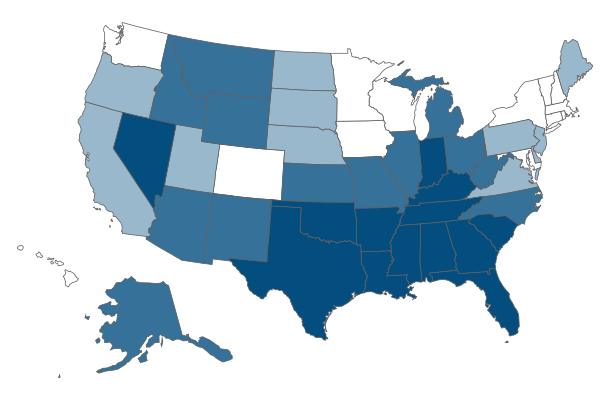
Image result for AIMING HIGHER: Results from the Commonwealth Fund Scorecard on State Health System Performance

The 2017 edition of the Commonwealth Fund Scorecard on State Health System Performance finds that nearly all state health systems improved on a broad array of health indicators between 2013 and 2015. During this period, which coincides with implementation of the Affordable Care Act’s major coverage expansions, uninsured rates dropped and more people were able to access needed care, particularly those in states that expanded their Medicaid programs. On a less positive note, between 2011–12 and 2013–14, premature death rates rose slightly following a long decline. The Scorecard points to a constant give-and-take in efforts to improve health and health care, reminding us that there is still more to be done.

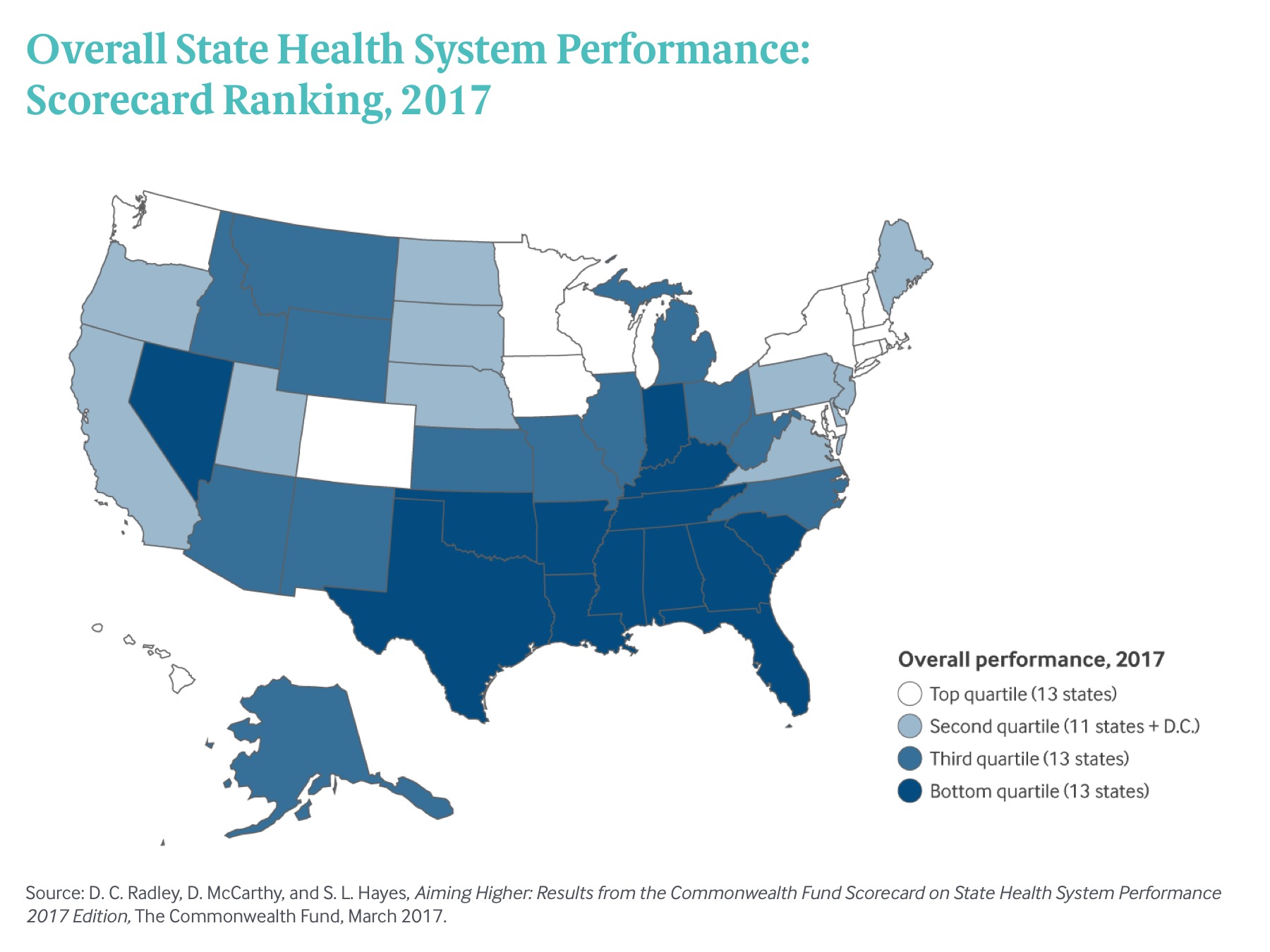
Vermont was the top-ranked state overall in this year’s Scorecard, followed by Minnesota, Hawaii, Rhode Island, and Massachusetts (Exhibit 1). California, Colorado, Kentucky, New York, and Washington made the biggest jumps in ranking, with New York moving into the top-performing group for the first time. Kentucky also stood out for having improved on more measures than any other state.

Exhibit 1Exhibit 1: Overall State Health System Performance: Scorecard Ranking, 2017

Using the most recent data available, the Scorecard ranks states on more than 40 measures of health system performance in five broad areas: health care access, quality, avoidable hospital use and costs, health outcomes, and health care equity. In reviewing the data, four key themes emerged:

  • There was more improvement than decline in states’ health system performance.
  • States that expanded Medicaid saw greater gains in access to care.
  • Premature death rates crept up in almost two-thirds of states.
  • Across all measures, there was a threefold variation in performance, on average, between top- and bottom-performing states, signifying opportunities for improvement.

By 2015, fewer people in every state lacked health insurance. Across the country, more patients benefited from better quality of care in doctors’ offices and hospitals, and Medicare beneficiaries were less frequently readmitted to the hospital. The most pervasive improvements in health system performance occurred where policymakers and health system leaders created programs, incentives, or collaborations to ensure access to care and improve the quality and efficiency of care. For example, the decline in hospital readmissions accelerated after the federal government began levying financial penalties on hospitals that had high rates of readmissions and created hospital improvement innovation networks to help spread best practices. (notes)

Still, wide performance variation across states, as well as persistent disparities by race and economic status within states, are clear signals that our nation is a long way from offering everyone an equal opportunity for a long, healthy, and productive life. Looking forward, it is likely that states will be challenged to provide leadership on health policy as the federal government considers a new relationship with states in public financing of health care. To improve the health of their residents, states must find creative ways of addressing the causes of rising mortality rates while also working to strengthen primary and preventive care.