UPMC fires back at state AG, seeks to join BCBS antitrust lawsuit

https://www.healthcaredive.com/news/upmc-fires-back-at-state-ag-seeks-to-join-bcbs-antitrust-lawsuit/548993/

Image result for upmc building

University of Pittsburgh Medical Center filed a counter lawsuit on Thursday against the Pennsylvania attorney general, who is seeking to force the healthcare giant into contracting with rival Highmark. The system is also seeking to insert itself in a broader lawsuit over the ways Blues operate.

The flurry of filings taps into big questions over payer competition and underscores tensions seen throughout the country between insurance companies and providers as they negotiate contracts, particularly in highly concentrated markets. States have stepped up their enforcement of consumer protections against rising healthcare costs — but UPMC is saying its regulators have greatly overstepped their bounds. 

Earlier this month, Shapiro alleged Pittsburgh’s dominant medical provider wasn’t living up to its charitable mission as a nonprofit, accusing the health system of “forsaking its charitable obligations” in exchange for “corporate greed.”

The legal duel stems from a contract dispute between UPMC and its rival Highmark. Until June 30, the two have a legal agreement protecting consumer access to the other’s network through a consent decree. UPMC refuses to modify the decree and contract with Highmark, which risks in-network access to UPMC hospitals for Highmark members.

In response to the attorney general’s initial complaint, UPMC alleges that Shapiro’s attempt to renew and modify an expiring agreement between the Pittsburgh health system and Highmark is “unprecedented and unwarranted.”  The modification would, among other things, remove the majority of UPMC’s board of directors and force the integrated system to contract with any payer. 

The state AG responded on Friday, accusing UPMC of ignoring its mission and noting it would not be intimated by the healthcare behemoth.

“With their filings today, UPMC has shown they intend to spend countless hours and untold resources on a legal battle instead of focusing on their stated mission as a non-profit charity — promoting the public interest and providing patient access to affordable health care,” said Attorney General’s Office spokesman Joe Grace.

In its notice to the AG, UPMC lays out five examples it calls frivolous enough to get Shapiro’s motion dismissed — including previous testimony delivered by Deputy Attorney General Jim Donahue in 2014, when he told state representatives there is “no statutory basis” to make the two companies contract with each other without setting a dangerous economic precedent.

“If we force the resolution in this case, we really could not avoid trying to force a similar resolution in all those other situations, and that is simply and unworkable method of dealing with these problems,” Donahue said at the time. “We’d be putting our finger on the scale, so to speak … and we’re not sure what those effects would be.”

One effect is a class action lawsuit, which UPMC filed separately Thursday. It alleges Shapiro has violated at least four federal laws: Medicare Advantage statutes protecting competition, the Affordable Care Act’s nonprofit payer regulations and the Sherman Act and the Employee Retirement Income Security Act of 1974.

“Purporting to act in his official capacity, General Shapiro has illegally taken over nonprofit healthcare in the Commonwealth of Pennsylvania,” UPMC’s class action states. “Without rulemaking, legislation or public comment, General Shapiro has announced new ‘principles’ that radically (and often in direct contravention of existing federal and state law) change how nonprofit health insurers and providers operate, now rendering the Attorney General the arbiter of how nonprofit health organizations should envision and achieve their mission.”

UPMC says Blues system bad for business

Separate from its battle with the state attorney general, UPMC is attempting to jump in the middle of a legal antitrust battle over how Blue Cross Blue Shield plans operate. UPMC is seeking both a preliminary injunction and a motion to intervene in the years-long federal case in Alabama.

UPMC is asking the Alabama court to stop the Blues plans from enforcing their own market allocation agreements that prevent UPMC from contracting with other Blues plans, according to the filing. UPMC says a significant chunk of its patients have a Blue Cross Blue Shield plan from a different provider other than Highmark.

Joe Whatley, co-lead counsel for provider plaintiffs in the Alabama case, told Healthcare Dive UPMC “presents a good example of how the Blues are abusing their illegal agreement for their benefit and to harm healthcare providers throughout the country.”

UPMC argues that it would contract with other Blue Cross Blue Shield plans, separate from Highmark, but cannot due to the way Blues operate — or limit how they compete with one another. BCBS plans tend to stake out their own geographic areas and avoid competition with one another, a practice the Alabama court has already found is in violation of antitrust laws. A BCBS appeal to the Alabama judge’s opinion was already struck down by the 11th U.S. Circuit Court of Appeals late last year.

UPMC is asking the Alabama court for an injunction, or to step in and stop the Blues plans from enforcing or complying with their own market allocation agreements that are preventing UPMC from contracting with other Blues plans, according to the filing. And because the hometown plan, Highmark, does not have a contract with UPMC after June 30, it means that other Blues plan members that have enjoyed in-network access to UPMC will soon lose access after the consent decree expires.

About 24% of UPMC’s hospital patients have a Blue Cross Blue Shield plan other than Highmark.

UPMC contends that it has tried to contract with other Blues but was turned down. “The average non-Highmark Blues patient does not know that UPMC has offered contracts to each of these plans and been turned down because the Blues’ illegal market allocation prevents them entering into such an agreement with UPMC,” according to the filing.

Without an injunction, UPMC alleges it will suffer irreparable harm to its reputation and will lose a significant number of patients who have a non-Highmark Blues plans.

The Pennsylvania attorney general’s office has not responded to Healthcare Dive’s request for comment and UPMC declined to discuss the case further.



Coping with Serious Illness in America

http://features.commonwealthfund.org/coping-with-serious-illness-in-america

Related image

Relying on Family and Friends

The luckiest among us have family and friends to lean on when times get tough. For those who develop a serious illness — an often painful and tumultuous experience — family and friends offer crucial emotional support and help with day-to-day activities. A recent survey of the sickest adults in America, conducted by the Harvard T. H. Chan School of Public Health, the New York Times, and the Commonwealth Fund, found that seriously ill adults also rely on their family and friends to organize their health care, helping them navigate an often complex, confusing, and inefficient system.

Focus groups and in-depth interviews conducted by the Commonwealth Fund since 2016 revealed that while taking care of a seriously ill family member or friend can bring meaning and satisfaction to caregivers, it also can become a complex and serious responsibility that burdens them.

Below we describe the many functions caregivers — defined as family and friends who provide care to the seriously ill — serve, as well as the financial, physical, and emotional challenges they face. We offer policy solutions, such as financial protections, employment flexibility, and training to prepare an “invisible workforce” for this deeply meaningful but sometimes overwhelming role.

Any one of us could find ourselves in the role of caregiver if we haven’t already. And our country and economy are likely to benefit when we help ensure caregivers are able to maintain their mental and physical health and stay in the workforce.

Learn more about the Health Care in America: The Experience of People with Serious Illness survey, including methodology and additional findings.

Many Caregivers Say They “Do Everything” for a Family Member or Friend with Serious Illness

Approximately 40 million Americans provide 37 billion hours of care and help each year to family members and friends. Most of the people with serious illness we surveyed (86%) reported that in recent years family and friends helped them deal with their medical or health condition at home.

Illness can make the simple activities of daily living, like cooking, cleaning, and bathing, nearly impossible, especially without assistance. Caregivers reported that helping with these routine tasks can become a huge commitment, and that the demand for care can escalate unexpectedly. “It started out as doing his laundry, getting groceries, but [my uncle’s] problems continued to get worse,” one caregiver explained. “There was really no other family in the area and now basically I do everything for him. I take him to his appointments. I cook his meals. When I leave him it almost feels like I’m leaving a child alone. It’s very scary.”

Even when a nurse or aide provides in-home help to the sick family member or friend, caregivers still need to organize the logistics of care, from scheduling doctors’ visits to taking time off work to provide transportation to the appointments and participate in the visits. Among people with serious illness we surveyed, more than half (55%) reported bringing a family member or friend to every medical appointment they had in recent years.

Our survey respondents also reported that they often relied on their family or friends who were health professionals (34%) for health care advice. These caregivers take on a number of important responsibilities for family members and friends with serious illness, such as helping to find qualified doctors, talking directly to the supervising clinician, and arranging appointments.

The Benefits and Tolls of Caregiving

People who care for a seriously ill family member or friend can benefit psychologically, emotionally, and socially from the experience. Previous studies have found caregiving increases self-confidence, makes caregivers feel closer to their ill family member or friend, and gives them the peace of mind that their family member or friend is well cared for. A daughter who cared for her mother with cancer described the fulfillment it brought her: “It meant a lot that I was able to be there for the person that was always there for me — who raised me and sacrificed for me.”

Despite the fulfillment caregiving can bring, it also can be incredibly burdensome and disruptive. The seriously ill adults we surveyed worry about the challenges their caregivers face. One seriously ill adult we spoke with said the following about her children: “Not only for my sake, but for the sake of my kids and my grandkids, I hope they are able to enjoy their later years and not worry about having to take care of me. I know they’d be glad to do it, but it has an impact on their lives, both short and long term.”

One-third (36%) of the seriously ill we surveyed reported that caregiving created problems for their family member or friend. These include emotional, physical, and financial strains.

Emotional strain

About one in three (31%) seriously ill adults in our survey reported their caregivers experienced emotional stress from caring for them. This is consistent with other studies that find caregivers experience significantly more stress than noncaregivers and have mental health issues like depression at twice the national rate. Caregivers who lack support from friends and family themselves are particularly affected by mental health issues and emotional strain.

Physical health issues

A quarter (25%) of the seriously ill adults we surveyed reported that their family or friend caregiver experienced physical strain from having to bathe, dress, and even lift them, to name a few issues. Other studies have shown just how powerful the physical toll of caregiving can be. Caregivers, compared to noncaregivers, are twice as likely to report chronic conditions like heart disease or diabetes, are more likely to view their health as fair or poor, and are even more likely to die. These physical consequences seem to be in part because of caregivers having limited time and resources to spend on their own health. They also may engage in unhealthy behaviors like drinking, eating poorly, and postponing their own doctors’ visits.

Financial problems

Nearly one in four (23%) seriously ill adults reported their caregiver experienced financial problems because of caregiving. Moreover, more than half (57%) of the seriously ill adults we surveyed said the costs of their medical care were a direct burden to their family. As seriously ill adults themselves face financial strain because of their condition, family members and friends may be left to pick up unpaid medical bills. Beyond paying directly for medical care, a study by AARP found that family caregivers spend on average close to $7,000 a year taking care of their family member, or about 20 percent of their annual income.

Employment disruption

Compounding the financial burden, caregiving can get in the way of work; 15 percent of the seriously ill we surveyed said their caregivers lost or had to change jobs because of their caregiving responsibilities.recent study found that nearly half of working caregivers said caregiving interfered with their job, and another 40 percent of those who were not working at the time of the study had quit their jobs or retired early because of caregiving. As one caregiver from our focus groups said, “My mother with Alzheimer’s lives with me. I manage all her affairs. I pretty much shut my life down to stop working and take care of her.” This need to drop out of the workforce is particularly concerning because the primary protection for working caregivers, the federal Family and Medical Leave Act (FMLA), offers only three months of unpaid leave. Moreover, it means the U.S. has fewer productive workers than it would if services were in place to support caregivers.

Support for “The Invisible Workforce”

There are several ways in which we as a nation could support this “invisible workforce” of caregivers — a group unseen, yet critical to the provision of care.

  • Education, training, and mental health support.Education and training on effective caregiving could help to improve both caregiver and patient outcomes. A recent study found that reviewing how to take care of their family member or friend before discharge from an inpatient hospital stay lowered the cost of postdischarge care and reduced readmissions. In addition, mental health support from behavioral health providers and others could offset the emotional and physical challenges caregivers experience. For example, a managed care plan in New Jersey, Amerigroup, hosts caregiver events where they provide educational workshops on illnesses and offer relaxation exercises to help caregivers cope.
  • Redesign health care for the seriously ill to make it less burdensome for patients and caregivers. Expanding the availability and affordability of respite care — which gives caregivers a temporary break — along with home care services, transportation, and care coordinators, would mean less responsibility for family and friends. AmeriHealth Caritas, for example, covers additional respite care beyond the state minimum to improve quality of life for enrollees and tackle caregiver burnout.
  • Financial support. Policies requiring paid leave for those working and taking care of sick family could protect them from some financial consequences and help keep them in the workforce longer term. In addition, federal and state policymakers could offer tax benefits, provide direct compensation, or allow family and friend caregivers to claim Social Security benefits for the time they spend caring for the seriously ill to offset financial costs. Lastly, payers can directly compensate caregivers for their time. For example, Medicaid long-term-care plans offer payment to caregivers for direct care, but the specific benefits and criteria vary from state to state. Paying informal caregivers could even save the health care system money long term by preventing more costly care later on.

Caregiving in America is not easy for the friends and family who provide this undervalued, unpaid, and even unrecognized service for both the person with serious illness and our society. To keep family and friend caregivers healthy and in the workforce, health systems, payers, and policymakers could expand training, increase insurance coverage for home-based services, and implement policies to financially protect caregivers.


Analysis Shows One-in-Five U.S. Rural Hospitals at High Risk of Closing Unless Financial Situation Improves

https://www.navigant.com/news/corporate-news/2019/rural-hospitals-analysis

https://www.beckershospitalreview.com/finance/1-in-5-rural-hospitals-at-high-risk-of-closing-analysis-finds.html?origin=cioe&utm_source=cioe

Related image

Twenty-one percent of U.S. rural hospitals are at high risk of closing unless their finances improve, according to an analysis from management consultancy firm Navigant.

The study also found 64 percent, or 277, of high financial risk rural hospitals are considered essential to their communities.

The analysis — which examined the financial viability (operating margin, days cash on hand and debt-to-capitalization ratio) and community essentiality of more than 2,000 of the nation’s rural hospitals — suggests 21 percent or 430 rural hospitals in 43 states are at high risk of closing. These hospitals represent 21,547 staffed beds, 707,000 annual discharges, 150,000 employees and $21.2 billion total patient revenue, according to Navigant.

Of the 43 states, 34 have five or more rural hospitals at risk. 

Navigant cited payer mix degradation; declining inpatient care driving excess capacity; and inability to leverage innovation as factors putting the hospitals at risk. Medicare payment reductions, the age of many rural facilities and a lack of capital to invest in updated, innovative technology were specifically cited.

“While the potential for a rural hospital crisis has been known for years, this predictive data sheds light on just how dire the situation could become,” the study authors concluded. “Now, by being able to accurately assess the economic health of all rural hospitals in America, there is no choice but to pay attention. Local, state and federal political leaders, as well as hospital administrators, must act to protect the well-being of rural hospitals nationwide and the communities they serve.”

Read more about the analysis here


The Biggest Growth Opportunities in Healthcare

https://www.managedhealthcareexecutive.com/healthcare-leadership/biggest-growth-opportunities-healthcare?rememberme=1&elq_mid=5658&elq_cid=876742&GUID=A13E56ED-9529-4BD1-98E9-318F5373C18F

Healthcare growth opportunities for 2019 should pivot around the three big themes: digital transformation, value-based care, and patient-centricity, according to a new report.

According to Frost & Sullivan’s report, “Global Healthcare Market Outlook, 2019,” digitization of products, services, and commerce models are democratizing current healthcare systems, manifesting a new era of healthcare consumerism.

“Now the new vision for healthcare is not just about access, quality, and affordability but also about predictive, preventive, and outcomes-based care models promoting social and financial inclusion,” says Kamaljit Behera, transformational health industry analyst at Frost & Sullivan, and author of the report. “This makes digital transformation and realization of long-pending policies reform a key growth priority for healthcare executives and major health systems during 2019 globally.”

According to Behera, increasing pricing pressure and shifting the focus of the healthcare industry from a volume- to value-based care model demands that drug and device manufacturers elevate their business models beyond products to customer-centric intelligent platforms and solutions.

“In 2019, the healthcare market will continue to transit and stick into the value-based model,” Behera says. “More sophisticated outcomes-based models will get deployed in developed markets, and emerging nations will start following the best practices suited to their local needs.”

Despite the promise of digital transformation, the potential promise and actual commercial application still remain the poles apart from some of the most touted technologies like AI and blockchain, according to Behera.

“Current technology is often perceived to increase the barriers between patient and providers,” he says. “In order to bridge these gaps, healthcare executives need to change the debate around digital transformation and start look beyond the mirage of technology novelty and really focus on the outcomes.”

Behera predicts that these five areas will be the biggest areas of growth for healthcare in 2019:

1. Meaningful small data

Healthcare data analytics focus will shift from ‘big data’ to ‘meaningful small data’ by hospital specialty, according to Behera. “Increasing digitization of healthcare workflows is leading us to a data explosion along the care cycle, globally,” he says. “This makes insights generation from existing healthcare data for targeted use cases a relatively low-hanging opportunity relative to other emerging technologies. Additionally, health data being the ‘holy grail,’ the analytics solutions are considered the first foundational step to catalyze complementing technology promises leveraging healthcare data (e.g., artificial intelligence, cloud computing, and blockchain).”

Entailing this, Frost & Sullivan research projects the healthcare analytics market revenue to cross $7.4 billion in the United States by the end of 2020.

 “The key pivotal theme driving this growth opportunity includes population health management, financial performance improvement, and operational automation by patients, payers, physicians, and procedures,” Behera says. “Also, the rise of value-based care and outcomes-based reimbursement programs will continue to boost the demand for specialized analytics solutions.”

In 2019, payers and providers will continue to prioritize and leverage the potential of specialty-specific analytics solutions to investigate drug utilization, treatment variability, clinical trial eligibility, billing discrepancy, and self-care program attribution specific to major chronic conditions, according to Beherea.

2. Digital health coming of age with increased focus on individual care

“During 2019, we project application of digital health will continue to go far beyond the traditional systems and empower individuals to be able to manage their own health,” Behera says.

Favorable reimbursement policies (e.g., toward clinically relevant digital health applications) will expand care delivery models beyond physical medicine to include behavioral health, digital wellness therapies, dentistry, nutrition, and prescription management, according to Behera.

“For example, major insurance bodies are already using digital health services to communicate with patients,” he says. “Traditionally, lack of formal reimbursement processes is actually a deterrent to the uptake of these—wearables, telehealth etc. The next 12 months will see a relaxation of reimbursement rules for digital health solutions.”

The global aging population and an expanding middle class are major contributors to the chronic disease epidemic and surging healthcare costs, Behera says. “This year will be a pivotal year for defining value for healthcare innovation and technology for digital health solutions catering to aged care and chronic conditions management to bending healthcare cost curve,” he says.

“Telemedicine in emerging markets will become more mainstream and will aim to become a managed services provider [rather] than being just a telemedicine platform,” he says. “Telemedicine will move into the public health space as well, with countries like Singapore is testing the platforms in a regulatory sandbox. Finally, as the lines between retail, IT, and healthcare continue to blur, non-traditional players such as Amazon, Apple, Google, Ali Health, Microsoft, and IBM, among others, will continue to make further headway into the individual care space— providing the required impetus to public health systems to ensure accessibility and affordability of care-leveraging, patient-centric digital health tools and solutions.”

Healthcare executives should prioritize their roadmap for growing IoMT and connected health ecosystems (device-, wearables-, and mHealth-generated individual health data) in order to monetize these new sources of innovation and service-oriented future revenue streams, according to Behera. “The future focus should shift from drug and device mind-set to intelligent solutions/services, demonstrating outcomes-based health benefits to individuals and their caregivers,” he says.

3. AI

In next 12 to 18 months, the priority will be to bring AI/cognitive platform technology use cases closer to clinical care to augment the physicians and even patients with actionable decision-making ability, according to Behera. “In next two to three years, AI will become a common theme across all digital initiative and platforms.”

AI-based work flow optimization use cases will represent more than 80% of the workflow market contribution. These include:

  • The elimination of unnecessary procedures and costs
  • In-patient care and hospital management
  • Patient data and risk analytics
  • Claim processing
  • Optimizing the drug discovery process

“For example, Google is already at work to use machine learning for predicting patients’ deaths, and the results boast a flattering figure of 95% accuracy, which is better than hospitals’ in-house warning systems,” says Behera. “AI application across clinical and non-clinical use cases will continue to show hard results and further bolster the growth in the healthcare space in 2019.”

AI-powered IT tools that manage payers’ and providers’ business risks (including clinical, operational, financial, and regulatory) continue to be important for the market, according to Behera. “Across all regions in the world, AI-based cognitive technologies are proving to be the most useful for medical imaging and clinical diagnostics—as a decision-support tool—followed by AI application to derive intelligence on remote patient monitoring data to promote outcomes-based personalized care.”

4. Regenerative medicine

Cell-gene therapy combinations are rapidly gaining momentum, which make use of gene-editing tools and vector delivery systems to devise innovative curative therapies, according to Behera.

“There is also a pipeline of induced pluripotent stem cells (IPSCs), mesenchymal stem cells (MSCs), and adipose-derived stem cells (ADSCs) for novel therapeutic treatments for neurological, musculoskeletal, and dermatological conditions, among others,” he says.

These are poised for growth because rising pressures to decrease healthcare cost globally, the emergence of value-based reimbursement models, and healthcare digitization trends are transitioning the treatment model from “one-size-fits-all” to stratified and outcomes-based targeted therapies, according to Behera.

“Many factors determine the rate at which the stem cell therapy market advances,” he says. “It is driven by the success of stem cell treatments in curing life-threatening diseases such as cancer, heart diseases and neuromuscular diseases in the world’s aging populations. Emerging gene-editing techniques such as CRISPR/Cas9 that offer high precision, accessibility, and scalability, compared to other genome editing methods, such as ZFNs and TALENs for cell and gene therapy applications will continue to attract high investment both from venture capital and pharma companies.”

As regenerative medicine is redefining medical technology synergies by combining stem cell technology with tissue engineering, market participants should be investing in innovative models such as risk sharing, in-licensing/out-licensing deals, fast-to-market models, and in-house expansions, according to Behera.

“With cell-therapy manufacturing being time sensitive, biopharma companies should implement IT-based solutions for improved manufacturing capabilities,” he says. “Despite the promises with novel cell and gene therapies such as CRISPR/Cas9, questions around ethical application challenge its future potential. This makes it necessary for the life science research executives to work closely with regulators in developing guidelines and regulations [that will] guide ethical and real-word unmet needs of the healthcare industry.”

5. Digital therapeutics

“Digital therapeutics are about to become a true medical alternative that will utilize communication-based technologies, apps, and software to improve patient outcomes and help to lower the cost of healthcare,” Behera says. “Digital therapeutics offer the benefit to improve patient outcomes and reduce treatment cost by replacing the need for a drug or augmenting a standard of care, but they are not endorsed by a regulatory body, such as the FDA.”

Frost & Sullivan projects that the overall digital therapeutics market is to grow at a CAGR of 30.7% from 2017 to 2023.

“Digital therapeutics will become an exciting healthcare option that adds a curative dimension to technology,” he says. “As care for these chronic diseases expands in scope, prevention and recovery are becoming the new focus areas—apart from diagnosis and treatment. This demands a holistic view of individual health, lifestyle, and environmental data beyond the clinical health records to efficiently stratify at-risk patients for a preventive and targeted treatment paradigm.” 

Defining digital therapeutics appears at first glance to be a simple task, but challenges develop when attempting to define digital therapeutics as a market opportunity, according to Behera.

“Healthcare executives exploring the growth opportunities should prioritize their market positioning, which is often dictated by focused use cases (e.g., condition management vs. behavior management) rather than the technology novelty,” he says. “At present, many companies are either claiming to be or cited in the media as digital therapeutics, but only a small number of early-stage participants are seeking FDA certification based on randomized clinical trials. They make it critical for healthcare executives to keep a close watch on progressing regulatory developments, such as the FDA precertification program.”


The 4 Biggest New Areas to Focus on in 2019

https://www.managedhealthcareexecutive.com/health-management/4-biggest-new-areas-focus-2019

Executives talking

If you ignore the Sword of Damocles hanging over the industry in the form of a Texas federal judge’s ruling the entire ACA unconstitutional, 2019 could shape up as a relatively chaos-free year with little chance of legislative or regulatory upheaval. Despite the fact that the number one issue on voters’ minds during the 2018 election was healthcare, it’s unlikely that the extremely divided Congress will be able to address it in any meaningful way. Cue the 2020 election.

The biggest issues healthcare industry leaders foresee include:

1. Addressing social drivers of health 

Although it’s become clear that a person’s zip code has more impact on their health than their DNA, dealing with the social determinants (or social drivers) of health that relate to where a person lives are often far outside of the scope of most health plans’ operations. That’s rapidly changing. Whether it’s food or housing insecurity, economic stability, social or environmental safety or literacy, the impacts these social drivers have on health outcomes and costs are significant. Spurred by state Medicaid agencies and CMS, finding and deploying tools to measure and address the underlying issues that drive much of the cost and utilization in healthcare will be a focus during the year.

2. Provider consolidation 

As hospital systems extend their reach with acquisitions, mergers and alliances (for example the $28 billion Catholic Health Initiatives and Dignity Health merger), health plans will be faced with much less leverage in rate negotiation and greater challenges in establishing competitive product differentiation as providers will have more power to dictate terms for products and rates. On the other hand, plans aligned with providers will face a more favorable environment and may see significant growth over their unaligned competition.

3. Medicaid work requirements 

Adding work requirements for “able-bodied adults” to Medicaid expansion waivers has allowed Republican states that opted out of this ACA option (and the significant federal dollars that go with it) to find a way to participate that aligns with their stated conservative values.

Unfortunately, work requirements are much easier to put in place than to administer as some of the early-implementing states like Arkansas are finding out. Expect more non-expansion states to use this mechanism to expand their Medicaid coverage and for the health plans involved to be inundated with a whole new set of administrative requirements and challenging enrollment issues.

4. Personal healthcare technologies 

The Dick Tracy watches are here and are way more than cool communication devices. Measuring pulse and blood sugar, breathing rate, simple ECGs, and providing emergency alerts for falls are only the beginning of what appears to be a host of clinical monitoring and alerts coming from these personal technologies. Whether and how health plans address and incorporate the application of these new capabilities to their membership will make a significant difference in the MCO’s market presence and competitive stance.

While these were a some of the more frequently mentioned challenges, obviously other issues resonated a higher level for some execs based on their geography and product lines. Here’s hoping that 2019 sees the industry better serve the diverse healthcare needs of the country by meeting consumers’ demands for quality, affordability, and access.


Anticipating the future promise of AI in medicine

He went hunting for gold-standard research on artificial intelligence in medicine — and didn’t find much

Image result for artificial intelligence in healthcare

A group of American and Chinese researchers published data this week showing that artificial intelligence (AI) is as accurate as physicians in diagnosing common clinical conditions in children. Scientists built an AI model using neural networks to process patient history, physical exam and lab data, clinical symptoms and other information to automatically generate a diagnosis. Using that model to evaluate the records of over 600,000 Chinese pediatric patients, the diagnostic accuracy of the AI-driven model was largely equivalent to that of physicians. Looser privacy standards in China make it easier to aggregate the data for AI-driven diagnosis, presenting a potential roadblock for replicating the results in the US. However, researchers cite the potential for AI to complement physician diagnosis, as algorithms recognize patterns that are often missed by doctors.

The scale of this study is impressive, but it’s hardly the first to illustrate the promise of AI in improving diagnosis and even substituting for high-cost clinical labor. However, few AI technologies have been able to make the leap from promising algorithm to real clinical application. Writing in Nature Medicine, digital-medicine guru Dr. Eric Topol recently reviewed the science and application of AI across clinical care, and found that while he “couldn’t find one discipline in medicine that doesn’t have significant AI potential impact”, there is an “AI chasm” between the developing science and real clinical impact. Most AI research is retrospective, and Topol identifies the need for true gold-standard, prospective studies. But he says that real impact, likely in visual diagnosis, could be imminent, with studies demonstrating AI analysis of radiographic images, retinal scans and skin lesions that is equal to or better than a doctor’s read. Topol doesn’t cite one key barrier of AI implementation: professional guilds, who have vested interest in keeping the diagnostic business in the hands of their members. Regardless, AI represents a promising path to reducing reliance on expensive human labor, one that is sure to be adopted as cost pressures mount. While we’d predict the first impact will come from automating “back-office” functions, doctors who resist AI are fighting a losing battle. 

Successful physicians will ascertain how to use AI to augment their practice—and the ones who blindly resist its use may be most in danger of being rendered obsolete.


Asking the wrong question about physician consolidation

https://journals.sagepub.com/doi/10.1177/1077558719828938?utm_source=The+Weekly+Gist&utm_campaign=41103e2ef1-EMAIL_CAMPAIGN_2019_02_14_09_16&utm_medium=email&utm_term=0_edba0bcee7-41103e2ef1-41271793&

Image result for healthcare vertical integrationImage result for healthcare vertical integration

A paper out this week from Rice University healthcare economist Vivian Ho is the latest analysis to posit that vertical integration of doctors and hospitals does little to improve care quality. Researchers evaluated 29 primarily hospital-focused quality and patient satisfaction measures and found that higher levels of vertical integration were associated with improved performance on just a small number of metrics—and increased market concentration was associated with lower scores on all patient satisfaction measures.

Before concluding that vertical integration generates little improvement in quality, it’s worth looking a little deeper at the methodology of this study, as well as the larger drivers of hospital-physician integration. Researchers used a blunt measure of vertical integration, combining health systems’ self-reported physician alignment model with a standard index of hospital market concentration (on the theory that lower hospital-to-hospital competition indicates greater vertical integration). The performance measures examined are hospital-focused, ignoring outpatient care quality, as well as the nuance of whether the “integrated” physicians in any market are responsible for the outcomes measured (employing primary care doctors and orthopedic surgeons would have little impact on measures of hospital treatment of heart attacks).

In a press release, the author notes: “If patient welfare doesn’t improve after integration, there may be other reasons why physicians and hospitals are forming closer relationships—perhaps to raise profits.” That’s right: there are many motives for vertical integration. Surely profitability has been a driver, as well as the rising complexity and deteriorating economics of running an independent practice. In the real world, physician alignment strategies are rarely driven by the primary goal of improved quality. However, many health systems have begun to recognize that closer financial alignment is a necessary (but far from sufficient) requirement to enable real progress on quality improvement. Regardless of alignment approach, though, quality improvement results from the hard work of care process redesign and cultural change, not as the inevitable result of vertical integration. Success stories are still too few and far between, but we believe there is value in leveraging vertical integration to make this work easier. Condemning vertical integration seems a harsh verdict; a more appropriate criticism would be that much of the heavy lifting of care redesign is yet to begin.


Here come the Millennials!

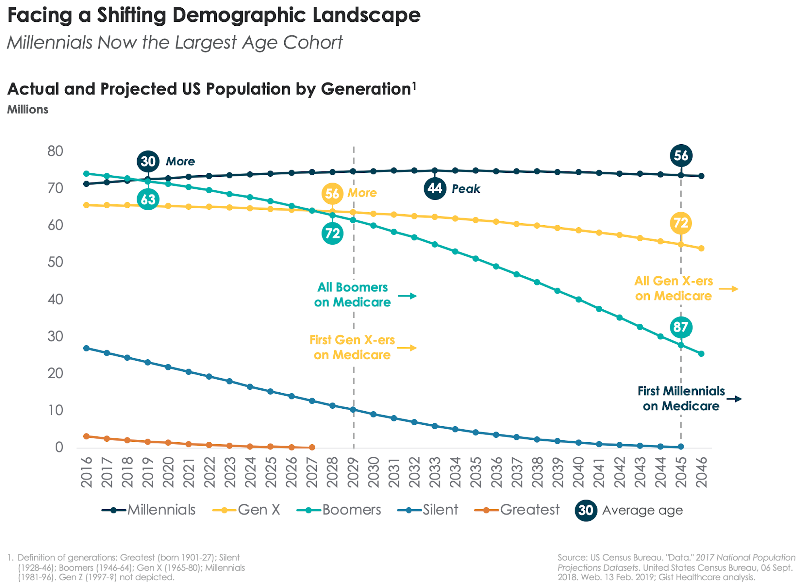
We spend an awful lot of time in healthcare talking about the Baby Boomers. No surprise, America has spent decades—six-and-a-half of them, to be exact—contending with the impact of this historically large generation on nearly every aspect of our national life. From politics to economics to culture, the Baby Boom reshaped almost every facet of our society, and healthcare has been no exception. The fact that over 10,000 Boomers join the Medicare ranks every day means they’ll have a transformative effect on how healthcare is delivered and paid for—up to and including the sustainability of the Medicare program itself. So it may come as a shock to Boomers to learn that, starting in 2019, it’s no longer All About Them. This year America passes a new milestone: Baby Boomers are now outnumbered by Millennials. As the chart below shows, Boomers (whose average age is now 63), will be surpassed this year by America’s new Largest Generation. Born between 1981 and 1996, the Millennials are now 30 years old on average, and there are 72.5M of them, compared to 72.0M Boomers—a gap that will continue to widen. (Thanks to immigration, we have another 14 years until we hit “peak” Millennial, according to Census Bureau projections.)

This demographic achievement alone ought to earn Millennials a participation trophy—obviously, not their first. (Forgive the sarcasm…we’re Gen X-ers, it’s what we do.) But this changing demographic landscape brings big implications for healthcare. Boomers are just entering their peak “senior care” consumption years now, and we’ll have a quarter-century or more of very expensive care to fund for a generation that is by all indications more riven with chronic disease but more likely to live into very old age than previous cohorts. That creates the imperative for population health approaches that allow care for seniors to be delivered in lower-acuity settings. At the same time, however, Millennials are really just entering the healthcare system. For the next several years, most of their care needs will be driven by having babies and caring for growing families. But just as the last of the Boomers get their Medicare cards in 2029, the Millennials will begin to enter their “upkeep” years—demanding a variety of diagnostics, surgeries, and procedures to keep them thriving. Who will pay for all of that specialty care, and where will it be delivered? Today’s health system planners would do well to begin to look ahead to future capacity needs, and economic models.

The Millennials bring dramatically different service expectations as well. This is a generation raised in the era of Amazon. One-click purchases, same-day delivery, frictionless transactions, personalized offerings, low institutional loyalty—all of that will shape the way this generation thinks about consuming healthcare, with huge implications for providers. This is a high-information generation, whose adult years have seen a pervasive shift from physical to digital commerce, and they’ll expect healthcare to follow that trend. Ask today’s pediatric providers how different the Millennials are as parent-consumers—you’ll quickly get the picture. Even as physicians, hospitals and others scramble to retool care delivery to more efficiently manage the swelling ranks of seniors, they’ll need to keep a close eye on the preferences of Millennials, upon whom their future fortunes will rely, and who won’t tolerate the hurry-up-and-wait ethos that still pervades American medicine.

(Spoiler alert: waiting in the wings is Gen Z, digital natives born in 1997 and after. Guess what? There’s even more of them!)


Testing a new role for ambulance services

https://www.cms.gov/newsroom/fact-sheets/emergency-triage-treat-and-transport-et3-model?utm_source=The+Weekly+Gist&utm_campaign=41103e2ef1-EMAIL_CAMPAIGN_2019_02_14_09_16&utm_medium=email&utm_term=0_edba0bcee7-41103e2ef1-41271793

Related image

On Thursday, the Center for Medicare & Medicaid Innovation (CMMI) announced the launch of a new payment pilot that would pay ambulance providers to deliver an expanded range of care services, and to transport patients to alternative care settings. Expected to launch next year, the Emergency Triage, Treat and Transport Model (ET3) is a five-year, voluntary payment model that would reimburse care such as onsite and telemedicine-enabled assessment, transport to an alternative care site, or treatment in place in response to a 911 call. The model will require ambulance providers and local governments responsible for 911 dispatch to cooperate on triage and care delivery and will provide funds to assist in integrating services. The agency also plans to invite state Medicaid programs and private insurers to collaborate in model adoption.
We’ve long been impressed by programs that use “community paramedics” to provide in-home assessment of homebound patients with complex care needs. As one participant told us, paramedics are ideally suited to assess a home situation; they have “seen everything” so nothing fazes them, and patients who frequently call 911 are comfortable with letting a paramedic in their home and are often willing to engage with them on broader care issues. Yet few of these programs have enjoyed sufficient funding to scale services. At first blush, the ET3 program could be one of the most innovative payment models CMMI has yet proposed, with the potential not only to eliminate thousands of unnecessary ED visits and provide more appropriate care in a lower-cost setting, but also to link at-risk patients with ongoing care management and social resources.


‘Told’ is the word most linked to negative hospital reviews on Yelp

https://www.beckershospitalreview.com/patient-engagement/told-is-the-word-most-linked-to-negative-hospital-reviews-on-yelp.html

Image result for yelp hospital reviews

When looking at hospital reviews on Yelp, researchers found the word most associated with negative reviews, including those with one-star ratings, was “told,” a study published in the Journal of General Internal Medicine found.

The researchers, from Philadelphia-based Penn Medicine, analyzed 51,376 reviews for 1,566 U.S. hospitals and found the word “told” appeared in 20 percent of the posts (9,578 in total). Reviews that included the word “told” averaged 1.78 stars out of five stars.

The one-star reviews the researchers saw that contained “told” highlighted frustrations about information that was ostensibly shared (“They never told me the cost of any of the procedures”), anger at a lack of listening (“I told her I did not want to discuss it any more but she persisted to badger me”) and feelings of futility (“Some examined me and told me there was nothing they could do for me”).

“Oftentimes, words such as ‘told’ hint at a breakdown in communication,” Anish Agarwal, MD, a National Clinician Scholars fellow and emergency medicine physician at Penn Medicine, said in a news release. “I suspect that patients are not feeling listened to or heard and this could be driving poor experiences and low reviews.”

For the positive hospital reviews, the word “friendly” was found in about 11 percent of them (5,594 in all). Along with the word “great,” “friendly” correlated the most with five-star reviews. In these reviews, patients often focused on hospital staff’s demeanor and attentiveness (“The entire staff was very friendly and made sure we were taken care of”).

“Patients value communication highly in their overall experience when they’re in the hospital,” Dr. Agarwal said. “As healthcare transitions to being more patient-centered, I think hospitals and providers need to continue to work on how we improve communication, how we listen and how we approach all patient interactions.”