Market Concentration and Potential Competition in Medicare Advantage

https://www.commonwealthfund.org/publications/issue-briefs/2019/feb/market-concentration-and-potential-competition-medicare

Market concentration and competition

ABSTRACT

  • Issue: Medicare Advantage (MA), the private option to traditional Medicare, now serves roughly 37 percent of beneficiaries. Congress intended MA plans to achieve efficiencies in the provision of health care that lead to savings for Medicare through managed competition among private health plans.
  • Goal: Two elements are needed for savings to accrue: a sound payment policy and effective competition among the private plans. This brief examines the latter.
  • Methods: We use data from 2009–17 to describe market structure in MA, including the insurers offering plans and enrollment in each U.S. county. We measure both actual and potential competitors for each county for each year.
  • Key Findings and Conclusions: MA markets are highly concentrated and have become more concentrated since 2009. From 2009–17, 70 percent or more of enrollees were in highly concentrated markets, dominated by two or three insurers. Since the payment system used to reimburse insurers selling in the MA market relies on competition to spur efficiency and premiums that more closely reflect insurers’ actual costs, these developments suggest that taxpayers and beneficiaries will overpay. We also find an average of six potential entrants into MA markets, which points to a source of competition that may be activated in MA. To tap into potential competition, further research is needed to understand the factors affecting entry into MA markets.

Introduction

Medicare Advantage (MA), the private option to traditional Medicare (TM), now serves roughly 37 percent of beneficiaries through health care plans. Federal subsidy of the premiums of MA plans is intended to create a “level playing field,” so that the government pays MA plans based on what beneficiaries would typically cost in TM. This approach is based on Alain Enthoven’s concept of “managed competition,” wherein private plans that provide better benefits and higher-quality care at a lower price than TM would attract beneficiaries. Two elements are needed for this approach to work: a sound payment policy and effective competition among the private plans. This issue brief examines the latter.

Recent data show that many MA markets are served by just one or a small number of insurers.1 In 2012, 97 percent of county markets in the MA program were designated as highly concentrated according to the definitions used by the Federal Trade Commission (FTC) and the U.S. Department of Justice (DOJ), with a Hirschman-Herfindahl Index (HHI) of greater than 2,500.2 In 2016, the Medicare Payment Advisory Commission observed that local markets for MA plans were becoming increasingly concentrated.3 Recently, courts have blocked mergers that would further erode competition within the MA market.4

This issue brief updates information about the market structure in the MA program. We report on traditional measures of market structure, such as concentration ratios and the HHIs, and a simple count of the number of insurers offering plans in a market. We also include the “two-firm concentration ratio,” or the share of enrollment accounted for by the top two firms. We also offer new perspectives on competition in MA. First, we comment on competition and choice from the standpoint of a beneficiary by examining the number of plans available. Second, we introduce the idea of “potential competition” in an MA market. Potential competition, like actual competition, can constrain market power. Third, we consider the role of TM in constraining the market power of MA insurers.

Actual and Potential Competition

News stories about consumers’ choices among Medicare Advantage plans often begin with a statement such as “On average, seniors will have a choice of 21 plans, although at least 40 plans will be accessible in some counties and large metropolitan areas of the country.”5 But such accounts give a misleading indication of competition in the MA program, because many insurers offer multiple health plan products in the same market. In this issue brief, we measure the number of MA plans but also focus on the number of different insurers in the market to assess competition at the insurer level.

An insurer needs to be wary of potential as well as actual competitors. Insurers that set premiums high may enable competitors to gain footholds in a market. A market is said to be “contestable” if it is relatively easy for a potential entrant to contest for market share.6Barriers to entry, the magnitude of one-time entry costs, and the availability of comparably efficient technology all influence contestability of a market. Here, we identify “potential competitors,” or insurers that are in a position to contest a county-defined market and therefore pose a competitive threat to incumbents. Insurers licensed to operate MA plans in a state have already crossed some local regulatory barriers and contract with some local providers. We therefore measure potential competition by the number of health insurers participating in some MA markets within the state but not in a particular county.

Data and Measurement

We use data from 2009–17 to describe market structure in MA, including the insurers offering plans in each county and the level of enrollment by county and plan. From these data we measure both actual and potential competitors for each county for each year. Actual competitors are those insurers that participate in MA in a specific county; potential competitors are the insurers participating in MA in a state but not in the county of interest. These data also allow us to compute concentration ratios and the HHI for each county and in each year. In some analyses we categorize the counties according to the HHI corresponding to the FTC/DOJ classifications of concentration: 1) not concentrated, HHI <1,501; 2) moderately concentrated, HHI=1,501–2,500; and 3) highly concentrated, HHI >2,500.

Results

As shown in Exhibit 1, in 2017 Medicare beneficiaries could choose from a relatively large number of private plans (roughly seven) by the standards of the private insurance market. The number of insurers declined from 2009 to 2011 then remained steady through 2017, averaging 2.5 in 2017. For comparison, in 2017, the average metropolitan area had two insurers competing in the health insurance marketplaces created by the Affordable Care Act.

Insurer concentration increased from 2009 to 2011 (the number of insurers selling MA plans fell from 4.5 to 2.9) then remained at about the same, high level of concentration. The two-firm concentration ratio was already high in 2009 (81%); it rose to 91 percent by 2011 and stayed there through 2017. The average county-level HHI was 4,914 in 2009, rising to 6,360 in 2013, and declining slightly to 6,285 in 2017. To put this in perspective, a market with two equal-size health plans would have an HHI of 5,000. The average MA market is therefore even more concentrated than that. Notably, the number of potential competitors also fell over the same period. Nevertheless there are now more potential than actual competitors in each county.

Exhibit 2 shows that 70 percent or more of MA enrollees were in highly concentrated markets (HHI>2,500). Few MA enrollees were able to choose a plan in a market not dominated by two or three insurers.

Virtually all Medicare enrollees face MA markets that are moderately to highly concentrated. Exhibit 3 shows the distribution of all Medicare enrollees (in MA and TM) by the levels of MA concentration. We stratify markets (i.e., counties) into quartiles according to the size of the total population of Medicare beneficiaries. The table reports mean population and mean HHI for each quartile of the total Medicare population. Among sparsely populated markets, which are largely rural, the mean HHI is 6,684 — indicating that they are highly concentrated. This is in part because of the difficulty that managed care plans, like HMOs and PPOs, have in establishing provider networks in rural areas where providers are scarce and provider markets are highly concentrated. In highly populated markets, the average HHI shows that they too are highly concentrated HHI = 3,774), but the index value is considerably lower than in sparsely populated markets.

Exhibit 4 shows the average numbers of potential entrants in counties grouped by the three HHI ranges. In recent years, there has been little difference in the number of potential competitors in areas with high or low concentration, implying that potential competitors are no more attracted to highly concentrated markets and may not discipline competition any more strongly in areas with few actual competitors. This was not true in earlier years, during which the number of potential competitors was higher in areas with less current competition. The number of potential competitors in moderately concentrated counties has remained steady over the nine-year period.

While Medicare beneficiaries have a choice between TM and MA, in assessing the competitive forces on MA plans we assume that the actual or potential competition from other MA plans matters most. The market position of an MA insurer in relation to TM received examination in connection with two recently proposed mergers, between Aetna and Humana and between Anthem and Cigna. The U.S. Department of Justice challenged these mergers on antitrust grounds, arguing that the proposed consolidations would threaten effective competition in MA. In the Aetna-Humana case, Judge Bates observed: “The weight of the evidence presented at trial indicates ‘industry [and] public recognition’ of a distinct market for Medicare Advantage. Competition within that market, between Medicare Advantage plans, is far more intense than competition with products outside of it.”7 While the role of traditional Medicare in affecting competition in the MA market deserves further analysis, competition among MA plans is where most of market discipline is likely to arise. While the presence of TM likely affects the conduct of MA plans, existing evidence suggests that the primary drivers of consumer choices are differences in the premiums, quality of care, and benefits among MA plans.8

Implications of MA Market Concentration

Even though 37 percent of all Medicare beneficiaries are enrolled in private plans, when compared with employer-based health insurance Medicare’s transition to managed care has been slow. Traditional Medicare is the last major bastion of open-network, fee-for-service health insurance, although the fee-for-service component is beginning to change with the spread of accountable care organizations. Competition or lack thereof of in a market plays a role in accelerating or attenuating this shift. Consumer choices tend to be driven by the better value (premiums and quality) that can turn more favorable with increased competition.

Several forces may have driven greater concentration in MA markets since 2009. First, consolidation in the health insurance industry generally may have affected the MA market structure.9 Concentration in provider markets also has been increasing, which has made price negotiations for health care services more difficult for insurers, especially smaller ones.10 Medicare policy changes over these years may have inadvertently limited the supply and market entry of MA insurers. When Medicare rules were changed to require all MA plans to create networks of providers, the effect of provider concentration was heightened and some health insurers were less willing to remain in and/or enter MA markets. This effect may have been especially significant in rural areas.11 At the same time, there appears to be a substantial number of potential MA insurer entrants in most moderate to highly concentrated markets, yet there appears to have been little clear impact on market outcomes in terms of premiums and quality.

Together, the confluence of these forces continues to push MA markets in the direction of greater concentration. Since the payment system used to reimburse insurers selling in the MA market relies on competition to drive premiums toward insurers’ actual costs, these developments suggest that taxpayers and beneficiaries will overpay for MA products, compared with what they might have paid in markets with more robust competition.

Need for Further Analysis

A competitive market is intended to deliver good products to consumers at low prices. Ultimately, the effect of Medicare Advantage market power on prices or quality of care needs to be assessed empirically. There is some, but limited, evidence on the exercise of MA market power.12 Further research is needed to understand how potential competitors affect the actions of existing competitors. It also will be important to understand the barriers to market entry for potential competitors, especially those that might be lowered to spur greater competition.



The Fiscal Case for Medicaid Expansion

https://www.commonwealthfund.org/blog/2019/fiscal-case-medicaid-expansion

Fiscal Case for Medicaid Expansion 21x9

After a two-and-a-half-year lull in which no state took up the Affordable Care Act’s (ACA) provision to expand Medicaid eligibility to more Americans living in poverty, 2019 has already ushered in an expansion in Virginia. And as many as six more states are waiting in the wings. In November, voters in Idaho, Nebraska, and Utah overwhelmingly approved state ballot initiatives to expand Medicaid. And in January, new governors supportive of expansion took office in Kansas and Wisconsin. The prospect of Medicaid expansion in these five states plus Maine, where implementation is finally under way following a 2017 ballot referendum, means that as many as 300,000 uninsured Americans may gain coverage this year.

But concerns about the cost of expanding eligibility for Medicaid have been a roadblock to implementation in these states, along with the dozen others that have yet to expand the program. Here, we look at the cost to states of expanding eligibility for Medicaid, and what expansion means in practice for state budgets.

The Federal Government Pays 90 Percent of the Total Cost of Medicaid Expansion

Beginning in 2014, the ACA offered states the option to expand eligibility for Medicaid to individuals with incomes up to 138 percent of the federal poverty level, or roughly $17,000 per year for a single person. (Previously, the federal government required Medicaid be available only to children, parents, people with disabilities, and some people over age 65, and gave states considerable discretion at setting income eligibility levels.) While Medicaid is a jointly funded partnership between the federal government and the states, the ACA provided 100 percent federal funding to cover the costs of newly eligible enrollees until the end of 2016 in states that took up the expansion. The federal government currently pays 93 percent of the total costs, and this year alone will provide an estimated $62 billion to fund expansion, according to the Congressional Budget Office.

In 2020, the federal share will drop to 90 percent where, barring a change to the law, it will stay. This leaves states on the hook for at most 10 percent of the total cost of enrollees in the new eligibility category — considerably less than the roughly 25 percent to 50 percent of the cost that states pay for enrollees eligible for Medicaid under pre-ACA criteria.

States Realize Savings from Expansion

Opponents of Medicaid expansion in states that have yet to implement it worry that even a 10 percent contribution to the cost of extending Medicaid coverage to more people will result in a large increase in state spending. But the experience of a long list of states suggests otherwise. That’s because expansion allows states to realize savings by moving adults who are in existing state-funded health programs into expansion coverage. Expansion also allows states to reduce their spending on uncompensated care as uninsured people gain coverage.

The table below offers a snapshot of what this looked like in Montana, where Medicaid expansion took effect in January 2016. In FY2017, the total cost of Medicaid expansion was $576.9 million. Because the federal match was 95 percent to 100 percent during this time, the state’s share was $24.5 million. But the state then experienced a series of offsets, or savings it realized from not spending money on separate health-related programs fully funded by the state, such as substance use disorder programs. The state also realized savings when some groups who were previously covered under existing Medicaid were moved to the expansion population, which has a higher federal matching rate. Taken together, these offsets added up to $25.2 million, leaving Montana with a surplus of $700,000 in FY2017. One study found that Arkansas and Kentucky amassed enough surplus because of offsets during the first two years of expansion, when the federal government was footing the entire bill, to cover the costs of expansion through FY2021.

Net Costs Are a Minuscule Portion of States’ Overall Budgets

It’s also worth noting that even if Montana had been responsible for 10 percent of the total cost in FY2017, or $57.7 million, after offsets were applied, the net cost to the state — or the amount it actually spent on Medicaid expansion — would have been $32.5 million, only about 1 percent of Montana’s general fund expenditures of $236.5 billion in FY2017. In Nebraska1 and in Kansas, two of the states that may be among the next to implement expansion, estimates have shown that the state cost after offsets is less than 1 percent of the general fund.

Paying the Balance

Of the 32 states that, along with the District of Columbia, have implemented Medicaid expansion, nine are using taxes — on cigarettes; alcohol; or hospital, provider, or health plan fees — to help pay for it. The ballot initiative approved by voters in Utah in November increased the state’s sales tax by 0.15 percent with the requirement that the new revenue be used to pay for the cost of expansion there. (Even so, earlier this week, Utah Governor Gary Herbert signed into law a bill approved by the Republican-led legislature that will scale back the full Medicaid expansion that voters approved.)

States that expand Medicaid also realize economic benefits beyond increased federal funds. For example, a Commonwealth Fund-supported study found that as a result of new economic activity associated with Medicaid expansion in Michigan, including the creation of 30,000 new jobs mostly outside the health sector, state tax revenues are projected to increase $148 million to $153 million a year from FY2019 through FY2021.

A U.S. Senate bill cosponsored by Senator Doug Jones (D–Ala.), who has advocated for his state to adopt expansion, could help reassure states skittish about expanding because of the impact on their budget. The legislation would grant states, regardless of when they adopt expansion, the same levels of federal matching funds that states that expanded the program in 2014 received (100% federal funding for the first three years, phasing down over three more years to 90%).

Indeed, a national study confirmed that during the two years when the federal government paid all of the costs for newly eligible enrollees, Medicaid expansion did not lead to any significant increases in state spending on Medicaid or to reductions in spending on other priorities such as education. But even at a lesser percent match, the fiscal case for expansion is compelling.

A future To the Point post will examine the broader economic benefits associated with Medicaid expansion.


Adventist Health to lay off 1,300+, keep wildfire-damaged hospital closed

Adventist Health finalizes layoffs at Feather River Hospital

Roseville, Calif.-based Adventist Health will not reopen its hospital in Paradise, Calif., and finalized more than 1,300 layoffs, according to the Paradise Post.

Adventist Health submitted a required Worker Adjustment and Retraining Notification letter to the state Jan. 8 explaining that more than 1,300 full- and part-time employees would be affected by the closure of Adventist Health Feather River.

The health system conducted a town hall meeting for employees in December 2018 and sent an email to employees about the hospital’s closure.

Adventist Health previously told the San Francisco Chronicle the hospital was severely damaged by the Camp Fire, the largest wildfire in U.S. history that burned at least 153,336 acres and destroyed at least 19,000 buildings, according to USA Today.

Officials told the Chronicle the hospital would not be restored until maybe 2020, but that all employees would receive their full salaries through Feb. 5 and full health benefits until May, according to the Paradise Post.

Officials said employees are encouraged to take advantage of services offered by the health system to assist in the employment search.

To access the full report, click here.


The Health 202: Jayapal to roll out sweeping Medicare-for-All bill by month’s end

https://www.washingtonpost.com/news/powerpost/paloma/the-health-202/2019/02/14/the-health-202-jayapal-to-roll-out-sweeping-medicare-for-all-bill-by-month-s-end/5c6496121b326b71858c6b85/?noredirect=on&utm_term=.3b80663a6c98

Image result for medicare at 50

Rep. Pramila Jayapal (D-Wash.) is seeking buy-in from more fellow Democrats for a sweeping Medicare-for-all bill she is poised to release near the end of the month.

It’s a proposal that has become a rallying cry for progressives and 2020 presidential candidates, but it is also exposing deep rifts in the Democratic Party over exactly how to achieve universal health coverage in the United States.

The Medicare for All Act of 2019, which Jayapal had planned to roll out this week but delayed because she was seeking more co-sponsors, would create a government-run single-payer health system even more generous than the current Medicare program. Her office hasn’t publicly released the details of the upcoming measure, but Democratic members told me it would cover long-term care and mental health services, two areas where Medicare coverage is sparse.

The bill also proposes to add dental, vision, prescription drugs, women’s reproductive health services, maternity and newborn care coverage to plans that would be available to people of all ages and would require no out-of-pocket costs for any services, according to a letter Jayapal sent to colleagues on Tuesday asking them to consider co-sponsoring the effort.

“Medicare for All is the solution our country needs,” the letter said. “Patients, nurses, doctors, working families, people with disabilities and others have been telling us this for years, and it’s time that Congress listens.”

The 150-page bill had 93 co-sponsors as of Tuesday, although Jayapal spokesman Vedant Patel said more Democrats have signed on since then. That’s still fewer than the 124 Democrats who co-sponsored a much less detailed Medicare-for-all proposal from then-Rep. John Conyers (D-Mich.) last year. A strategist who has been working with Democrats on health-care ideas told me there have been some frustrations that more members haven’t yet signed on to Jayapal’s bill, despite the fact that there are 40 more Democrats in the House this year.

But Jayapal said she’s confident she’ll have 100 co-sponsors by the time of the bill’s planned Feb. 26 release, explaining she’s not surprised members would take more time to consider it given its length.

“It’s a 150-page bill … it’s not an eight-page resolution,” Jayapal told me yesterday. “Now we’re actually putting detail into it, and so we feel confident we will continue to add cosponsors even after introduction.”

Patel also noted it’s still early in the year, saying he “disagrees” with the notion that it’s taking a long time to bring Democrats on board.

“It’s the second week of February and we are at more than 95 co-sponsors,” he said. “Coalition building is a process, but we are on track to introduce this historic legislation with resounding support at the end of the month.”

Yet differences are emerging among Capitol Hill Democrats over how to expand coverage, part of a larger debate roiling the party as 2020 candidates, many of them senators, and a new class of freshmen House Democrats move the party left not only on health care but also on the environment.

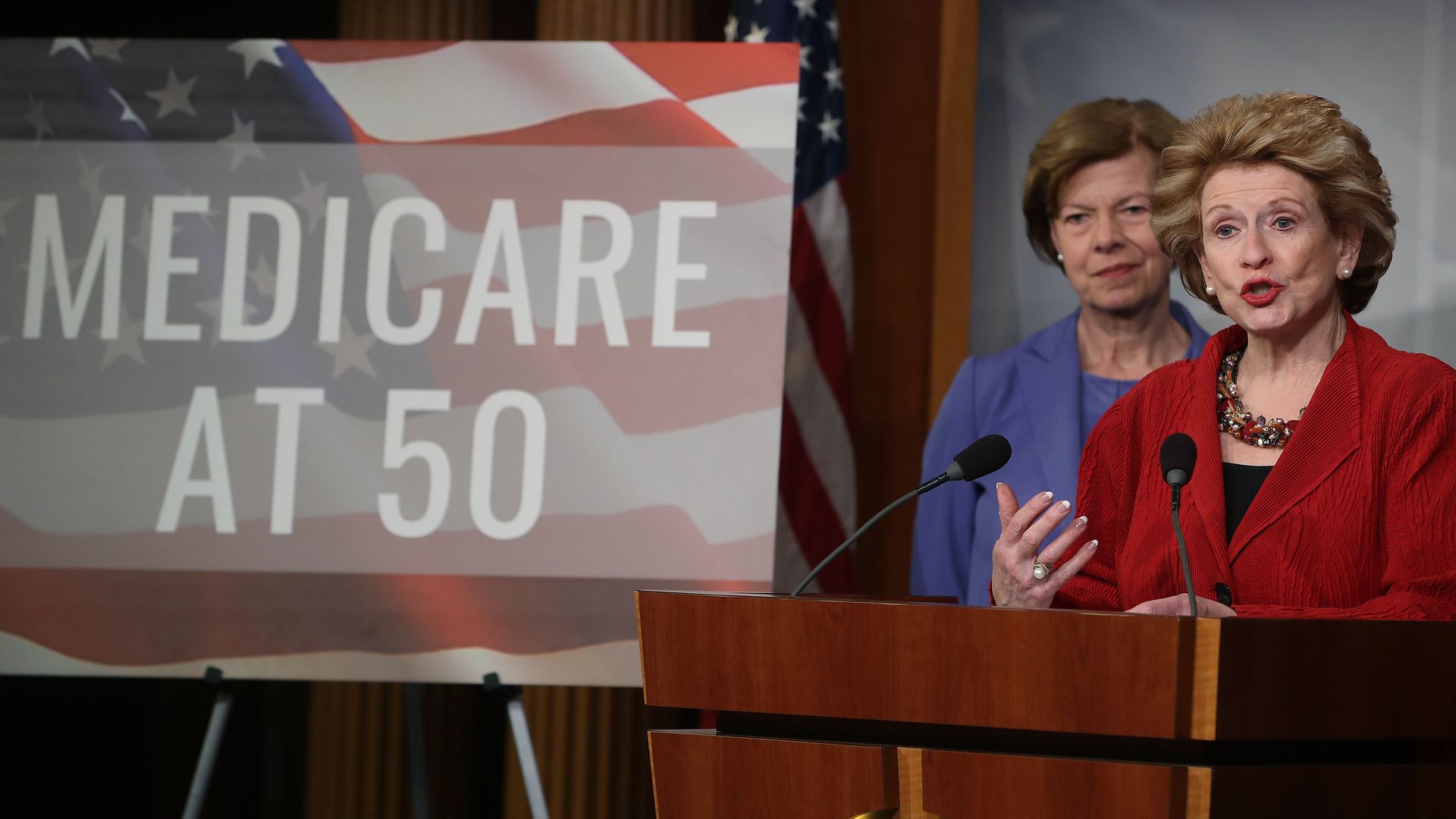
The cracks were especially apparent yesterday, as a separate group of lawmakers gathered to re-introduce their own proposal to allow people to buy in to Medicare starting at age 50. That measure, offered by Sen. Debbie Stabenow (D-Mich.) and Rep. Brian Higgins (D-N.Y.), would take a more incremental approach to expanding health coverage — one that could play better with voters who would stand to lose private coverage under a single-payer program.

Their bill, dubbed the “Medicare at 50 Act,” would allow people to buy Medicare plans instead of purchasing private coverage on the Obamacare marketplaces if they are uninsured or prefer it to coverage offered in their workplace.

And today, Sen. Brian Schatz (D-Hawaii) and Rep. Ben Ray Luján (D-N.M.) are reintroducing their State Public Option Act, which allows people to buy a Medicaid plan regardless of their income. That measure has broad backing from not just lawmakers (20 senators co-sponsored it last year) but also well-known health policy wonks including former Centers for Medicare and Medicaid Services Administrator Andy Slavitt.

Higgins is one of several Democrats on the House Budget Committee who have proposed a total of three separate and contrasting bills to expand Medicare to more people. The others are Reps. Rosa DeLauro (D-Conn.) and Jan Schakowsky (D-Ill.), who have a bill to expand Medicare to all ages while still preserving employer-sponsored coverage, and Jayapal.

Once Jayapal rolls out her legislation, the Congressional Budget Office is expected to release an analysis of how much it would cost by the end of March or the beginning of April, Budget Committee Chairman John Yarmuth (D-Ky.) told me. At that point, the committee will hold a hearing with the CBO to go over the cost and its potential impact on the federal budget.

That’s where Jayapal could run into roadblocks.Given the extensive benefits she’s proposing, her bill would probably come at a steep cost to taxpayers — and paying for things is almost always Congress’s trickiest task. Of course, supporters of the legislation stress its benefits would fill in much-needed gaps in coverage under the current Medicare program.

“The biggest change I give her so much credit for is it has long-term care,” said Rep. Ro Khanna (D-Calif.), who is a co-sponsor of Jayapal’s Medicare-for-all bill. “This is huge.”

And then there’s also the question of how voters might react if told they would lose their current coverage. Sen. Kamala Harris (D-Calif.), who has gone the furthest of all the 2020 candidates in pushing for an overhaul of the U.S. health-care system, attracted widespread attention recently when she suggested she’d be fine with entirely eliminating private coverage in favor of government-run plans.

“We’re very aware that there is anxiety about — however imperfect — a system you know and doctors you know, and that is going to be all part of the hearing process, public input into: How do we build a system in this country that really cares about all Americans?” said Rep. Katherine Clark (D-Mass.), another co-sponsor of the Jayapal bill.