MercyOne Health System is now a full member of Livonia, Mich.-based Trinity Health.
Trinity Health completed its acquisition about five months after entering into an agreement with CommonSpirit Health to acquire all facilities and assets of Iowa-based MercyOne. MercyOne was founded in 1998 through a collaboration between Catholic Health Initiatives, now CommonSpirit, and Trinity Health.
“For close to 25 years, we have served Iowa communities. With MercyOne now fully part of Trinity Health, we are a stronger and more unified system that will strengthen MercyOne’s ability to serve our patients, colleagues, and communities,” said Mike Slubowski, president and CEO of Trinity Health, in a news release.
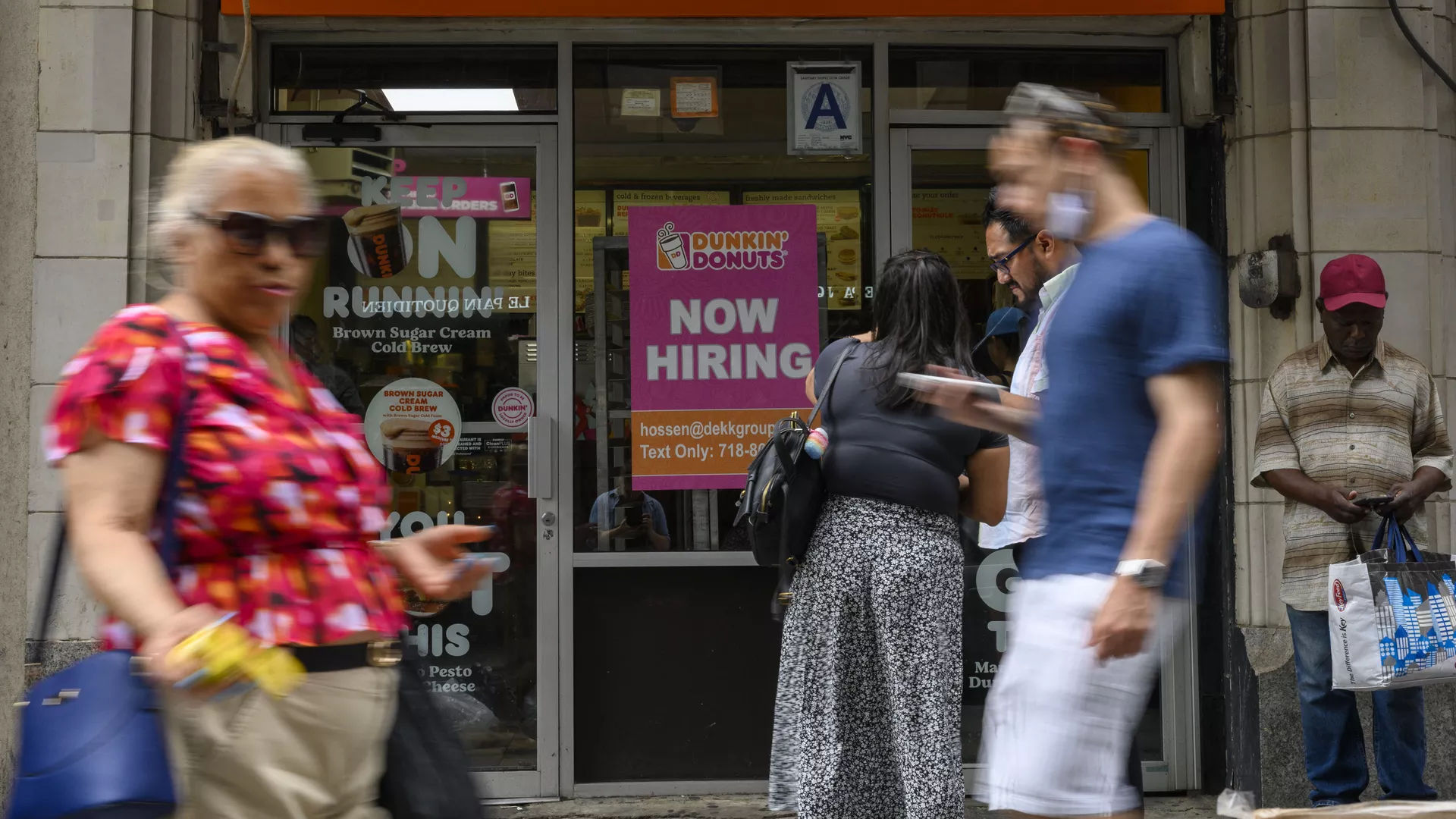
America had another month of solid job gains: The economy added 315,000 jobs in August, while the unemployment rate ticked up to 3.7% as more workers entered the labor force, the government said on Friday.
Why it matters: Employers continue to hire workers at a robust pace, even as the Federal Reserve raises interest rates swiftly to crush inflation.
Job growth eased from July’s breakneck pace, which were revised a tick higher to 528,000 jobs. Job growth in June was weaker than initially thought, downwardly revised by 100,000 to 293,000.
The August figures are roughly in line with economists’ expectations.
Details: Perhaps the most welcoming piece of news in the report is the influx of workers who entered the labor force last month. The labor force participation rate — the share of people working or looking for work — rose by 0.3 percentage points, after a string of monthly declines.
Average hourly earnings rose by 0.3%, a slowdown from the 0.5% rate in July.
The backdrop: The Fed has been bracing for some heat to come out of the labor market. It has raised interest rates at a historically rapid pace in a bid to squash elevated inflation. This report offers some good news as wage growth slowed — and more workers entered the workforce, helping ease the tightness in the labor market.
Higher rates work to slow demand by making it pricier for consumers and companies to borrow money, causing slower economic growth and, in turn, less price pressure.
“While higher interest rates, slower growth, and softer labor market conditions will bring down inflation, they will also bring some pain to households and businesses,” chair Jerome Powell said last week.
One of China’s biggest cities, Chengdu, announced a lockdown of its 21.2 million residents as it launched four days of citywide Covid-19 testing, as some of country’s most populous and economically important urban centers battle outbreaks.
All residents in Chengdu, the capital of Sichuan province, were ordered to stay largely at home from 6 p.m. on Thursday, with households allowed to send one person per day to shop for necessities, the city government said in a statement.
The southwestern Chinese metropolis of Chengdu announced a lockdown of its 21.2 million residents as it launched four days of citywide Covid-19 testing, as some of the country’s most populous and economically important cities battle outbreaks.
Residents of Chengdu, the capital of Sichuan province, were ordered to stay home from 6 p.m. on Thursday, with households allowed to send one person per day to shop for necessities, the city government said in a statement.
Chengdu, which reported 157 domestically transmitted infections on Wednesday, is the largest Chinese city to be locked down since Shanghai in April and May. It remained unclear whether the lockdown would be lifted after the mass testing ends on Sunday.
Other major cities including Shenzhen in the south and Dalian in the northeast have also stepped up Covid restrictions this week, ranging from work-from-home requirements to the closure of entertainment businesses in some districts.
The moves curtail the activities of tens of millions of people, intensifying the challenges for China to minimize the economic impact of a “dynamic-zero” Covid policy that has kept China’s borders mostly shut to international visitors and make it an outlier as other countries try to live with the coronavirus.
Most of the curbs are intended to last a few days for now, although two provincial cities in northern China have extended curbs slightly beyond initial promises.
Chengdu’s lockdown sparked panic buying of essentials among residents.
“I am waiting in a very long queue to get in the grocery near my home,” 28-year-old engineer Kya Zhang said, adding that she was worried about access to fresh food if the lockdown is extended.
Hwabao Trust economist Nie Wen said that because Chengdu acted quickly to lock down, it was unlikely to see a repeat of Shanghai’s two-month ordeal.
Non-essential employees in Chengdu were asked to work from home and residents were urged not to leave the city unless needed. Residents who must leave their residential compounds for hospital visits or other special needs must obtain approval from neighborhood staffers.
Industrial firms engaged in important manufacturing and able to manage on closed campuses were exempted from work-from-home requirements.
Sweden’s Volvo Cars said it would temporarily close its Chengdu plant.
Flights to and from Chengdu were dramatically curtailed, according to Flight Master data. At 10 a.m. local time (0200 GMT) on Thursday, it showed 398 flights had been canceled at Shuangliu Airport in Chengdu, with a cancellation rate of 62%. At Chengdu’s Tianfu Airport, 79%, or 725 flights, were canceled.
Shenzhen curbs
In Shenzhen, which has the third-highest economic output among Chinese cities, the most populous district Baoan and tech hub Nanshan suspended large events and indoor entertainment for a few days and ordered stricter checks of digital health credentials for people entering residential compounds.
Nanshan is home to internet giant Tencent and the world’s biggest dronemaker, DJI, among other major Chinese companies.
More than half of Shenzhen’s ten districts, home to over 15 million people, have ordered blanket closure of entertainment venues and halted or reduced restaurant dining for a few days, with curbs in two districts initially planned to be lifted by the end of Thursday.
Shenzhen authorities have largely avoided shutting down offices and factories as they did during a week-long lockdown in March.
Data on Thursday showed that Chinese factory activity contracted for the first time in three months in August amid weakening demand, while power shortages and fresh Covid-19 flare-ups disrupted production.
In Shanghai, schools reopened on Thursday after being closed for months.
Mainland China has reported no Covid death since May, leaving the death toll at 5,226.
The Food and Drug Administration (FDA) on Wednesday authorized updated COVID-19 booster shots specifically targeting a subvariant of omicron.
The move comes ahead of a fall campaign to give Americans booster shots, which is expected to launch in the coming days.
The move marks the first time the vaccines have been updated since the first shots were cleared at the end of 2020, and the updated shots are designed to catch up to evolutions in the virus.
The shots from Pfizer and Moderna target the omicron subvariants BA.4 and BA.5, as well as the original virus.
The shots can begin going into arms once the final step in the process, a Centers for Disease Control and Prevention committee, clears them, which is expected to occur on Thursday.
A major question, though, is how many people will actually want the new shots, given that uptake for the existing booster shots has lagged.
Only about half of people who got the first two shots received the initial booster dose.
“The COVID-19 vaccines, including boosters, continue to save countless lives and prevent the most serious outcomes (hospitalization and death) of COVID-19,” said FDA Commissioner Robert Califf. “As we head into fall and begin to spend more time indoors, we strongly encourage anyone who is eligible to consider receiving a booster dose with a bivalent COVID-19 vaccine to provide better protection against currently circulating variants.”
Seeking to keep up with the ever-evolving virus, the FDA did not wait for the time-consuming process of going through full clinical trials on this tweaked vaccine. But it noted that it is highly confident that the vaccines are safe and effective. The agency pointed to the millions of doses of the original vaccines that have been given, as well as data from another version of the updated vaccine, along with preliminary data on this one.
Peter Marks, a top FDA vaccine official, compared the process to the annual updates to the flu vaccine that seek to adapt to the changes in that virus.
“The public can be assured that a great deal of care has been taken by the FDA to ensure that these bivalent COVID-19 vaccines meet our rigorous safety, effectiveness and manufacturing quality standards for emergency use authorization,” Marks said.
The updated Moderna vaccine is cleared for people 18 and older, and the Pfizer vaccine for people 12 and older.
For both, people are eligible for the booster shot of the updated vaccine if it has been at least two months since their last shot.




 HENRY KOTULA