Hospice Industry Awash with For-Profit Bad Actors

https://mailchi.mp/0622acf09daa/the-weekly-gist-december-2-2022?e=d1e747d2d8

An unsparing piece published this week in the New Yorker examines the unscrupulous and exploitative practices of AseraCare and several other for-profit hospice providers, who have gone from controlling 30 percent of the hospice market to more than 70 percent across the last decade. The article outlines the companies’ playbook of delivering the least amount of care to the greatest number of patients, many of whom are not actually in need of hospice services at all.

In order to game Medicare’s policy to extract repayments from hospice providers whose average patient stay exceeds six months, many of these companies have employed strategies ranging from recruiting “last breath” patients from oncologists to lower their average length of stay, to “graduating” an absurd 70 percent of enrolled patients once they reach their six-month limit. 

The Gist: While it only takes a few bad apples spoil the bunch, the US hospice industry appears to be in a thoroughly rotten state. Caring for the elderly and dying is already a difficult (and expensive) proposition, and the questionable practices detailed in this piece further undermine the good work being done by those providers committed to helping patients and their families during extraordinarily difficult times. 

Currently subject to only minimal federal oversight, the hospice industry is in dire need of stronger regulation, which might take its cue from California, which recently issued a licensing moratorium for hospice providers while redesigning its auditing process.
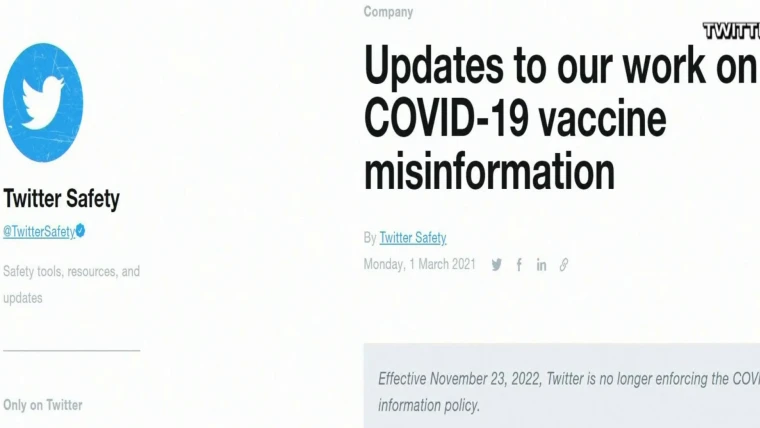
Twitter no longer policing COVID misinformation

https://mailchi.mp/0622acf09daa/the-weekly-gist-december-2-2022?e=d1e747d2d8

Amid a flurry of policy changes initiated by Elon Musk since his takeover of the social media company last month, Twitter has ceased its formal efforts to combat COVID misinformation. To date, Twitter had removed over 100K posts for violating its COVID policy. The company will now rely on its users to combat disinformation through its “Birdwatch” program, which lets users rate the accuracy of tweets and submit corrections. Many of the 11K accounts suspended for spreading COVID misinformation, including those of politicians like Rep. Marjorie Taylor Greene (R-GA), have also been reinstated. 

The Gist: We’ve seen the damage caused by inaccurate or deliberately misleading COVID information, which has likely played a role in the US’s lower vaccination rates compared to other high-income countries. Around one in five Americans use Twitter, far fewer than Facebook or YouTube, but the platform is seen as highly influential, both for the reach of its content and also its moderation decisions. 

This policy change is worrisome, not only because COVID is still taking the lives of hundreds of Americans daily, but also because COVID misinformation catalyzes broader healthcare misinformation, including antivax sentiments and an overall mistrust of medical experts.

U.S. economy adds 263,000 jobs in November

The jobs market stayed strong last month: Employers added 263,000 jobs, while the unemployment rate held at 3.7%, near the lowest level in a half-century, the Labor Department said on Friday.

Why it matters: The figures are the latest signal of a roaring labor market that continues to defy fears of a recession.

  • November’s payroll gains are above the addition of 200,000 jobs that economists had expected.

By the numbers: Job growth last month was slightly slower than the 284,000, added in October, which was revised up by 23,000. In September, the economy added 269,000 jobs, 46,000 fewer than initially estimated.

  • Average hourly earnings, a measure of wage growth, rose by 0.6% in November — faster than the prior month, when earnings rose by 0.5%. Over the past year ending in November, average hourly earnings increased by 5.1%.
  • The share of people working or looking for work, known as the labor force participation rate, ticked down to 62.1%, compared to 62.2% in October.

The backdrop: Economists have been bracing for cracks in the labor market that have yet to appear.

  • It has been an ugly stretch for layoffs in a handful of sectors like technology, with large-scale job cuts announced at MetaAmazon and Twitter.

But overall, the booming job market has continued for workers, even in the face of ultra-aggressive efforts by the Federal Reserve to try to cool demand for labor to help put a lid on inflation.

  • Last month, Fed chair Jerome Powell said that employers bidding up wages to attract workers is not “the principal story of why prices are going up.”
  • Still, the labor market may point to clues about how inflation will evolve in certain categories, including industries within the services sector where wages make up the biggest costs for businesses, Powell said on Wednesday.

Virus roundup: There are new dominant Covid-19 strains in the US

Monkeypox cases in women and non-binary people may be getting misdiagnosed as sexually transmitted infections (STIs), daily Covid-19 hospital admissions are expected to increase for the first time since July, and more in this week’s roundup of monkeypox and Covid-19 news.

Monkeypox:

  • Monkeypox may be getting misdiagnosed as STIs in women and non-binary people, according to a new study published in The Lancet. For the study, researchers gathered data from 69 cisgender women, 62 transgender women, and five nonbinary people assigned female at birth with confirmed monkeypox cases between May 11 and Oct. 4 across 15 countries. The study found that 73% of monkeypox infections among this group were likely acquired from sexual contact. While nearly all monkeypox infections among trans women were likely acquired through sexual contact, roughly 24% of cis women and nonbinary people were believed to have acquired an infection outside of sexual contact, such as household or occupational exposure, according to the researchers. In addition, the researchers found that around 33% of cisgender women were misdiagnosed before being diagnosed with monkeypox—and almost half received a delayed diagnosis. “It’s very likely that infections have been missed and not picked up at all,” said Chloe Orkin, a physician and researcher at Queen Mary University of London. “The lesson here is that everybody needs to know about this,” Orkin noted. While public health messages have been primarily directed toward men who have sex with men, “it’s important to recognize this is not the only group,” she added. (Mandavilli, New York Times, 11/21; Hart, Forbes, 11/17)

Covid-19:

  • CDC is forecasting an uptick in Covid-19 hospitalizations for the first time since July, according to national disease modeling. In the coming weeks, CDC’s ensemble forecast from 15 modeling groups is projecting a nationwide increase in daily Covid-19 hospital admissions, with a forecasted 2,000 to 9,000 new daily admissions on Dec. 9. As of Nov. 11, the seven-day average of new hospital admissions for Covid-19 was 3,330—a slight decrease from 3,374 the previous week. In addition, modeling from Mayo Clinic is projecting a 51.5% increase in daily Covid-19 cases over next two weeks, with average daily cases projected to increase from 37,912.7 cases on Nov. 18 to 57,441 on Dec. 2. However, CDC’s ensemble forecast from 13 modeling groups projects that Covid-19 deaths will remain stable or follow an uncertain pattern over the next month. (Bean, Becker’s Hospital Review, 11/21)
  • Earlier this month, omicron subvariants BQ.1 and BQ.1.1 surpassed BA.5 as the dominant strains of the coronavirus in the United States. Currently, BA.5 accounts for roughly 25% of new Covid-19 cases, and BQ.1 and BQ.1.1 account for an equal proportion of around 48% of cases. As BQ.1 and BQ.1.1 become more dominant, many experts are voicing concern over low vaccine uptake and evidence that suggests the dominant strains are not as susceptible to current treatments. For instance, FDA earlier this month updated its guidance for two monoclonal antibody treatments—bebtelovimab and Evusheld—warning that BQ.1 and BQ.1.1 showed significant declines in susceptibility to the treatments. (Choi, The Hill, 11/18)
  • A new study published in JAMA Network Open found that almost 15% of 62,525 hospitalized Covid-19 patients had a medical contradindication after taking Paxlovid’s antiviral combination of nirmatrelvir and ritonavir. To evaluate Paxlovid eligibility among hospitalized Covid-19 patients, researchers used a list of individual contraindications created by FDA. The patients were hospitalized in Paris University hospitals between Jan. 24, 2020, and Nov. 30, 2021. In total, over 9,100 patients—or 14.6%—experienced a medical contraindication to Paxlovid, making the treatment inadvisable. Notably, contraindication rates were higher among men (18%) than in women (11.3%). Among older patients, contradiction rates were 26.9%. “The most prevalent contraindications were severe kidney impairment and use of medications dependent on CYP3A for clearance,” researchers said.