


Taken from the New Testament of Quality Medicine

With a 51-50 vote, Senate Democrats passed a sweeping $739 billion bill Aug. 7 that furthers some of the largest changes to healthcare in years.
Titled the Inflation Reduction Act, the bill touches energy, tax reform and healthcare. The House is expected to take it up Aug. 12, with Democrats aiming to approve it and send it to President Joe Biden’s desk.
Here are seven healthcare takeaways from the 755-page bill:
Drug pricing
1. For the first time, Medicare would be allowed to negotiate the price of prescription medicines with manufacturers. Negotiation powers will apply to the price of a limited number of drugs that incrementally increases over the next seven years. Ten drugs will be eligible for negotiations beginning in 2026; eligibility expands to 15 drugs in 2027 and 20 by 2029.
2. The HHS secretary will provide manufacturers of selected drugs with a written initial offer that contains HHS’ proposal for the maximum fair price of the drug and reasoning used to calculate that offer. Manufacturers will have 30 days to either accept HHS’ offer or propose a counteroffer.
3. Members of Medicare Part D prescription drug plan would see their out-of-pocket costs for prescription drugs capped at $2,000 per year, with the option to break that amount into monthly payments, beginning in 2025.
4. Democrats lost on a provision to place a $35 cap on insulin for Americans covered by private health plans. The provision to cap insulin at $35 dollars for Medicare enrollees passed by a of 57-43.
5. Drug companies will be required to rebate back price differences to Medicare if they raise prices higher than the rate of inflation, coined an “inflation rebate.”
6. The legislation makes all vaccines covered under Medicare Part D free to beneficiaries with no deductibles, co-insurance or cost-sharing, starting in 2023.
Tax subsidies
7. The legislation extends the Affordable Care Act’s federal health insurance subsidies, now set to expire at the end of the year, through 2025. Democrats say the extension will prevent an estimated 3.4 million Americans from losing health coverage.

Kaiser Permanente reported lower revenues in the second quarter of this year than in the same period a year earlier, and the Oakland, Calif.-based healthcare giant ended the period with a net loss.
Kaiser, which provides healthcare and health plans, reported operating revenue of $23.47 billion in the second quarter of 2022, down from $23.69 billion in the same quarter of 2021. The organization’s expenses climbed from $23.34 billion in the second quarter of last year to $23.38 billion in the same period this year.
“Much like the entire health care industry, we continue to address deferred care while navigating COVID-19 surges and associated expenses,” Kathy Lancaster, Kaiser executive vice president and CFO, said in an Aug. 5 earnings release. “Kaiser Permanente’s integrated model of providing both care and coverage enables us to meet these challenges as demonstrated by our moderate increase in year-over-year operating expenses for the second quarter.”
Kaiser ended the second quarter of this year with operating income of $89 million, down from $349 million a year earlier.
After factoring in a nonoperating loss of $1.4 billion, Kaiser reported a net loss of $1.3 billion for the second quarter of this year, compared to net income of $2.97 billion in the same period last year. Kaiser said the loss was largely attributable to market conditions.
This is the second quarter in a row that Kaiser has reported a loss. The organization closed out the first quarter of this year with a net loss of $961 million, compared to net income of $2 billion in the same quarter of 2021.

As RNs struggle to work through staffing shortages, their job satisfaction has sharply declined, with 67% saying they plan to leave their jobs within the next few years, according to a survey from the American Association of Critical-Care Nurses (AACN) published in Critical Care Nurse.
For the survey, AACN collected responses from 9,862 nurses, 9,335 of which met the study criteria of being currently practicing RNs, in October 2021. The mean age was 46.5 years, and the mean years of experience was 17.8 years.
Of the participants, 78.3% worked in direct care, and 19.4% worked in a Beacon unit, meaning that their unit had been recognized by an AACN Beacon Award for Excellence. Half of the participants said they spent 50% or less of their time caring for Covid-19 patients, while the other half said they spent 50% or more.
To measure the health of a work environment, AACN looked at six standards:
Overall, AACN found that nurses’ perceptions of quality on these six measures had declined across the board since the organization’s 2018 survey.
In particular, appropriate staffing was the lowest rated of all the standards at 2.33 out of 4, which is the lowest rating the standard has received since AACN first began the survey in 2006. Only 24% of RNs said their units had the right number of nurses with the right knowledge and skills more than 75% of the time—down from 39% who said the same in 2018.
In addition, there was a significant decline in how RNs rated the quality of care in their organizations and their units. Only 16% rated their organizations’ quality of care as excellent (compared to 24% in 2018), and 30% rated their units’ quality of care as excellent (compared to 44% in 2018). Over 50% of nurses said quality of care in their organization or unit has gotten somewhat or much worse over the last year.
Many nurses also reported difficulties with their physical and psychological well-being in the survey. For example, less than 50% of RNs said they felt their organization values their health and safety, a significant decline from 68% who said the same in 2018.
In addition, 40% of participants reported that they were not emotionally healthy. The percentage of RNs who reported experiencing moral distress also doubled from 11% in 2018 to 22% in 2021.
A significant portion of RNs also reported experiencing verbal abuse, physical abuse, sexual harassment, or discrimination over the past year. Of the 7,399 RNs who answered this question, 72% said they had experienced at least one negative incident, with verbal abuse being the most common at 65%, followed by physical abuse at 28%.
Only 40% of RNs said they were “very satisfied” with their job, down from 62% who said the same in 2018. Further, a significant number of RNs in the survey reported planning to leave their jobs within the next few years.
Overall, 67% of RNs said they planned to leave their current position within the next three years, compared to 54% in 2018. Of this group, 36% said they planned to leave within the next year, with 20% planning to leave within the next six months.
According to the respondents, the top factors that could lead them to reconsider their decision to leave their job were a higher salary and more benefits (63%), better staffing (57%), and more respect from administration (50%).
“Without improvements in the work environment, the results of this study indicate that nurses will continue to exit the workforce in search of more meaningful, rewarding, and sustainable work,” the survey’s authors wrote. “It is time for bold action, and this study shows the way.” (Firth, MedPage Today, 8/3; Ulrich et al., Critical Care Nurse, 8/1)

Concerns about an imbalance in supply and demand in the nursing workforce have been around for years. The number of nursing professionals nationally may be healthy, but many nurses are not in the local areas, sites of care, or roles where they’re needed most. And many of today’s nurses don’t have the specialized skills they need, widening the existing gap between nurse experience and job complexity.
As a result, gaping holes in staffing rosters, prolonged vacancies, unstable turnover rates, and unchecked use of premium labor are now common.
Health care leaders need to confront today’s challenges in the nursing workforce differently than past cyclical shortages. In this report, we present six hard truths about the nursing workforce. Then, we detail tactics for how leaders can successfully address these challenges—stabilizing the nursing workforce in the short term and preparing it for the future.
The Biden administration has declared the monkeypox outbreak a public health emergency — a move that gives officials more flexibility to tackle the virus’ spread.
Why it matters: New York, California and Illinois all declared public health emergencies related to monkeypox in the last two weeks. The World Health Organization has already declared monkeypox a global emergency.
Details: Department of Health and Human Services secretary Xavier Becerra made the announcement Thursday in a briefing on monkeypox.
What they’re saying: “We’re prepared to take our response to the next level in addressing this virus,” Becerra said Thursday. “We urge every American to take monkeypox seriously and to take responsibility to help us tackle this virus.”
State of play: Dr. Robert Califf, the commissioner of the Food and Drug Administration, said the U.S. is “at a critical inflection point” in the monkeypox outbreak, requiring “additional solutions to address the rise in infection rates.”
The big picture: Biden’s decision to declare monkeypox a public emergency allows him to raise awareness of the virus and unlock more flexibility for spending on ways to treat and tackle the virus.
What’s next: U.S. health officials said that 800,000 monkeypox vaccine doses will be made available for distribution. But in hotspot states for the monkeypox outbreak, there’s a drastic disconnect between the number of doses that local health officials say they need versus what they have been allotted.
https://www.axios.com/2022/07/29/monkeypox-cases-virus-vaccine-us
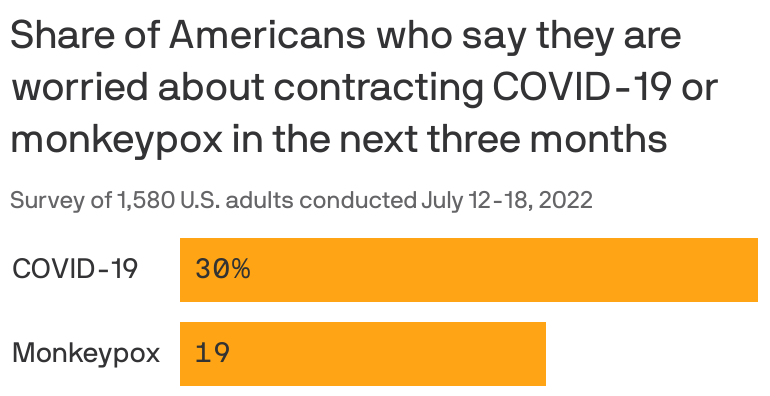
About 20% of Americans are afraid they’ll soon contract monkeypox, but there are still some significant holes in the public’s understanding of the virus, according to a new survey from the Annenberg Public Policy Center.
The big picture: These early stages of monkeypox outbreaks aren’t nearly as dangerous as early COVID outbreaks were, but some of the challenges for public health officials — like educating people about a virus they’re not familiar with, and mobilizing vaccination efforts — are similar.
By the numbers: One in five Americans are worried about getting monkeypox in the next three months, the Annenberg survey found.
Between the lines: Memories of false assurances and mixed messaging about the coronavirus in the early days of the pandemic are factoring into public sentiment on monkeypox, said Kathleen Hall Jamieson, director of the Annenberg center.
Misinformation and conspiracy theories are also a problem.
What we’re watching: Perceptions of risk remain fluid and could shift if monkeypox finds new modes of transmission, or if it continues to affect children.

Updated on Aug. 5 with comments from Sutter Health.
A $457 million net loss for the quarter ended June 30 has brought Sutter Health even deeper into the red for 2022, according to new financial filings.
The Sacramento-based nonprofit health system brought in $3.49 billion in total operating revenues from the quarter, down slightly from the prior year’s $3.51 billion.
At the same time, the system’s operating expenses grew from $3.41 billion in the second quarter of 2021 to $3.55 billion in the most recent quarter, driven by $30 million and $151 million year-over-year increases in salaries and purchased services, respectively. The latter includes the increased professional fees being felt by labor-strapped systems across the country.
These led the system to report a $51 million operating loss for the quarter as opposed to the $106 million operating gain from last year’s equivalent quarter.
“Poorly” performing financial markets also took a toll on Sutter’s numbers. The system’s quarterly investment income dipped from $251 million to $56 million from 2021 to 2022. A $495 million downward change in net unrealized gains and losses on its investments was also a stark reversal from the prior year’s $270 million increase.
The new numbers cement what was already looking to be a tricky year for Sutter Health, which had previously reported a $184 million net loss for its opening quarter.
Despite a 1.5% year-over-year operating revenue increase to $7.05 billion for the opening six months, a 1.7% year-over-year operating revenue bump places the system’s year-to-date income at $44 million (0.6% operating margin), slightly below last year’s $57 million (0.8% operating margin).
However, market struggles through both quarters and a $208 million loss tied to the disaffiliation of Samuel Merritt University now has Sutter sitting at a $641 million net loss for the opening half of 2022. The system was up $825 million at the same time last year.
“Sutter’s finances have stabilized, but our year-to-date numbers show we still have more affordability work ahead as we strive to best position Sutter Health to serve our patients and communities into the future,” the system wrote in an email statement. “We are grateful for our employees and clinicians who have worked diligently over the last several years to help bring our costs down—at the same time managing through the pandemic and continuing to provide high-quality, nationally recognized care.”
Sutter noted in the filing that it is or will be in labor negotiations with much of its unionized workforce, as 43% of its contract agreements have either expired or will be running their course within the year.
The filing also included notice of a handful of legal matters that have yet to be resolved. These include an antitrust verdict in favor of Sutter that is being appealed by the plaintiff, a lawsuit regarding an alleged privacy breach of two anonymous plaintiffs and two separate class-action complaints regarding employee retirement plan funding, among others.
“The organization continues to face financial headwinds like inflation and increased staffing costs, as evidenced by our near breakeven operating margin,” Sutter said in a statement. “Even still, we are encouraged that independent ratings agencies have recently acknowledged our efforts to date. In the second quarter, Moody’s, S&P and Fitch all affirmed the system’s existing ‘A’ category bond ratings.”
Much of Sutter’s pains are being felt across the industry. A recent Kaufman Hall industrywide report showed only marginal relief from expenses and middling non-COVID volume recovery through June, while a Fitch Ratings update on nonprofit hospitals warned that these challenges and broader inflation pressures will likely weigh down the sector through 2022.
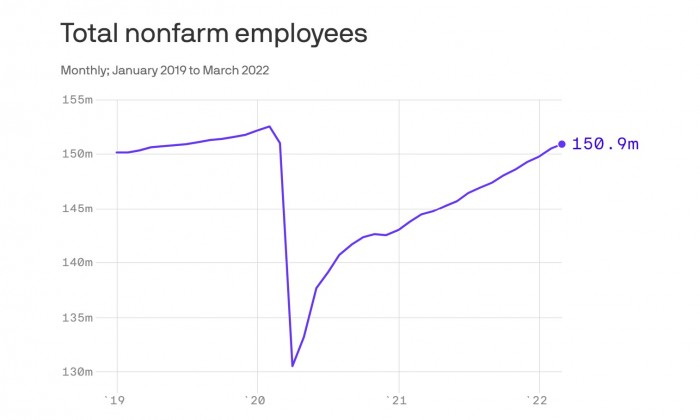
Employers added a stunning 528,000 jobs in July, while the unemployment rate ticked down to 3.5%, the lowest level in nearly 50 years, the Labor Department said on Friday.
Why it matters: It’s the fastest pace of jobs growth since February as the labor market continues to defy fears that the economy is heading into a recession.
The backdrop: The data comes at a delicate time for the U.S. economy. Growth has slowed as the Federal Reserve raises interest rates swiftly in an attempt to contain soaring inflation.


Hospitals are forced to absorb inflationary expenses, particularly related to supporting their workforce, AHA says.
The Centers for Medicare and Medicaid Services’ increase in the inpatient payment rate for 2023 is welcome but not enough to offset expenses, according to the American Hospital Association.
CMS set a 4.1% market basket update for 2023 in its final rule released Monday, calling it the highest in the last 25 years. The increase was due to the higher cost in compensation for hospital workers.
The final rule gave inpatient hospitals a 4.3% increase for 2023, as opposed to the 3.2% increase in April’s proposed rule.
WHY THIS MATTERS
CMS used more recent data to calculate the market basket and disproportionate share hospital payments, a move that better reflects inflation and labor and supply cost pressures on hospitals, the AHA said.
“That said, this update still falls short of what hospitals and health systems need to continue to overcome the many challenges that threaten their ability to care for patients and provide essential services for their communities,” said AHA Executive Vice President Stacey Hughes. “This includes the extraordinary inflationary expenses in the cost of caring hospitals are being forced to absorb, particularly related to supporting their workforce while experiencing severe staff shortages.”
The AHA would continue to urge Congress to take action to support the hospital field, including by extending the low-volume adjustment and Medicare-dependent hospital programs, Hughes said.
In late July, Senate and House members urged CMS to increase the inpatient hospital payment.
Premier, which works with hospitals, also said the 4.3% payment update falls short of reflecting the rising labor costs that hospitals have experienced since the onset of the pandemic.
“Coupled with record high inflation, this inadequate payment bump will only exacerbate the intense financial pressure on American hospitals,” said Soumi Saha, senior vice president of Government Affairs for Premier.
THE LARGER TREND
Recent studies show hospitals remain financially challenged since the COVID-19 pandemic’s effect on revenue and supply chain and labor expenses. Piled onto that has been inflation that has added to soaring expenses.
Hospital margins were up slightly from May to June, but are still significantly lower than pre-pandemic levels, according to a Flash Report from Kaufman Hall.
The effects of the pandemic on the healthcare industry have been profound, resulting in the creation of new business models, according to a report from McKinsey.
Transformational change is necessary as hospitals have been hit hard by eroding margins due to cost inflation and expenses, Fitch found.

