

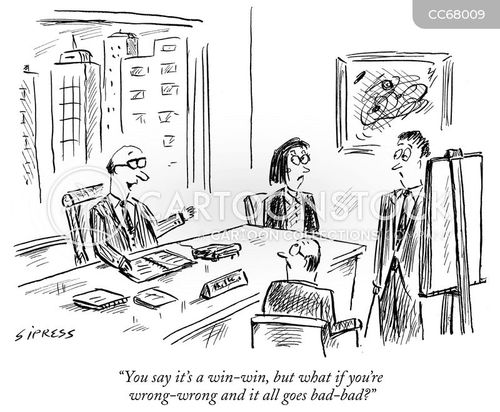
Cartoon – When a Win-Win goes Bad-Bad

https://mailchi.mp/d88637d819ee/the-weekly-gist-march-19-2021?e=d1e747d2d8

A new piece in the Atlantic sparked debate this week about the risk of ongoing COVID exposure to children as the country navigates toward the end of the pandemic. Brown University economist Emily Oster equated a child’s risk of serious illness from the coronavirus to that of their vaccinated grandmother. If grandma receives the Pfizer vaccine, her risk of serious illness is decreased by 95 percent. According to Oster, the condition of “being a child” aged 0-17 is 98 percent protective against hospitalization—so go ahead, plan that family summer vacation!
Oster cites no clinical or scientific experts in her piece, but some doctors were quick to respond that the comparisons are not equivalent (and also provide ready-made scripting for the “anti-vaxx” movement, which could claim that kids are already “basically vaccinated”).
But the article does bring up a real question that millions of families will soon face: what can we do when grandma and grandpa (and hopefully mom and dad) are vaccinated, but the kids are not? Given the pace of clinical trials, teens could be eligible for vaccination as soon as late summer, but COVID vaccines might not be approved for younger children until months later—and this generational vaccine divide will likely linger into 2022.
Undoubtedly children are at lower risk from COVID than adults, and likely transmit the disease less frequently (although much of the data supporting the latter comes from studies in schools, where social distancing and masking are enforced). And we’re not out of the woods yet: as COVID cases surge again in Michigan, schools there have seen a spike in outbreaks as well.
As families look at conflicting data and messages in the media, they need clear, coordinated guidance from state and federal officials to help them gauge safety as they navigate their second “pandemic summer”.
https://mailchi.mp/d88637d819ee/the-weekly-gist-march-19-2021?e=d1e747d2d8

It’s long been accepted as a truism that “moms” make most of a family’s healthcare choices. This has led many health systems to invest in high-end women’s services, especially labor and delivery facilities, with the hope of winning the entire family’s long-term healthcare loyalty.
This conventional wisdom has existed since the middle of the last century, when the postwar Baby Boom coincided with the rise of commercial insurance. But it’s hard to find real evidence that these investments deliver on their intent—and we think the argument deserves to be reexamined.
An expectant mother is likely years away from her family’s major healthcare spending events. Giving her a fantastic virtual care experience, or taking great care of her teenager who blows out a knee playing soccer, is likely to engender greater loyalty to the health system when she’s looking for her first mammogram, than her labor and delivery experience from a decade earlier. That’s not to say that top-notch obstetrics isn’t important—but market-leading labor and delivery facilities are likely more critical for wholesale purchasers, such as an employer considering a narrow network, or for physicians choosing where to build an OB practice.
Direct-to-consumer strategies should be built on more sophisticated consumer research that takes into account the preferences of a new generation of consumers, for whom not all healthcare choices are equal—that same consumer will be in different “segments” and make different choices for different problems over time, not all pre-determined by one memorable birthing experience.
https://mailchi.mp/d88637d819ee/the-weekly-gist-march-19-2021?e=d1e747d2d8

We had occasion this week, when asked to weigh in on a health system’s “primary care strategy”, to assert once again that primary care is not a thing.
We were being intentionally provocative to make a point: what we traditionally refer to as “primary care” is actually a collection of different services, or “jobs to be done” for a patient (to borrow a Clayton Christensen term).
These include a range of things: urgent care, chronic disease management, medication management, virtual care, women’s health services, pediatrics, routine maintenance, and on and on. What they have in common is that they’re a patient’s “first call”: the initial point of contact in the healthcare system for most things that most patients need. It’s a distinction with a difference, in our view.
If you set out to address “primary care strategy”, you’re going to end up in a discussion about physician manpower, practices, and economics at a level of generalization that often misses what patients really need. Rather than the traditional E pluribus unum (out of many, one) approach that many take, we’d advise an Ex uno plures (out of one, many) perspective.
Ask the question “What problems do patients have when they first contact the healthcare system?” and then strategize around and resource each of those problems in the way that best solves them. That doesn’t mean taking a completely fragmented approach—it’s essential to link each of those solutions together in a coherent ecosystem of care that helps with navigation and information flow (and reimbursement).
But continuing to perpetuate an entity called “primary care” increasingly seems like an antiquated endeavor, particularly as technology, payment, and consumer preferences all point to a more distributed and easily accessible model of care delivery.
https://mailchi.mp/d88637d819ee/the-weekly-gist-march-19-2021?e=d1e747d2d8

The American Rescue Plan stimulus package just sweetened the deal for the twelve holdout states that haven’t yet expanded Medicaid. In exchange for expanding eligibility to the roughly four million adults with incomes up to 133 percent of the federal poverty level, new expansion states will also be eligible for a five percent increase in the federal matching rate for their entire traditional Medicaid population for a two-year period.
The graphic above shows the cumulative fiscal impact for holdout states, should all Medicaid-eligible individuals enroll. Since the traditional Medicaid population is so much larger than the expansion population, the temporary increase more than offsets states’ cost to cover their share of the expansion, resulting in an estimated net fiscal benefit of almost $10B. While the net benefit would vary from state to state, a Kaiser Family Foundation analysis found the two most populous non-expansion states, Texas and Florida, could net up to $1.9B and $1.8B respectively across the two-year period.
Medicaid expansion has had a significant positive financial impact on hospitals, reducing uncompensated care and increasing overall operating margin by an average of 1.7 percent.
A recent analysis by the Center on Budget and Policy Priorities found uncompensated care costs as a share of hospital expenses fell an average of 45 percent in Medicaid expansion states between 2013 and 2017. So far, only two states eligible for the enhanced expansion, Alabama and Wyoming, have signaled interest in taking advantage of the new deal. Convincing the remaining ten to follow suit will require intense and coordinated advocacy efforts from the healthcare and business communities. Making the financial case for expansion should prove straightforward, compared to overcoming long-entrenched political opposition.
:max_bytes(150000):strip_icc()/GettyImages-477514725-c4271ad485734ba6b84cae22be7833cf.jpg)
Fourteen defendants have been sentenced to more than 74 years in prison combined and ordered to pay $82.9 million in restitution for their roles in a $200 million healthcare scheme designed to get physicians to steer patients to Forest Park Medical Center, a now-defunct hospital in Dallas, the U.S. Justice Department announced March 19.
More than 21 defendants were charged in a federal indictment in 2016 for their alleged involvement in a bribe and kickback scheme that involved paying surgeons, lawyers and others for referring patients to FPMC’s facilities. Those involved in the scheme paid and/or received $40 million in bribes and kickbacks for referring patients, and the fraud resulted in FPMC collecting $200 million.
Several of the defendants, including a founder and former administrator of FPMC, were convicted at trial in April 2019 and sentenced last week. Other defendants pleaded guilty before trial.
Hospital manager and founder Andrew Beauchamp pleaded guilty in 2018 to conspiracy to pay healthcare bribes and commercial bribery, then testified for the government during his co-conspirators’ trial. He admitted that the hospital “bought surgeries” and then “papered it up to make it look good.” He was sentenced March 19 to 63 months in prison.
Wilton “Mac” Burt, a founder and managing partner of the hospital, was found guilty of conspiracy, paying kickbacks, commercial bribery in violation of the Travel Act and money laundering. He was sentenced March 17 to 150 months in prison.
Four surgeons, a physician and a nurse were among the other defendants sentenced last week for their roles in the scheme. Access a list of the defendants and their sentences here.

