


Cartoon – Importance of Product Safety Testing


President Trump said at a Fox News town hall Tuesday that he would “love” to have the country “opened up, and just raring to go” by Easter, or April 12, despite warnings from public health officials that easing social distancing restrictions too soon could cause the number of coronavirus cases to skyrocket.
New York City Mayor Bill de Blasio told a news conference Tuesday he plans to release from Rikers Island some 300 nonviolent inmates who are over 70 years old as a measure against the novel coronavirus pandemic.
The USS Theodore Roosevelt reported three cases of sailors contracting COVID-19 Tuesday, Navy officials said at a briefing — marking the first U.S. sailors to test positive aboard a Navy ship while at sea.
A minor died from the novel coronavirus in Los Angeles County, California, the county’s health department said Tuesday, although it later said that “there may be an alternate explanation” for the death of a California teenager whose “early tests indicated a positive result for COVID-19.”
The trade groups representing hospitals, doctors and nurses called on the public today to stay at home to slow the spread of the new coronavirus.
Up to 5,000 students will be allowed to return to Liberty University’s campus this week, as the Lynchburg, Virginia, college bucks the national trend of school closures.
https://www.axios.com/new-york-battle-coronavirus-58626845-3b0f-4afb-89e7-12be2346396b.html
New York’s fight against the novel coronavirus is also the nation’s fight, as the state — and the city in particular — emerges with “astronomical numbers” of cases, to quote Gov. Andrew Cuomo.
Why it matters: The Empire State has 5% of the world’s COVID-19 cases and about 50% of the nation’s. Its success — or failure — in fighting the virus, safeguarding citizens and treating the afflicted will tell us a lot about what can succeed in the rest of the U.S.
It’s a national travel hub, so it could be the catalyst for outbreaks elsewhere.
Cuomo is trying to shut the state down and stop the spread.
A pivotal moment: Cuomo spoke passionately at a press conference Tuesday about the importance of devoting all resources to New York’s rapidly escalating caseload.
Later in the day, at a media briefing by the White House coronavirus task force, the White House advised people who had recently left New York City to self-quarantine for 14 days.
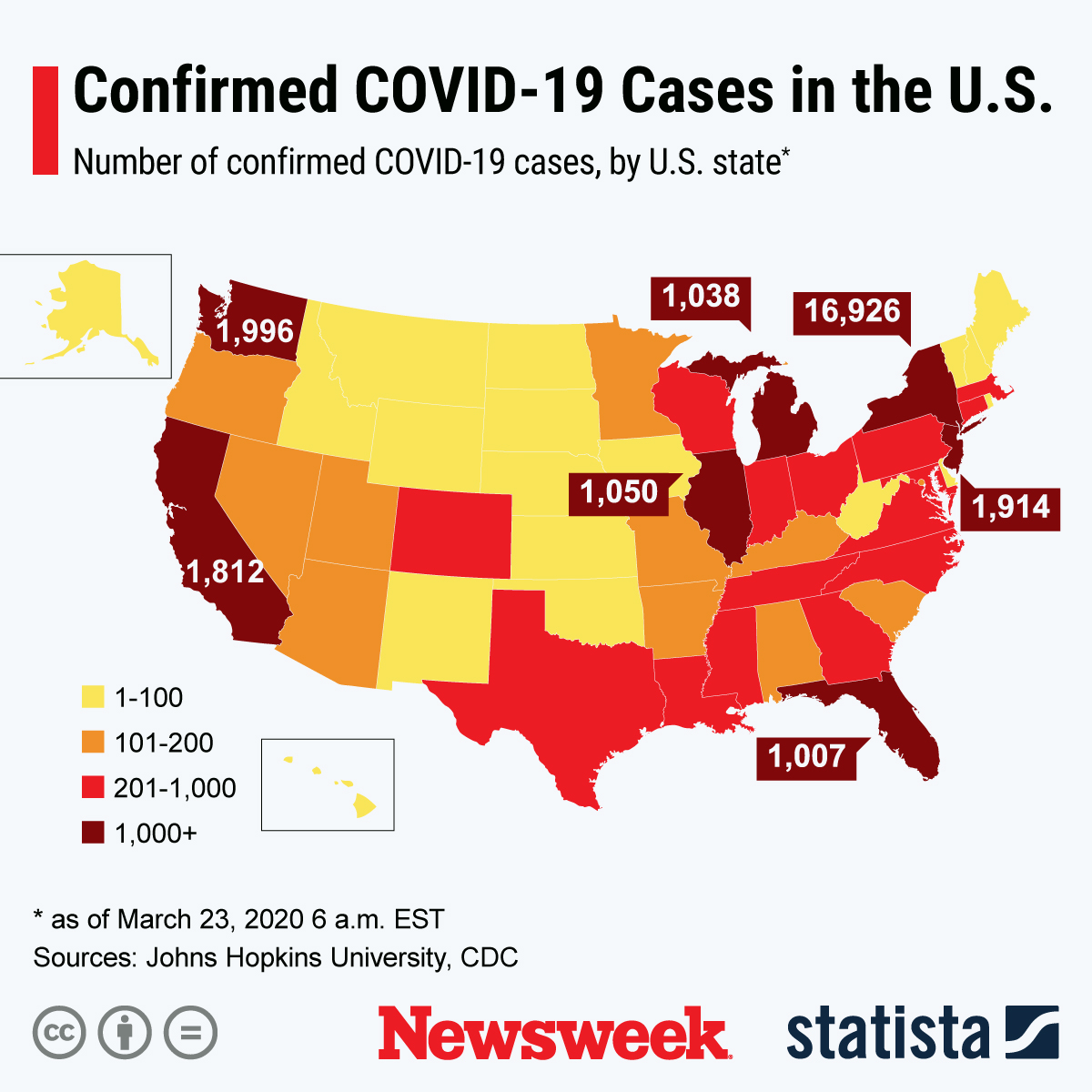
By the numbers: New York has 25,000 cases of the novel coronavirus, vs. 2,800 in California, 2,200 in Washington state and 1,200 in Florida, Cuomo said.
New York is throwing everything against the wall. Not only have residents been told to stay home whenever possible — and schools and most retail stores are closed — but the state is also trying experimental treatments and testing far more people for the virus than other places in the U.S.
“What happens in New York, we can expect to see in other cities around the world, but maybe not at the same scale,” Denis Nash, an epidemiologist at City University of New York’s school of public health, told Axios.
Be smart: Population density, which a New York Times headline called a “trait defining New York life,” is the reason the Big Apple has become the U.S. focal point.
As the densest city in the country, “New York is really a testing ground” for ways to fight the coronavirus, Tomas Hoyos, co-founder of Voro, an online social network where people share recommendations for doctors, told Axios.
My thought bubble: As a born-and-bred New Yorker who watched from my office window as the second plane hit the Twin Towers on 9/11, I find eerie similarities between the empty streets I see this week — and the constant wail of emergency sirens — and the days after the terror attacks.

If President Trump follows through on his statements that he wants to “open” the U.S. up again, an already patchwork shield of state “stay at home” orders could look like even more of a patchwork, Axios’ David Nather reports.
The big picture: Just 17 states have ordered people to stay at home, and most of those are states with Democratic governors. Only Ohio, Indiana, Massachusetts and West Virginia have Republican governors.
Between the lines: Some Republican governors, like Greg Abbott of Texas, have resisted calls to issue statewide stay-at-home orders, leaving it to cities and counties to issue their own restrictions.
The bottom line: The “mitigation strategy” of social distancing urged by health experts has been uneven throughout the U.S. — and it’s likely to get more uneven.
The U.S. keeps reacting too late to the novel coronavirus, prolonging its economic pain and multiplying its toll on Americans’ health.
Why it matters: The spread and impact of the coronavirus may be unfathomable, but it’s not unpredictable. And yet the U.S. has failed to respond accordingly over and over again.
First, it happened with testing — a delay that allowed the virus to spread undetected.
Between the lines: Proactive containment and mitigation steps would have required extraordinary political and economic capital, especially if they had come early in the process, when many Americans didn’t grasp the full weight of this challenge.
Now, even as testing and hospital capacity remain limited, President Trump is eager for an economic recovery — even though, by all estimates, the outbreak is only going to get worse.
The bottom line: When I asked one senior Health and Human Services official how all of this keeps happening, the official said it’s at least partially due to disconnects — between Trump and his administration; between the government and the private sector, and between the U.S. and the rest of the world.

The president is questioning whether stay-at-home orders have gone too far. But relaxing them could significantly increase the death toll from the coronavirus, health officials warn.
As the United States entered Week 2 of trying to contain the spread of the coronavirus by shuttering large swaths of the economy, President Trump, Wall Street executives and many conservative economists began questioning whether the government had gone too far and should instead lift restrictions that are already inflicting deep pain on workers and businesses.
Consensus continues to grow among government leaders and health officials that the best way to defeat the virus is to order nonessential businesses to close and residents to confine themselves at home. Britain, after initially resisting such measures, essentially locked down its economy on Monday, as did the governors of Virginia, Michigan and Oregon. More than 100 million Americans will soon be subject to stay-at-home orders.
Relaxing those restrictions could significantly increase the death toll from the virus, public health officials warn. Many economists say there is no positive trade-off — resuming normal activity prematurely would only strain hospitals and result in even more deaths, while exacerbating a recession that has most likely already arrived.
The economic shutdown is causing damage that is only beginning to appear in official data. Morgan Stanley researchers said on Monday that they now expected the economy to shrink by an annualized rate of 30 percent in the second quarter of this year, and the unemployment rate to jump to nearly 13 percent. Both would be records, in modern economic statistics.
Officials have said the federal government’s initial 15-day period for social distancing is vital to slowing the spread of the virus, which has already infected more than 40,000 people in the United States. But Mr. Trump and a chorus of conservative voices have begun to suggest that the shock to the economy could hurt the country more than deaths from the virus.
On Monday, Mr. Trump said his administration would reassess whether to keep the economy shuttered after the initial 15-day period ends next Monday, saying it could extend another week and that certain parts of the country could reopen sooner than others, depending on the extent of infections.
“Our country wasn’t built to be shut down,” Mr. Trump said during a briefing at the White House. “America will, again, and soon, be open for business. Very soon. A lot sooner than three or four months that somebody was suggesting. Lot sooner. We cannot let the cure be worse than the problem itself.”
Similar views are emanating from parts of corporate America, where companies are struggling with a shutdown that has emptied hotels, airplanes, malls and restaurants and sent the stock market tumbling so fast that automatic circuit breakers to halt trading have been tripped repeatedly. Stocks have collapsed about 34 percent since the coronavirus spread globally — the steepest plunge in decades — erasing three years of gains under Mr. Trump.
Lloyd Blankfein, the former chief executive of Goldman Sachs, wrote on Twitter that “crushing the economy” had downsides and suggested that “within a very few weeks let those with a lower risk to the disease return to work.”
Even Gov. Andrew M. Cuomo of New York, whose state has emerged as the epicenter of the outbreak in the United States, has begun publicly floating the notion that, at some point, states will need to restart economic activity and debating how that should unfold.
“You can’t stop the economy forever,” Mr. Cuomo said in a news conference on Monday. “So we have to start to think about does everyone stay out of work? Should young people go back to work sooner? Can we test for those who had the virus, resolved, and are now immune and can they start to go back to work?”
Any push to loosen the new limits on commerce and movement would contradict the consensus advice of public health officials, risking a surge in infections and deaths from the virus. Many economists warn that abruptly reopening the economy could backfire, overwhelming an already stressed health care system, sowing uncertainty among consumers, and ultimately dealing deeper, longer-lasting damage to growth.
The recent rise of cases in Hong Kong, after there had been an easing of the spread of the virus, is something of an object lesson about how ending strict measures too soon can have dangerous consequences. Yet places like China, which took the idea of lockdown to the extreme, have managed to flatten the curve.
“You can’t call off the best weapon we have, which is social isolation, even out of economic desperation, unless you’re willing to be responsible for a mountain of deaths,” said Arthur Caplan, a professor of bioethics at NYU Langone Medical Center. “Thirty days makes more sense than 15 days. Can’t we try to put people’s lives first for at least a month?”
For the last four days, some White House officials, including those working for Vice President Mike Pence, who leads the coronavirus task force, have been raising questions about when the government should start easing restrictions.
Among the options being discussed are narrowing restrictions on economic activity to target specific age groups or locations, as well as increasing the numbers of people who can be together in groups, said one official, who cautioned that the discussions were preliminary.
Health officials inside the administration have mostly opposed that idea, including Dr. Anthony S. Fauci, an infectious diseases expert and a member of the White House coronavirus task force, who has said in interviews that he believes it will be “at least” several more weeks until people can start going about their lives in a more normal fashion.
Dr. Deborah L. Birx, the White House coronavirus response coordinator, said the United States had learned from other countries like China and South Korea, which were able to control the spread of the virus through strict measures and widespread testing.
“Those were eight- to 10-week curves,” she said on Monday, adding that “each state and each hot spot in the United States is going to be its own curve because the seeds came in at different times.”
Dr. Birx added that the response “has to be very tailored geographically and it may have to be tailored by age group, really understanding who’s at the greatest risk and understanding how to protect them.”
Other advisers, including members of Mr. Trump’s economic team, have said repeatedly in recent months that the virus does not itself pose an extraordinary threat to Americans’ lives or the economy, likening it to a common flu season. Some advisers believe the White House overreacted to criticism of Mr. Trump’s muted actions to deal with the emerging pandemic and gave health experts too large a sway in policymaking.
On Monday, Mr. Trump echoed those concerns, saying that things like the flu or car accidents posed as much of a threat to Americans as the coronavirus and that the response to those was far less draconian.
“We have a very active flu season, more active than most. It’s looking like it’s heading to 50,000 or more deaths,” he said, adding: “That’s a lot. And you look at automobile accidents, which are far greater than any numbers we’re talking about. That doesn’t mean we’re going to tell everybody no more driving of cars. So we have to do things to get our country open.”
Mr. Trump has watched as a record economic expansion and booming stock market that served as the basis of his re-election campaign evaporated in a matter of weeks. The president became engaged with the discussion on Sunday evening, after watching television reports and hearing from various business officials and outside advisers who were agitating for an end to the shutdown.
Casey Mulligan, a University of Chicago professor who served as chief economist for Mr. Trump’s Council of Economic Advisers, said on Monday that efforts to shut down economic activity to slow the virus would be more damaging than doing nothing at all. He suggested a middle ground, one that weighs the costs and benefits of saving additional lives.
“It’s a little bit like, when you discover sex can be dangerous, you don’t come out and say, there should be no more sex,” Mr. Mulligan said. “You should give people guidance on how to have sex less dangerously.”
Many other economists say the restrictions in activity now are helping the economy in the long run, by beginning to suppress the infection rate.
“The idea that there’s a trade-off between health and economics right now is likely badly mistaken,” said Jason Furman of Harvard University, a former chairman of the Council of Economic Advisers under President Barack Obama. “The thing damaging our economy is a virus. Everyone who is trying to stop that virus is working to limit the damage it does to our economy and help our eventual rebound. The choice may well be taking pretty extreme steps now or taking very extreme steps later.”
Mr. Furman and other economists have pushed Mr. Trump and Congress to ease the economic pain by offering trillions of dollars in government assistance to affected workers and businesses. As lawmakers tried to negotiate an agreement on such a bill Monday, an influential business lobbying group, the U.S. Chamber of Commerce, said it supported restrictions on the economy to slow the virus.
“Our view is, when it comes to how you contain the virus, you do everything the public health professionals say to contain the virus,” said Neil Bradley, the chamber’s executive vice president and chief policy officer.
The president’s suggestion that the response may be an overreaction plays into doubts already held by some Americans suffering the economic consequences. Among the self-quarantined, some have questioned the purpose of isolating themselves if the virus is already circulating widely. Students sent home from college have wondered whether they are more likely to infect higher-risk older adults at home.
Dan Patrick, Texas’ lieutenant governor, said Monday on Fox News that he was in the “high-risk pool” but would be willing to risk his life to preserve the country for his children and grandchildren.
“We are going to be in a total collapse, recession, depression, collapse in our society,” said Mr. Patrick, who turns 70 next week. “If this goes on another several months, there won’t be any jobs to come back to for many people.”
But public health officials stress that there would be consequences to ending the measures too quickly. In a tweet on Monday morning, Thomas P. Bossert, the former homeland security adviser who for weeks has been vocal about the need for the U.S. government to take stricter measures, said: “Sadly, the numbers now suggest the U.S. is poised to take the lead in #coronavirus cases. It’s reasonable to plan for the US to top the list of countries with the most cases in approximately 1 week. This does NOT make social intervention futile. It makes it imperative!”
Mr. Trump’s interest in potentially easing some of the restrictions met with pushback from one of his close allies, Senator Lindsey Graham, Republican of South Carolina, who himself self-quarantined after a potential exposure. “President Trump’s best decision was stopping travel from China early on,” Mr. Graham tweeted on Monday. “I hope we will not undercut that decision by suggesting we back off aggressive containment policies within the United States.”
Health officials remain largely united in defense of sustaining the restrictions.
“There is a way to think through how and when to start reopening our economy and society, and it’s important to get this right,” said Dr. Thomas R. Frieden, a former director of the Centers for Disease Control and Prevention.
Dr. Tom Inglesby, the director of the Center for Health Security at the Johns Hopkins Bloomberg School of Public Health, pointed to the experience of countries like Italy, which did not institute aggressive measures to stop the spread of the virus and saw infection rates and deaths soar as a result.
The United States will need “a couple weeks” to see positive effects from its measures, Dr. Inglesby said, and abandoning them would mean “patients will get sick in extraordinary numbers all over the country, far beyond what the U.S. health care system will bear.”

