10 Health Care Trends To Watch In 2020

https://blog.providence.org/news/10-health-care-trends-to-watch-in-2020?_ga=2.242868994.1447754200.1576610293-1113187070.1573499391

Image result for 10 Health Care Trends To Watch In 2020

With 2020 shaping up to be another big year for health care, executives at Providence, one of the largest health systems in the country, today released their annual New Year’s predictions.

External forces will continue to bear down on health care, Providence leaders said. Politics, technology, social issues, labor shortages and heightened consumer expectations will all play a role. As a result, providers will feel more intense pressure to accelerate the transformation of health care.

“The question is whether providers can pivot fast enough,” said Rod Hochman, M.D., president and CEO of Providence. “In 2020, health systems that can get ahead of the major trends will be best positioned to meet the future needs of their communities.”

What can you expect next year? Here are Providence’s top 10 predictions.

  1. The value of health system consolidation will come to fruition in the form of large scale improvements in clinical quality and outcomes.

One of the most important reasons health systems have consolidated in recent years is to improve clinical quality and spread best practice across scale. Because clinical integration takes time, this will be the year that significant results begin coming to fruition. For example, Providence has leveraged its seven-state system to reverse the alarming national rise in U.S. mothers dying in childbirth. Thanks to collaboration among its clinical teams, Providence is one of the safest places for moms to give birth, having nearly eliminated preventable maternal deaths over the last three years. At the same time, Providence has reduced the cost of caring for moms covered by Medicaid, as well as the cost of NICU care. Expect more examples of improved outcomes and costs to emerge in 2020 as proven practices in other clinical areas begin bearing fruit on a large scale.

  1. Corporate social responsibility will take on a bigger role in tackling homelessness, suicide, the opioid crisis and other social issues that affect health.  

More companies will partner with health systems, government agencies, social services and other nonprofits to take action on the social determinants of health. Be Well OC is one example of the type of coalition that will make a significant impact in 2020. The public-private partnership in Orange County, Calif., brings diverse organizations together to meet the urgent need for mental health and addiction services in the community. Meanwhile, in cities like Seattle, Wash., health systems like Providence are partnering with the business community and other not-for-profits to address the growing homelessness epidemic.

  1. Personalized medicine and population health, two seemingly opposite approaches to health care, will begin working hand in hand to improve outcomes in the U.S.

The path to a healthier nation will be accelerated by treating both the unique needs of the individual down to the DNA level, as well as common issues shared by people in similar demographics. Health systems like Providence, for example, are using genomics to pinpoint a person’s biologic age, as well as tailor medical interventions to the individual. At the same time, Providence is coordinating care and resources across broad segments of people through steps such as cancer screenings and improving access to housing and nutrition. Combining the power of these two disciplines will help catapult the health of the nation.

  1. Health systems will prioritize digital access to care, convenience and personalization to compete with disruptors and collaborate with big tech.

Delivering same-day access to care – how, when and where people want it – will be a burning priority for health systems in 2020. New entrants will continue to disrupt the space and raise consumer expectations. Leading health systems like Providence will stay ahead of the curve with digital platforms that integrate telehealth, its in-store clinics at Walgreens and its vast network of specialty, primary care and urgent care clinics across the Western U.S. To help patients navigate these care options, Providence will also continue to develop its artificial intelligence capability, making its AI bot, “Grace,” more pervasive, helpful and capable. Providence will also continue to engage patients between episodes of care by providing personalized content and services to keep them healthy while developing a long-term, digitally engaged relationship with patients.

  1. As more health systems partner with tech companies to bring health care into the digital age, patients will count on providers to serve as the guardians of their personal health information. 

Machine learning and artificial intelligence will raise the potential for new breakthroughs in medicine and care delivery, and data will be key to this level of innovation. But whether tech companies are prioritizing the best interest of patients will remain a lingering question for the American public. Patients will look to providers to be their voice and advocates when it comes to protecting their health information. Expect providers to stand up for data privacy and security and take the lead in ensuring data is used responsibly for the common good.

  1. The race to bring voice-activated technology to health care will heat up and will be a central feature in the hospital and clinic of the future.

Just as Alexa and Siri are transforming the way we live our personal lives, voice and natural language processing are the future of health care. Expect innovation to accelerate around smart clinics and hospitals that make it easier for clinicians to treat and care for patients.  Voice commands that process and analyze information will support clinical decision making at the bedside and the exam room. As part of a new partnership between Providence and Microsoft to build the “care site of the future,” clinical communications and voice-activated technology will be a central feature.

  1. Simplifying the electronic medical record will become a rallying cry for clinicians.

With burnout on the rise among physicians, nurses and other caregivers, reducing the time it takes to chart in the electronic medical record will be key to improving the work environment for clinicians. Shifting the national conversation from EMR “interoperability” to “usability” will take on greater urgency. A simplified, more intuitive EMR means clinicians can spend less time on the computer and more time focused directly on patients, creating a better experience for clinicians and the patients they serve.

  1. The health care workforce will continue to evolve and adopt new skill sets. At the same time, talent shortages will become more pronounced.

As the sector changes at a rapid pace, the health care workforce will need to add new skill sets to keep up with innovations in medicine and care delivery. Clinicians will also need to become more proficient in managing the social determinants of health and caring for the whole person, not just physically, but also mentally and emotionally. Health systems will seek to stay competitive in a tough labor market by offering attractive pay and benefit packages. A commitment to investing in education and career development, as well as creating engaging work environments, will also be a key focus for retaining and recruiting top talent.

  1. Price transparency will remain a hot issue. But the focus needs to shift to giving patients the information they want most: what their out-of-pocket costs will be.   

Patients deserve to know what their health care costs will be up front, so they can make informed decisions as they shop for care. Rather than inundating them with a deluge of prices and negotiated rates for hundreds of services that may or may not be relevant to their personal situation, more emphasis needs to be placed on helping them understand what their specific out-of-pocket costs will be. The amount individuals pay is typically based on their insurance coverage. That’s why health systems like Providence are actively developing price estimator tools and self-service portals, based on blockchain and AI technology, to help patients more quickly and easily access this information.

  1. New alternatives to “Medicare for All” will emerge in the presidential debates. One viable option that should be taken seriously: free primary care for every American.

In the 2020 elections, concerns will be raised over whether Americans will lose their private commercial or employer-sponsored insurance under a Medicare for All plan. A new campaign platform — free primary care for all — should be considered as a more effective, affordable alternative. By guaranteeing access to primary care, the nation can focus on prevention, chronic disease management and helping Americans live their healthiest life possible. Providence is participating in the current administration’s innovative primary care pilots, which are showing positive results in terms of better outcomes and reduced costs.
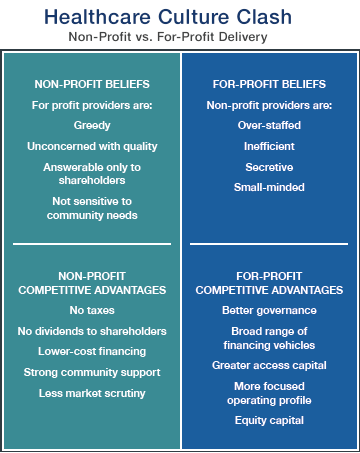


Top 5 Differences Between NFPs and For-Profit Hospitals

https://www.healthleadersmedia.com/finance/top-5-differences-between-nfps-and-profit-hospitals

Image result for Non-Profit and For-Profit Hospitals

Although nonprofit and for-profit hospitals are fundamentally similar, there are significant cultural and operational differences, such as strategic approaches to scale and operational discipline.

All hospitals serve patients, employ physicians and nurses, and operate in tightly regulated frameworks for clinical services. For-profit hospitals add a unique element to the mix: generating return for investors.

This additional ingredient gives the organizational culture at for-profits a subtly but significantly different flavor than the atmosphere at their nonprofit counterparts, says Yvette Doran, chief operating officer at Saint Thomas Medical Partners in Nashville, TN.

“When I think of the differences, culture is at the top of my list. The culture at for-profits is business-driven. The culture at nonprofits is service-driven,” she says.

Doran says the differences between for-profits and nonprofits reflect cultural nuances rather than cultural divides. “Good hospitals need both. Without the business aspects on one hand, and the service aspects on the other, you can’t function well.”

There are five primary differences between for-profit and nonprofit hospitals.

1. Tax Status

The most obvious difference between nonprofit and for-profit hospitals is tax status, and it has a major impact financially on hospitals and the communities they serve.

Hospital payment of local and state taxes is a significant benefit for municipal and state governments, says Gary D. Willis, CPA, a former for-profit health system CFO who currently serves as CFO at Amedisys Inc., a home health, hospice, and personal care company in Baton Rouge, LA. The taxes that for-profit hospitals pay support “local schools, development of roads, recruitment of business and industry, and other needed services,” he says.

The financial burden of paying taxes influences corporate culture—emphasizing cost consciousness and operational discipline, says Andrew Slusser, senior vice president at Brentwood, TN-based RCCH Healthcare Partners.

“For-profit hospitals generally have to be more cost-efficient because of the financial hurdles they have to clear: sales taxes, property taxes, all the taxes nonprofits don’t have to worry about,” he says.

“One of the initiatives we’ve had success with—in both new and existing hospitals—is to conduct an Operations Assessment Team survey. It’s in essence a deep dive into all operational costs to see where efficiencies may have been missed before. We often discover we’re able to eliminate duplicative costs, stop doing work that’s no longer adding value, or in some cases actually do more with less,” Slusser says.

2. Operational Discipline

With positive financial performance among the primary goals of shareholders and the top executive leadership, operational discipline is one of the distinguishing characteristics of for-profit hospitals, says Neville Zar, senior vice president of revenue operations at Boston-based Steward Health Care System, a for-profit that includes 3,500 physicians and 18 hospital campuses in four states.

At Steward, we believe we’ve done a good job establishing operational discipline. It means accountability. It means predictability. It means responsibility. It’s like hygiene. You wake up, brush your teeth, and this is part of what you do every day.”

A revenue-cycle dashboard report is circulated at Steward every Monday morning at 7 a.m., including point-of-service cash collections, patient coverage eligibility for government programs such as Medicaid, and productivity metrics, he says. “There’s predictability with that.”

A high level of accountability fuels operational discipline at Steward and other for-profits, Zar says.

There is no ignoring the financial numbers at Steward, which installed wide-screen TVs in most business offices four years ago to post financial performance information in real-time. “There are updates every 15 minutes. You can’t hide in your cube,” he says. “There was a 15% to 20% improvement in efficiency after those TVs went up.”

3. Financial Pressure

Accountability for financial performance flows from the top of for-profit health systems and hospitals, says Dick Escue, senior vice president and chief information officer at the Hawaii Medical Service Association in Honolulu.

Escue worked for many years at a rehabilitation services organization that for-profit Kindred Healthcare of Louisville, Kentucky, acquired in 2011. “We were a publicly traded company. At a high level, quarterly, our CEO and CFO were going to New York to report to analysts. You never want to go there and disappoint. … You’re not going to keep your job as the CEO or CFO of a publicly traded company if you produce results that disappoint.”

Finance team members at for-profits must be willing to push themselves to meet performance goals, Zar says.

“Steward is a very driven organization. It’s not 9-to-5 hours. Everybody in healthcare works hard, but we work really hard. We’re driven by each quarter, by each month. People will work the weekend at the end of the month or the end of the quarter to put in the extra hours to make sure we meet our targets. There’s a lot of focus on the financial results, from the senior executives to the worker bees. We’re not ashamed of it.”

“Cash blitzes” are one method Steward’s revenue cycle team uses to boost revenue when financial performance slips, he says. Based on information gathered during team meetings at the hospital level, the revenue cycle staff focuses a cash blitz on efforts that have a high likelihood of generating cash collections, including tackling high-balance accounts and addressing payment delays linked to claims processing such as clinical documentation queries from payers.

For-profit hospitals routinely utilize monetary incentives in the compensation packages of the C-Suite leadership, says Brian B. Sanderson, managing principal of healthcare services at Oak Brook, IL–based Crowe Horwath LLP.

“The compensation structures in the for-profits tend to be much more incentive-based than compensation at not-for-profits,” he says. “Senior executive compensation is tied to similar elements as found in other for-profit environments, including stock price and margin on operations.”

In contrast to offering generous incentives that reward robust financial performance, for-profits do not hesitate to cut costs in lean times, Escue says.

“The rigor around spending, whether it’s capital spending, operating spending, or payroll, is more intense at for-profits. The things that got cut when I worked in the back office of a for-profit were overhead. There was constant pressure to reduce overhead,” he says. “Contractors and consultants are let go, at least temporarily. Hiring is frozen, with budgeted openings going unfilled. Any other budgeted, but not committed, spending is frozen.”

4. Scale

The for-profit hospital sector is highly concentrated.

There are 4,862 community hospitals in the country, according to the American Hospital Association. Nongovernmental not-for-profit hospitals account for the largest number of facilities at 2,845. There are 1,034 for-profit hospitals, and 983 state and local government hospitals.

In 2016, the country’s for-profit hospital trade association, the Washington, DC–based Federation of American Hospitals, represented a dozen health systems that owned about 635 hospitals. Four of the FAH health systems accounted for about 520 hospitals: Franklin, TN-based Community Hospital Systems (CHS); Nashville-based Hospital Corporation of America; Brentwood, TN–based LifePoint Health; and Dallas-based Tenet Healthcare Corporation.

Scale generates several operational benefits at for-profit hospitals.

“Scale is critically important,” says Julie Soekoro, CFO at Grandview Medical Center, a CHS-owned, 372-bed hospital in Birmingham, Alabama. “What we benefit from at Grandview is access to resources and expertise. I really don’t use consultants at Grandview because we have corporate expertise for challenges like ICD-10 coding. That is a tremendous benefit.”

Grandview also benefits from the best practices that have been shared and standardized across the 146 CHS hospitals. “Best practices can have a direct impact on value,” Soekoro says. “The infrastructure is there. For-profits are well-positioned for the consolidated healthcare market of the future… You can add a lot of individual hospitals without having to add expertise at the corporate office.”

The High Reliability and Safety program at CHS is an example of how standardizing best practices across the health system’s hospitals has generated significant performance gains, she says.

“A few years ago, CHS embarked on a journey to institute a culture of high reliability at the hospitals. The hospitals and affiliated organizations have worked to establish safety as a ‘core value.’ At Grandview, we have hard-wired a number of initiatives, including daily safety huddles and multiple evidence-based, best-practice error prevention methods.”

Scale also plays a crucial role in one of the most significant advantages of for-profit hospitals relative to their nonprofit counterparts: access to capital.

Ready access to capital gives for-profits the ability to move faster than their nonprofit counterparts, Sanderson says. “They’re finding that their access to capital is a linchpin for them. … When a for-profit has better access to capital, it can make decisions rapidly and make investments rapidly. Many not-for-profits don’t have that luxury.”

5. Competitive Edge

There are valuable lessons for nonprofits to draw from the for-profit business model as the healthcare industry shifts from volume to value.

When healthcare providers negotiate managed care contracts, for-profits have a bargaining advantage over nonprofits, Doran says. “In managed care contracts, for profits look for leverage and nonprofits look for partnership opportunities. The appetite for aggressive negotiations is much more palatable among for-profits.”