The Do’s and Don’ts of Navigating the Health System when you Need It: My First-Hand Experience

I fell down a flight of stairs at 4 a.m. last Wednesday.

It was totally my fault.

Since then, I have used hospital emergency departments in 2 states, a freestanding imaging center and a large orthopedic clinic and I’m just getting started. Six days in, I’m lucky to be alive but I still don’t know the extent of my injuries, my chances of playing golf again nor what I will end up spending on this ordeal. But nonetheless, it could have been worse. I’m alive.

Surprises in all aspects of life are never anticipated fully and always disruptive. This one, for me, is no exception. I am frustrated by my accident and uncomfortable with sudden dependence on others to help navigate my recovery.

But this is also a teachable moment., As I am navigating through this ordeal, I find myself reflecting on the system—how it works or doesn’t—based on what I am experiencing as a patient.

Here’s my top three observations thus far:

The patient experience is defined by the support team:

The heroes in every setting I’ve used are the clerks, technicians, nurses and support staff who’ve made the experiences tolerable and/or reassuring. Patients like me are scared. Emotional support is key: some of that is defined by standard operating procedures and checklists but, in other settings, it’s cultural. Genuineness, empathy and personal attention is easy to gauge when pain is a factor. By the time physicians are on the scene, reassurance or fear is already in play. Care teams include not just those who provide hands-on care, but the administrative clerks and processes that either heighten patient anxiety or lessen fear. The health and well-being of the entire workforce—not just those who deliver hands-on care—matters. And it’s easy to see distinctions between organizations that embrace that notion and those that don’t.

Navigation is no-man’s land:

The provider organizations I’ve used thus far have 3 different owners and 3 different EHR systems. Each offers written counsel about ‘patient responsibility’ and each provides a list of do’s and don’ts for each phase of the process. Sharing test results across the 3 provider organizations is near impossible and coordination of care management is problematic unless all parties agree and protocols facilitating sharing in place.  Perhaps because it was a holiday weekend, perhaps because staffing levels were less than usual, or perhaps because the organizations are fierce competitors, navigating the system has been unusually difficult. Navigating the system in an emergency is essential to optimal outcomes: processes to facilitate patient navigation are not in place.

What’s clear is hospitals, clinics and imaging facilities on different EHR systems don’t exchange data willingly or proactively. And, at every step, getting approvals from insurers a major step in the processes of care.

Price transparency is a non-issue in emergency care: 

The services I am receiving include some that are “shoppable” and many that aren’t. I have no idea what I will end up spending, my out-of-pocket obligations nor what’s to come. I know among the mandatory forms I signed in advance of treatment in all 3 sites were consent forms for treatment and my obligation for payment. But in an emergency, it’s moot: there’s no way to know what my costs will be or my out-of-pocket responsibility. So, the hospital and insurer price transparency rules (2021, 2022) might elevate awareness of price distinctions across settings of care but their potential to bend the cost curve is still suspect.

Patients, like me, have to fend for ourselves. I am a number. Last Wednesday, waiting 85 minutes to be seen was frightening and frustrating though comparatively fast. Duplicative testing, insurer approvals, work-shift transitions, bedside manners, team morale, and sterile care settings seem the norm more than exception.

So, for me, the practical takeaways thus far are these:

  • Don’t have an accident on a holiday weekend.
  • Don’t expect front desk and check-out personnel to engage or answer questions. They’re busy.
  • Don’t expect to start or leave without paying something or agreeing you will.
  • Don’t expect waiting areas and exam rooms to be warm or inviting.
  • Do have great neighbors and family members who can help. For me, Joe, Jordan, Erin and Rhonda have been there.

The health system is complicated and relationships between its major players are tense. Not surprisingly and for many legitimate reasons, my experience, thus far, is the norm. We can do better.

Paul

P.S. As I have reflected on the event last week, I found myself recalling the numerous times I called on “my doctors” to help my navigation of the system. They include Charles Hawes (deceased), Ben Womack, Ben Heavrin, David Maron, David Schoenfeld and Blake Garside. And, in the same context, the huge respect I have for clinicians I’ve known through Vanderbilt and Ohio State like Steve Gabbe and Andy Spickard who personify the best the medical profession has to offer. Thanks gentlemen. What you do matters beyond diagnoses and treatments.  Who you are speaks volumes about the heart and soul of this industry now struggling to re-discover its purpose.

Epic expanding its lead on EHR competitors

https://mailchi.mp/b7baaa789e52/the-weekly-gist-september-29-2023?e=d1e747d2d8

Two large nonprofit health systems made headlines earlier this month announcing that they plan to transition, enterprise-wide, from Oracle Cerner to Epic for their electronic health record (EHR) system.

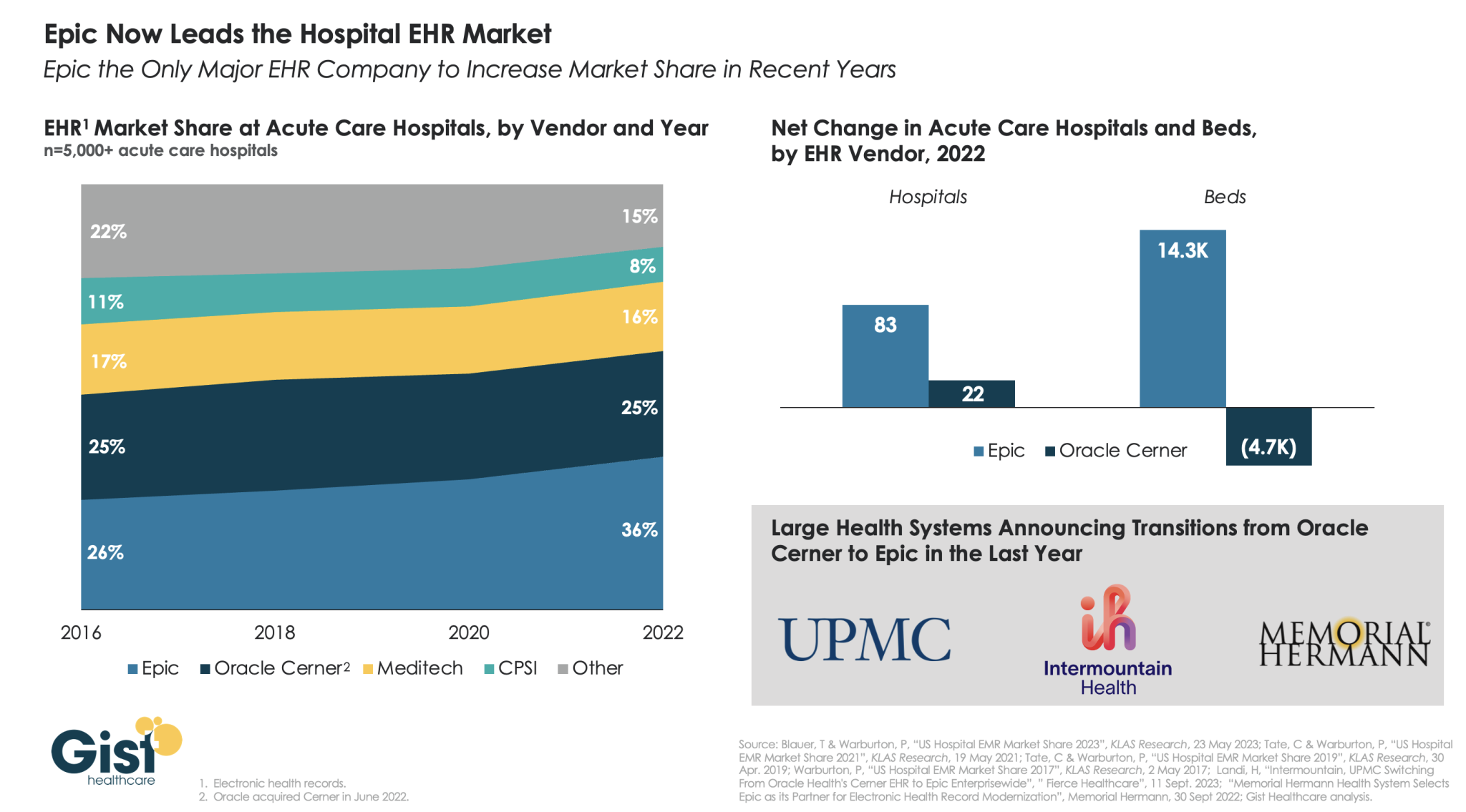
Using data from KLAS Research, the graphic below shows how Epic has emerged in recent years as the leader in the hospital EHR market. From 2016 to 2022, Epic increased its acute care hospital market share from 26 percent to 36 percent, while its main rival, Oracle Cerner, held flat at 25 percent.

Moreover, Epic is gaining popularity among larger health systems, while Oracle Cerner lost almost 5K beds in 2022, despite gaining 22 hospitals, as it trades large systems for smaller hospitals. 

Epic’s ability to consolidate multiple archives into a single, more functional platform has made it popular with physicians, whose feedback was cited by Intermountain as a key reason behind the system’s decision to switch. 

With three quarters of Americans having an Epic record, the company is leveraging its pole position in aggregating healthcare data as healthcare approaches the cusp of a generative AI boom, recently announcing an expanded partnership with Microsoft focused on integrating AI tools into its EHR system. 

A health system’s guide to reducing bureaucratic clinician busywork

https://mailchi.mp/b7baaa789e52/the-weekly-gist-september-29-2023?e=d1e747d2d8

Published this week in the Harvard Business Review, this intriguing case study tells the story of how Hawaii Pacific Health, a four-hospital system based in Honolulu, worked with its providers to reduce the deluge of needless or low-value administrative tasks required each day by the system’s electronic health record (EHR) platform.

The system’s “Get Rid of Stupid Stuff” (GROSS) initiative created a simple, accessible submission form that allowed providers to flag EHR prompts and workflows ranging from inefficient (printing and scanning discharge papers patients had already signed electronically) to nonsensical (affirming adolescent patients had received proper care for their non-existent umbilical cords). Around 10 percent of suggestions submitted were for prompts that could be immediately eliminated, 15 percent caught gaps in communication and workflow, and the remaining 75 percent identified more complex opportunities for redesign. The GROSS initiative not only freed thousands of labor hours, but also boosted morale by engaging clinicians in the system’s efforts to improve operations. 

The Gist: While Hawaii Pacific Health is far from the only system to have successfully engaged its providers in the mission of reducing administrative busywork, this case study provides an example of how sometimes the simplest approaches can be the most effective. 

As systems now look to generative AI as the next frontier of bureaucratic efficiency, they will need to optimize workflow processes before automating them in order to avoid ingraining today’s inefficiencies.

Intermountain and UPMC switching from Oracle Cerner to Epic

https://mailchi.mp/e1b9f9c249d0/the-weekly-gist-september-15-2023?e=d1e747d2d8

Two of the nation’s largest nonprofit health systems, Salt Lake City, UT-based Intermountain Healthcare and Pittsburgh, PA-based UPMC, have recently announced plans to end their electronic health record (EHR) contracts with Oracle Cerner and transition, enterprise-wide, to Epic.

Intermountain, which operates 33 hospitals across seven states, plans to integrate Epic’s EHR into all of its facilities by 2025; its legacy SCL Health hospitals in Colorado and Montana already use Epic.

UPMC, which operates 40 hospitals in three states, has set mid-2026 as the target for consolidating its nine EHRs into a single platform with Epic. It has been using Oracle Cerner in inpatient settings and Epic for ambulatory care.

Both systems cited provider feedback and a desire to simplify patient record-keeping as key reasons behind their decisions to switch. 

The Gist: With two more marquee health systems jumping ship for Epic, Oracle Cerner faces a steeper battle to maintain a foothold with health systems and may need to rethink its target market and value proposition. 

Cerner initially appealed to large, progressive, value-oriented systems with highly customizable offerings, but over the years the resulting “Franken-Cerner” systems (as one CIO put it) became hard to maintain and scale. 

Meanwhile, Epic continues to grow its lead in the domestic EHR market: it now covers roughly half of acute-care beds in the US and holds records on 78 percent of US patients. 

Sitting on troves of health data, Epic is also well-positioned to become a leader in the rollout of next-generation healthcare AI, which it has already set in motion through its partnership with Microsoft.

Epic, Microsoft expand generative artificial intelligence (AI) partnership

https://mailchi.mp/d29febe6ab3c/the-weekly-gist-august-25-2023?e=d1e747d2d8

On Tuesday, Verona, WI-based Epic and Redmond, WA-based Microsoft announced a suite of new AI-powered solutions available to users of Epic’s electronic health records (EHR) system.

In April 2023, Epic began integrating Microsoft’s Azure OpenAI Service, which utilizes GPT-4 capabilities, into its EHR. This next phase builds on that collaboration, introducing tools that support ambient notetaking, create clinical documentation summaries, and offer medical coding suggestions, all through generative AI. Epic is rolling out these services as it debuts its revamped third-party app market, which now hosts programs developed by Microsoft-owned Nuance as well as smaller startups. 

The Gist: Given the massive datasets required to train these AI programs, the competition to deploy AI-powered healthcare workforce at scale will likely be driven by the largest tech and healthcare data companies rather than smaller start-ups. 

Epic’s new app marketplace for third-party vendors is meant to ensure just that, by positioning it as the primary hub for many healthcare-specific AI programs in development. 

Health systems will race to take advantage of the cost savings unlocked by these technologies, which they will hope integrate seamlessly into their EHRs. 

As physicians stand to benefit from eased administrative burdens, but also have justified concerns over generative AI’s reliability, health systems should keep an open dialogue with frontline providers as they implement these new tools.   

Top 6 EHRs for large hospitals, per Black Book Research

Epic was named the top EHR for acute care hospitals with 251 beds or more by Black Book Research.

The research group based its results on surveys of 18 performance indicators conducted between the second quarter of 2022 and the third quarter of 2023.

Here are the top six EHRs for large hospitals, according to the report:

1. Epic

2. Oracle Cerner

3. Altera Digital Health (Sunrise)

4. GE HealthCare

5. Altera Digital Health (Paragon)

6. Meditech

Is AI suffering from the “cost disease” it’s supposed to cure? 

https://mailchi.mp/edda78bd2a5a/the-weekly-gist-june-23-2023?e=d1e747d2d8

An in-depth piece co-published this week in New York Magazine chronicles the Kafkaesque working environment of artificial intelligence (AI) annotators, whose “unprecedented feat[s] of tedious and repetitive behavior” have enabled the AI boom. AI learns by training on massive, meticulously labeled datasets, but that training is not some high-tech, futuristic process.

Instead, AI companies of all kinds have secretively hired a vast, global web of millions of low-wage laborers—mostly in the global south—to annotate these large datasets according to precise, convoluted rules sets (one worker reported marking all the knees and elbows in pictures of crowds for 36 hours straight!). AI optimists predict this phase of labor-intensive annotation will pass once the bots advance to the point of automating the annotating process, but most use cases remain far from this goal. Turns out the AI systems are pretty poor students as well: for example, the models need to be explicitly taught the difference between a shirt, and the reflection of a shirt in a mirror, and a shirt on a hangar, and a shirt on a chair, and on and on. 

The Gist: If AI needs to be trained by thousands of low-skilled, low-wage workers to identify an elbow, how many doctors will it take to train the algorithms to accurately diagnose a CT scan as cancerous? Thanks to electronic health records, some of this annotation work has been built into the images, but the sensitivity and high price of patient data make it harder to assemble datasets large enough to power the training. 

While some remain hopeful that AI has the potential to eventually cure healthcare of Baumol’s cost diseasethe path to that point will be paved by significant, tedious manual labor hours performed behind the scenes—adding substantial additional cost and slowing the advent of the long-predicted future of ubiquitous, super-intelligent bots.

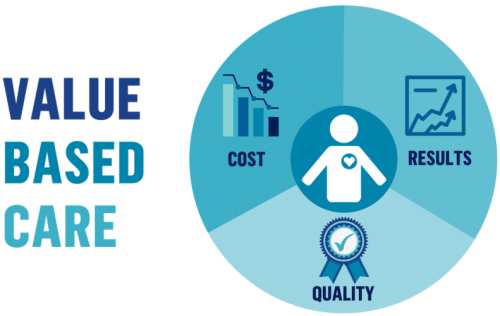
Value-based Care

Context: 

Value-based care is widely accepted as key to the health system’s transformation. Changing provider incentives from volume to value and engaging provider organizations in risk-sharing models with payers (including Medicare) are means to that end. But implementation vis a vis value-based models has produced mixed results thus far and current financial pressures facing providers (esp. hospitals) have stymied momentum in pursuit of value in healthcare. Last week, CMS indicated it intends to continue its value-based insurance design (VBID) model which targets insurers, and last month announced continued commitment to its bundled payment and ACO models. But they’re considered ‘works in process’ that, to date, have attracted early adopters with mixed results.

Questions:

What’s ahead for the value agenda in healthcare? Is it here to stay or will something replace it? How is your organization adapting?

Key takeaways from Discussion:

  • ‘Not-for-profit hospitals and health systems are fighting to survive: near-term investments in value-based models are unlikely unless they’re associated with meaningful near-term savings that hospitals and physicians realize. Unlike investor-owned systems and private-equity backed providers, NFP systems face unique regulatory constraints, increasingly limited access to capital hostile treatment in media coverage and heavy-handed treatment by health insurers.’
  • Demonstrating value in healthcare remains its most important issue but implementing policies that advance a system-wide definition of value and business models that create a fair return on investment for risk-taking organizations are lacking. The value agenda must be adopted by commercial payers, employers and Medicaid and not limited to/driven by Medicare-alone.’
  • The ACO REACH model is promising but hospitals are hesitant to invest in its implementation unless compelled by direct competitive threats and/or market share leakage. It involves a high level of financial risk and relationship stress with physicians if not implemented effectively.’
  • ‘Health insurers are advantaged over provider organizations in implementing value-strategies: they have data, control of provider networks and premium dollars.’
  • ‘Any and all value models must directly benefit physicians: burnout and frustration are palpable, and concern about income erosion is widespread.’
  • ‘Value in healthcare is a long-term aspirational goal: getting there will be tough.’

My take:

Hospitals, health systems, medical groups and other traditional providers are limited in their abilities to respond to opportunities in AI and value-based models by near-term operating margin pressures and uncertainty about their finances longer-term. Risk avoidance is reality in most settings, so investments in AI-solutions and value-based models must produce near-term ROI: that’s reality. Outsiders that operate in less-regulated environments with unlimited access to capital are advantaged in accessing and deploying AI and value-based model pursuits. Thus, partnerships with these may be necessary for most traditional providers.

AI is tricky for providers:

Integration of AI capabilities in hospitals and medical practices will produce added regulator and media scrutiny about data security and added concern for operational transparency. It will also prompt added tension in the workforce as new operational protocols are implemented and budgets adapted.  And cooperation with EHR platforms—EPIC, Meditech, Cerner et al—will be essential to implementation. But many think that unlikely without ‘forced’ compliance.

Value-based models:

Participation in value-based models is a strategic imperative: in the near term, it adds competencies necessary to network design and performance monitoring, care coordination, risk and data management. Longer-term, it enables contracting directly with commercial payers and employers—Medicare alone will not drive the value-imperative in US healthcare successfully. Self-insured employers, private health insurers, and consumers will intensify pressure on providers for appropriate utilization, lower costs, transparent pricing, guaranteed outcome and satisfying user experiences. They’ll force consumerism and value into the system and reward those that respond effectively.

The immediate implications for all traditional provider organizations, especially not-for-profit health systems like the 11 who participated in Chicago last week, are 4:

  • Education: Boards, managers and affiliated clinicians need ongoing insight about generative AI and value-based models as they gain traction in the industry.
  • Strategy Development: Strategic planning models must assess the impacts of AI and value-based models in future-state scenario plans.
  • Capital: Whether through strategic partnerships with solution providers or capital reserves, investing in both of these is necessary in the near-term. A wait-and-see strategy is a recipe for long-term irrelevance.
  • Stakeholder Communication: Community leaders, regulators, trading partners, health system employees and media will require better messaging that’s supported by verifiable facts (data). Playing victim is not a sustainable communications strategy.

Generative AI and value-based models are the two most compelling changes in U.S. healthcare’s future. They’re not a matter of IF, but how and how soon.

CommonSpirit confirms large-scale ransomware attack

https://mailchi.mp/4587dc321337/the-weekly-gist-october-14-2022?e=d1e747d2d8

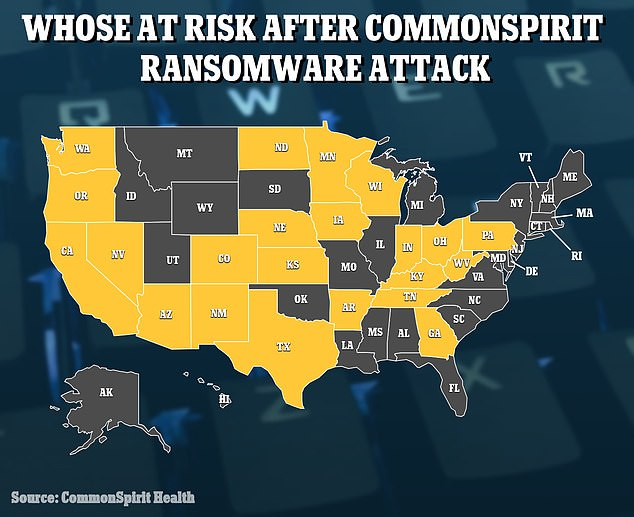
The fourth-largest US hospital system, Chicago-based CommonSpirit Health, is struggling with the impact of a major cyberattack, more than a week after it began disrupting electronic health record access and delaying care in multiple regions across the country. Beyond confirming the attack, the system has not provided many details, other than that it took immediate steps to protect its systems and has begun an investigation.

The Gist: Healthcare hacking is on the rise—our industry experienced the largest increase in cyberattacks of any in 2021. Sitting on troves of valuable patient data, health systems must ready themselves for the reality that hacking attempts are no longer a question of “if,” but “when.” Now is the time not only to ensure proper safeguards are in place to prevent such attacks, but also to prepare response plans for once a hack is confirmed, to be able to continue patient care amid disruption when time is of the essence and patient lives are at stake. 

Oracle completes its $28B Cerner acquisition

https://mailchi.mp/ce4d4e40f714/the-weekly-gist-june-10-2022?e=d1e747d2d8

Kansas City, MO-based electronic health record (EHR) company Cerner is now a business unit within Oracle, the Austin, TX-based software behemoth. Oracle, which already sells some software to insurers, hospitals, and public health departments, called Cerner the company’s “anchor asset”, and hopes to use it to expand its healthcare presence. Oracle co-founder and board chair Larry Ellison unveiled lofty plans to create a national health records database, but he didn’t detail how the company would get access to health records from non-Cerner systems, as interoperability standards haven’t been fully implemented.

The Gist: In addition to the challenge of entering the complex EHR and healthcare data market, Oracle now faces the challenge of rebuilding Cerner’s growth, and its clients’ confidence. Cerner lags Epic in terms of hospital market share: Epic holds about a third of the US hospital market, compared to Cerner’s 24 percent. Epic gained an additional 74 hospitals last year, compared to Cerner’s five.

Anecdotally, we know of several long-term Cerner health system clients who are either in the middle of, or planning for, a transition to Epic, which is seen by health system leaders as the superior EMR option. (In the words of one executive, “No CEO ever got fired for choosing Epic.”) If a stronger Cerner product emerges as a result of the acquisition, it could help to stem this tide.