

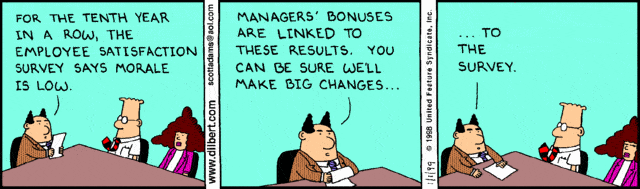
Cartoon – Importance of Employee Satisfaction

https://mailchi.mp/f3434dd2ba5d/the-weekly-gist-december-20-2019?e=d1e747d2d8

For many employers, narrowing provider networks has been a bridge too far, despite unrelenting healthcare cost growth.
A recent Los Angeles Times profile of a Boston union that was able not only to lower costs but also nearly eliminate employee cost-sharing may make doubters reconsider. Unite Here Local 26, which represents 9,000 hotel workers and their families, implemented a narrow network health plan in 2013, when two-thirds of its members agreed to forego care at certain marquee academic hospitals, which charged two to three times more than others in the Boston area.
Today the union actually pays less in medical costs per member than it did six years ago, and premiums are ten percent lower than the national average, despite Boston being one of the highest-cost healthcare markets in the country. Employees pay no deductibles, and generic medications cost them only $1. Savings have translated into raises for many employees, with some low-income workers seeing a pay jump of up to 39 percent across six years.
As we’ve discussed in the past, employers are reaching a limit on how high they can push deductibles, especially in a tight labor market. Some are beginning to experiment with various network options that lower health care costs—but many have been reticent to change benefit design in any way that could be perceived as narrowing choice.
Local 26’s experience shows that well-designed narrow networks, implemented with employee education and buy-in, can provide cost relief for both businesses and individuals that can be sustained over time.

 HENRY KOTULA