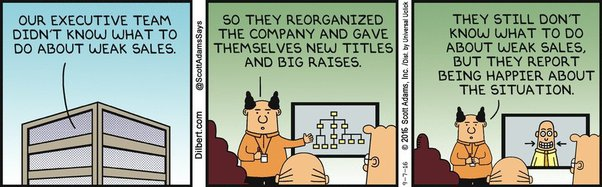
At least five health systems announced changes to executive ranks and administration teams in February and March.
The changes come as hospitals continue to grapple with financial challenges, leading some organizations to cut jobs and implement other operational adjustments. Changes to executive ranks include reorganizing executive responsibilities and executive appointments.
The following changes were announced within the last two months and are summarized below, with links to more comprehensive coverage of the changes.
1. Philadelphia-based Penn Medicine is eliminating administrative positions. The change is part of a reorganization plan to save the health system $40 million annually, the Philadelphia Business Journal reported March 13. Kevin Mahoney, CEO of the University of Pennsylvania Health System, told Penn Medicine’s 49,000 employees last week that changes include the elimination of a “small number of administrative positions which no longer align with our key objectives,” according to the publication. The memo did not indicate the exact number of positions that were eliminated.
2. Sovah Health, part of Brentwood, Tenn.-based Lifepoint Health, has eliminated the COO positions at its Danville and Martinsville, Va., campuses. The responsibilities of both COO roles will now be spread across members of the existing administrative team.
3. Cox Medical Group, a subsidiary of Springfield, Mo.-based CoxHealth, has made several leadership changes to support the health system’s new operating model. The new model is focused on key service lines — such as cardiovascular services, orthopedics and primary care. Four things to know.
4. Valley Health, a six-hospital health system based in Winchester, Va., eliminated 31 administrative positions. The job cuts are part of the consolidation of the organization’s leadership team and administrative roles. They were announced internally on Feb. 28.
5. Roseville, Calif.-based Adventist Health will transition from seven networks of care to five systemwide to reduce costs and strengthen operations, according to a Feb. 15 news release shared with Becker’s. Under the reorganization, the health system will have separate networks for Northern California, Central California, Southern California, Oregon and Hawaii. The reorganization will result in job cuts, including reducing administration by more than $100 million.
MetroHealth CEO Airica Steed, EdD, RN, is suspending supplemental and one-time bonus programs that led to the firing of former CEO Akram Boutros, MD, Cleveland.com reported March 14.
Dr. Steed also told Cuyahoga County Council that new safeguards are being put in place after Dr. Boutros was accused of taking $1.9 million in what the health system’s board called “improper bonuses,” according to the report.
The plan outlined by Dr. Steed includes a national search to fill several critical executive roles, including a human resources officer who will ensure the department is thoroughly involved in compensation matters going forward, according to the report. Dr. Steed said that structure was not previously in place.
The system is also seeking a permanent CFO after Craig Richmond resigned from the role, according to the report. Geoff Himes, the health system’s former vice president of finance, is serving as interim CFO.
The plan also calls for creating a workplace culture where “no one is afraid to speak up if they’re not sure what’s being asked of them is the right thing to do,” according to the report.
A report from the accounting firm BDO at the request of the system’s board found that Dr. Boutros paid himself $1.9 million in unauthorized bonuses and concealed the actions from the board, according to Cleveland.com. He was fired in November after the payments came to light. He was set to retire at the end of 2022.
The BDO report said Dr. Boutros created the Supplemental Performance Based Variable Compensation/Supplemental Incentive Compensation program without involving the human resources department. Former CFO Mr. Richmond allegedly forwarded details of the program down the chain for payroll approval without confirming there had been board approval.
Dr. Boutros’ attorney Jason Bristol sent a letter to Cuyahoga County Council alleging the BDO report is “biased, inaccurate and seriously flawed,” according to Cleveland.com. Mr. Bristol argued the report contained no supporting evidence for the assertion Dr. Boutros secretly created a bonus program. He also said Mr. Richmond resigned because he believed the report “inaccurate, incomplete, and misleading,” citing a letter released by Mr. Richmond’s attorney. Mr. Richmond resigned two days before the report was released.
Dr. Boutros has filed multiple lawsuits since his firing. He filed a lawsuit Nov. 28 in Cuyahoga County Common Pleas Court, alleging violations of Ohio’s Open Meetings Act and the board bylaws. Dr. Boutros also alleges board retaliation and accuses the MetroHealth board of violating the law in its hiring of Dr. Steed. Dr. Boutros filed a separate lawsuit against the health system in December alleging breach of contract. He has repaid the system $2.1 million for the bonuses and interest.
Healthcare leaders now need to strike a delicate balance that requires managing financial and growth metrics, increasing the speed of transformation, and building the health systems of tomorrow. So how do we redefine compensation models to reward all these behaviors?
Executive compensation might not spring to mind as a key driver of healthcare transformation, nor does it seem naturally connected to critical issues such as health equity, patient safety, or quality of care – just a few of the areas where significant changes can be made to transform healthcare. But, in fact, executives leading not-for-profit health systems today are tasked with delivering measurable results that improve the health status of their patients and their communities. And to ensure that these new performance metrics are met, we must change how we think about —and deliver—compensation.
Defining a new model
While executive compensation has always been tied to specific objectives, they have historically leaned heavily toward financial performance, volume and margins, with a modest portion of compensation aligned to quality of care and patient outcomes. But transformative approaches such as population health, value-based care, patient wellness and health outcomes are shifting the mark.
Healthcare leaders now need to strike a delicate balance that requires managing financial and growth metrics, increasing the speed of transformation, and building the health systems of tomorrow. So how do we redefine compensation models to reward all these behaviors?
Some might say that the answer lies in adjusting incentive plans. While incentive plans across health care have not changed significantly in the past decade, the sophistication of the plans has changed, reflecting greater attention to delivering a better patient experience. But delivering better experiences does not imply that health systems have transformed from the top down. In my mind, adjusting incentive plans only solves part of the problem.
If we want true health care transformation—and we should, in order to best serve patients and communities—health systems need to re-evaluate the outcomes for each stakeholder and create incentives to evolve leadership as a whole. We need to rethink executive compensation models to align with value-based care, patient experience, and the resulting outcomes, along with traditional performance measurements.
Leading through lingering disruption
But rethinking executive compensation models won’t be an easy task, especially given the external challenges and changes thrust upon the health care system over the last few years.
As with nearly every other aspect of health care, pay for performance was disrupted during the pandemic. Demand for health services changed dramatically, labor and attrition issues intensified, and supply chain problems and operational costs increased. These new pressures required executives to manage through long periods of uncertainty where meeting operational pay-for-performance goals was nearly impossible. Fast-forward to today, the executive talent market remains extraordinarily competitive. Demand outpaces supply due to higher-than-typical retirements, effects of the great resignation, the need for new skill sets and overall burnout.
As a result, there has been upward pressure on compensation to address and fulfill unexpected but immediate needs such as rewarding executives for managing in a unique and challenging performance environment, increasing efforts to recruit and retain, and recognizing leaders for their hard-won accomplishments.
Considerations and changes
When considering adjusting models for 2023 and beyond, CEOs and compensation committees need to take these pressures and disruptions into account. They should look closely at their own compensation data from the past two years – not as a lighthouse for future compensation, but as data that may need to be set aside due to the volume of performance goals and achievements that were up-ended by the pandemic. When relying on external industry data, the same rules apply; smaller data sets or those that don’t account for the past two years may be misleading, so review carefully before using limited data sets to inform adjusted models.
Just as important, CEOs and compensation committees should consider new performance measurements tied to both financial and quality or value-based transformation metrics. We don’t need to eliminate traditional financial and operational goals because viability is still a business mandate. But how can we articulate compensation-driven KPIs for stewardship of patient and community health, improved outcomes and reduced cost of care? Too many measures are akin to having no measures at all.
The compensation mix should take into account a more focused approach to long-term measures. The old paradigm of 12-month incentive cycles is not enough to address the time required to truly transform health care. Another consideration should be performance-based funding of deferred compensation based on achieving transformation goals, and greater use of retention programs to support the maintenance of a stable executive team during the transformation period. Covid-19 proved how crisis can be an accelerator for change. True transformation should blend the skills gained from crisis management with planful, thoughtful and intentional change.
In addition, some metrics may need to incorporate a discretionary component, considering ongoing disruption within the workforce, supply chain limitations, and energy, equipment and labor cost increases. More organizations are also including health equity, DE&I, and ESG goals in incentive programs to tighten alignment with mission-critical board-mandated goals.
Transformative change
There are four elements that are vital in the journey to transform health care from “heads in beds” to the public-service-oriented organizations that they were meant to be—and can be again. With mounting pressure from patients, communities, and payers to boards and employees, CEOs and compensation committees must become key drivers of change, setting the right goals and incentives from the top down.
Affordability: can patients afford the care they need?
Quality: is the care being delivered of the utmost quality?
Usability: how can we reduce hurdles to undertaking the care plan?
Access: are all community members able to access needed care?
Solving for each of these elements is one of the biggest challenges we face, and as we begin to emerge from the disruption of the pandemic, leaders will be watched closely to ensure that they deliver—and can clearly show the path to delivery.
Ideally, end achievements would include patients spending less to achieve better health; payers controlling costs and reducing risk; providers realizing efficiencies and greater patient satisfaction; and alignment of medical supplier pricing to patient outcomes. And when you zoom out to reveal the bigger picture, all of these pieces come together to achieve healthier populations and lower overall health care costs, while still meeting the financial goals of the organization.
We’re asking a lot of already-overburdened health care executives. Stakeholders must prove that we value leaders with the right mindset and skillset in order to attract executives who can shepherd organizations through the transformation journey. This requires a setting where there is supportive leadership, a compelling mission and opportunity for personal growth and development. It will not be easy, but without rethinking how we design compensation models from the top down, it will be unnecessarily challenging.
The board of trustees at Cleveland-based MetroHealth System has fired President and CEO Akram Boutros, MD.
Dr. Boutros was fired Nov. 21 after the board received findings of a probe into compensation issues involving more than $1.9 million in supplemental bonuses, Vanessa Whiting, chair of the board, said in a statement posted on the health system’s website. The probe found that between 2018 and 2022, Dr. Boutros authorized the compensation for himself, without disclosure to the board.
“We have taken these actions mindfully and deliberately but with sadness and disappointment,” Ms. Whiting said. “We all recognize the wonderful things Dr. Boutros has done for our hospital and for the community. However, we know of no organization permitting its CEO to self-evaluate and determine their entitlement to an additional bonus and at what amount, as Dr. Boutros has done.”
Dr. Boutros took the helm of MetroHealth in 2013. Last year, Dr. Boutros announced his plans to retire at the end of 2022. In September, MetroHealth named Airica Steed, EdD, RN, its next president and CEO. Dr. Steed, who is executive vice president and system COO of Sinai Chicago Health System, will take the helm of MetroHealth Dec. 5, according to Ms. Whiting’s statement. Meanwhile, Nabil Chehade, MD, executive vice president and chief clinical transformation officer at MetroHealth, will assume the CEO’s duties on an interim basis.
Ms. Whiting said MetroHealth discovered the compensation issues related to Dr. Boutros while preparing for the CEO transition, and an internal investigation took place, led by the Tucker Ellis law firm.
She said Dr. Boutros admitted to conducting self-assessments of his performance under specific metrics he established and authorizing payment to himself of more than $1.9 million in supplemental bonuses between 2018 and 2022.
According to Ms. Whiting, Dr. Boutros repaid more than $2.1 million in October, representing the supplemental bonus money paid without board approval for performance in calendar years 2017 through 2021, plus more than $124,000 in interest.
She said the board has also implemented immediate CEO spending and hiring limitations through Dec. 31, 2022, and Dr. Boutros has self-reported to the Ohio Ethics Commission.
MetroHealth’s internal investigation is ongoing.
Among Dr. Boutros’ accomplishments at MetroHealth were helping annual revenue increase from $785 million to more than $1.5 billion; growing the health system’s workforce from 6,200 to nearly 8,000 while seeing employee minimum wage increase to $15 per hour; and developing Ohio’s only Ebola treatment center.
A Universal Health Services investor is suing several executives of the King of Prussia, Pa.-based system, alleging they unjustly enriched themselves through stock options amid the pandemic, according to Law360.
The lawsuit, filed in the Delaware Chancery Court and made public July 9, accuses UHS executives and directors of taking advantage of a pandemic-related temporary hit in the company’s stock price and argues taking the stock options was “grossly unfair to the company and its stockholders.”
“The controllers and other company insiders took advantage of the temporary drop in the company’s stock price to grant and receive options to buy the company’s stock at rock bottom prices, thereby showering themselves in excessive compensation,” the lawsuit claims.
In particular, the lawsuit claims that in just 12 days after the stock options were granted, defendants made over $30 million in gains.
Several top execs were named as defendants, including Alan Miller, UHS founder and chair and Marc Miller, CEO and president of UHS. Three other UHS execs were named, as well as Warren Nimetz, an administrative partner of law firm Norton Rose Fulbright’s New York office.
“UHS’s directors and officers deny any liability associated with the company’s routine and publicly disclosed options grant in March 2020,” attorney Matthew Madden of Robbins Russell Englert Orseck & Untereiner, representing UHS, its executives and Mr. Nimetz, told Law360. “The options grant was in line with the company’s compensation practices in prior years and took place at a board meeting scheduled months in advance.”
Mr. Madden added that UHS’ executives and officials “acted properly” and that the plaintiff’s claims are “baseless.”
“UHS is proud of its service to patients, and stewardship of investor capital, during these unprecedented times in the healthcare industry,” Mr. Madden told Law360.
Tower Health said it is cutting salaries of executives and managers amid financial losses linked to the COVID-19 pandemic.
The West Reading, Pa.-based health system has struggled financially in the last two fiscal years. It recorded an operating loss of $378.2 million in fiscal year 2020, as well as an operating deficit of $178.8 million the year prior. And last November, the health system said it would consider selling six of its Philadelphia-area hospitals, including those it has purchased since 2017 from Franklin, Tenn.-based Community Health Systems, as part of a financial turnaround plan.
To help offset the financial damage, about 400 Tower Health executives and managers will have their pay cut, beginning in their Feb. 19 paychecks, according to The Philadelphia Inquirer, which cites a letter CEO Clint Matthews wrote to staff. Executives will have their pay cut by 15 percent, and directors, senior directors and associate vice presidents will have their pay cut by 10 percent.
In a statement shared with Becker’s on Feb. 8, the health system said it “is undertaking several initiatives as part of a coordinated plan to improve operations, strengthen care delivery and address the ongoing financial impact of COVID-19.”
“These actions include compensation reductions for executives and managerial employees, along with operational improvements to reduce costs and enhance revenue,” according to the Tower Health statement.
The salary cuts will be in effect until June 30, and do not affect front-line clinical or support staff, who received merit increases in January.
Tower Health projects cost savings of about $11.6 million because of the pay cuts.
“Reducing management compensation is a difficult but necessary decision that will stabilize and strengthen our financial performance as we continue to meet the challenges of the COVID-19 pandemic, as well as our ongoing mission of providing compassionate, accessible, high-quality, cost-effective healthcare to our communities,” the health system said.
Mario Jardon, president and CEO of the Hialeah-based Citrus Health Network, made $574,660, which the state says includes $360,840 in excess compensation. The state says the agency also paid excessive compensation to two other executives at the community-based mental health center, for a total of $403,000 in excessive compensation. The company denies it.
The child welfare agency that serves Miami-Dade and Monroe counties pushed back Wednesday against allegations made by the governor’s chief inspector general, denying claims that it used taxpayer funds to pad excessively high salaries of top executives.
In a statement, Citrus Health Network President and CEO Mario Jardon and Citrus Health Network Board of Directors Chair Patricia Croysdale said that the state did not check with them before issuing the preliminary report and Jardon’s salary, and that of chief operating officer Maria Alonso, “do not come from state funds allocated to Citrus as the lead agency, and are provided at no cost to the state.”
Citrus Health Network, a mental health nonprofit, won a half-billion dollar contract in 2019 from the state Department of Children & Families to oversee child welfare cases in Miami-Dade and Monroe. The arrangement is part of the state program that has privatized state services to a patchwork of “lead agencies.”
Florida law prohibits a community-based care lead agency that receives state and federal funding to provide welfare services from paying its executives more than 150% of what the Department of Children and Families secretary makes — a threshold estimated at $213,820.
In response to the Citrus Health comments, Meredith Beatrice, spokesperson for Gov. Ron DeSantis, said that the intent of the report was to highlight agencies that “were either in non-compliance or appeared to have excessive compensation” and will be investigated further.
“Nothing within the document is conclusory or final,’’ she said.
PRELIMINARY FINDINGS
The report says Jardon made $574,660, which the state says includes $360,840 in excess compensation. The state also said Alonso, Jardon’s partner, made $42,379 over the maximum, and the company’s chief information officer, Renan Llanes, made $172 over the limit.
“The Governor’s Office of Inspector General chose to release a preliminary report incorrectly alleging inappropriate use of state funds and excessive executive compensation without first confirming the information in the report directly with Citrus, and without utilizing other publicly available fiscal documents related to our company,’’ the company’s statement said.
The Citrus Health contract began in July 2019, but the state report appears to have used compensation data from tax documents ending in June 2019.
Citrus also pointed to its web site, which has posted a document that shows a 2020-21 budget that includes compensation of $207,711 with “other compensation” of $20,498 for its director. The company said that refers to Esther Jacobo, the director of the Citrus Health Family Care Network, who formerly was the interim secretary at DCF.
A footnote then adds that “CEO and COO are provided at no cost to [Citrus Family Care Network] and DCF.”
“At the beginning of operations as the lead agency, Citrus’ Board of Directors resolved not to burden the budget of the lead agency with the salaries of the CEO and COO of Citrus Health Network,” said Citrus Health Network spokesperson Leslie M. Viega in a statement. “Our CEO and COO’s salaries do not come from any funds allocated to Citrus as the lead agency, regardless of the source, including state-appropriated funds, state-appropriated federal funds, or private funds.”
The company says the salaries are paid through another division, its federally qualified health center which provides behavioral health, primary care, housing for the homeless, and other social services.The Herald/Times asked Citrus Health for a copy of the financial documents that demonstrate this claim but the organization has not provided them.
The inspector general’s investigation is the result of an executive order by DeSantis in February 2020 after the Miami Herald reported and a House of Representatives investigation found that the Florida Coalition Against Domestic Violence paid its chief executive officer, Tiffany Carr, more than $7.5 million over three years.
Carr, who is now a party to two lawsuits, including an attempt by the state to claw back the compensation she was awarded, is currently engaged in negotiations with the attorney general’s office over a mediated settlement.
But it was Carr’s ability to use her network of influential legislators and lobbyists, coupled with the lack of oversight by the Department of Children and Families, that provoked legislators and the governor’s investigators to look into how other non-profits are compensating their executives.
Carr persuaded her board of directors, a close-knit group whom she hand-selected, to approve her compensation package that included thousands of hours of paid leave which she converted to cash.. She justified her salary and bonuses by using comparable salaries of similar organizations but she is alleged to have misrepresented the size of her organization to make the comparisons work to her advantage.
Investigators also suspect Carr avoided declaring millions of dollars in deferred compensation on her tax forms by using a loophole in the tax code.
The governor’s office said the next phase of the investigation will be to meet with the nine community-based care organizations early next week “to explain the process” before the final report is completed by June 30.
“It is important to note that the entities impacted from this review will have an opportunity in late May to offer a written response to the draft of the final report,’’ Beatrice said. “Their responses will be included as an attachment to the final report presented to the governor.”











 HENRY KOTULA