Michael Dowling: The most pressing question to start the year

The new year is always an ideal time for healthcare leaders to reflect on the state of our industry and their own organizations, as well as the challenges and opportunities ahead.

As the CEO of a large health system, I always like to reflect on one basic question at the end of each year: Are we staying true to our mission? 

Certainly, maintaining an organization’s financial health must always be a priority but we should also never lose sight of our core purpose. In a business like ours that has confronted and endured a global pandemic and immense financial struggles over the past several years, I recognize it’s increasingly difficult to maintain our focus on mission while trying to find ways to pay for rising labor and supply costs, infrastructure improvements needed to remain competitive and other pressures on our day-to-day operations. 

After all, the investments we need to make to promote community wellness, mental health, environmental sustainability and health equity receive little or no reimbursement, negatively impacting our financial bottom lines. During an era of unprecedented expansion of Medicaid and Medicare, we get less and less relief from commercial insurers, whose denial and delay tactics for reimbursing medical claims continue to erode the stability of many health systems and hospitals, especially those caring for low-income communities. 

Despite those enormous pressures, it’s imperative that we continue to support underserved communities, military veterans struggling with post-traumatic stress, and intervention programs that help deter gun violence and addiction. 

The list of other worthy investments goes on and on: charity care to uninsured or underinsured patients who can’t pay their medical bills, funding for emergency services that play such a critical role during public health emergencies, nutritional services for families struggling to put food on the table, programs that combat human trafficking and support women’s health, the LGBTQIA+ community and global health initiatives that aid Ukraine, the Middle East and other countries torn apart by war, famine and natural disasters. 

We must also recognize the key role of healthcare providers as educators. School-based mental health programs are saving lives by identifying children exhibiting suicidal behaviors, anger management issues and other troublesome behaviors. School outreach efforts have the added benefit of helping health systems and hospitals address their own labor shortages by introducing young people to career paths that will help shape the future healthcare workforce. 

Without a doubt, the “to-do” list of community health initiatives that support our mission is daunting. We can’t do it all alone, but as the largest employers in cities and towns across America, health systems and hospitals can serve as a catalyst to get all sectors of our society — government, businesses, schools, law enforcement, churches, social service groups and other community-based organizations — to recognize that “health” goes far beyond the delivery of medical care. 

The health of individuals, families and communities hinges on the prevalence of good-paying jobs, decent and affordable housing, quality education, access to healthy foods, medical care, transportation, clean air and water, low prevalence of crime and illicit drugs, and numerous other variables that typically depend on the zip codes where we live. Those so-called social determinants of health are the driving factors that enable communities and the people who live there to either prosper or struggle, resulting in disparities that are the underlying cause of why so many cities and towns across the country fall into economic decay and become havens for crime and hotbeds for gun violence, which shamefully is now the leading cause of death for children and adolescents. 

To revive these underserved communities, many of which are in our own backyards, we have to look at all of the socioeconomic issues they struggle with through the prism of health and use the collective resources of all stakeholders to bring about positive change. 

Health is how we work together to build a sense of community. Having a healthy community also requires everyone doing what they can to tone down the political rhetoric and social media-fueled anger that is polarizing our society. Health is bringing back a sense of civility and respect in our public discourse, and promoting the values of honesty, decency and integrity. 

As healthcare providers and respected business leaders, we should all make a New Year’s resolution to stay true to our mission and do what we can within our communities to bring oxygen to hope, optimism and a healthier future. 
Kids who survive shootings — and their families — face greater health burdens

https://www.axios.com/2023/11/07/gun-violence-children-pain-mental-health

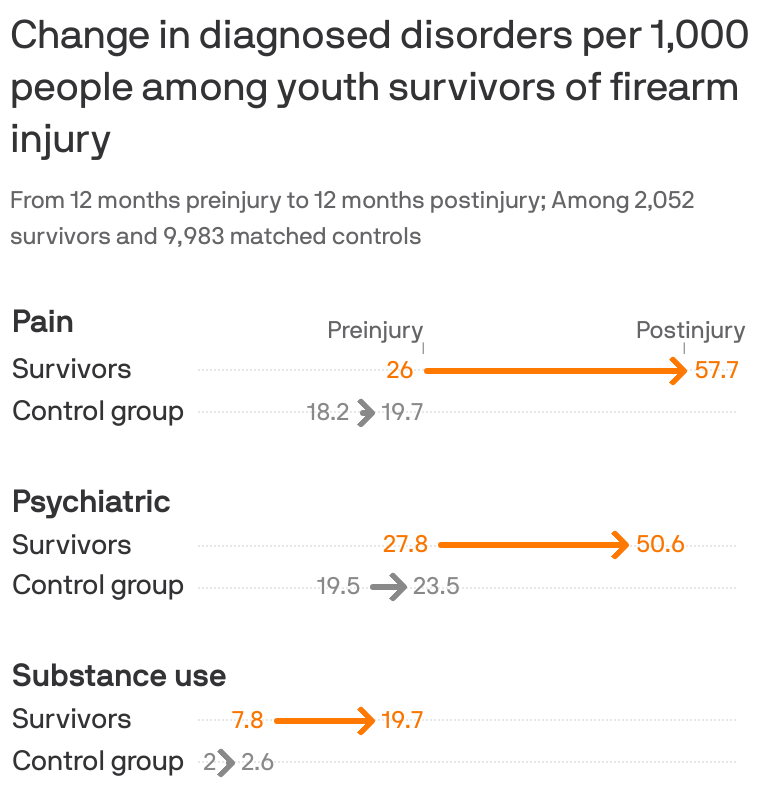
Young survivors of shootings face a litany of physical, psychiatric and substance abuse disorders that can combine to drive up their health costs almost 2,000%, according to new research.

The big picture: 

Guns have become the leading cause of death among kids, but many more survive being shot. Their needs offer a rare and detailed look at the cumulative consequences of gun violence and the burden it places on survivors, their families and the health system.

By the numbers: 

Using a trove of claims data for employer-sponsored insurance, researchers in Health Affairs compared over 2,000 child and adolescent shooting survivors and 6,000 family members with much larger control groups that did not suffer gun injury between 2007-2021.

  • In the year after being shot, survivors had a 117% increase in pain disorders including musculoskeletal pain and headaches compared with the control group, with a 293% increase for those more severely wounded.
  • There was a 68% increase in psychiatric disorders, such as PTSD and mood disorders, with a 321% increase among those with worse injuries.
  • Substance use disorders rose 144% percent — and cases rose regardless of the severity of the injury.
  • Emergency room visits for gun injuries among kids doubled during the pandemic, according to separate research published Monday in Pediatrics.

There is also an impact on families’ mental health and even the types of care they got in the aftermath of a child surviving a shooting, researchers found in the Health Affairs study.

  • Diagnosed psychiatric disorders among mothers and fathers increased by about 30% — and the increases were much larger among parents of children who died.
  • Mothers had a 75% increase in mental health visits, while other routine care like office visits and lab tests declined slightly for themselves and the siblings of survivors.
  • That was consistent with a “crowding out” effect when more acute health care needs arise, researchers said.

What they’re saying: 

“Our study shines light on the substantial effects incurred not just directly by victims and survivors of gun violence, but indirectly by parents and siblings who, we found, often relinquish their own routine health care to the more acute health needs of the family,” senior study author Chana Sacks, co-director of the MGH Gun Violence Prevention Center, said in a statement.

Survivors’ health care costs also soared 17-fold to nearly $35,000 on average over the course of a year. Two-thirds of the cost was in the first month after being shot, while survivors used more health care across the board — including more visits to doctor’s offices, ER trips, imaging and mental health services.

  • Insurers covered the vast majority of the care, but families were on hook for about 5% of the cost.

Between the lines: 

Researchers looked at claims data for workplace health insurance only, so the results don’t include kids without insurance or those enrolled in Medicaid — a major source of coverage, especially for children of color.

Firearm-related Injuries Cost US Healthcare $1B Annually

ttps://medcitynews.com/2023/04/gun-violence-healthcare-costs/?utm_medium=email&_hsmi=255846167&_hsenc=p2ANqtz-_dvFU0DOP4iOPFuqoTdvRwnXBSHTQJaXxK9BOrg5BQ0cQ_7PuWJ_KN4z0KqlHL0yQZCndlLTqNJEKp6soK6s2MU_0Z4w&utm_content=255846167&utm_source=hs_email

In just 2020, deaths from gun violence cost the U.S. healthcare system $290 million, or about $6,400 per patient, according to a report from the Commonwealth Fund. These costs are mostly covered by Medicaid and other government insurance programs.

The U.S. healthcare system sees about 30,000 inpatient hospital stays and 50,000 emergency room visits due to gun violence each year, leading to more than $1 billion in initial medical costs, according to a new analysis.

The Commonwealth Fund published these results last week and relied on three data sources for its analysis: the 2019 Global Burden of Disease study, the Small Arms Survey and the U.S. Government Accountability Office.

Even after leaving the hospital, patients are faced with challenges. A year after a gun injury, medical spending rises about $2,495 per person per month. In addition, those who suffer firearm injuries are more likely to form mental health challenges and substance use disorders.

“The impact of gun violence reaches far beyond the hospital room,” the analysis states.

Firearm-related deaths are increasing, according to the Centers for Disease Control and Prevention. In 2021, almost 49,000 Americans died from firearms, compared to 45,000 in 2020.

Additional findings from the report include:

  • In 2019, the U.S. had a higher rate of firearm deaths than any other country. Its rate of firearm deaths was almost five times as much as France, the second-highest country.
  • Eight times more people in the U.S. died from firearm violence in 2019 compared to Canada, the second-highest country.
  • More people died from self-harm by firearm in the U.S. than any other country in 2019, more than three times higher than France and Switzerland.
  • More women were killed by guns in the U.S. than any other country in 2019.
  • In the U.S., there are 67 million more firearms than people. That difference is higher than the population of the United Kingdom, which has 66.2 million people.
  • In the U.S., 52% of people who are admitted to hospitals for firearm injuries are Black, 29% are White, 14% are Hispanic and 5% are another race or ethnicity. Black Americans account for 50% of firearm injury hospital costs, while White Americans account for 27%, Hispanic Americans account for 17% and other races or ethnicities account for 6%.
  • About 48% of firearm-related inpatient hospital stays are in the American South, while 20% are in the Midwest, 20% are in the West and 12% are in the Northeast. The South accounts for 44% of firearm injury hospital costs, while the West accounts for 26%, the Midwest accounts for 18% and the Northeast accounts for 11%.

The missing Americans: early death in the United States 1933-2021

Figure. Excess deaths in the U.S. relative to other wealthy nations, 1933-2021. Source: Human Mortality Database. Note: Figure shows the difference between the number of deaths that occurred in the U.S. each year and the number of deaths that would have occurred if the U.S. had age-specific mortality rates equal to the average of other wealthy nations. The comparison set includes Austria, Belgium, Canada, Denmark, Finland, France, Germany, Iceland, Italy, Japan, Luxembourg, Netherlands, Norway, Portugal, Spain, Sweden, Switzerland, and the United Kingdom. The average of other wealthy nations excludes Portugal prior to 1940, Austria and Japan prior to 1947, Germany prior to 1956, and Luxembourg prior to 1960. From 1960, all countries are represented (solid dots).

COVID-19 led to a large increase in U.S. deaths. However, even before the pandemic, the U.S. had higher death rates than other wealthy nations. How many deaths could be avoided if the U.S. had the same mortality rates as its peers?

In a new study, we quantify the annual number of U.S. deaths that would have been averted over nearly a century if the U.S. had age-specific mortality rates equal to the average of 18 similarly wealthy nations. We refer to these excess U.S. deaths as “missing Americans.”

The annual number of “missing Americans” increased steadily beginning in the late 1970s, reaching 626,353 in 2019 (Figure). Excess U.S. deaths jumped sharply to 991,868 in 2020 and 1,092,293 in 2021 during the COVID-19 pandemic.

In 2021, nearly 1 out of every 3 U.S. deaths would have been averted if U.S. mortality rates had equaled those of its peer nations. Half of these excess deaths were among U.S. residents under 65 years. We estimate that the 1.1M excess deaths in 2021 were associated with 25M years of life lost, accounting for the number of years the deceased would otherwise be expected to live.

We also compared mortality rates of U.S. racial and ethnic groups with the international benchmark. Black and Native Americans accounted for a disproportionate share of the “missing Americans.” However, the majority of “missing Americans” were White non-Hispanic persons.

Our findings are consistent with recent reports that the life expectancy gap between the U.S. and peer nations widened during the pandemic, with U.S. life expectancy falling from 78.9 to 76.6 years. Life expectancy is widely reported, but it is a complex measure and may be misinterpreted as reflecting small differences in mortality at advanced ages.

In fact, the greatest relative differences in mortality between the U.S. and peer countries occur before age 65. In 2021, half of all deaths to U.S. residents under 65 years – and 90% of the increase in under-65 mortality since 2019 – would have been avoided if the U.S. had the mortality rates of other wealthy nations. In addition to the loss of life, these early deaths often leave behind child (and elder) dependents without key social and economic support.

Our calculations were based on recently released mortality data, obtained from the U.S. Centers for Disease Control and Prevention WONDER Database and the Human Mortality Database. The international comparison group included all available countries with relatively complete mortality data starting in 1960 or earlier, after excluding former communist countries. Our paper builds on prior analyses of excess deaths by our study team and by others.

We find a very large increase in excess U.S. deaths during the COVID-19 pandemic. However, this spike occurred on top of a growing trend that reached 600,000 excess deaths in 2019. Future COVID-19 deaths could be reduced with broader vaccine uptake, worker protections, and masking during surges. Even if COVID-19 mortality were eliminated, however, the U.S. would likely suffer hundreds of thousands of excess deaths each year, with many linked to firearms, opioids, and obesity.

Addressing excess deaths in the U.S. will require public health and social policies that target the root causes of U.S. health malaise, including fading economic opportunities and rising financial insecurity, structural racism, and failures of institutions at all levels of government to invest adequately in population health.

Gun Violence as a Public Health Issue

Gun violence is a public health problem, but we don’t approach it like one. The debate often gets framed as “guns or no guns” when it isn’t that black and white. In this episode we break down how and why to approach gun violence as a public health problem, what the current research has to say, and what we need to move forward.

American Medical Association (AMA) takes strong stand on social issues

https://mailchi.mp/8e26a23da845/the-weekly-gist-june-17th-2022?e=d1e747d2d8

At its annual meeting this week, the AMA’s policymaking arm voted to adopt resolutions opposing state efforts that criminalize abortion or limit access to reproductive healthcare. This comes ahead of the much-anticipated Supreme Court decision, which is expected to overturn the 1973 Roe v. Wade decision. The nation’s largest physician organization joined the American College of Obstetricians and Gynecologists in calling on the Food and Drug Administration to make birth control pills available over-the-counter and without age restrictions. The AMA also declared climate change a public health crisis, as physicians are already seeing negative health effects from heat-related injuries.   

The Gist: As a new generation of physicians has entered the workforce, the policy priorities of physician lobbying organizations have evolved. We are seeing a growing interest in addressing hot-button social issues head-on. The AMA has declared both gun violence and racism to be public health issues, and supports health insurance coverage expansion, positions that would have been unimaginable a few decades ago. 

Though progressive on social issues, however, the AMA is still advocating against state efforts to expand mid-level providers’ scope of practice—maintaining its traditional role as a protector of the physician guild.  

Speaking up about the unspeakable

The right to bear arms has existed since we became a nation. So, too, has the risk of violence that extensive gun ownership creates in our society. 

Unfortunately, recent mass shooting incidents, fueled by hatred or mental illness, have sparked a great deal of fear and confusion among Americans.  

As healthcare leaders, our concern centers on the treatment of those who are victims of senseless gun violence. And not just those who are shot, but the other victims as well.

Healthcare providers must care for all victims — the ones who are traumatized because a loved one has been hurt or lost, the ones who were at the chaotic scene of the violence, or who are haunted by the endless media stories they cannot seem to tune out. The emotional toll of this violence is incomprehensible.

Healthcare facilities attempt to provide refuge from violence and seek to provide healing and hope to all victims of violence. 

And yet, sadly, we are not immune to being another venue for violence

Unstable individuals with guns and other weapons of harm find their way into our buildings and hallways as well. Earlier this month, a man who blamed his physician for ongoing pain after a recent back surgery shot and killed his surgeon and three other people before fatally shooting himself in a Tulsa, Okla., medical facility. Also this month, a hospital security officer was shot and killed by a prison inmate who was receiving care in a Dayton, Ohio, emergency room.

These incidents are the latest horrifying tragedies in a wave of deadly gun violence occurring across our country, including two heart-breaking mass shootings in Buffalo, N.Y., and Uvalde, Texas. We mention these tragedies not to make a political statement, but to raise awareness of the consequences of this violence on healthcare providers and the public health. 

As healthcare workers, healers, and caregivers, we work to fix what is broken and put people back together. We bring solutions. We engage with our hearts to stand together in the fear and vulnerabilities of those who need us so that we can help them through difficult challenges. We look to bring light to dark situations. We seek to be beacons of hope. 

The escalation of recent shootings, suicides and other violent behaviors underscores the urgency for a national conversation on what has become a serious public health crisis. We believe health systems have a credible voice and can play a critical role beyond being places to physically and emotionally care for the victims of violence.

It’s easy to allow ourselves to become numb to the frequency of these unconscionable, violent acts. But we owe it to present and future generations not to let that happen. We recognize there are no easy answers to this national problem. After all, we are dealing with abnormal behavior — the decision to seriously harm or kill other people. That this behavior is increasing calls for something to be done to effect positive change.

People across our country and the communities we serve are hurting and vulnerable. Many people are weary from the pandemic that has impacted our hearts and our health. Violence and death, and particularly mass shootings, hit adults hard. Now consider what the prevalence and threat of school shootings have done to an entire generation of children, who are growing up with the fear of being shot and killed in a place they should feel safe.

We all can play a role. Recently, our two organizations decided to do something to reduce gun violence by sponsoring a law enforcement gun buyback program to help get guns off the street. This effort was part of the largest single-day gun buyback in New Jersey state history. It successfully removed over 2,800 guns statewide. Private organizations, companies, and individuals must think of additional creative ways beyond criticizing politicians, to bring about the change we need. 

We encourage organizations and communities to come together, to pool their minds and their resources to address gun violence in society as the urgent public health crisis that it is. We must create meaningful public health campaigns around the safe storage and handling of firearms, and sensible and innovative ways to prevent gun violence in schools, healthcare settings and public places. Individuals should educate themselves on the issues surrounding gun violence so they may contribute to the effort to bring about necessary and meaningful change.  

And yes, we need to accelerate efforts around our nation’s mental health crisis. We know from the data and what we are all experiencing that the COVID-19 pandemic has exacerbated what was already a growing nationwide mental health crisis. 

Violence against any person in any venue is unspeakable. Yet just because it is unspeakable does not mean we should not speak up about it. Let us put our anger, shock and heartbreak into positive change. With the same unstoppable resolution that we seek to cure cancer or slow heart disease, let us advocate, educate and take meaningful action to end gun violence and all senseless violence that is taking such a tragic toll on our nation and our wellbeing.  

Mr. Pullin is president and CEO of Virtua Health. Mr. O’Dowd is co-president and CEO of Cooper University Health Care.

About Virtua Health
Virtua Health is an academic health system committed to helping the people of South Jersey be well, get well, and stay well by providing the complete spectrum of advanced, accessible, and trusted healthcare services. Virtua’s 14,000 colleagues provide tertiary care, including renowned cardiology and transplant programs, complemented by a community-based care portfolio. In addition to five hospitals, two satellite emergency departments, 30 ambulatory surgery centers, and more than 300 other locations, Virtua brings health services directly into communities through Hospital at Home, physical therapy and rehabilitation, mobile screenings, and its paramedic program. Virtua has 2,850 affiliated doctors and other clinicians, and its specialties include orthopedics, advanced surgery, and maternity. Virtua is academically affiliated with Rowan University, leading research, innovation, and immersive education at the Virtua Health College of Medicine & Health Sciences of Rowan University. Virtua is also affiliated with Penn Medicine for cancer and neuroscience, and the Children’s Hospital of Philadelphia for pediatrics. As a not-for-profit, Virtua is committed to the well-being of the community and provides innovative outreach programs that address social challenges affecting health, most notably the “Eat Well” food access initiative, which includes the unparalleled Eat Well Mobile Grocery Store. A Magnet-recognized health system ranked by U.S. News and World Report, Virtua has received many awards for quality, safety, and its outstanding work environment. For more information, visit Virtua.org. To help Virtua make a difference, visit GiveToVirtua.org.

About Cooper University Health Care
Cooper University Health Care is a leading academic health system with more 8,500 employees and more than 800 employed physicians. Cooper University Hospital is the only Level 1 Trauma Center in South Jersey and the busiest in the region.  Annually, nearly two million patients are served at Cooper’s 635-bed flagship hospital, outpatient surgery center, three urgent care centers, and more than 105 ambulatory offices throughout the community. The Cooper Health Sciences campus is home to Cooper University Hospital, MD Anderson Cancer Center at Cooper, Children’s Regional Hospital at Cooper, and Cooper Medical School of Rowan University. Visit CooperHealth.org to learn more.

Former patient kills his surgeon and three others at a Tulsa hospital

https://mailchi.mp/31b9e4f5100d/the-weekly-gist-june-03-2022?e=d1e747d2d8

On Wednesday afternoon, an aggrieved patient shot and killed four people, including his orthopedic surgeon and another doctor, at a Saint Francis Hospital outpatient clinic, before killing himself. The gunman, who blamed his surgeon for ongoing pain after a recent back surgery, reportedly purchased his AR-15-style rifle only hours before the mass shooting, which also injured 10 others. The same day as this horrific attack, an inmate receiving care at Miami Valley Hospital in Dayton, OH shot and killed a security guard, and then himself.

The Gist: On the heels of the horrendous mass shootings in Buffalo and Uvalde, we find ourselves grappling with yet more senseless gun violence. Last week, we called on health system leaders to play a greater role in calling for gun law reforms. This week’s events show they must also ensure that their providers, team members, and patients are safe. 

Of course, that’s a tall order, as hospital campuses are open for public access, and strive to be convenient and welcoming to patients. Most health systems already staff armed security guards or police officers, have a limited number of unlocked entrances, and provide active shooter training for staff.

This week’s events remind us that our healthcare workers are not just on the front lines of dealing with the horrific outcomes of gun violence, but may find themselves in the crosshairs—adding to already rising levels of workplace violence sparked by the pandemic.

Something must change.

Gun violence, the leading cause of death among US children, claims more victims

https://mailchi.mp/d73a73774303/the-weekly-gist-may-27-2022?e=d1e747d2d8

Only 10 days after a racially motivated mass shooting that killed 10 in a Buffalo, NY grocery store, 19 children and two teachers were murdered on Tuesday at an elementary school in Uvalde, TX. The Uvalde shooting was the 27th school shooting, and one of over 212 mass shootings, that have occurred this year alone.

Firearms recently overtook car accidents as the leading cause of childhood deaths in the US, and more than 45,000 Americans die from gun violence each year. 

The Gist: Gun violence is, and has long been, a serious public health crisis in this country. It is both important to remember, yet difficult for some to accept, that many mass shootings are preventable. 

Health systems, as stewards of health in their communities, can play a central role in preventing gun violence at its source, both by bolstering mental health services and advocating for the needed legislative actions—supported by a strong majority of American voters—to stem this public health crisis. 

As Northwell Health CEO Michael Dowling said this week, “Our job is to save lives and prevent people from illness and death. Gun violence is not an issue on the outside—it’s a central public health issue for us. Every single hospital leader in the United States should be standing up and screaming about what an abomination this is. If you were hesitant about getting involved the day before…May 24 should have changed your perspective. It’s time.”

Michael Dowling: ‘Every single US hospital leader should be screaming about what an abomination this is’

Americans and global leaders have responded to the May 24 shooting at a Texas elementary school with heartbreak, anger and calls for change to better fight gun violence. But if you’re paying attention, the calls out of healthcare — from trauma surgeons, pediatricians, nurses, leaders and more — carry a distinct type of exasperation and sorrow. 

“I’m in one of my hospitals now, sitting with some staff talking about it — it’s just so frustrating,” Michael Dowling, president and CEO of New Hyde Park, N.Y.-based Northwell Health, told me over the phone early Wednesday morning. “This does not represent what the United States stands for — that we allow people who should never be allowed to carry a gun to do so and walk into a school and kill fourth graders.”

The attack by a lone 18-year-old gunman at Robb Elementary School in the small town of Uvalde, Texas, has left at least 19 students and two adults dead. Students in the school, grades 2 through 4, were two days away from summer vacation. 

Unlike many other known threats to our health, seeing the medical community condemn mass shootings still seems to leave some Americans doing a double take. It’s increasingly difficult to see what has them confused. 

In 2016, the American Medical Association declared gun violence a public health crisis after a lone gunman killed 49 people and wounded 53 more in a mass shooting in a gay nightclub in Orlando, Fla. Even after the declaration, healthcare professionals and leaders continued to defy insistence from gun rights advocates that gun violence was not within their specialty or expertise. Or as the National Rifle Association put it in simpler terms in 2018: “Someone should tell self-important anti-gun doctors to stay in their lane.” The #ThisIsOurLane movement started then. The attempt to silence medical professionals ironically made their calls for action louder.

As healthcare professionals responded to the ongoing public health emergency of COVID-19, the arms race grew and gun buying intensified — “a surge in purchasing unlike anything we’ve ever seen,” as one gun researcher at the University of California, Davis, put it. People who already owned guns bought more, and people who had never owned a gun bought them too. In 2020, firearm-related injuries were the No. 1 cause of death of children and teens, according to the CDC

Every day, 321 people are shot in the United States, and more than 40,000 Americans die from gun violence each year. Yet some healthcare executives still fear that taking the position that gun violence is a public health crisis will throw them into political turmoil given how toxic politics are in this country. It’s one position for the AMA and its 250,000-plus members to take, but another for an individual leader who may be the face of an organization in their community. There are risks of offending board members, donors, elected officials and other constituents ⁠— including patients. But here’s the thing: There will always be a reason to delay, to soften language, to wonder if this mass shooting is the one to react to.

Mr. Dowling urges his colleagues to step it up, noting how hospital and health system leaders can be ambassadors for gun safety in their communities, given the influence they wield as the largest employers in many communities.

“This is about protecting people’s health. This is about protecting kids’ lives. Have some courage. Stand up and do something,” he said. “Put the interest of the community in the center of what you think about each and every day. Our job is to save lives and prevent people from illness and death. Gun violence is not an issue on the outside — it’s a central public health issue for us. Every single hospital leader in the United States should be standing up and screaming about what an abomination this is.

“If you were hesitant about getting involved the day before May 24, May 24 should have changed your perspective. It’s time.”

Northwell established The Gun Violence Prevention Learning Collaborative for Health Systems and Hospitals, a grassroots initiative that gives healthcare professionals the space to have open dialogue about the impact of gun violence, share best practices and collectively take action. Learn more here