Douglas MacArthur was one of the finest military leaders the United States ever produced. John Gardner, in his book On Leadership described him as a brilliant strategist, a farsighted administrator, and flamboyant to his fingertips. MacArthur’s discipline and principled leadership transcended the military. He was an effective general, statesman, administrator and corporate leader.
William Addleman Ganoe recalled in his 1962 book, MacArthur Close-up: An Unauthorized Portrait, his service to MacArthur at West Point. During World War II, he created a list of questions with General Jacob Devers, they called The MacArthur Tenets. They reflect the people-management traits he had observed in MacArthur. Widely applicable, he wrote, “I found all those who had no troubles from their charges, from General Sun Tzu in China long ago to George Eastman of Kodak fame, followed the same pattern almost to the letter.”
Do I heckle my subordinates or strengthen and encourage them?
Do I use moral courage in getting rid of subordinates who have proven themselves beyond doubt to be unfit?
Have I done all in my power by encouragement, incentive and spur to salvage the weak and erring?
Do I know by NAME and CHARACTER a maximum number of subordinates for whom I am responsible? Do I know them intimately?
Am I thoroughly familiar with the technique, necessities, objectives and administration of my job?
Do I lose my temper at individuals?
Do I act in such a way as to make my subordinates WANT to follow me?
Do I delegate tasks that should be mine?
Do I arrogate everything to myself and delegate nothing?
Do I develop my subordinates by placing on each one as much responsibility as he can stand?
Am I interested in the personal welfare of each of my subordinates, as if he were a member of my family?
Have I the calmness of voice and manner to inspire confidence, or am I inclined to irascibility and excitability?
Am I a constant example to my subordinates in character, dress, deportment and courtesy?
Am I inclined to be nice to my superiors and mean to my subordinates?
Is my door open to my subordinates?
Do I think more of POSITION than JOB?
Do I correct a subordinate in the presence of others?
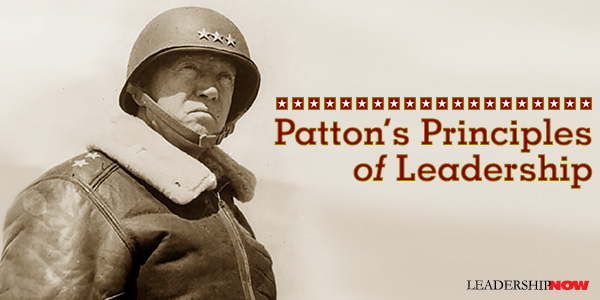
BORN in San Gabriel, California, in 1885, George S. Patton, Jr. was the general deemed most dangerous by the German High Command in World War II. Known for his bombastic style, it was mostly done to show confidence in himself and his troops, says author Owen Connelly.
On December 21, 1945, Patton died in Heidelberg, Germany. The following day the New York Times wrote the following editorial:
History has reached out and embraced General George Patton. His place is secure. He will be ranked in the forefront of America’s great military leaders.
Long before the war ended, Patton was a legend. Spectacular, swaggering, pistol-packing, deeply religious, and violently profane, easily moved to anger because he was first of all a fighting man, easily moved to tears because, underneath all his mannered irascibility, he had a kind heart, he was a strange combination of fire and ice. Hot in battle and ruthless, too. He was icy in his inflexibility of purpose. He was no mere hell-for-leather tank commander but a profound and thoughtful military student.
Everyone is to lead in person.
Commanders and staff members are to visit the front daily to observe, not to meddle. Praise is more valuable than blame. Your primary mission as a leader is to see with your own eyes and be seen by your troops while engaged in personal reconnaissance.
Issuing an order is worth only about 10 percent. The remaining 90 percent consists in assuring proper and vigorous execution of the order.
Plans should be simple and flexible. They should be made by the people who are going to execute them.
Information is like eggs. The fresher the better.
Every means must be used before and after combats to tell the troops what they are going to do and what they have done.
Fatigue makes cowards of us all. Men in condition do not tire.
Courage. Do not take counsel of your fears.
A diffident manner will never inspire confidence. A cold reserve cannot beget enthusiasm. There must be an outward and visible sign of the inward and spiritual grace.
Discipline is based on pride in the profession of arms, on meticulous attention to details, and on mutual respect and confidence. Discipline must be a habit so ingrained that it is stronger than the excitement of battle or the fear of death.
A good solution applied with vigor now is better than a perfect solution ten minutes later.







 HENRY KOTULA