



Michael Drobot, former owner and CEO of Pacific Hospital in Long Beach, Calif., is currently imprisoned for his role in a kickback scheme, and prosecutors say he has now agreed to plead guilty to new charges.
Mr. Drobot pleaded guilty to charges of conspiracy and paying illegal kickbacks in 2014. He admitted paying millions of dollars in bribes to physicians in exchange for referring thousands of patients to his hospital for spinal surgeries. He was one of several defendants charged for their roles in the kickback scheme, which resulted in the submission of more than $950 million in fraudulent claims.
In January 2018, Mr. Drobot was sentenced to more than five years in prison and ordered to forfeit $10 million to the government, which included the profits from the sale of a 1965 Aston Martin, a 1958 Porsche and a 1971 Mercedes-Benz. Federal prosecutors allege Mr. Drobot violated the order by transferring the Aston Martin to an auction company. Profits from the sale of the vehicle were allegedly transferred to Mr. Drobot’s personal bank account and used for personal expenses, according to MyNewsLA.com.
Prosecutors charged Mr. Drobot with wire fraud, engaging in monetary transactions in property derived from unlawful activity and criminal contempt of court. He is expected to plead guilty to the new charges, which carry a maximum sentence of 50 years, in coming weeks, according to the report.


What makes an effective leader? This question is a focus of my research as an organizational scientist, executive coach, and leadership development consultant. Looking for answers, I recently completed the first round of a study of 195 leaders in 15 countries over 30 global organizations. Participants were asked to choose the 15 most important leadership competencies from a list of 74. I’ve grouped the top ones into five major themes that suggest a set of priorities for leaders and leadership development programs. While some may not surprise you, they’re all difficult to master, in part because improving them requires acting against our nature.
This theme combines two of the three most highly rated attributes: “high ethical and moral standards” (67% selected it as one of the most important) and “communicating clear expectations” (56%).
Taken together, these attributes are all about creating a safe and trusting environment. A leader with high ethical standards conveys a commitment to fairness, instilling confidence that both they and their employees will honor the rules of the game. Similarly, when leaders clearly communicate their expectations, they avoid blindsiding people and ensure that everyone is on the same page. In a safe environment employees can relax, invoking the brain’s higher capacity for social engagement, innovation, creativity, and ambition.
Neuroscience corroborates this point. When the amygdala registers a threat to our safety, arteries harden and thicken to handle an increased blood flow to our limbs in preparation for a fight-or-flight response. In this state, we lose access to the social engagement system of the limbic brain and the executive function of the prefrontal cortex, inhibiting creativity and the drive for excellence. From a neuroscience perspective, making sure that people feel safe on a deep level should be job #1 for leaders.
But how? This competency is all about behaving in a way that is consistent with your values. If you find yourself making decisions that feel at odds with your principles or justifying actions in spite of a nagging sense of discomfort, you probably need to reconnect with your core values. I facilitate a simple exercise with my clients called “Deep Fast Forwarding” to help with this. Envision your funeral and what people say about you in a eulogy. Is it what you want to hear? This exercise will give you a clearer sense of what’s important to you, which will then help guide daily decision making.
To increase feelings of safety, work on communicating with the specific intent of making people feel safe. One way to accomplish this is to acknowledge and neutralize feared results or consequences from the outset. I call this “clearing the air.” For example, you might approach a conversation about a project gone wrong by saying, “I’m not trying to blame you. I just want to understand what happened.”
Providing clear direction while allowing employees to organize their own time and work was identified as the next most important leadership competency.
No leader can do everything themselves. Therefore, it’s critical to distribute power throughout the organization and to rely on decision making from those who are closest to the action.
Research has repeatedly shown that empowered teams are more productive and proactive, provide better customer service, and show higher levels of job satisfaction and commitment to their team and organization. And yet many leaders struggle to let people self-organize. They resist because they believe that power is a zero-sum game, they are reluctant to allow others to make mistakes, and they fear facing negative consequences from subordinates’ decisions.
To overcome the fear of relinquishing power, start by increasing awareness of physical tension that arises when you feel your position is being challenged. As discussed above, perceived threats activate a fight, flight, or freeze response in the amygdala. The good news is that we can train our bodies to experience relaxation instead of defensiveness when stress runs high. Try to separate the current situation from the past, share the outcome you fear most with others instead of trying to hold on to control, and remember that giving power up is a great way to increase influence — which builds power over time.
Leaders who “communicate often and openly” (competency #6) and “create a feeling of succeeding and failing together as a pack” (#8) build a strong foundation for connection.
We are a social species — we want to connect and feel a sense of belonging. From an evolutionary perspective, attachment is important because it improves our chances of survival in a world full of predators. Research suggests that a sense of connection could also impact productivity and emotional well-being. For example, scientists have found that emotions are contagious in the workplace: Employees feel emotionally depleted just by watching unpleasant interactions between coworkers.
From a neuroscience perspective, creating connection is a leader’s second most important job. Once we feel safe (a sensation that is registered in the reptilian brain), we also have to feel cared for (which activates the limbic brain) in order to unleash the full potential of our higher functioning prefrontal cortex.
There are some simple ways to promote belonging among employees: Smile at people, call them by name, and remember their interests and family members’ names. Pay focused attention when speaking to them, and clearly set the tone of the members of your team having each other’s backs. Using a song, motto, symbol, chant, or ritual that uniquely identifies your team can also strengthen this sense of connection.
What do “flexibility to change opinions” (competency #4), “being open to new ideas and approaches” (#7), and “provides safety for trial and error” (#10) have in common? If a leader has these strengths, they encourage learning; if they don’t, they risk stifling it.
Admitting we’re wrong isn’t easy. Once again, the negative effects of stress on brain function are partly to blame — in this case they impede learning. Researchers have found that reduced blood flow to our brains under threat reduces peripheral vision, ostensibly so we can deal with the immediate danger. For instance, they have observed a significant reduction in athletes’ peripheral vision before competition. While tunnel vision helps athletes focus, it closes the rest of us off to new ideas and approaches. Our opinions are more inflexible even when we’re presented with contradicting evidence, which makes learning almost impossible.
To encourage learning among employees, leaders must first ensure that they are open to learning (and changing course) themselves. Try to approach problem-solving discussions without a specific agenda or outcome. Withhold judgment until everyone has spoken, and let people know that all ideas will be considered. A greater diversity of ideas will emerge.
Failure is required for learning, but our relentless pursuit of results can also discourage employees from taking chances. To resolve this conflict, leaders must create a culture that supports risk-taking. One way of doing this is to use controlled experiments — think A/B testing — that allow for small failures and require rapid feedback and correction. This provides a platform for building collective intelligence so that employees learn from each other’s mistakes, too.
“Being committed to my ongoing training” (competency #5) and “helping me grow into a next-generation leader” (#9) make up the final category.
All living organisms have an innate need to leave copies of their genes. They maximize their offspring’s chances of success by nurturing and teaching them. In turn, those on the receiving end feel a sense of gratitude and loyalty. Think of the people to whom you’re most grateful — parents, teachers, friends, mentors. Chances are, they’ve cared for you or taught you something important.
When leaders show a commitment to our growth, the same primal emotions are tapped. Employees are motivated to reciprocate, expressing their gratitude or loyalty by going the extra mile. While managing through fear generates stress, which impairs higher brain function, the quality of work is vastly different when we are compelled by appreciation. If you want to inspire the best from your team, advocate for them, support their training and promotion, and go to bat to sponsor their important projects.
These five areas present significant challenges to leaders due to the natural responses that are hardwired into us. But with deep self-reflection and a shift in perspective (perhaps aided by a coach), there are also enormous opportunities for improving everyone’s performance by focusing on our own.
https://www.jpmorgan.com/commercial-banking/insights/healthcare-mixed-outlook

In a recent survey of healthcare leaders, most were confident about their own organizations going into the new year. But respondents expressed concern about a range of evolving industry-wide challenges, including costs, technology and talent.
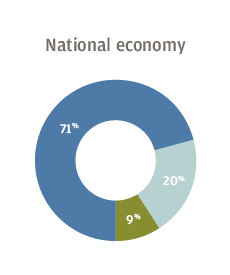
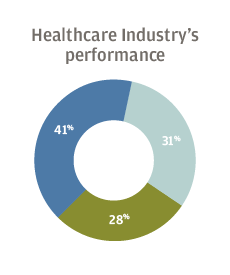
A majority of US healthcare executives surveyed by J.P. Morgan said they were optimistic about the financial performance of their own organizations going into 2019, as well as the national and local economies. But most were less positive about the outlook for the industry as a whole, with 28 percent expressing pessimism and another 31 percent merely neutral.
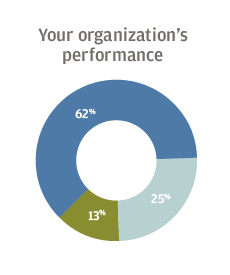



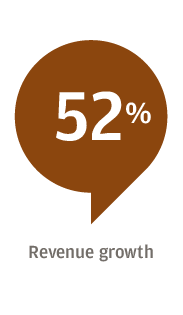
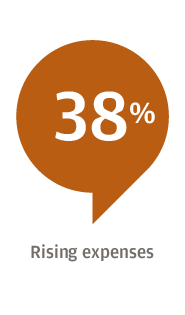
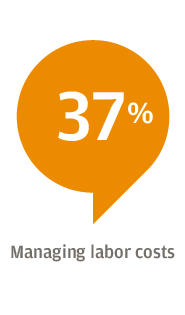
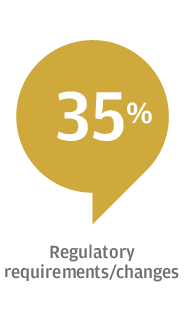
Respondents to the survey, conducted Oct. 16 to Nov. 2 of 2018, said their biggest concerns were revenue growth, rising expenses and labor costs. The executives said their organizations plan to invest the most in information technology and physician recruitment.
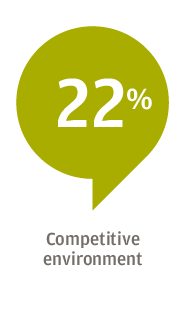
The pessimism about the industry likely stems, in part, from regulatory uncertainty and an ongoing shift from a fee-for-service model toward a value-based payment system, said Will Williams, Senior Healthcare Industry Executive within J.P. Morgan’s Commercial Banking Healthcare group. “Healthcare is going through the most transition of any industry in the country right now,” he said. Amid this upheaval, healthcare organizations face a combination of challenges, including lower reimbursement rates for Medicaid and Medicare patients, increased competition, and higher costs for labor, pharmaceuticals and technology investments.
The optimism that executives feel about their own hospital or healthcare group may come from a sense that an individual organization can adapt to industry changes, said Jenny Edwards, Commercial Banker in the healthcare practice at J.P. Morgan. “You can control certain factors, and make adjustments to compensate for the headwinds.”

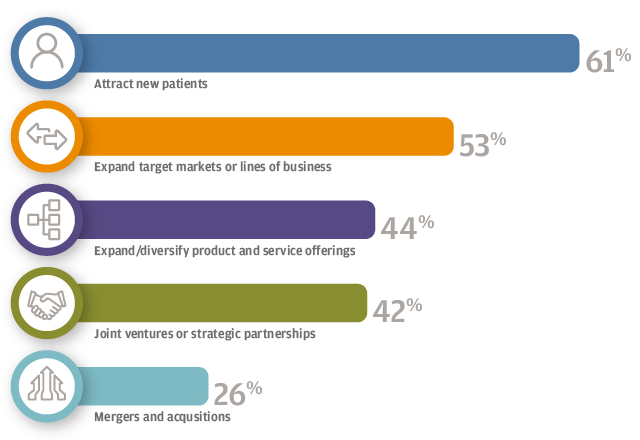
For 61 percent of respondents, the focus is on attracting new patients, followed by expanding target markets or lines of business (53 percent), and expanding or diversifying product and service offerings (44 percent). Hospitals, for example, have worked to add more patients to their broader healthcare system by opening clinics for urgent care or physical therapy, Edwards said.
As patient habits change, hospital systems have needed to become more consumer-focused, Edwards said. Patients are more likely to shop around for their care, expect transparent pricing and review healthcare workers on social media sites. This “retail-ization” trend in healthcare is accelerating, Edwards said. “You can shop for healthcare like you would a new pair of jeans.”
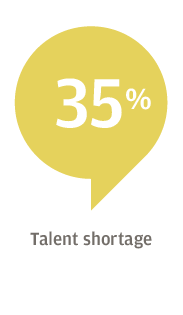
The talent shortage is top of mind for many healthcare executives, with 92 percent of survey respondents saying they were at least somewhat concerned with finding candidates with the right skill set. For 35 percent of respondents, the talent shortage is one of their top three challenges.
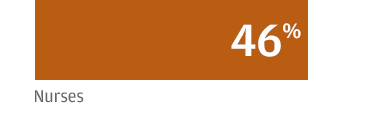
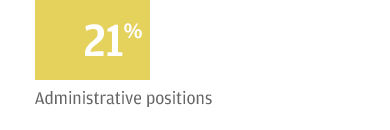
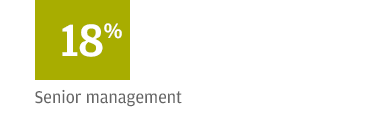
For those respondents who expressed concern, the most difficulty arises in filling positions for physicians (52 percent) and nurses (46 percent). To address the challenge, 76 percent said they expect to increase compensation of their staff over the next 12 months. According to 37 percent of respondents, the talent pool’s high compensation expectations factor into the shortage.



The talent shortage is an issue across the industry, Williams said, and burnout among doctors and nurses presents an ongoing problem. One contributing cause could be evolving changes in daily practice, with considerably more time today spent on electronic medical record entries and less on patient care. Williams said, “Doctors are getting frustrated. The problem is trying to replace those doctors as they quit practicing.”
Healthcare executives are particularly concerned about shortages of primary care professionals. “Rural communities already have these shortages,” said Brendan Corrigan, Vice Chair of the J.P. Morgan Healthcare Council.
Labor costs tend to be higher in healthcare than in other sectors, Williams said, as a hospital must have coverage for all of its major roles 24 hours a day. When asked where they struggle with workforce management, the survey respondents cite staff turnover and its associated cost (47 percent), the ability to flex staff based on patient volumes (41 percent), and the cost of overtime and premium labor (36 percent). These workforce issues not only represent specific challenges; they all contribute to labor costs, which, as noted above, rank in the top three challenges for 2019.
A majority (51 percent) of organizations plan to invest in IT over the next 12 months. Other areas for investment included physician recruitment (44 percent) and new or replacement facilities (36 percent).
Since healthcare organizations manage a large amount of private patient health information, data security remains a large part of IT expenditures. “It’s a huge focus—they’re spending a lot of time and money on preventing a breach,” Edwards said. She goes on to note that the transition to patient EMR systems brings another big IT expense—more than $1 billion for the largest healthcare systems.
Overall, the survey showed healthcare executives grappling with rising costs and structural changes that affect the entire industry. “Healthcare is trying to figure out how to fix themselves,” Williams said.
 HENRY KOTULA