Only 10 days after a racially motivated mass shooting that killed 10 in a Buffalo, NY grocery store, 19 children and two teachers were murdered on Tuesday at an elementary school in Uvalde, TX. The Uvalde shooting was the 27th school shooting, and one of over 212 mass shootings, that have occurred this year alone.
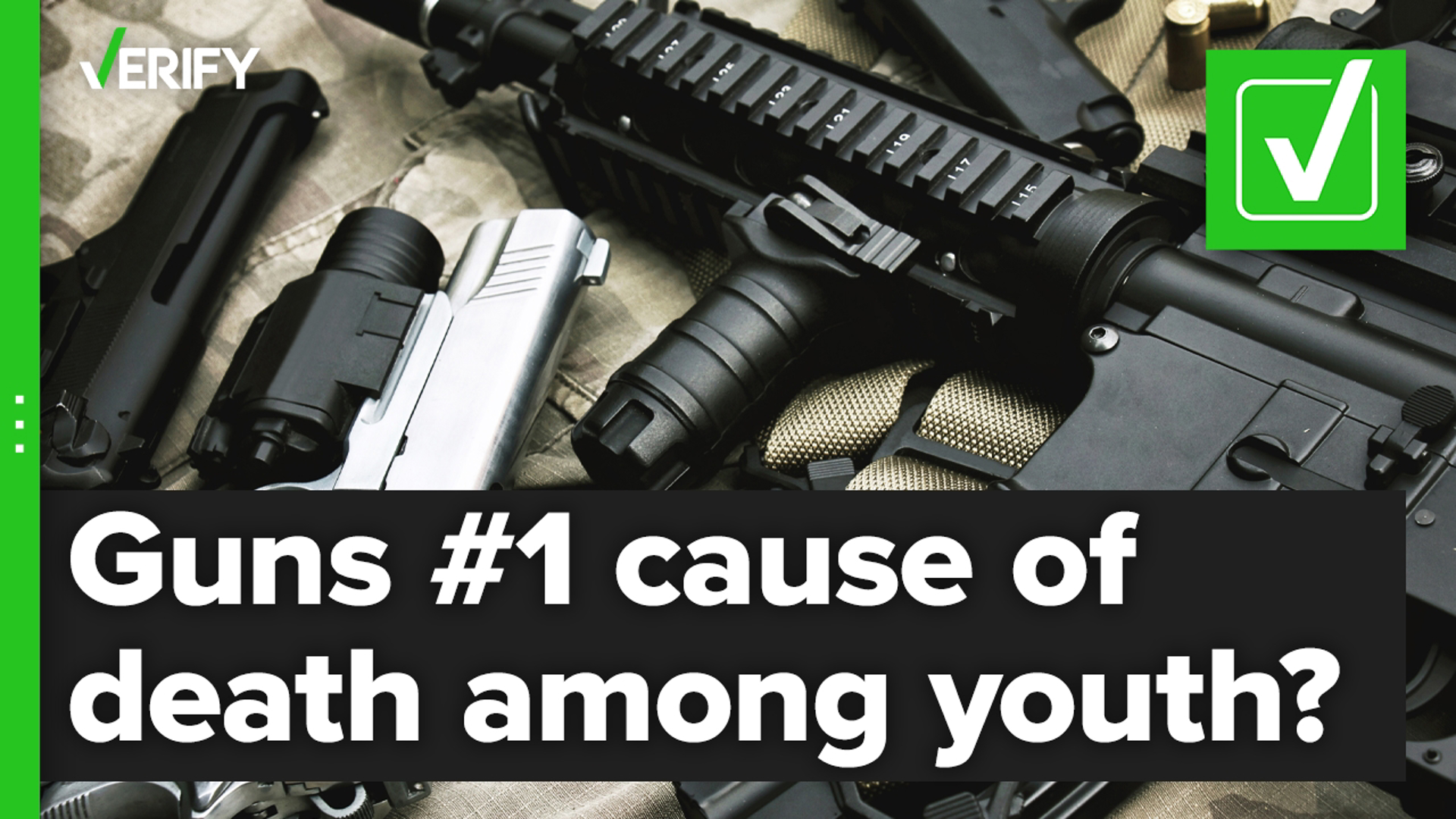
Firearms recently overtook car accidents as the leading cause of childhood deaths in the US, and more than 45,000 Americans die from gun violence each year.
The Gist: Gun violence is, and has long been, a serious public health crisis in this country. It is both important to remember, yet difficult for some to accept, that many mass shootings are preventable.
Health systems, as stewards of health in their communities, can play a central role in preventing gun violence at its source, both by bolstering mental health services and advocating for the needed legislative actions—supported by a strong majority of American voters—to stem this public health crisis.
As Northwell Health CEO Michael Dowling said this week, “Our job is to save lives and prevent people from illness and death. Gun violence is not an issue on the outside—it’s a central public health issue for us. Every single hospital leader in the United States should be standing up and screaming about what an abomination this is. If you were hesitant about getting involved the day before…May 24 should have changed your perspective. It’s time.”
Douglas MacArthur was one of the finest military leaders the United States ever produced. John Gardner, in his book On Leadership described him as a brilliant strategist, a farsighted administrator, and flamboyant to his fingertips. MacArthur’s discipline and principled leadership transcended the military. He was an effective general, statesman, administrator and corporate leader.
William Addleman Ganoe recalled in his 1962 book, MacArthur Close-up: An Unauthorized Portrait, his service to MacArthur at West Point. During World War II, he created a list of questions with General Jacob Devers, they called The MacArthur Tenets. They reflect the people-management traits he had observed in MacArthur. Widely applicable, he wrote, “I found all those who had no troubles from their charges, from General Sun Tzu in China long ago to George Eastman of Kodak fame, followed the same pattern almost to the letter.”
Do I heckle my subordinates or strengthen and encourage them?
Do I use moral courage in getting rid of subordinates who have proven themselves beyond doubt to be unfit?
Have I done all in my power by encouragement, incentive and spur to salvage the weak and erring?
Do I know by NAME and CHARACTER a maximum number of subordinates for whom I am responsible? Do I know them intimately?
Am I thoroughly familiar with the technique, necessities, objectives and administration of my job?
Do I lose my temper at individuals?
Do I act in such a way as to make my subordinates WANT to follow me?
Do I delegate tasks that should be mine?
Do I arrogate everything to myself and delegate nothing?
Do I develop my subordinates by placing on each one as much responsibility as he can stand?
Am I interested in the personal welfare of each of my subordinates, as if he were a member of my family?
Have I the calmness of voice and manner to inspire confidence, or am I inclined to irascibility and excitability?
Am I a constant example to my subordinates in character, dress, deportment and courtesy?
Am I inclined to be nice to my superiors and mean to my subordinates?
Is my door open to my subordinates?
Do I think more of POSITION than JOB?
Do I correct a subordinate in the presence of others?
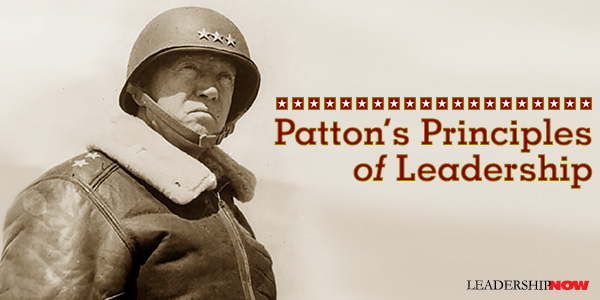
BORN in San Gabriel, California, in 1885, George S. Patton, Jr. was the general deemed most dangerous by the German High Command in World War II. Known for his bombastic style, it was mostly done to show confidence in himself and his troops, says author Owen Connelly.
On December 21, 1945, Patton died in Heidelberg, Germany. The following day the New York Times wrote the following editorial:
History has reached out and embraced General George Patton. His place is secure. He will be ranked in the forefront of America’s great military leaders.
Long before the war ended, Patton was a legend. Spectacular, swaggering, pistol-packing, deeply religious, and violently profane, easily moved to anger because he was first of all a fighting man, easily moved to tears because, underneath all his mannered irascibility, he had a kind heart, he was a strange combination of fire and ice. Hot in battle and ruthless, too. He was icy in his inflexibility of purpose. He was no mere hell-for-leather tank commander but a profound and thoughtful military student.
Everyone is to lead in person.
Commanders and staff members are to visit the front daily to observe, not to meddle. Praise is more valuable than blame. Your primary mission as a leader is to see with your own eyes and be seen by your troops while engaged in personal reconnaissance.
Issuing an order is worth only about 10 percent. The remaining 90 percent consists in assuring proper and vigorous execution of the order.
Plans should be simple and flexible. They should be made by the people who are going to execute them.
Information is like eggs. The fresher the better.
Every means must be used before and after combats to tell the troops what they are going to do and what they have done.
Fatigue makes cowards of us all. Men in condition do not tire.
Courage. Do not take counsel of your fears.
A diffident manner will never inspire confidence. A cold reserve cannot beget enthusiasm. There must be an outward and visible sign of the inward and spiritual grace.
Discipline is based on pride in the profession of arms, on meticulous attention to details, and on mutual respect and confidence. Discipline must be a habit so ingrained that it is stronger than the excitement of battle or the fear of death.
A good solution applied with vigor now is better than a perfect solution ten minutes later.
Americans and global leaders have responded to the May 24 shooting at a Texas elementary school with heartbreak, anger and calls for change to better fight gun violence. But if you’re paying attention, the calls out of healthcare — from trauma surgeons, pediatricians, nurses, leaders and more — carry a distinct type of exasperation and sorrow.
“I’m in one of my hospitals now, sitting with some staff talking about it — it’s just so frustrating,” Michael Dowling, president and CEO of New Hyde Park, N.Y.-based Northwell Health, told me over the phone early Wednesday morning. “This does not represent what the United States stands for — that we allow people who should never be allowed to carry a gun to do so and walk into a school and kill fourth graders.”
The attack by a lone 18-year-old gunman at Robb Elementary School in the small town of Uvalde, Texas, has left at least 19 students and two adults dead. Students in the school, grades 2 through 4, were two days away from summer vacation.
Unlike many other known threats to our health, seeing the medical community condemn mass shootings still seems to leave some Americans doing a double take. It’s increasingly difficult to see what has them confused.
In 2016, the American Medical Association declared gun violence a public health crisis after a lone gunman killed 49 people and wounded 53 more in a mass shooting in a gay nightclub in Orlando, Fla. Even after the declaration, healthcare professionals and leaders continued to defy insistence from gun rights advocates that gun violence was not within their specialty or expertise. Or as the National Rifle Association put it in simpler terms in 2018: “Someone should tell self-important anti-gun doctors to stay in their lane.” The #ThisIsOurLane movement started then. The attempt to silence medical professionals ironically made their calls for action louder.
As healthcare professionals responded to the ongoing public health emergency of COVID-19, the arms race grew and gun buying intensified — “a surge in purchasing unlike anything we’ve ever seen,” as one gun researcher at the University of California, Davis, put it. People who already owned guns bought more, and people who had never owned a gun bought them too. In 2020, firearm-related injuries were the No. 1 cause of death of children and teens, according to the CDC.
Every day, 321 people are shot in the United States, and more than 40,000 Americans die from gun violence each year. Yet some healthcare executives still fear that taking the position that gun violence is a public health crisis will throw them into political turmoil given how toxic politics are in this country. It’s one position for the AMA and its 250,000-plus members to take, but another for an individual leader who may be the face of an organization in their community. There are risks of offending board members, donors, elected officials and other constituents — including patients. But here’s the thing: There will always be a reason to delay, to soften language, to wonder if this mass shooting is the one to react to.
Mr. Dowling urges his colleagues to step it up, noting how hospital and health system leaders can be ambassadors for gun safety in their communities, given the influence they wield as the largest employers in many communities.
“This is about protecting people’s health. This is about protecting kids’ lives. Have some courage. Stand up and do something,” he said. “Put the interest of the community in the center of what you think about each and every day. Our job is to save lives and prevent people from illness and death. Gun violence is not an issue on the outside — it’s a central public health issue for us. Every single hospital leader in the United States should be standing up and screaming about what an abomination this is.
“If you were hesitant about getting involved the day before May 24, May 24 should have changed your perspective. It’s time.”
Northwell established The Gun Violence Prevention Learning Collaborative for Health Systems and Hospitals, a grassroots initiative that gives healthcare professionals the space to have open dialogue about the impact of gun violence, share best practices and collectively take action. Learn more here.









 HENRY KOTULA