One of the things I’ve always found most fascinating about news coverage and policymaker attention to health insurers is how little focus is placed on what these companies say to their investors.
It’s no secret that each quarter, all public companies update their shareholders and provide guidance for the future. When I was at Cigna, preparing the CEO to speak with reporters and investor analysts was arguably considered the most important role I had every three months.
Mining insights from those earnings reports has been a focus of mine since I became an insurance industry whistleblower. Recently, for example, we’ve highlighted how CVS/Aetna, in particular, has taken a beating on its stock price for reporting increased spending on medical care by seniors in Medicare Advantage plans.
Now, though, CEOs have become even more public and open, beyond their quarterly earnings calls, about the challenges they are having extracting further profit from the Medicaid and Medicare programs. This should be noted, particularly by the bipartisan group of lawmakers in Washington increasingly eyeing regulatory reform on insurer practices like prior authorization, as evidence that insurers are going to become even more aggressive in limiting care to preserve their 2024 profits.
Centene’s CEO saida few days ago that medical claims are increasing in the company’s managed Medicaid business. UnitedHealth and Elevance, which owns several Blue Cross Blue Shield companies that have converted to for-profit status, also recently reported they’re seeing similar results. Combined with increased medical spending on Medicare Advantage claims, one might guess this would begin to worry investors that insurers would lower their profit forecasts.
But none of these companies have so far expressed concern about not meeting their 2024 profit expectations.
So, medical claims in Medicaid and Medicare Advantage plans – now the majority of the business for many of the largest insurers – are rising, but these companies aren’t expecting to disappoint Wall Street with a drop in profits. How is that possible?
Because insurers can deploy the tools to prevent patients from accessing care. And their playbook isn’t secret, or complicated.
By further increasing prior authorization in Medicaid and Medicare Advantage plans, insurers can limit how many seniors and low-income Americans follow through with legitimate care and procedures. (Here’s a recent congressional report on increased hurdles insurers have put in place to prevent children from receiving preventive care in Medicaid plans. And insurers’ increasing use of prior authorization in Medicare Advantage is something we’ve regularly covered.)
Unlike their marketplace and employer-based plans, insurers can’t negotiate reimbursement rates for Medicaid and Medicare Advantage plans that they manage.
But beyond prior authorization, they can put other layers of bureaucracy in place that increase how long it takes a provider to be reimbursed for providing care – and to make it more complicated for doctors to ensure they’re reimbursed fully for the care they provide.
In effect, these tactics can amount to decreasing the already industry-low rate of reimbursement for doctors from the Medicaid and Medicare Advantage programs. Physicians, you should expect to see more hurdles to reimbursement in these programs throughout the balance of 2024 as insurers look to hoard as much cash as they can.
In Medicare Advantage plans, insurers can pursue the industry jargon of a “benefit buydown” to further shift costs onto plan enrollees and off insurers themselves. Because the federal government pays insurers a flat amount per Medicare Advantage enrollee, regardless of how much health care spending each patient has, it is in the insurers’ financial interest to claim that seniors and disabled people enrolled in their plans are sicker than they really are.
Rising out-of-pocket costs that seniors and disabled people in Medicare Advantage plans are facing is a consequence of insurers wanting to squeeze further profits out of the program, and is a way to maintain direct government payments per enrollee within the insurers’ coffers.
Physicians for a National Health Program estimate nearly 12 million seniors are in a Medicare Advantage plan that excludes more than 70% of doctors in their county.
Negative stories about Medicare Advantage (MA) insurers are finally making it to mainstream media after percolating below the surface for years. More and more patients, physicians, and even health care executives are speaking up about the disastrous expansion of this program. Shockingly, some of these stories have come from the insurance companies themselves.
With no hint of shame or irony, executives like CFO Thomas Cowhey of CVS Health have delivered lines such as “The goal next year is margin over membership,” making explicit that more money is their mantra. With all these reports of limited networks, care denials, delayed payments, and corporate greed, you may feel like the story of MA can’t get any worse.
Impossibly, it does. Physicians for a National Health Program (PNHP) has just recently released a bombshell report exposing the sheer breadth of harm that MA insurers have done to patients and health care workers across the country. The report combines policy analysis of dozens of academic studies, news reports, and government investigations with personal stories from people hurt by the insurance companies running these plans. We want to take some time to explore the report’s findings, and highly encourage you to read it in full as well.
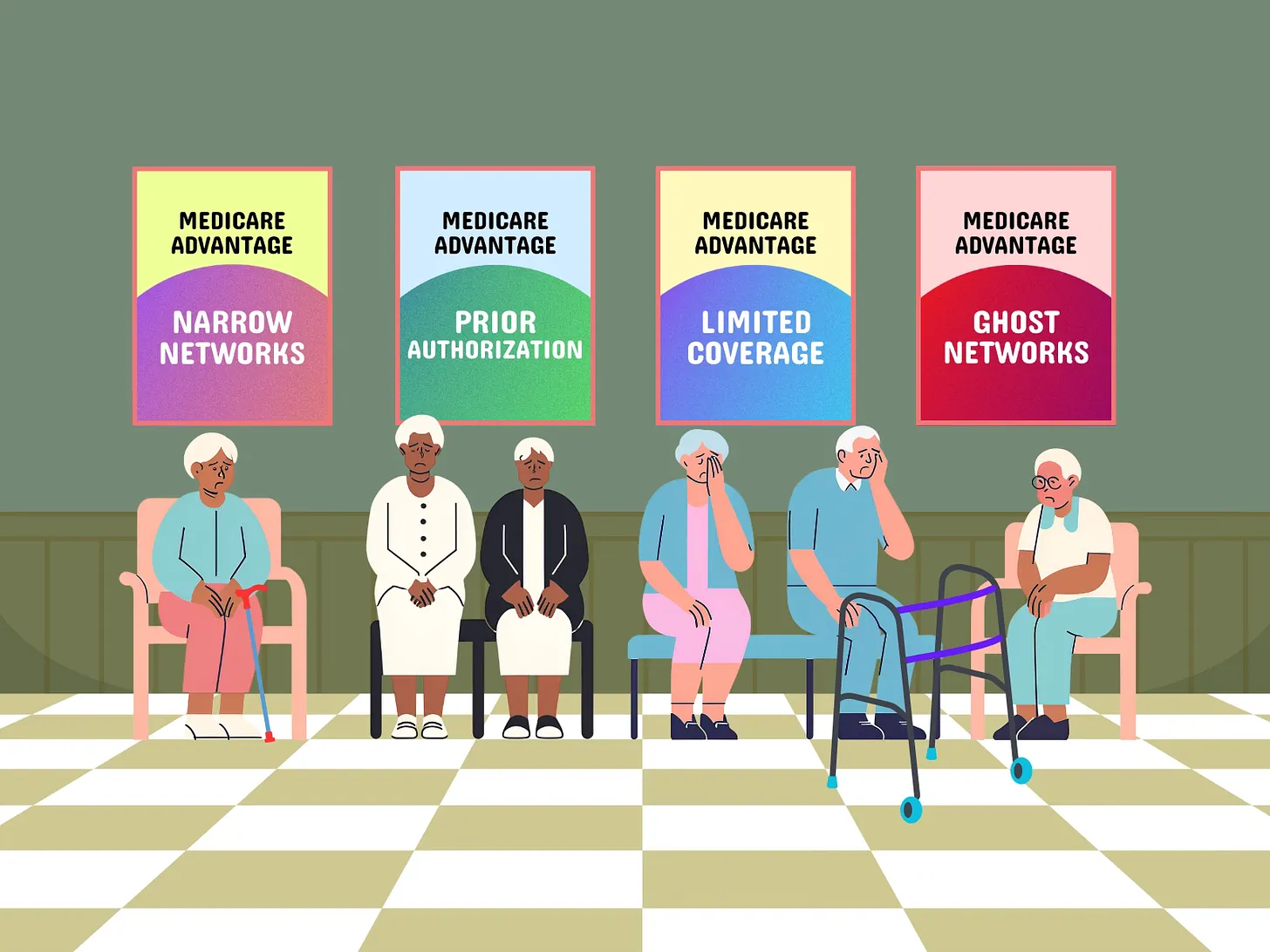
Patients in MA experience difficulties from the moment they begin to seek care. By PNHP’s estimate, 11.7 million beneficiaries are in a plan that excludes more than 70% of doctors in their county. These narrow networks mean that patients often have to travel hours for an appointment, and can’t see their preferred family physician or the right specialist for their condition. This can have dire consequences.
One study found that cancer patients in MA are less likely to be treated at teaching hospitals, Commission on Cancer-accredited hospitals, or National Cancer Institute-designated centers. As a result, these patients suffer higher mortality rates following surgery for a number of kinds of cancer, with some cancer patients in MA plans being twice as likely to die as those in traditional Medicare.
Put simply, narrow networks designed to reap profits in MA are killing patients.
Even if they’re able to find the right doctor, getting care doesn’t become any easier. MA insurers almost always require prior authorization for standard, evidence-based tests, procedures, and treatments, making patients wait weeks or even months to get the life-saving care they need now.
In one story from the report, a physician recounts how damaging this practice can be:
I had a patient with several chronic diseases who was very sick and had just survived major abdominal surgery, almost miraculously. In the aftermath, she desperately needed to go to acute rehab, which is the most intensive rehab – we found a facility, she liked it, her family liked it, and then her MA plan looked at the place and said ‘No, she’s healthy enough to not go to acute rehab, we won’t authorize it.’ This was after our PM&R specialist, physical therapist, and 3 MDs on our team had told her she needed acute rehab, and that it was the only thing that would keep her out of the hospital again. And this insurer, without anyone ever looking at her, rejected that conclusion. And we knew that on traditional Medicare this never would’ve happened.
Prior authorization is also a gigantic waste of time and resources for doctors and health care workers who want to spend that time caring for patients. PNHP found that medical practices are forced to waste between 11.1 and 20.5 million hours per year filling out authorization forms and fighting with insurance companies to get necessary care approved.
Much of this is done arbitrarily, wearing patients down with bureaucracy so the insurance company doesn’t have to pay for treatment. When challenged on appeal, somewhere around 80% of denials are reversed, proving there was no good medical reason for the denial in the first place.
Assuming you can find a doctor in your narrow network, and that your doctor makes it through the red-tape nightmare to get your necessary care approved, you may then find yourself dealing with severely limited coverage and thousands of dollars in medical bills. In fact, 7.3 million beneficiaries in MA are considered underinsured based on their reporting of high health care costs. Seniors and people with disabilities are often enticed into MA by advertisements or insurance brokers who tout low premiums and supplemental benefits as big perks of their plans, only to find that once they actually become sick, coverage dries up fast.
After experiencing all of these hardships, many beneficiaries find themselves wanting to get out of MA and go to traditional Medicare, and studiesshow that those who are seriously ill or who have high health care costs indeed switch out of the program at high rates. Unfortunately, if you stay in MA too long, you may be trapped in the program for good.
For the first twelve months someone is in MA, they have a guarantee that no Medigap insurer can deny them a policy. However, once this period is up, this guarantee disappears in 46 of 50 states.
If you decide to switch back to traditional Medicare after a year, you are no longer guaranteed to receive this coverage, and you can be denied a policy on the basis of “pre-existing conditions,” a practice that most believe was fully outlawed following the passage of the Affordable Care Act.
Imagine you get sick while in MA, and rack up thousands of dollars in medical bills that you can’t pay. When you try to switch to traditional Medicare, you can be denied Medigap coverage because of the very illness that made you need to leave MA. Many people simply cannot afford Medicare without Medigap, meaning their only option is to stay in their MA plan.
If all of this seems crazy, that’s because it is. Medicare Advantage is a total rejection of the founding principles of Medicare and health care in general, and every harmful practice in this report is done in the name of profit. Restricting networks, denying care, refusing to cover costs–these are all ways that insurance companies in MA keep our taxpayer dollars while leaving patients and health care workers to deal with the consequences. We need to work together to get these greedy middlemen out of Medicare before they take it over entirely. Our hard-earned dollars should be going to traditional Medicare, the program that actually serves its constituents.
Medicare spends huge sums financing the dental, vision and other benefits offered by Medicare Advantage plans. A new government report sounds the alert about their potential misuse.
In mid-March, the Medicare Payments Advisory Commission (MedPAC), which advises Congress on Medicare policy, made a bombshell disclosure in its annual Medicare report. The rebates that Medicare offers Medicare Advantage plans for supplemental benefits like vision, dental, and gym membership were at “nearly record levels”, more than doubling from 2018 to nearly $64 billion in 2024, but the government “does not have reliable information about enrollees’ actual use of these benefits at this time.”
In other words: $64 billion is being spent to subsidize private Medicare Advantage plans to provide benefits that are not available to enrollees in traditional Medicare, and the government has no idea how they are being spent.
Not only is this an enormous potential misallocation of taxpayer resources from the Medicare trust fund, it is also a critical part of Medicare Advantage’s marketing scam. The additional benefits offered in Medicare Advantage plans are what entice people to give up traditional Medicare, where there is no prior authorization, closed networks, or care denials.
But, as MedPAC states in the report, even though the Centers for Medicare and Medicaid Services (CMS) does not collect the data on utilization of supplemental benefits, what little data there is does not paint a pretty picture, with MedPAC noting that, “Limited data suggest that use of non-Medicare-covered supplemental benefits is low.”
HEALTH CARE un-covered is among the first media outlet to report MedPAC’s findings.
A 2018 study by Milliman, an actuarial firm, found that just 11 percent of Medicare Advantage beneficiaries had claims for dental care in that year, and that “multiple studies using survey data have found that beneficiaries with dental coverage in MA are not more likely to receive dental services than other Medicare beneficiaries.” A study from the Consumer Healthcare Products Association found that just one-third of eligible participants in Medicare Advantage plans used an over-the-counter medication benefit at pharmacies, leaving $5 billion annually on the table for insurers to pocket. Elevance Health, formerly Anthem, has 42 supplemental benefits available to Medicare Advantage beneficiaries. They analyzed a subset of 860,000 beneficiaries. For six of the 42 benefits, the $124 billion insurer could not report utilization data. For the other 36 supplemental benefits, the bulk of those covered used fewer than four benefits, with a full quarter not using any benefits at all and a majority using one or less benefits.
Medpac added that it had “previously reported that while these benefits often include coverage for vision, hearing, or dental services, the non-Medicare supplemental benefits are not necessarily tailored toward populations that have the greatest social or medical needs. The lack of information about enrollees’ use of supplemental benefits makes it difficult to determine whether the benefits improve beneficiaries’ health.”
With studies already showing that Medicare Advantage is associated with increased racial disparities in seniors’ health care, the massive subsidies provided to supplemental benefits appears to be an inadvertent driver of this problem:
the $64 billion—at least the portion of it that is actually being spent as opposed to deposited into insurer coffers—is likely not going to the populations that actually need it.
Amber Christ is the managing director of health policy for Justice in Aging, which advocates for the rights of seniors. “Health plans are receiving a large amount of dollars to provide supplemental benefits through rebates to plans. Clearly the offering have expanded, but the extent that they are being used is a black box,” she said. What little we do know, she said, indicates a “real lack of utilization.”
Christ pointed out that the Biden administration has taken some significant steps forward. “We’ve seen some good things coming out of CMS that will bring some transparency—the plans are going to have to report spending and utilization data, and in 2026 they will have to start sending notices to enrollees at the six-month point, letting people know what benefits they have used and what’s available. Those are all good moves.”
What’s missing from the proposed rule-making, however, is how the colossal outlays to supplemental benefits impact the goal of health equity, Christ said. “What we would have wanted to see more is demographics around utilization. Are there disparities in access?”
Of particular concern to advocates is the way that Medicare Advantage plans use supplemental benefits to market to “dual eligibles,” people who are eligible for Medicaid and Medicare. Medicare Advantage plans have taken to offering what amounts to cash benefits to dual eligibles, which provides a very strong incentive for people to sign up for Medicare Advantage.
But it’s effectively a trap, as being in both Medicare Advantage and Medicaid can not only result in prior authorization, care denials, and losing access to one’s physician, but also making care endlessly complex.
“Medicaid offers a bunch of supplemental benefits, either fully or often more comprehensively than Medicare Advantage. Seniors get lured into these health plans for benefits that they already have access to. But because benefits between Medicare Advantage and Medicaid aren’t coordinated people experience disruptions to their access to care. If they are dually enrolled it should go above and beyond, not duplicate coverage or making it more difficult to access coverage,” Christ said.
David Lipschutz, the associate director of the Center for Medicare Advocacy, related an experience he had with a state health official who counseled a senior against enrolling in Medicare Advantage. The official “was able to stop them and help them think through their choices. She wanted to enroll in a Medicare Advantage plan that offered a flex benefit,” which is basically restricted cash (Aetna, for example, restricts its recipients to spending the money at stores owned by CVS Health, its parent company). “None of her five doctors contracted with the Medicare Advantage plan. Had it not been with that interaction with the health counselor. She would have traded the flex card for no access to her current physicians. It’s an untenable situation.”
Lipschutz added that Medicare Advantage insurers contract with community organizations to administer supplemental benefits, which helps to insulate the industry from political pressure from advocates in Washington. “This whole new range of supplemental benefits has also at the same time pulled in a lot of community based organizations. They need the cash that the plans are offering. It creates a welcome dynamic for insurance companies trying to make community organizations dependent on their money. But it’s not a good situation to be in when you’re trying to reign in Medicare Advantage overpayments.”
Bid/Ask
The core of the financing of supplemental benefits is through a bid system, in which CMS sets a benchmark based on area fee-for-service Medicare spending, and then invites insurers to submit a bid, and then receives a rebate for supplemental benefits based on the benchmark. The essential problem is that the average person in traditional Medicare is sicker than someone in a Medicare Advantage plan—the research shows that when patients get sick, they leave Medicare Advantage for traditional Medicare if they can. And Medicare Advantage plans aggressively market to healthier patients—the oft-touted gym membership supplemental benefit only works for those who actually work out at the gym regularly. (Well under one-third of those 75 and over.)
And in counties with low traditional Medicare spending, the benchmark is at 115 or 107.5 percent—an unreasonable and massive subsidy written into the Affordable Care Act at the behest of the insurance lobby. The lowest benchmark is at 95 percent of FFS spending for areas with high costs.
“The way the payment is set up leads to this excessive amount of rebate dollars,” said Lipschutz. “It’s a fundamentally flawed payment system which is in dire need of reform.” Lipschutz’s position jives with the MedPAC report, which states that: “A major overhaul of MA policies is urgently needed.”
Supplements For Half
“You shouldn’t have to enroll in a private plan just to access these benefits,” said Lipschutz. But that’s exactly the choice millions of seniors are faced with. Forty-nine percent of seniors remain in traditional Medicare.
And for that group, Medicare offers no supplemental benefits, Christ said. “As a foundational principle spending all this money for Medicare Advantage to give supplemental benefits doesn’t make sense. This is the Medicare trust fund. Half of Medicare has “access,” and the other half, in traditional Medicare, doesn’t. Wouldn’t those dollars be better spent giving everyone access? Especially when we understand that Medicare Advantage has narrower providers and prior authorization.
There’s a recognition that these supplemental benefits have positive impacts on quality of life, but we’re not offering it in traditional Medicare—even though Medicare Advantage is not doing a better job than traditional Medicare.”
House of Cards?
A new lawsuit, filed in April, could substantially impact the incentives that plans have to offer supplemental benefits. To manage costs, many Medicare Advantage plans have value-based care arrangements with providers—meaning that they share some of their revenues with hospitals and other health providers to ensure access to networks and to smooth costs out in the long run.
But as part of this arrangement, providers bear some of the costs of the plans—including the cost of supplemental benefits. Bridges Health Partners, which is a clinically integrated network of doctors and hospitals, sued Aetna to block the allocation of supplemental benefits to the expenses that they bear the cost of, due to a 20-fold increase in their costs.
Combined with the 2026 requirement from CMS that participants be informed as to what benefits they haven’t used, insurers’ ability to offer these supplemental benefits and still retain sky-high profit margins could be curtailed.
I wrote Monday about how the additional Medicare claims CVS/Aetna paid during the first three months of this year prompted a massive selloff of the company’s shares, sending the stock price to a 15-year low.
During CVS’s May 1 call with investors, CEO Karen Lynch and CFO Thomas Cowhey assured them the company had already begun taking action to avoid paying more for care in the future than Wall Street found acceptable.
Among the solutions they mentioned:
Ratcheting up the process called prior authorization that results in delays and denials of coverage requests from physicians and hospitals; kicking doctors and hospitals out of its provider networks; hiking premiums; slashing benefits; and abandoning neighborhoods where the company can’t make as much money as investors demand.
On Tuesday at the Bank of America Securities Healthcare Conference, Cowhey doubled down on that commitment to shareholders and provided a little more color about what those actions would look like and how many human beings would be affected. As Modern Healthcare reported:
Headed into next year, Aetna may adjust benefits, tighten its prior authorization policies, reassess its provider networks and exit markets, CVS Chief Financial Officer Tom Cowhey told investors. It will also reevaluate vision, dental, flexible spending cards, fitness and transportation benefits, he said. Aetna is also working with its employer Medicare Advantage customers on how to appropriately price their business, he said.
Could we lose up to 10% of our existing Medicare members next year? That’s entirely possible, and that’s OK because we need to get this business back on track,” Cowhey said.
Insurers use the word “members” to refer to people enrolled in their health plans. You can apply for “membership” and pay your dues (premiums), but insurers ultimately decide whether you can stay in their clubs. If they think you’re making too many trips to the club’s buffet or selecting the most expensive items, your membership can–and will–be revoked.
That mention of “employer Medicare Advantage customers” stood out to me and should be of concern to people like New York Mayor Eric Adams, who was sold on the promise that the city could save millions by forcing municipal retirees out of traditional Medicare and into an Aetna Medicare Advantage plan. A significant percentage of Aetna’s Medicare Advantage “membership” includes people who retired from employers that cut a deal with Aetna and other insurers to provide retirees with access to care. Despite ongoing protests from thousands of city retirees, Adams has pressed ahead with the forced migration of retirees to Aetna’s club. He and the city’s taxpayers will find out soon that Aetna will insist on renegotiating the deal.
Back to that 10%. Aetna now has about 4.2 million Medicare Advantage “members,” but it has decided that around 420,000 of those human beings must be cut loose. Keep in mind that those humans are not among the most Internet-savvy and knowledgeable of the bewildering world of health insurance. Many of them have physical and mental impairments. They will be cast to the other wolves in the Medicare Advantage business.
Welcome to a world in which Wall Street increasingly calls the shots and decides which health insurance clubs you can apply to and whether those clubs will allow you to get the tests, treatments and medications you need to see another sunrise.
As Modern Healthcare noted, Aetna is not alone in tightening the screws on its Medicare Advantage members and setting many of them adrift. Humana, which has also greatly disappointed Wall Street because of higher-than-expected health care “utilization,” told investors it would be taking the same actions as Aetna.
But Aetna in particular has a history of ruthlessly cutting ties with humans who become a drain on profits. As I wrote in Deadly Spin in 2010:
Aetna was so aggressive in getting rid of accounts it no longer wanted after a string of acquisitions in the 1990s that it shed 8 million (yes, 8 million) enrollees over the course of a few years. The Wall Street Journal reported in 2004 that Aetna had spent more than $20 million to install new technology that enabled it “to identify and dump unprofitable corporate accounts.” Aetna’s investors rewarded the company by running up the stock price.
I added this later in the book:
One of my responsibilities at Cigna was to handle the communication of financial updates to the media, so I knew just how important it was for insurers not to disappoint investors with a rising MLR [medical loss ratio, the ratio of paid claims to revenues]. Even very profitable insurers can see sharp declines in their stock prices after admitting that they had failed to trim medical expenses as much as investors expected. Aetna’s stock price once fell more than 20% in a single day after executives disclosed that the company had spent slightly more on medical claims during the most recent quarter than in a previous period. The “sell alarm” was sounded when the company’s first quarter MLR increased to 79.4% from 77.9% the previous year.
I could always tell how busy my day was going to be when Cigna announced earnings by looking at the MLR numbers. If shareholders were disappointed, the stock price would almost certainly drop, and my phone would ring constantly with financial reporters wanting to know what went wrong.
May 1 was a deja-vu-all-over-again day for Aetna. You can be certain the company’s flacks had a terrible day–but not as terrible as the day coming soon for Aetna’s members when they try to use their membership cards.
Speaking of Lynch, one of the people commenting on the piece I wrote Monday suggested I might have been a bit too tough on Lynch, who I know and liked as a human being when we both worked at Cigna. The commenter wrote that:
After finishing Karen S. Lynch’s book, “Taking Up Space,” I came to the conclusion that she indeed has a very strong conscience and sense of responsibility, not totally to shareholders, but more importantly to the insured people under Aetna and the customers of CVS.”
I don’t doubt Karen Lynch is a good person, and I know she is someone whose rise to become arguably the business world’s most powerful woman was anything but easy, as the magazine for alumni of Boston College, her alma mater, noted in a profile of her last year. Quoting from a speech she delivered to CVS employees a few years earlier, Daniel McGinn wrote:
Lynch began with a story to illustrate why she was so passionate about health care. She described how she’d grown up on Cape Cod as the third of four children. Her parents’ relationship broke up when she was very young and her father disappeared, leaving her mom, Irene, a nurse who struggled with depression, as a single parent. In 1975, when Lynch was 12, Irene took her own life, leaving the four children effectively orphaned.
During her speech, several thousand employees listened in stunned silence as Lynch explained how her mom’s life might have turned out differently if she’d had access to better medical treatment, or if there’d been less stigma and shame about getting help for depression. She then talked about how an insurance company like Aetna could play a role in reducing that stigma, increasing access to care, and helping people live with mental illness.
I’m sure when she goes home at night these days, Lynch worries about what will happen to those 420,000 other humans who will soon be scrambling to get the care they need or to find another club that will take them. Their lives most definitely will turn out differently to appease the rich people who control her and the rest of us.
But she is stuck in a job whose real bosses–investors and Wall Street financial analysts–care far more about the MLR, earnings per share and profit margins than the fate of human beings less fortunate than they are.
The Affordable Care Act turned 14 on March 23. It has done a lot of good for a lot of people, but big changes in the law are urgently needed to address some very big misses and consequences I don’t believe most proponents of the law intended or expected.
At the top of the list of needed reforms: restraining the power and influence of the rapidly growing corporations that are siphoning more and more money from federal and state governments – and our personal bank accounts – to enrich their executives and shareholders.
I was among many advocates who supported the ACA’s passage, despite the law’s ultimate shortcomings. It broadened access to health insurance, both through government subsidies to help people pay their premiums and by banning prevalent industry practices that had made it impossible for millions of American families to buy coverage at any price. It’s important to remember that before the ACA, insurers routinely refused to sell policies to a third or more applicants because of a long list of “preexisting conditions” – from acne and heart disease to simply being overweight – and frequently rescinded coverage when policyholders were diagnosed with cancer and other diseases.
While insurance company executives were publicly critical of the law, they quickly took advantage of loopholes (many of which their lobbyists created) that would allow them to reap windfall profits in the years ahead – and they have, as you’ll see below.
I wrote and spoke frequently as an industry whistleblower about what I thought Congress should know and do, perhaps most memorably in an interview with Bill Moyers. During my Congressional testimony in the months leading up to the final passage of the bill in 2010, I told lawmakers that if they passed it without a public option and acquiesced to industry demands, they might as well call it “The Health Insurance Industry Profit Protection and Enhancement Act.”
A health plan similar to Medicare that could have been a more affordable option for many of us almost happened, but at the last minute, the Senate was forced to strip the public option out of the bill at the insistence of Sen. Joe Lieberman (I-Connecticut), who died on March 27, 2024. The Senate did not have a single vote to spare as the final debate on the bill was approaching, and insurance industry lobbyists knew they could kill the public option if they could get just one of the bill’s supporters to oppose it. So they turned to Lieberman, a former Democrat who was Vice President Al Gore’s running mate in 2000 and who continued to caucus with Democrats. It worked. Lieberman wouldn’t even allow a vote on the bill if it created a public option. Among Lieberman’s constituents and campaign funders were insurance company executives who lived in or around Hartford, the insurance capital of the world. Lieberman would go on to be the founding chair of a political group called No Labels, which is trying to find someone to run as a third-party presidential candidate this year.
The work of Big Insurance and its army of lobbyists paid off as insurers had hoped. The demise of the public option was a driving force behind the record profits – and CEO pay – that we see in the industry today.
The good effects of the ACA:
Nearly 49 million U.S. residents (or 16%) were uninsured in 2010. The law has helped bring that down to 25.4 million, or 8.3% (although a large and growing number of Americans are now “functionally uninsured” because of unaffordable out-of-pocket requirements, which President Biden pledged to address in his recent State of the Union speech).
The ACA also made it illegal for insurers to refuse to sell coverage to people with preexisting conditions, which even included birth defects, or charge anyone more for their coverage based on their health status; it expanded Medicaid (in all but 10 states that still refuse to cover more low-income individuals and families); it allowed young people to stay on their families’ policies until they turn 26; and it required insurers to spend at least 80% of our premiums on the health care goods and services our doctors say we need (a well-intended provision of the law that insurers have figured out how to game).
The not-so-good effects of the ACA:
As taxpayers and health care consumers, we have paid a high price in many ways as health insurance companies have transformed themselves into massive money-making machines with tentacles reaching deep into health care delivery and taxpayers’ pockets.
To make policies affordable in the individual market, for example, the government agreed to subsidize premiums for the vast majority of people seeking coverage there, meaning billions of new dollars started flowing to private insurance companies. (It also allowed insurers to charge older Americans three times as much as they charge younger people for the same coverage.) Even more tax dollars have been sent to insurers as part of the Medicaid expansion. That’s because private insurers over the years have persuaded most states to turn their Medicaid programs over to them to administer.
We invite you to take a look at how the ascendency of health insurers over the past several years has made a few shareholders and executives much richer while the rest of us struggle despite – and in some cases because of – the Affordable Care Act.
BY THE NUMBERS
In 2010, we as a nation spent $2.6 trillion on health care. This year we will spend almost twice as much – an estimated $4.9 trillion, much of it out of our own pockets even with insurance.
In 2010, the average cost of a family health insurance policy through an employer was $13,710. Last year, the average was nearly $24,000, a 75% increase.
The ACA, to its credit, set an annual maximum on how much those of us with insurance have to pay before our coverage kicks in, but, at the insurance industry’s insistence, it goes up every year. When that limit went into effect in 2014, it was $12,700 for a family. This year, it has increased by 48%, to $18,900. That means insurers can get away with paying fewer claims than they once did, and many families have to empty their bank accounts when a family member gets sick or injured. Most people don’t reach that limit, but even a few hundred dollars is more than many families have on hand to cover deductibles and other out-of-pocket requirements.
Now 100 million Americans – nearly one of every three of us – are mired in medical debt, even though almost 92% of us are presumably “covered.” The coverage just isn’t as adequate as it used to be or needs to be.
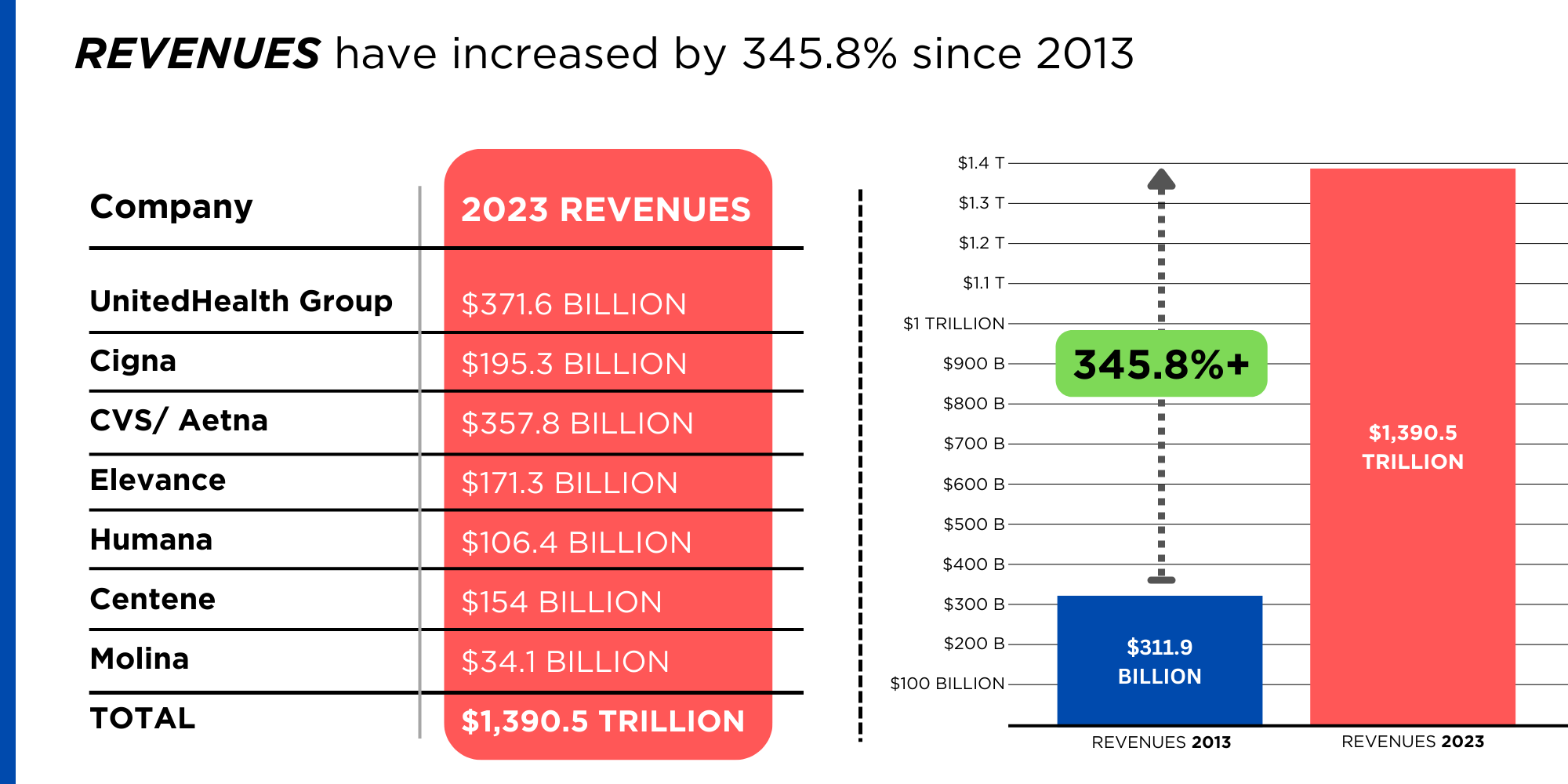
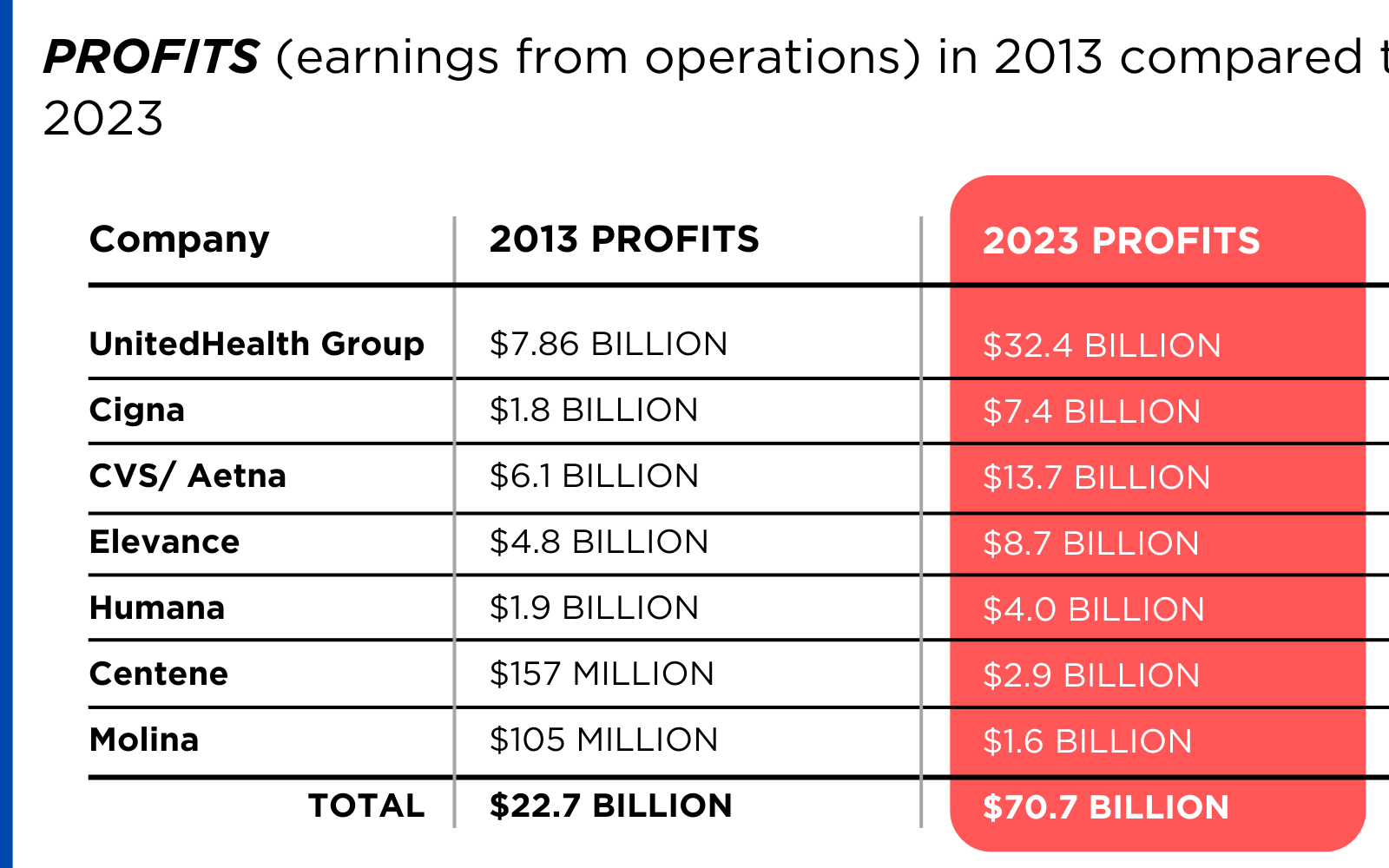
Meanwhile, insurance companies had a gangbuster 2023. The seven big for-profit U.S. health insurers’ revenues reached $1.39 trillion, and profits totaled a whopping $70.7 billion last year.
SWEEPING CHANGE, CONSOLIDATION–AND HUGE PROFITS FOR INVESTORS
Insurance company shareholders and executives have become much wealthier as the stock prices of the seven big for-profit corporations that control the health insurance market have skyrocketed.
NOTE: The Dow Jones Industrial Average is listed on this chart as a reference because it is a leading stock market index that tracks 30 of the largest publicly traded companies in the United States.
REVENUES collected by those seven companies have more than tripled (up 346%), increasing by more than $1 trillion in just the past ten years.
PROFITS (earnings from operations) have more than doubled (up 211%), increasing by more than $48 billion.
The CEOs of these companies are among the highest paid in the country. In 2022, the most recent year the companies have reported executive compensation, they collectively made $136.5 million.
U.S. HEALTH PLAN ENROLLMENT
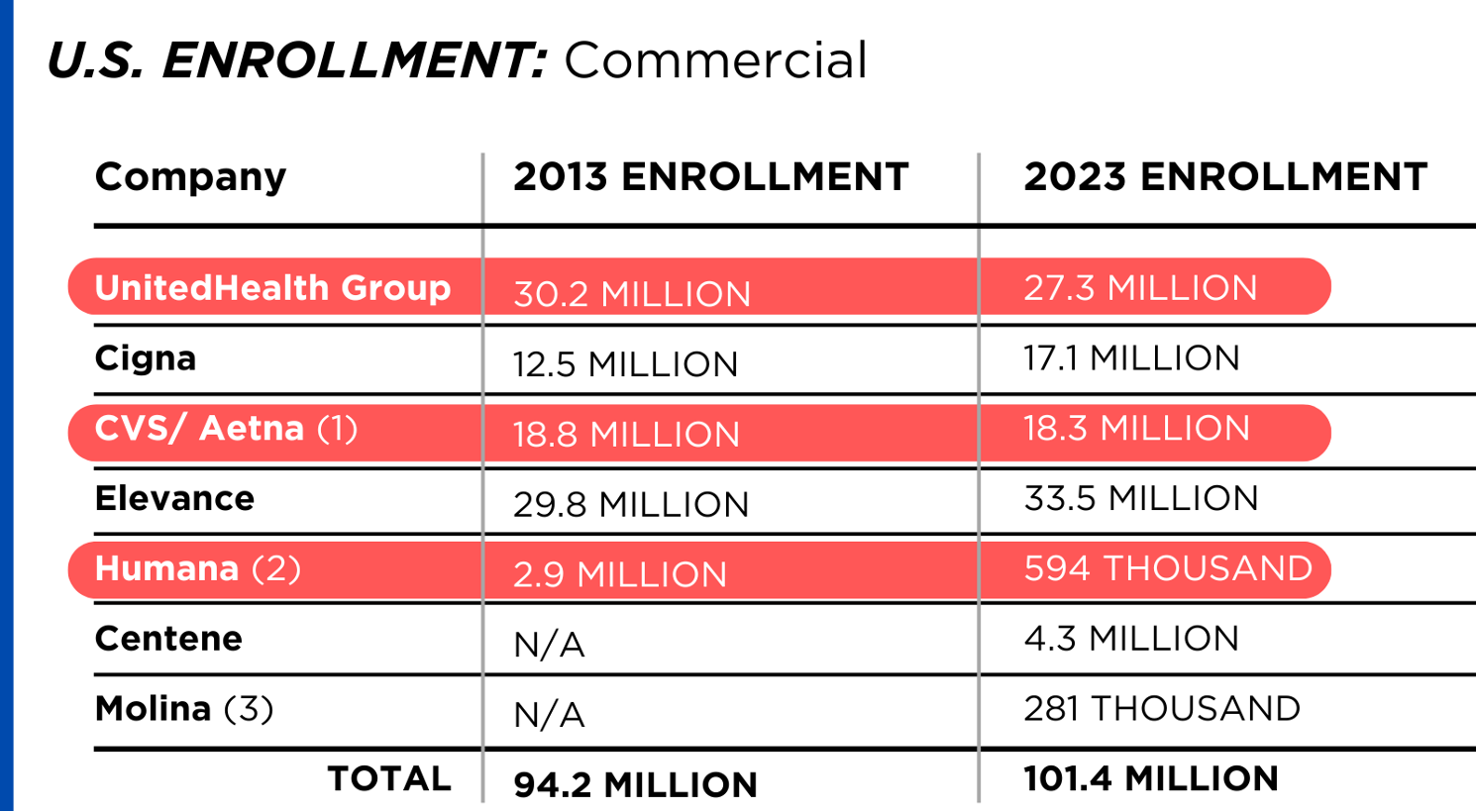
Enrollment in the companies’ health plans is a mix of “commercial” policies they sell to individuals and families and that they manage for “plan sponsors” – primarily employers and unions – and government/enrollee-financed plans (Medicare, Medicaid, Tricare for military personnel and their dependents and the Federal Employee Health Benefits program).
Enrollment in their commercial plans grew by just 7.65% over the 10 years and declined significantly at UnitedHealth, CVS/Aetna and Humana. Centene and Molina picked up commercial enrollees through their participation in several ACA (Obamacare) markets in which most enrollees qualify for federal premium subsidies paid directly to insurers.
While not growing substantially, commercial plans remain very profitable because insurers charge considerably more in premiums now than a decade ago.
(1) The 2013 total for CVS/Aetna was reported by Aetna before its 2018 acquisition by CVS. (2) Humana announced last year it is exiting the commercial health insurance business. (3) Enrollment in the ACA’s marketplace plans account for all of Molina’s commercial business.
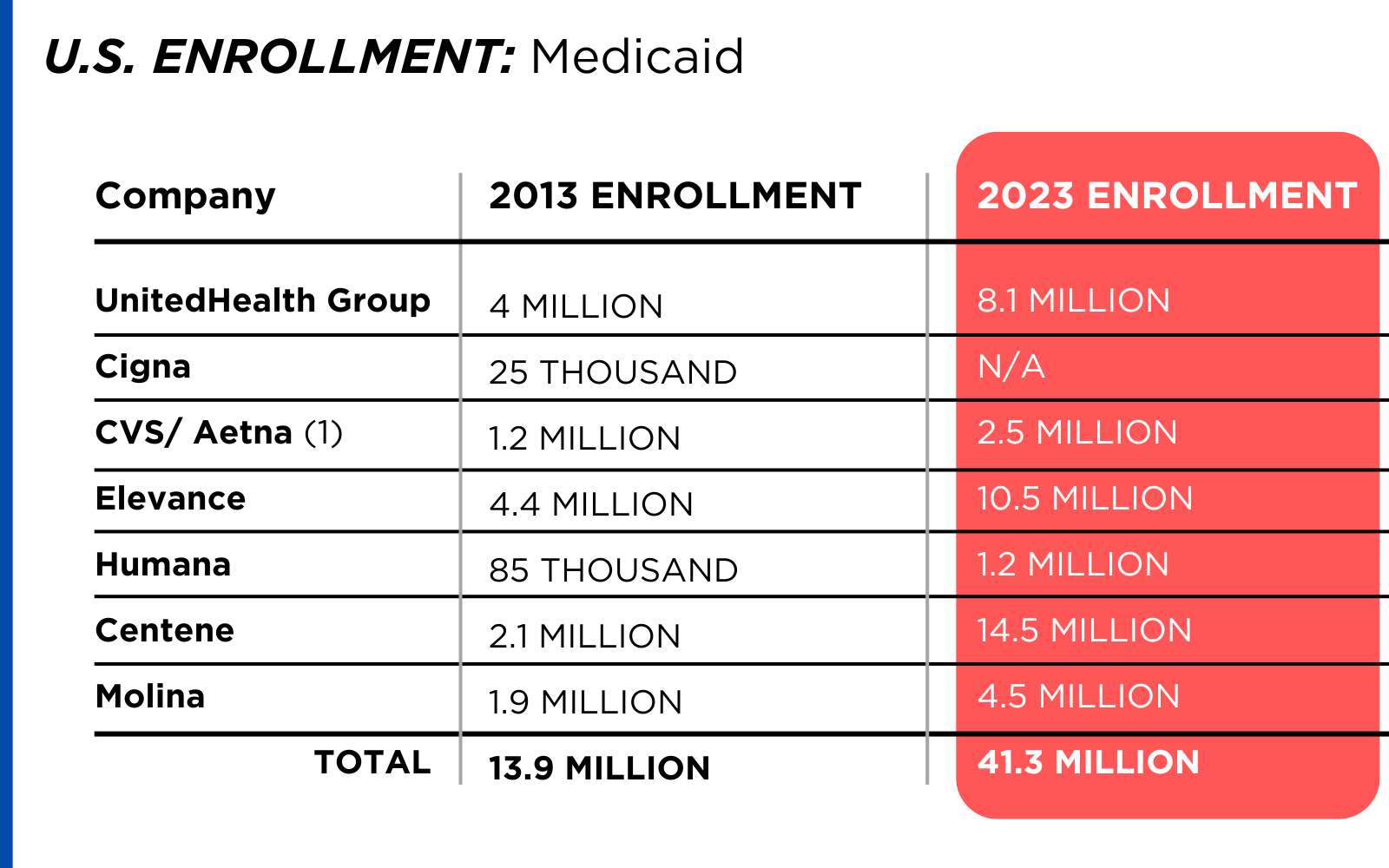
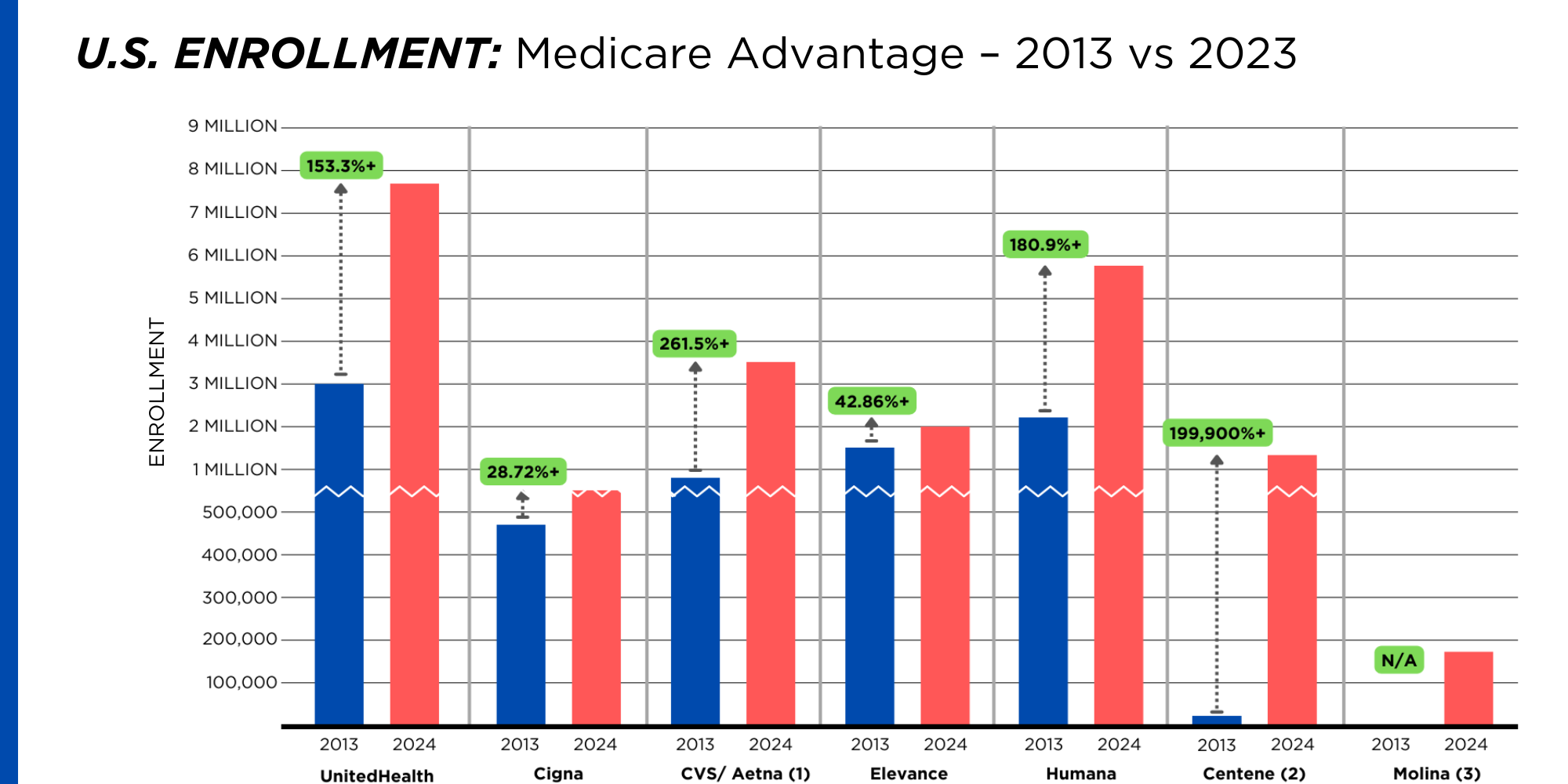
By contrast, enrollment in the government-financed Medicaid and Medicare Advantage programs has increased 197% and 167%, respectively, over the past 10 years.
(1) The 2013 total for CVS/Aetna was reported by Aetna before its 2018 acquisition by CVS.
Of the 65.9 million people eligible for Medicare at the beginning of 2024, 33 million, slightly more than half, enrolled in a private Medicare Advantage plan operated by either a nonprofit or for-profit health insurer, but, increasingly, three of the big for-profits grabbed most new enrollees. Of the 1.7 million new Medicare Advantage enrollees this year, 86% were captured by UnitedHealth, Humana and Aetna. Those three companies are the leaders in the Medicare Advantage business among the for-profit companies, and, according to the health care consulting firm Chartis, are taking over the program “at breakneck speed.”
(1) The 2013 total for CVS/Aetna was reported by Aetna before its 2018 acquisition by CVS. (2,3) Centene’s and Molina’s totals include Medicare Supplement; they do not break out enrollment in the two Medicare categories separately.
It is worth noting that although four companies saw growth in their Medicare Supplement enrollment over the decade, enrollment in Medicare Supplement policies has been declining in more recent years as insurers have attracted more seniors and disabled people into their Medicare Advantage plans.
OTHER FEDERAL PROGRAMS
In addition to the above categories, Humana and Centene have significant enrollment in Tricare, the government-financed program for the military. Humana reported 6 million military enrollees in 2023, up from 3.1 million in 2013. Centene reported 2.8 million in 2023. It did not report any military enrollment in 2013.
Elevance reported having 1.6 million enrollees in the Federal Employees Health Benefits Program in 2023, up from 1.5 million in 2013. That total is included in the commercial enrollment category above.
At Cigna, Express Scripts’ pharmacy operations now contribute more than 70% to the company’s total revenues. Caremark’s pharmacy operations contribute 33% to CVS/Aetna’s total revenues, and Optum Rx contributes 31% to UnitedHealth’s total revenues.
WHAT TO DO AND WHERE TO START
The official name of the ACA is the Patient Protection and Affordable Care Act. The law did indeed implement many important patient protections, and it made coverage more affordable for many Americans. But there is much more Congress and regulators must do to close the loopholes and dismantle the barriers erected by big insurers that enable them to pad their bottom lines and reward shareholders while making health care increasingly unaffordable and inaccessible for many of us.
Several bipartisan bills have been introduced in Congress to change how big insurers do business.
And as noted above, President Biden has asked Congress to broaden the recently enacted $2,000-a-year cap on prescription drugs to apply to people with private insurance, not just Medicare beneficiaries. That one policy change could save an untold number of lives and help keep millions of families out of medical debt. (A coalition of more than 70 organizations and businesses, which I lead, supports that, although we’re also calling on Congress to reduce the current overall annual out-of-pocket maximum to no more than $5,000.)
I encourage you to tell your members of Congress and the Biden administration that you support these reforms as well as improving, strengthening and expanding traditional Medicare. You can be certain the insurance industry and its allies are trying to keep any reforms that might shrink profit margins from becoming law.
It’s no secret I feel strongly that “Medicare Advantage for All” is not a healthy end goal for universal health care coverage in our country. But I also recognize there are many folks, across the political spectrum, who see the program as one that has some merit. And it’s not going away anytime soon. To say the insurance industry has clout in Washington is an understatement.
As politicians in both parties increase their scrutiny of Medicare Advantage, and the Biden administration reviews proposed reforms to the program, I think it’s important to highlight common-sense, achievable changes with broad appeal that would address the many problems with MA and begin leveling the playing field with the traditional Medicare program.
1. Align prior authorization MA standards with traditional Medicare
Since my mother entered into an MA plan more than a decade ago, I’ve watched how health insurers have applied practices from traditional employer-based plans to MA beneficiaries. For many years, insurers have made doctors submit a proposed course of treatment for a patient to the insurance company for payment pre-approval — widely known as “prior authorization.”
While most prior authorization requests are approved, and most of those denied are approved if they are appealed, prior authorization accomplishes two things that increase insurers’ margins.
The practice adds a hurdle between diagnosis and treatment and increases the likelihood that a patient or doctor won’t follow through, which decreases the odds that the insurer will ultimately have to pay a claim. In addition, prior authorization increases the length of time insurers can hold on to premium dollars, which they invest to drive higher earnings. (A considerable percentage of insurers’ profits come from the investments they make using the premiums you pay.)
Last year, the Kaiser Family Foundation found the level of prior authorization requests in MA plans increased significantly in recent years, which is partially the result of the share of services subject to prior authorization increasing dramatically. While most requests were ultimately approved (as they were with employer-based insurance plans), the process delayed care and kept dollars in insurers’ coffers longer.
The outrage generated by older Americans in MA plans waiting for prior authorization approvals has moved the Biden administration to action.
Beginning in 2024, MA plans may be no more restrictive with prior authorization requirements than traditional Medicare.
That’s a significant change and one for which Health and Human Services Secretary Xavier Becerra should be lauded.
But as large provider groups like the American Hospital Association have pointed out, the federal government must remain vigilant in its enforcement of this rule. As I wrote about recently with the implementation of the No Surprises Act, well-intentioned legislation and implementation rules put in place by regulators can have little real-world impact if insurers are not held accountable. It’s important to note, though, that federal regulatory agencies must be adequately staffed and resourced to be able to police the industry and address insurers’ relentless efforts to find loopholes in federal policy to maximize profits. Congress needs to provide the Department of Health and Human Services with additional funding for enforcement activities, for HHS to require transparency and reporting by insurers on their practices, and for stakeholders, especially providers and patients, to have an avenue to raise concerns with insurers’ practices as they become apparent.
2. Protect seniors from marketing scams
If it’s fall, it’s football season. And that means it’s time for former NFL quarterback Joe Namath’s annual call to action on the airwaves for MA enrollment.
As Congresswoman Jan Schakowsky and I wrote about more than a year ago, these innocent-appearing advertisements are misleading at their best and fraudulent at their worst. Thankfully, this is another area the Biden administration has also been watching over the past year.
CMS now prohibits the use of ads that do not mention a specific plan name or that use the Medicare name and logos in a misleading way, the marketing of benefits in a service area where they are not available, and the use of superlatives (e.g., “best” or “most”) in marketing when not substantiated by data from the current or prior year.
As part of its efforts to enforce the new marketing restrictions, the Center for Medicare and Medicaid Services for the first time evaluated more than 3,000 MA ads before they ran in advance of 2024 open enrollment. It rejected more than 1,000 for being misleading, confusing, or otherwise non-compliant with the new requirements. These types of reviews will, I hope, continue.
CMS has proposed a fixed payment to brokers of MA plans that, if implemented, would significantly improve the problem of steering seniors to the highest-paying plan — with the highest compensation for the insurance broker. I think we can all agree brokers should be required to direct their clients to the best product, not the one that pays the broker the most. (That has been established practice for financial advisors for many years.) CMS should see this rule through, and send MA brokers profiteering off seniors packing.
A bonus regulation in this space to consider: banning MA plan brokers from selling the contact information of MA beneficiaries. Ever wonder why grandma and grandpa get so many spam calls targeting their health conditions? This practice has a lot to do with it. And there’s bipartisan support in Congress for banning sales of beneficiary contact information.
In addition, just as drug companies have to mention the potential side effects of their medications, MA plans should also be required to be forthcoming about their restrictions, including prior authorization requirements, limited networks, and potentially high out-of-pocket costs, in their ads and marketing materials.
3. Be real about supplemental benefits
Tell me if this one sounds familiar. The federal government introduced flexibility to MA plans to offer seniors benefits beyond what they can receive in traditional Medicare funded primarily through taxpayer dollars.
Those “supplemental” benefits were intended to keep seniors active and healthy. Instead, insurers have manipulated the program to offer benefits seniors are less likely to use, so more of the dollars CMS doles out to pay for those benefits stay with payers.
Many seniors in MA plans will see options to enroll in wellness plans, access gym memberships, acquire food vouchers, pick out new sneakers, and even help pay for pet care, believe it or not — all included under their MA plan. Those benefits are paid for by a pot of “rebate” dollars that CMS passes through to plans, with the presumed goal of improving health outcomes through innovative uses.
There is a growing sense, though, that insurers have figured out how to game this system. While some of these offerings seem appealing and are certainly a focus of marketing by insurers, how heavily are they being used? How heavily do insurers communicate to seniors that they have these benefits, once seniors have signed up for them? Are insurers offering things people are actually using? Or are insurers strategically offering benefits that are rarely used?
Those answers are important because MA plans do not have to pay unused rebate dollars back to the federal government.
CMS in 2024 is requiring insurers to submit detailed data for the first time on how seniors are using these benefits. The agency should lean into this effort and ensure plan compliance with the reporting. And as this year rolls on, CMS should be prepared to make the case to Congress that we expect the data to show that plans are pocketing many of these dollars, and they are not significantly improving health outcomes of older Americans.
4. Addressing coding intensity
If you’re a regular reader, you probably know one of my core views on traditional Medicare vs. Medicare Advantage plans. Traditional Medicare has straightforward, transparent payment, while Medicare Advantage presents more avenues for insurers to arbitrarily raise what they charge the government. A good example of this is in higher coding per patient found in MA plans relative to Traditional Medicare.
An older patient goes in to see their doctor. They are diagnosed, and prescribed a course of treatment. Under Traditional Medicare, that service performed by the doctor is coded and reimbursed. The payment is generally the same no matter what conditions or health history that patient brought into the exam room. Straightforward.
MA plans, however, pay more when more codes are added to a diagnosis.
Plans have advertised this to doctors, incentivizing the providers to add every possible code to a submission for reimbursement. So, if that same patient described above has diabetes, but they’re being treated for an unrelated flu diagnosis, the doctor is incentivized by MA to add a code for diabetes treatment. MA plans, in turn, get paid more by the government based on their enrollee’s health status, as determined based on the diagnoses associated with that individual.
Extrapolate that out across tens of millions of seniors with MA plans, and it’s clear MA plans are significantly overcharging the federal government because of over-coding.
One solution I find appealing: similar to fee-for-service, create a new baseline for payments in MA plans to remove the incentive to add more codes to submissions. Proposals I’ve seen would pay providers more than traditional Medicare but without creating the plan-driven incentive for doctors to over-code.
5. Focusing in on Medicare Advantage network cuts in rural areas
Rural America is older and unhealthier than the national average. This should be the area where MA plans should experience the highest utilization.
Instead, we’re seeing that the aggressive practices insurers use to maximize profits force many rural hospitals to cancel their contracts with MA plans. As we wrote about at length in December, MA is becoming a ghost benefit for seniors living in rural communities. The reimbursement rates these plans pay hospitals in rural communities are significantly lower than traditional Medicare. That has further stressed the low margins rural hospitals face.
As Congressional focus on MA grows, I predict more bipartisan recommendations to come forth that address the growing gap between MA plan payments and what hospitals need to be paid in rural areas.
If MA is not accepted by providers in older, rural America, then truly, what purpose does it serve?
Claim denials are increasing, especially in Medicare Advantage, and it’s affecting hospital’s revenue cycles and patient care.
“We definitely are seeing an increase in denials,” said Sherri Liebl, executive director of Revenue Cycle, CentraCare Health, a large multispecialty system in Minnesota. CareCare has two acute care hospitals, seven Critical Access Hospitals and 30 standalone clinics, many of them in rural areas.
CentraCare reported a positive margin this year, but in no way realizes the profits of insurers, especially the national insurers where Liebl is having the most difficulty with claims.
CentraCare’s goal in its cost to collect – not all-around denials – is to be at 2%. The health system is closer to 7% on its cost to collect.
“The cost for our organization is exorbitant,” Lieble said.
Much of the blame for denials is falling to artificial intelligence being used in algorithms to deny claims.
UnitedHealthcare has been sued in a class action lawsuit that alleges the insurer unlawfully used an artificial intelligence algorithm to deny rehabilitative care to sick Medicare Advantage patients.
Cigna has also been suedfor allegedly using algorithms to deny claims. The lawsuit claims the Cigna PXDX algorithm enables automatic denials for treatments that do not match preset criteria, evading the legally required individual physician review process.
A Cigna Healthcare spokesperson said the vast majority of claims reviewed through PXDX are automatically paid, and that the PXDX process does not involve algorithms, AI or machine learning, but a simple sorting technology that has been used for more than a decade to match up codes. Claims declined for payment via PXDX represent less than 1% of the total volume of claims, the spokesperson said.
Industry consultant Adam Hjerpe, who formerly worked for UnitedHealth Group, said there’s nothing new about payers using artificial intelligence. AI has been used for 20 years in robotic processes, statements in Excel and algorithms, he said.
Everybody is working with good intent, Hjerpe said. There are reasonable controls in place to avoid fraud and abuse.
Claims are being denied for missing information, or for the information being out of sequence, or for the claim giving an incomplete picture of the care.
“We don’t want care delayed,” he said.
Nobody wins in claims denials, said Susan Taylor, Pega’s vice president of Healthcare and Life Sciences.
While payers save money in the short-term, in the long-term, the best arrangement is to have payers and providers work together to prevent denials, said Taylor, who has worked in healthcare for more than 25 years, starting on the health system side before moving into IT.
“There are more claims of note being denied,” Taylor said. “If you look at the ecosystem, there are a lot of opportunities for error.”
The solution is building an agility layer to streamline workflows throughout the revenue cycle, from initial claim submission to the complex denials processing stage.
WHY THIS MATTERS
Liebl said that denials have increased over the past two years and that there’s also been an uptick in payer audits months after payment has been made.
Insurers want justification for why CentraCare should keep its payments, and this is especially true for Medicare Advantage claims, she said.
One insurer said the claim didn’t meet inpatient criteria and downgraded the claim to an observation patient.
“We have a pretty good success rate as far as being able to justify we did the right care,” Liebl said.
Asked what’s driving the higher denial rates Lieble said, “Everybody wants to keep margins and expand their business. I think it comes down to profit margins, trying to keep profit margins high; we’re just trying to stay afloat.”
To combat denials and work with payers, CentraCare founded a joint operating committee to have successful partnerships. They’ve been more successful with the local Minnesota plans than the national plans, but Liebl is optimistic, she said.
“I am hopeful we can create partnerships …” she said. “Some of the denials we receive are against their payer policy. We need to be able to hold payers accountable.”
Larger health systems have a little more clout, and CentraCare is able to partner with other health systems through the Minnesota Hospital Association.
What’s being lost in all this is the patient, Liebl said. Sometimes a patient is getting a bill up to a year after a procedure.
“Sometimes the patient focus is lost when we work through some of this,” she said.
“They keep our money longer,” Liebl said. “They hold our money hostage. We have denials sitting out there for 300 days. It’s a lot of administrative burden on our part. We’ve spent a lot of money just to get the money in the door. Finally when that claim has been resolved, it’s a year later. No one wins? I think there is some winning going on one side.”










 HENRY KOTULA