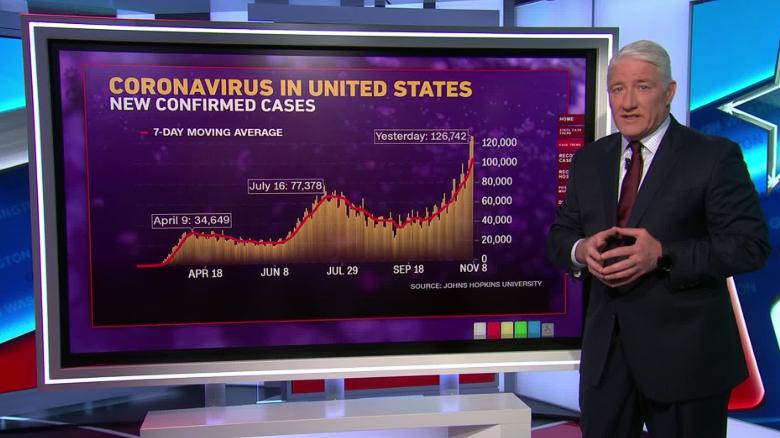
These charts show how serious this fall’s Covid-19 surge is in the US

https://www.cnn.com/2020/11/12/health/coronavirus-fall-surge-statistics/index.html
These charts show how serious the fall COVID-19 surge is in the US - Local  News 8

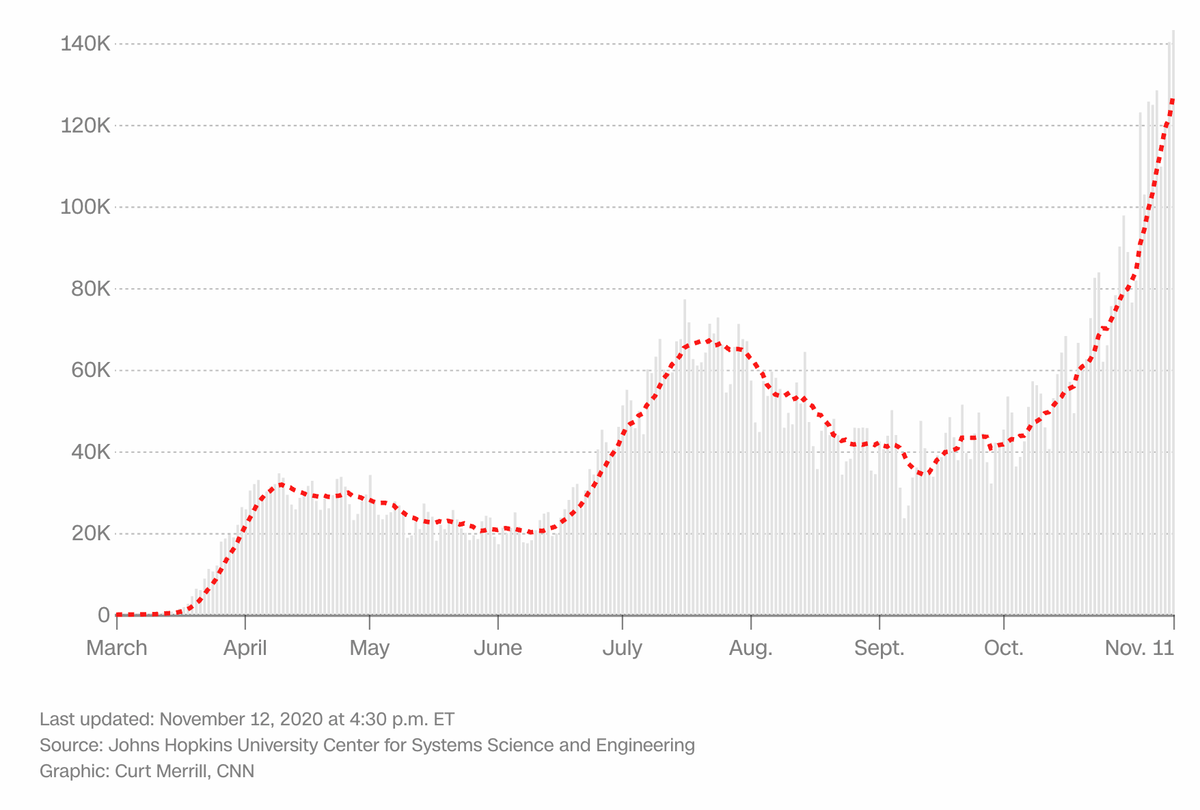
Official Covid-19 cases and hospitalizations in the United States are piling up at record rates — and daily deaths, experts fear, may soon follow.The following charts show how the fall coronavirus wave has put the US on unprecedented ground by some metrics, and with numbers trending up, point to how the situation could get worse while the country awaits a vaccine and distribution of new treatments.

Daily case counts are reaching new highs

Daily cases were dipping as recently as September, as the nation was bouncing back from a summer surge.But infections roared back in a way not recorded before.Thursday brought the United States’ highest one-day infection total (above 153,000) and seven-day average for new daily infections (more than 131,000) on record, according to Johns Hopkins University data.

That average is more than 3.5 times higher than it was on September 12, when it was at a post-summer surge low of 34,198.And it’s well above the summer’s highest seven-day average, which was around 67,100 on July 22.

There has been good news recently:vaccine candidate was reportedly found to be more than 90% effective, and the US Health and Human Services secretary said vaccines could be widely available in the second quarter of 2021. And the Food and Drug Administration this week approved a new antibody treatment that may lower the risk that patients with mild to moderate disease will be hospitalized.But with colder weather potentially driving risky gatherings indoors, and no vaccine available this minute, experts warn daily infections have room to grow.“It will not surprise me if in the next weeks we see over 200,000 new cases a day,” Michael Osterholm, director of the Center for Infectious Disease Research and Policy at the University of Minnesota, told CNN on Monday.We should stress that the chart captures reported cases. Studies have estimated infections were vastly undercounted, especially early in the pandemic, partly because of limited test availability.Some health experts have said hospitalizations can be a truer measure of the pandemic’s severity — though rising cases are a warning sign, since a patient’s hospitalization can come well after diagnosis.

‘Most sensitive indicator’ of infections is up

US test positivity rates are rising

A test positivity rate is the percentage of people who get tested and turn out to be infected. And the US rate has been shooting up in recent weeks.The country’s test positivity rate averaged 8.7% over seven days as of early Thursday, according to the COVID Tracking Project.That’s above a summer’s highest seven-day average of about 7.9% in mid-July.The World Health Organization in May advised governments not to reopen until test positivity rates were 5% or lower for at least 14 days.And the director of the US Centers for Disease Control and Prevention, Dr. Robert Redfield, has suggested that communities’ positivity rates should be below 5% to comfortably have schools open.

White House coronavirus task force coordinator Dr. Deborah Birx has said test positivity rate is the statistic she watches the closest, because it is “the most sensitive indicator” of how the coronavirus situation is unfolding at any particular time and place.

Hospitals have more Covid patients than ever

More Covid-19 patients are reported to be in US hospitals now than at any previous point in the pandemic. About 65,300 coronavirus patients were in those facilities Wednesday, according to the COVID Tracking Project.That’s more than double the number from September 20, when the country was at post-summer-surge low of 28,608.And it’s beyond the summer peak of 59,718 on July 23, and the spring peak of 59,940 on April 15.”The new hospitalization record underscores that we’ve entered the worst period for the pandemic since the original outbreak in the Northeast,” two COVID Tracking Project co-founders wrote in an online post Wednesday.These hospitalization numbers prove that the current surge of Covid-19 cases is not merely the result of increased screening of asymptomatic people. Rather, the cases we’re detecting are a leading indicator that many people are seriously ill,” the post reads.Some hospital systems have said in recent days they are close to being overwhelmed.Seventeen states reported records for Covid-19 hospitalizations on Tuesday: Alaska, Arkansas, Colorado, Indiana, Iowa, Kentucky, Minnesota, Missouri, Montana, Nebraska, Ohio, Oklahoma, Oregon, South Dakota, Tennessee, Wisconsin and Wyoming, the tracking project said.The hospitalization numbers likely have become more accurate over time — Florida didn’t report its hospitalizations until July 10, the COVID Tracking Project notes.

The toll of lives lost is climbing, too

The country’s recent daily Covid-19 death tallies aren’t in record territory, but they are shooting upward.The average number of deaths per day, across a week, rose above 1,000 this week for the first time since the summer.That average was 1,034 on Wednesday — the highest since August 10, Johns Hopkins data shows. More than 1,380 deaths were reported on Wednesday alone.The University of Washington’s Institute for Health Metrics and Evaluation projects the US could average more than 1,650 deaths per day by December 1, and more than 2,200 daily by January 1, if government leaders kept current social distancing mandates and even added some.That would recall the tallies seen early in the pandemic, when 2,000+ deaths were reported daily for a time in April. The highest daily average across a week was 2,241, on April 24.Infections appear to be killing fewer people on average now than early in the pandemic, in part, experts say, because of changes in the way the disease is treated and a rise in the proportion of younger people becoming infected.But as hospitalizations break records, daily death rates could climb further.”The ratio of hospitalizations to deaths has fallen tremendously since the spring,” the COVID Tracking Project’s post from Wednesday reads. “But it is also true that wherever we see hospitalizations go up, deaths rise two to three weeks later.”

‘Covid-hell.’ ‘Humanitarian disaster.’ Experts sound the alarm about U.S. coronavirus outbreak.

Public health experts sound alarm about coronavirus in the United States -  The Washington Post

Public health experts are sounding the alarm about the trajectory of the pandemic in the United States as the coronavirus spreads through the country largely unabated and officials muse aloud about the possibility of fresh lockdowns.

The experts use different language to underscore the situation’s urgency: Former Centers for Disease Control and Prevention director Tom Frieden said the nation is experiencing a “dangerous time.” CNN chief medical correspondent Sanjay Gupta called the crisis a “humanitarian disaster.” Epidemiologist Michael Osterholm, who was recently named to President-elect Joe Biden’s coronavirus task force, described the situation bluntly as “covid-hell.”

Their warnings come amid widespread fatigue with restrictions, even as the virus is nowhere near finished rampaging across the country. Although several states implemented new mitigation measures this week, many people have been letting down their guards or, in some cases, vowing outright to ignore the rules.

Fourteen states, mostly in the Midwest, had reported record numbers of hospitalizations by midday Thursday as the seven-day average number of cases reached highs in 23 states, from Nevada to Maryland, according to data tracked by The Washington Post. Hospital officials predicted that they could soon face excruciating decisions about how to prioritize care as they run short on beds and staff.

“Our hospitals are full,” Megan Ranney, an emergency medicine professor at Brown University, said in an interview. “Our workers are getting sick. And it is simply overwhelming the system.”

The rapid rise in hospitalizations could foreshadow a long period of rising deaths, said Scott Gottlieb, former director of the Food and Drug Administration. Although improvements in care have pushed the mortality rate below 1 percent in the United States, 1,549 people died of the virus Wednesday, the highest toll since April.

The distribution of hospitalizations across the country means it will be hard for health-care workers from one region of the country to serve as backup in another area, Gottlieb wrote on Twitter. The only slightly reassuring news is that most hospitals have not entered true crisis mode, he said Thursday on CNBC’s “Squawk Box.”

“Every hospital system is a little pressed right now,” Gottlieb said. “There’s only a handful that are really overwhelmed: Wisconsin, parts of Texas, Utah, South and North Dakota.”

But the trends suggest that that could change. Osterholm said ballooning numbers of infections nationwide mean more hospitals could soon look like those in El Paso, where health-care workers are bringing in mobile morgues and airlifting patients to other cities.

“We have to tell the story of what’s coming; people don’t want to hear that El Paso isn’t an isolated event,” he told Yahoo Finance on Thursday. “It will become the norm.”

Frieden tweeted that the United States has entered “the exponential phase” of virus spread and that the situation will worsen significantly before it improves. But he emphasized that policy decisions have an impact, and throwing in the towel is the wrong solution.

“Not all of the US is experiencing the same rate of Covid spread — some states are doing much better than others,” he wrote. “For example, South Dakota (the state with the highest rate) has 100 times more spread than Vermont right now.”

Individual decisions also make a difference, Gottlieb said, especially as people prepare to travel and visit people outside their household for Thanksgiving. The transmission of the virus tracks closely with people’s movement in their communities.

“If people on the whole just go to the store one less time a week, you could substantially reduce spread,” Gottlieb said on “Squawk Box.”

The lack of that kind of self-sacrifice is one factor that Ranney said she believes is contributing to the virus surging to a far greater extent than it did in the spring. New rules from local and state governments, such as curfews, have been relatively mild compared to the widespread shutdowns of March and April.

The holiday season, meanwhile, is a looming danger that Ranney expects will lead to a “deadly” spike in infections. The virus’s prevalence across the country means that this is the worst time for people to increase their risk of transmission by attending family-centric celebrations, she said.

The likelihood that there will be an easily available vaccine next year is the light at the end of the tunnel. But in the meantime, Ranney said people need to fight the urge to pretend that life is normal and instead seek ways to socialize more safely — outdoors, at a distance and while wearing masks.

“A vaccine is coming. This is not forever,” she said. “But right now, we’ve got to stop this chain of transmission.”

U.S. lockdown not inevitable, Fauci says. But the numbers are horrendous.

https://www.washingtonpost.com/nation/2020/11/12/coronavirus-covid-live-updates-us/

https://www.washingtonpost.com/video/national/why-experts-say-nationwide-mask-use-is-currently-the-best-strategy-to-combat-coronavirus/2020/11/11/f98b67bf-bb19-4acf-9efb-0ab91a3386dc_video.html

Should I wear a mask? You'll soon face growing pressure, experts say.

The United States’ top infectious-disease expert, Anthony S. Fauci, cautioned against despair as the country endures a surge in covid-19 cases unlike anything it has previously seen. A record high of 145,835 new cases were reported Wednesday, just one week after the U.S. hit 100,000 cases for the first time. At least 65,000 Americans are hospitalized with covid-19, according to The Post’s latest data.

In an interview with “Good Morning America” on Thursday, Fauci insisted that the United States could still make it through the winter without a national lockdown “if we can just hang in there” and adopt stronger social distancing habits until vaccines arrive.

U.S. surpasses 10 million coronavirus cases, experts warn country is entering worst phase

US coronavirus: The country nears 10 million Covid-19 cases - CNN

The United States surpassed 10 million coronavirus cases on Monday, just 10 days after hitting 9 million. The average number of daily new infections has exceeded 100,000, and public health experts warn the country is entering the pandemic’s worst phase yet.

The United States hit the milestone as Pfizer announced its coronavirus vaccine candidate was more than 90 percent effective, compared with a placebo. Epidemiologists and health experts were optimistic about the results, but also cautioned that more information is needed on the vaccine’s long-term efficacy and safety.

U.S. Hits New Coronavirus Case Record for Third Straight Day

U.S. Hits New Coronavirus Case Record for Third Straight Day - The New York  Times

More than 132,700 new cases were announced across the United States on Friday. The country also reported more than 1,000 deaths for the fourth straight day.

As the eyes of a tired nation remained transfixed on the results of the presidential election, the United States set a daily record for new cases for the third straight day, with more than 132,700 new cases on Friday. And it reported more than 1,000 deaths for the fourth straight day, the first such stretch since August.

The United States first reported a record of over 107,000 cases in a single day on Wednesday. On Thursday, it was over 121,000 new cases, another record, according to a New York Times database.

The country recorded more than 1,220 deaths on Friday. It was the first time over 1,000 deaths had been recorded for four consecutive days since Aug. 25-28.

At least 17 states reported single day records for new cases on Friday. And four states reported record deaths: Kansas, Nebraska, South Dakota and Utah.

In 27 states, there have been more cases announced in the past week than in any other seven-day stretch since the pandemic began. More than 54,800 people were hospitalized with the virus on Friday, according to the Covid Tracking Project.

Driven by surges in the United States and Europe, new daily cases have surpassed 605,000 globally for the first time and a harrowing 50 million total cases appears to be close on the horizon.

Across the continent, hospitals and health care systems are stretched thin, prompting fresh lockdowns and restrictions.

Portugal declared a new state of emergency on Friday. Romania, which passed 10,000 daily cases for the first time, announced that it would close schools and implement an overnight curfew. Poland reported a record 445 virus deaths on Friday and admitted the first patient to its new field hospital at a stadium in Warsaw.

As of Saturday morning, at least 1,242,600 people with Covid-19 worldwide had died since the start of the pandemic. Both new infections and deaths have risen more than 30 percent in the past 14 days.

The number of confirmed cases lags behind the true number of infections, though it is guesswork to say by how much. Countries around the world have worked to increase their testing capacity, but the new surges are straining even that in some places.

Germany, which had been lauded for its testing capacity early on, is tightening the rules governing who gets a test paid for by the public health insurers. Under new rules those with flulike symptoms are only eligible if they also belong to a high-risk group, or can prove contact to someone either infected or at high risk of becoming infected.

“Test, test test — but target,” read a government announcement released on Friday. In the first week of November, the country’s labs were able to handle nearly 1.6 million tests a day, but as the new cases rise and with more people becoming sick with seasonal flu, the system is under stress.

Coronavirus/COVID-19 Update

https://newamerica.cmail20.com/t/ViewEmail/d/2A08F1E2FC06AACC2540EF23F30FEDED/4CBA9809BC8E10D4F6A1C87C670A6B9F

Coronavirus/COVID-19 Update | Insights | Skadden, Arps, Slate, Meagher &  Flom LLP

There have been 9,487,080 coronavirus cases in the United States, and 233,729 people have died (Johns Hopkins). Around 3,743,527 people have recovered, and the United States has conducted 150,969,797 tests. Worldwide, there have been 48,107,322 confirmed cases of coronavirus, with 1,225,881 deaths. At least 31,917,411 people have recovered from the virus. 

U.S. Reports More Than 100,000 New Cases on Wednesday, Following Second-Highest Daily Covid-19 Cases on Election Day; Hospitalizations Increase; Covid-19 Becomes Third Leading Cause of Death in Arkansas.

The U.S. recorded more than 91,000 new cases of Covid-19 on Election Day, Nov. 3, and more than 100,000 new cases on Wednesday, Nov. 4 (CNNJohns HopkinsNYT). Six states – Idaho, Maine, Minnesota, New Mexico, Ohio and Pennsylvania – reported single-day highs on Tuesday. And five states — Maine, Minnesota, Indiana, Nebraska and Colorado — set single-day case records on Wednesday. The seven-day average for daily new cases now tops 90,000, the highest since the pandemic began and more than twice as high as the average during the low point in early September.

More than 50,000 people were hospitalized with the virus during voting on Tuesday. In the Midwest in particular, hospitalizations are rising steeply. Some Midwest hospitals are under strain as they work to provide care for large numbers of Covid-19 patients.

In Arkansas on Tuesday, Governor Asa Hutchinson announced that Covid-19 has become the third leading cause of death in the state, after cancer and heart attacks. “It is a deadly virus that takes people’s lives,” the governor said. “We want to make sure everybody understands the seriousness of it.” Bo Ryall, president and CEO of the Arkansas Hospital Association, asked residents to “please adhere to safety measures again” to help mitigate the strain on hospitals.

Cartoon – We have it under control!

How political cartoons are commenting on Trump's covid-19 case - The  Washington Post

How Are Americans Catching the Virus? Increasingly, ‘They Have No Idea’

How Are Americans Catching the Virus? Increasingly, 'They Have No Idea' -  The New York Times

New outbreaks used to be traced back to crowded factories and rowdy bars. But now, the virus is so widespread not even health officials are able to keep up.

When the coronavirus first erupted in Sioux Falls, S.D., in the spring, Mayor Paul TenHaken arrived at work each morning with a clear mission: Stop the outbreak at the pork plant. Hundreds of employees, chopping meat shoulder to shoulder, had gotten sick in what was then the largest virus cluster in the United States.

That outbreak was extinguished months ago, and these days, when he heads into City Hall, the situation is far more nebulous. The virus has spread all over town.

“You can swing a cat and hit someone who has got it,” said Mr. TenHaken, who had to reschedule his own meetings to Zoom this past week after his assistant tested positive for the virus.

As the coronavirus soars across the country, charting a single-day record of 99,155 new cases on Friday and surpassing nine million cases nationwide, tracing the path of the pandemic in the United States is no longer simply challenging. It has become nearly impossible.

Gone are the days when Americans could easily understand the virus by tracking rising case numbers back to discrete sources — the crowded factory, the troubled nursing home, the rowdy bar. Now, there are so many cases, in so many places, that many people are coming to a frightening conclusion: They have no idea where the virus is spreading.

“It’s just kind of everywhere,” said Crystal Watson, a senior scholar at the Center for Health Security at the Johns Hopkins Bloomberg School of Public Health, who estimated that tracing coronavirus cases becomes difficult once the virus spreads to more than 10 cases per 100,000 people.

  • The election. And its impact on you.

In some of the hardest-hit spots in the United States, the virus is spreading at 10 to 20 times that rate, and even health officials have all but given up trying to figure out who is giving the virus to whom.

There have been periods earlier in the pandemic when infections spread beyond large, well-understood clusters in prisons, business meetings and dinner parties, tearing through communities in ways that were nearly impossible to keep track of. But for the most part, that experience was isolated to hard-hit places like New York City in the spring and portions of the Sun Belt in the summer.

This time, the diffuse, chaotic spread is happening in many places at once. Infections are rising in 41 states, the country is recording an average of more than 79,000 new cases each day, and more Americans say they feel left to do their own lonely detective work.

“I was so careful,” said Denny Taylor, 45, who said he had taken exacting precautions — wearing a mask, getting groceries delivered — before he became the first in his family and among his co-workers to test positive for the virus. Lying in a hospital bed in Omaha this past week, he said he still had no idea where he caught it.

Uncovering the path of transmission from person to person, known as contact tracing, is seen as a key tool for containing the spread of the coronavirus. Within a day or two of testing positive, residents in many communities can expect to get a phone call from a trained contact tracer, who conducts a detailed interview before beginning the painstaking process of tracking down each new person who may have been exposed.

“We were pretty successful and we were very proud of how the case numbers went down,” said Dr. Sehyo Yune, who supervised a team of contact tracers in Massachusetts this spring. It was one of several strategies that helped tamp down earlier outbreaks in places like Massachusetts, New York and Washington, D.C.

But as cases skyrocket again in many states, many health officials have conceded that interviewing patients and dutifully calling each contact will not be enough to slow the outbreak. “Contact tracing is not going to save us,” said Dr. Ogechika Alozie, chief medical officer at Del Sol Medical Center in El Paso, where hospitalizations in the county have soared by more than 400 percent and officials issued a new order for residents to stay at home.

The problem, of course, is that failing to fully track the virus makes it much harder to get a sense of where the virus is flourishing, and how to get ahead of new outbreaks. But once an area spins out of control, trying to trace back each chain of transmission can feel like scooping cupfuls of water from a flood.

In some places, overwhelmed health officials have abandoned any pretense of keeping up.

In North Dakota, state officials announced they could no longer have one-on-one conversations with everyone who may have been exposed. Aside from situations involving schools and health care facilities, people who test positive were advised to notify their own contacts, leaving residents largely on their own to follow the trail of the outbreak.

In Philadelphia, where cases recently spiked to more than 300 per day, city officials acknowledged that they now must leave some cases untracked. Most people, they said, are catching the virus through family and friends.

“We weren’t supposed to get to this point,” said Dr. Arnold S. Monto, a professor of epidemiology at the University of Michigan, who said the process of tracking cases and notifying people who may have been exposed is a gold standard of disease prevention but impractical after a certain level of infection.

“If you have five clusters going on at the same time,” he said, “it’s hard to say where it came from.”

When a first major outbreak hit Grand Forks, N.D., in April, the problem was clear: More than 150 employees of a wind turbine blade factory were infected. The factory shut its doors for several weeks, and public health officials tested and contact traced each case.

For the rest of the summer, Grand Forks, a college town of 56,000 on the border with Minnesota, saw almost no new infections. An uptick in August was quickly tied to students at the University of North Dakota and largely contained.

Now, though, any sense of control has vanished. Active cases of Covid-19 have quadrupled since the beginning of October to 912 in Grand Forks County, and about half the people contacted by the health department say they are not sure how they became infected.

“People are realizing that you can get it anywhere,” said Kailee Leingang, a 21-year-old nursing student who also works as a state contact tracer in Grand Forks. Even Ms. Leingang has fallen ill, along with several of her colleagues. She traces her case to her parents, who first started showing symptoms. Beyond that, the trail goes cold.

“They have no idea,” she said of where her parents came in contact with the virus.

Ms. Leingang, isolating at her home with her cat, feels sicker by the day. Dishes have piled up in the sink — she is too weak to stand long enough to wash them. But she is still working, calling at least 50 people a day to notify them that their tests came back positive, though her job is no longer to track who else they may have infected. “With the high number of cases right now,” she said, “our team can’t afford to have somebody not work.”

In earlier, quieter periods of the pandemic, the virus spread with some degree of certainty. In all but the hardest-hit cities, people could ask a common question — “Where did you get it?” — and often find tangible answers.

A popular college bar in East Lansing, Mich., Harper’s Restaurant and Brewpub, became a hot spot this summer after dozens of people piled into the bar, drinking, dancing and crowding close together. At least 192 people — 146 people at the bar and 46 people with ties to those at the bar — were infected. Afterward, Gov. Gretchen Whitmer shut down indoor dining in bars in parts of the state.

In Ingham County, which includes much of East Lansing, it is far harder to tell where the virus is spreading now. Of the county’s 4,700 reported cases over the course of the pandemic, more than 2,700 have come since the beginning of September.

Much of the new spread may be tied to students at Michigan State University, where students are living off campus and taking classes online. But every day, employers and residents call the Health Department to report random cases that defy easy explanation.

“It’s just a hodgepodge,” said Linda Vail, the Ingham County health officer.

Heidi Stevens is among the newly infected who considers her case a mystery. As a columnist at The Chicago Tribune, Ms. Stevens works from home. Her children attend school online. She wears a mask when she goes for a run, and she has not had a haircut since January.

So when she got a precautionary test a few weeks ago, with the hopes of inviting friends over to have cake for her daughter’s 15th birthday, Ms. Stevens was shocked to learn she was positive.

“I would drive myself crazy if I tried to really nail it down,” said Ms. Stevens, 46, who was hospitalized for three days and still wakes up with headaches. Did she pick up an infected apple at the grocery store and somehow touch her eye? Should she have been wearing a face shield, in addition to her mask? The possibilities feel endless.

“It’s just out there,” she said.

Coronavirus Update

The latest

The United States reported a record high of more than 90,000 new coronavirus infections on Friday, and today’s count is on pace to go even higher. The country has now exceeded 9 million cases since the outbreak began, with the last 1 million added in just the last two weeks.

More than 1,000 coronavirus deaths were also reported Thursday, a sadly frequent milestone, which the president’s son Donald Trump Jr. effectively dismissed Thursday night when he claimed in a Fox News interview that the death rate had dropped to “almost nothing.”

As evidence, Trump Jr. cited a misleading graph on his Instagram page – apparently compiled from incomplete and already outdated federal data – which was used as evidence to suggest that the “death rate” has been falling dramatically in the last two weeks. In fact, daily deaths are slightly rising after a long plateau, and the situation is expected to worsen in November as the virus takes its toll on the newly infected. “I realize I am naive,” Ashish K. Jha, the dean of the Brown University School of Public Health, tweeted in response to the interview. “But I’m still shocked by the casualness by which our political and media leaders and their families dismiss the daily deaths of nearly a thousand Americans.”

A federal program to inspect nursing homes in the early days of the U.S. outbreak cleared nearly 80 percent of them of any infection-control violations, including some facilities that were experiencing covid-19 outbreaks during the inspections. “All told, homes that received a clean bill of health earlier this year had about 290,000 coronavirus cases and 43,000 deaths among residents and staff, state and federal data shows,” our Business desk reported.

Hundreds of thousands of Americans will have coronavirus infections on Election Day, and options are dwindling for those who intend to vote. “Some will be required to get doctor’s notes or enlist family members to help,” our Investigations desk reported. “Others, in isolation, will need to have a witness present while they vote. Planned accommodations — such as officials hand-delivering ballots — may prove inadequate or could be strained beyond limits.”

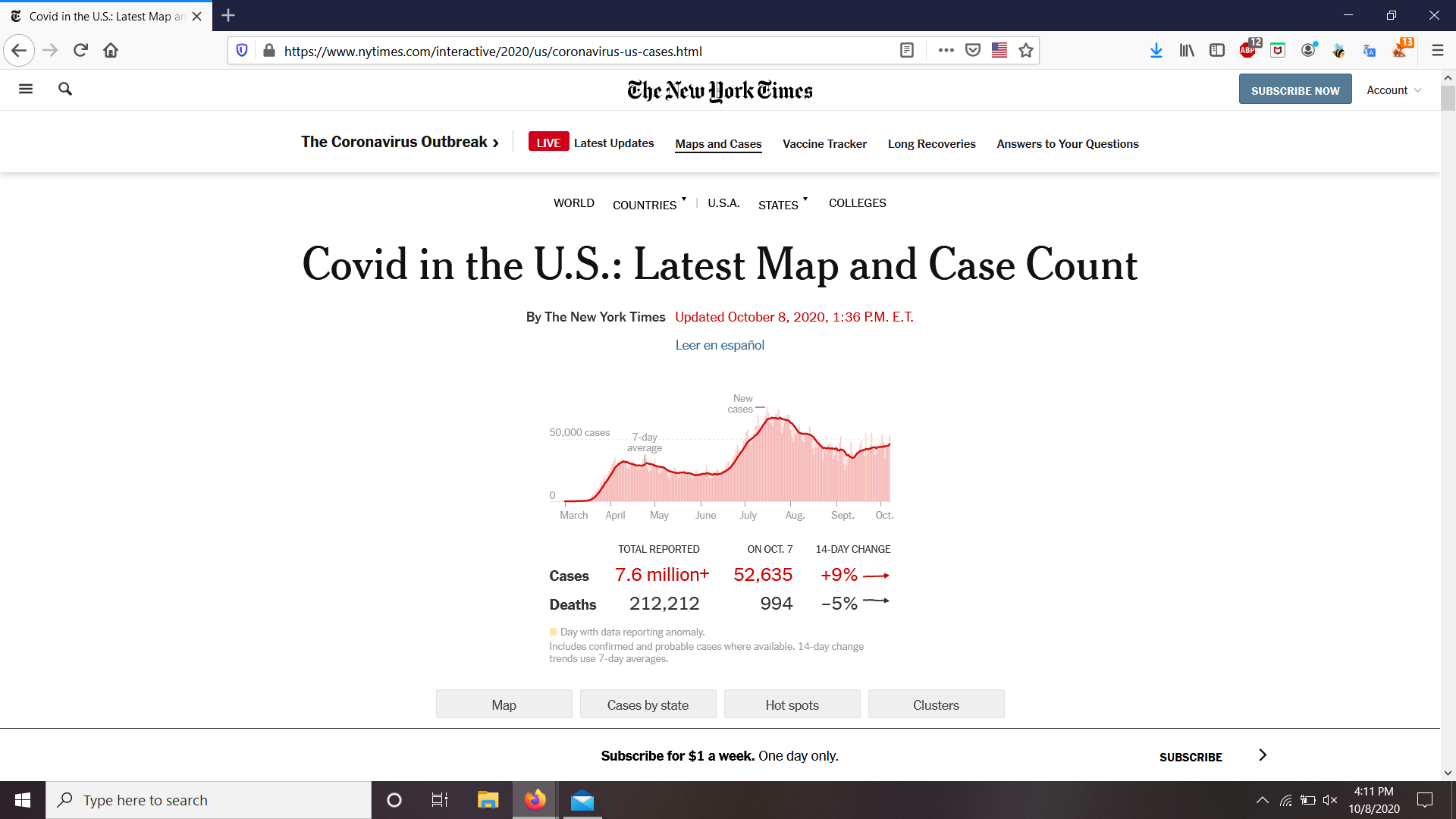
Covid in the U.S.: Latest Map and Case Count

https://covid-19archive.org/files/original/ce33d05f1f89e57f13ea7f309f0e1592024f6fb8.png

At least 1,004 new coronavirus deaths and 90,728 new cases were reported in the United States on Oct. 29. Over the past week, there have been an average of 77,865 cases per day, an increase of 42 percent from the average two weeks earlier.

As of Friday afternoon, more than 9,078,400 people in the United States have been infected with the coronavirus and at least 229,200 have died, according to a New York Times database.

Covid in the U.S.: Latest Map and Case Count - The New York Times

Case numbers in the United States have reached alarming new records in recent days as outbreaks continue to grow across the country. Though rural counties and small metro areas continue to see some of the worst growth, infections are also rising rapidly around major cities like Chicago and Milwaukee.

The national trajectory is worsening rapidly. Wisconsin has opened a field hospital. North Dakota, which not long ago had relatively few cases, has grown so overwhelmed that it has now ended most contact tracing. Cases have reached record levels recently in more than 20 states, including Illinois, Tennessee, New Mexico, Nebraska and Utah.