Explainer: What to Know About Monkeypox

Explainer: What to Know About Monkeypox

The COVID-19 pandemic is still fresh in the minds of the people around the world, so it comes as no surprise that recent outbreaks of another virus are grabbing headlines.

Monkeypox outbreaks have now been reported in multiple countries, and it has scientists paying close attention. For everyone else, numerous questions come to the surface:

  • How serious is this virus?
  • How contagious is it?
  • Could monkeypox develop into a new pandemic?

Below, we answer these questions and more.

What is Monkeypox?

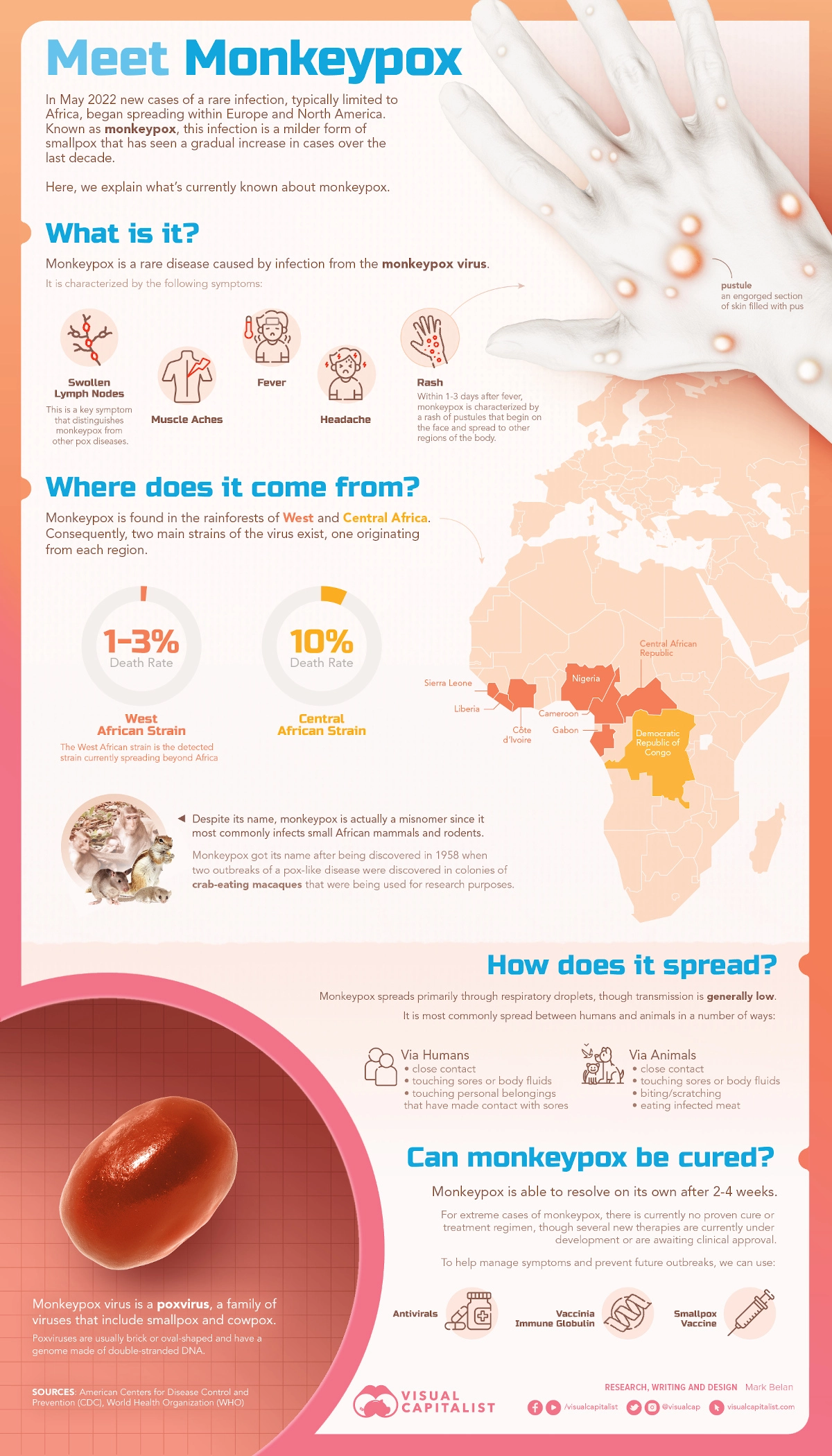
Monkeypox is a virus in the Orthopoxvirus genus which also includes the variola virus (which causes smallpox) and the cowpox virus. The primary symptoms include fever, swollen lymph nodes, and a distinctive bumpy rash.

There are two major strains of the virus that pose very different risks:

  • Congo Basin strain: 1 in 10 people infected with this strain have died
  • West African strain: Approximately 1 in 100 people infected with this strain died

At the moment, health authorities in the UK have indicated they’re seeing the milder strain in patients there.

Where did Monkeypox Originate From?

The virus was originally discovered in the Democratic Republic of Congo in monkeys kept for research purposes (hence the name). Eventually, the virus made the jump to humans more than a decade after its discovery in 1958.

It is widely assumed that vaccination against another similar virus, smallpox, helped keep monkeypox outbreaks from occurring in human populations. Ironically, the successful eradication of smallpox, and eventual winding down of that vaccine program, has opened the door to a new viral threat. There is now a growing population of people who no longer have immunity against the virus.

Now that travel restrictions are lifting in many parts of the world, viruses are now able to hop between nations again. As of the publishing of this article, a handful of cases have now been reported in the U.S., Canada, the UK, and a number of European countries.

On the upside, contact tracing has helped authorities piece together the transmission of the virus. While cases are rare in Europe and North America, it is considered endemic in parts of West Africa. For example, the World Health Organization reports that Nigeria has experienced over 550 reported monkeypox cases from 2017 to today. The current UK outbreak originated from an individual who returned from a trip to Nigeria.

Could Monkeypox become a new pandemic?

Monkeypox, which primarily spreads through animal-to-human interaction, is not known to spread easily between humans. Most individuals infected with monkeypox pass the virus to between zero and one person, so outbreaks typically fizzle out. For this reason, the fact that outbreaks are occurring in several countries simultaneously is concerning for health authorities and organizations that monitor viral transmission. Experts are entertaining the possibility that the virus’ rate of transmission has increased.

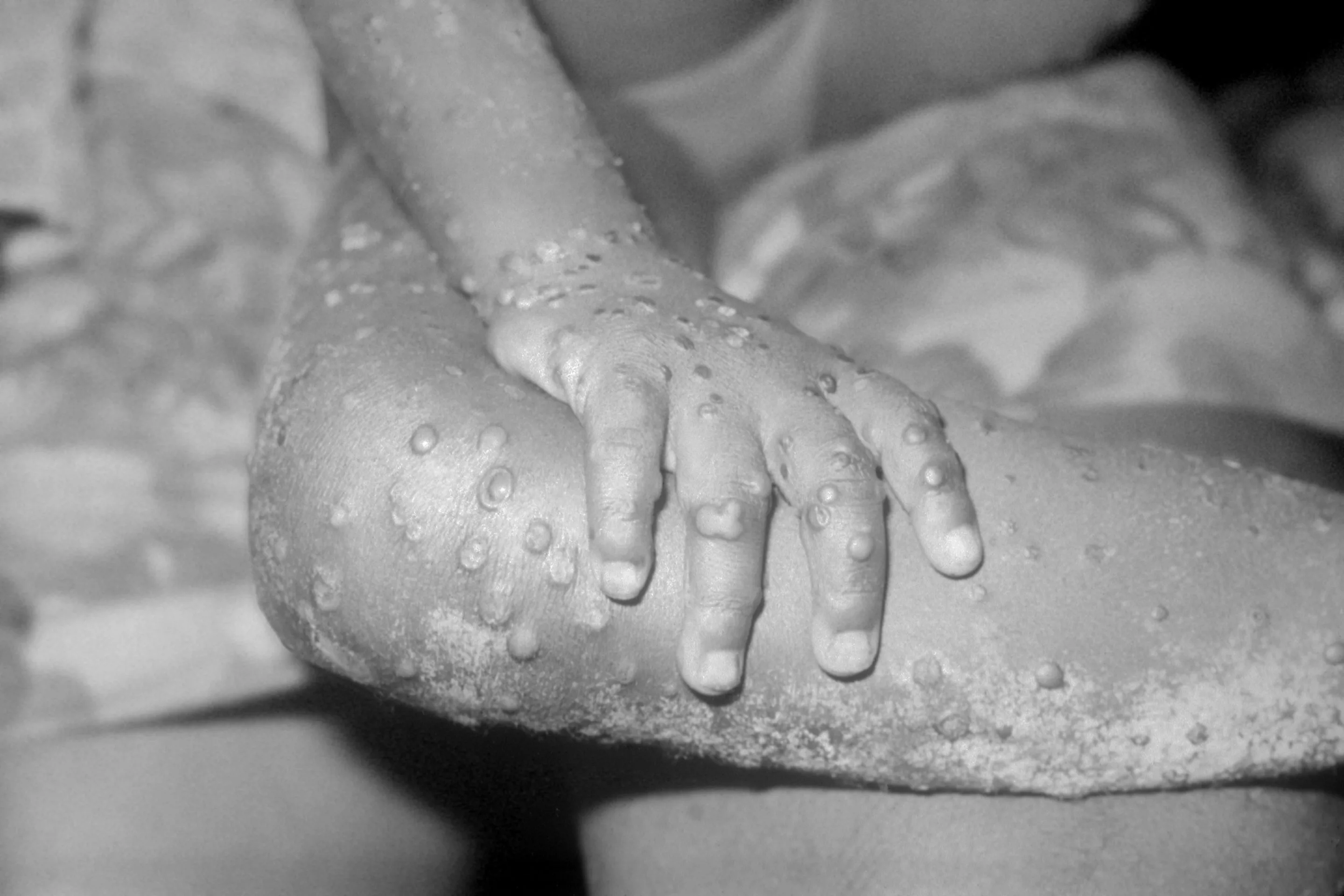
Images of people covered in monkeypox lesions are shocking, and people are understandably concerned by this virus, but the good news is that members of the general public have little to fear at this stage.

I think the risk to the general public at this point, from the information we have, is very, very low.
–TOM INGLESBY, DIRECTOR, JOHNS HOPKINS CENTER FOR HEALTH SECURITY


The summer of subvariants

As this summer heats up, so has the spread of the hot new version of COVID-19.

Why it matters: This subvariant of Omicron called BA.5 — the most transmissible subvariant yet — quickly overtook previous strains to become the dominant version circulating the U.S. and much of the world.

BA.5 is so transmissible — and different enough from previous versions — that even those with immunity from prior Omicron infections may not have to wait long before falling ill again.

What they’re saying: “I had plenty of friends and family who said: ‘I didn’t want to get it but I’m sort of glad I got it because it’s out of the way and I won’t get it again’,” Bob Wachter, chairman of the University of California, San Francisco Department of Medicine told Axios. “Unfortunately that doesn’t hold the way it once did.”

  • “Even this one bit of good news people found in the gloom, it’s like, ‘Sorry’,” Wachter said.

State of play: This week, the CDC reported BA.5 became the dominant variant in the U.S., accounting for nearly 54% of total COVID cases. Studies show extra mutations in the spike protein make the strain three or four times more resistant to antibodies, though it doesn’t appear to cause more serious illness.

  • Hospital admissions are starting to trend upward again, CDC data shows, though they’re still well below what was seen during the initial spread of Omicron.
  • It’s unclear whether that could be indicating an increase in patients in for COVID, or patients who happen to have COVID, Wachter said. “We’re up in hospitalizations around 20% but with a relatively small number of ICU patients,” Wachter said about COVID cases at UCSF.
  • In South Africa, the variant had no impact on hospitalizations while Portugal saw hospitalizations rise dramatically, Megan Ranney, academic dean at the Brown University School of Public Health told Axios.
  • “So the big unknown is what effect it’s going to have on the health care system and the numbers of folks living with long COVID,” she said.

Yes, but: “I’m certainly hearing about more reinfections and more fairly quick reinfections than at any other time in the last two and a half years,” Wachter said.

Zoom in: That is also largely the experience of the surge seen firsthand in New York City by Henry Chen, president of SOMOS Community Care, who serves as a primary care physician across three boroughs of the city.

  • With this particular variant, he said: “The symptoms are pretty much the same but a little bit more severe than the last wave. It’s more high fever, body ache, sore throat and coughing,” Chen said, adding his patient roster is mostly vaccinated.
  • But it is occurring among patients who’d gotten the virus only three or four months ago, he said.

The big picture: Another summertime wave of cases could prolong the pandemic, coming after many public health precautions were lifted and with available vaccines losing their efficacy against the ever-evolving virus.

The bottom line: The messaging isn’t to panic, but to understand the virus is likely spreading in local communities much more than individuals realize due to shrinking testing programs  and without the level of protection they might assume they have.

  • “If you don’t want to get sick, you still need to be taking at least some precautions,” Ranney said. “[COVID] is still very much among us.”

As COVID-19 restrictions loosen, diseases rebound in atypical ways

Numerous viruses that were seemingly dormant during the pandemic are returning in new and atypical ways, CNBC reported June 10.

Flu, respiratory syncytial virus, adenovirus, tuberculosis and monkeypox are among the viruses that have recently surged or exhibited unusual behaviors. 

The U.S. saw extremely mild flu seasons in 2020-21 and 2021-22, likely due to high rates of mask-wearing, social distancing and other COVID-19 prevention measures. However, flu cases started to rise this February and continued to climb through the spring as more public health measures receded. 

“We’ve never seen a flu season in the U.S. extend into June,” Scott Roberts, MD, associate medical director for infection prevention at Yale New Haven (Conn.) Hospital, told CNBC. “COVID has clearly had a very big impact on that. Now that people have unmasked [and] places are opening up, we’re seeing viruses behave in very odd ways that they weren’t before.”

Washington state is also reporting its most severe tuberculosis outbreak in 20 years, while the world is grappling with a monkeypox outbreak that’s affected more than 1,000 people. 

These viruses, suppressed during the pandemic, now have more opportunities to spread as people resume daily life, become more social and travel more. Society, as a whole, also has less immunity against the viruses after two years of reduced exposure to them, according to the report.

The pandemic has also boosted surveillance efforts and public interest in other outbreaks, experts say. 

“COVID has raised the profile of public health matters so that we are perhaps paying more attention to these events when they occur,” Jennifer Horney, PhD, professor of epidemiology at the University of Delaware in Newark, told CNBC.

View the full article here.

COVID-19 cases are on the rise. Does it matter anymore?

COVID-19 cases have risen in the U.S. to around 100,000 per day, and the real number could be as much as five times that, given many go unreported.  

But the situation is far different from the early months of the pandemic. There are now vaccines and booster shots, and new treatments that dramatically cut the risk of the virus. So how much do cases alone still matter?

That question has prompted debate among experts, even as much of America goes on with their lives, despite the recent surge in cases.  

How much concern high case numbers alone should prompt is “the trillion-dollar question,” said Bob Wachter, chair of the department of medicine at the University of California-San Francisco.  

In the early days of the pandemic, dying of COVID-19 was a concern for him, but now, in an era of vaccines and treatments, “it doesn’t even cross my mind anymore,” he said.  

But he noted there are other risks, including long COVID-19: symptoms like fatigue or difficulty concentrating that can linger for months.  

“I think long COVID is pretty scary,” he said.  

While cases have risen to around 100,000 reported per day, deaths have stayed flat, a testament to the power of vaccines and booster shots in preventing severe illness, as well as the Pfizer treatment pills Paxlovid, which cut the risk of hospitalization or death by around 90 percent.  

Hospitalizations have risen, but only modestly, to around 27,000, one of the lowest points of the pandemic, according to a New York Times tracker.  

Cases have now been “partially decoupled” from causing hospitalizations and deaths, said Preeti Malani, an infectious disease expert at the University of Michigan, such that hospitals are no longer overwhelmed. 

“[Cases are] not without any consequence, but in terms of pressure on the health system, so far we’re not seeing that, which is really what drove all of this,” she said.  

The behavior of much of America reflects a lessened concern about the risk of being infected. Restaurants and bars are packed. Many people do not wear masks even on airplanes or on the subway.  

An Axios-Ipsos poll in May found just 36 percent of Americans said there was significant risk in returning to their “normal pre-coronavirus life.” 

In the Biden administration, health officials are still advising people to wear masks in areas the Centers for Disease Control and Prevention classifies as at “high” risk. But President Biden himself is talking about the virus far less than he did at the start of his administration, and is not making sustained calls for people to wear masks.  

White House COVID-19 response coordinator Ashish Jha touted progress in defanging cases on Thursday.  

“We see cases rising, nearly 100,000 cases a day, and yet we’re still seeing death numbers that are substantially, about 90 percent lower, than where they were when the president first took office,” he told reporters.  

Some experts are pushing back on the deemphasis of case numbers, saying they still matter.  

The bunk that cases are not important is preposterous,” Eric Topol, professor of molecular medicine at Scripps Research, wrote last month. “They are infections that beget more cases, they beget Long Covid, they beget sickness, hospitalizations and deaths. They are also the underpinning of new variants.” 

Even if one does not get severely ill oneself, more cases mean more chances for the virus to spread on to someone who is more vulnerable, like the elderly or immunocompromised.  

While deaths are way down from their peak earlier in the pandemic, there are still around 300 people dying from the virus every day, a number that would have proved shocking in a pre-COVID-19 world.  

Leana Wen, a public health professor at George Washington University, recommended that people take a rapid test before visiting a more vulnerable person, as a safeguard that avoids more burdensome restrictions.  

“Cases alone do not tell the whole story,” she said, adding, “As a policy matter we need to stop using the same comparisons we were in 2020 and 2021.” 

There is still much that is unknown about long COVID-19, one of the biggest risks remaining for healthy, younger people who are vaccinated.  

recent article in the Journal of the American Medical Association estimated 10 percent to 30 percent of COVID-19 infections result in long COVID-19 symptoms, but there is no precise estimate. 

Experts also urge people who have not gotten their booster shots, or not been vaccinated at all, to do so, given that many are more vulnerable to the virus if they are not up-to-date on their shots.  

A new variant also always holds the risk of upending the current risk-benefit calculations. The virus has continued to evolve to spread more easily, and a future mutation could cause more severe illness or more greatly evade vaccines.  

Pfizer and Moderna are working on updated vaccines to better target the omicron variant, but the Biden administration warns it will not have enough money to purchase those new vaccines for all Americans this fall unless Congress provides more funding. The funding request has been stalled for months, though, itself a sign of the reduced sense of urgency around the virus fight. 

At least for now, though, while many people are getting COVID-19, fewer are getting extremely sick.  

“It’s a very risky time if you don’t want to get COVID [at all],” Wachter said. “But a relatively less risky time if your goal is to not get severe COVID or die.” 

Eyeing a rebound in emergency department volumes

https://mailchi.mp/31b9e4f5100d/the-weekly-gist-june-03-2022?e=d1e747d2d8

This week we heard from three healthcare executives that they’ve seen a recent uptick in emergency department (ED) volumes. As we’ve discussed before, ED visits plummeted at the beginning of the pandemic, and were the slowest class of care volume to rebound. Over the past year, many systems reported that ED volume had remained persistently stuck at 10 to 15 percent lower than pre-COVID levels, leading us to question whether there had been a secular shift in patient demand, with consumers choosing alternative options like telemedicine or urgent care as a first stop for minor acute care needs. 
 
An uptick in ED volume would be welcome news to many hospital executives, as the emergency department is the source of half or more of inpatient admissions for many hospitals. But according to what we’re hearing, the recent rise in emergency department patient volume has not resulted in an expected bump in inpatient volume.

“We’ve dug into it, and it seems like the jump in ED visits is a function of COVID,” one leader shared. “There’s just so much COVID out there now…even though the disease is milder, there are still a lot of patients coming to the ED. But unlike last year, most aren’t sick enough to be admitted.”

And ED visits for other causes have not rebounded in the same way: “We’re hoping patients aren’t still staying away because they’re afraid of catching the virus.” We’ll be watching closely across the summer to see how volumes trend as the pandemic waxes and wanes across the country—we’d still bet that many consumers have changed their thinking on where and how they will seek care when the need arises.   

Omicron Is About To Make Americans Act Immorally, Inappropriately

A friend called me for medical advice two weeks ago. He’s single, in his thirties and generally healthy, but he’d developed a dry cough with mild congestion. After a self-administered Covid-19 test turned up negative results, he remained suspicious he could be infected.

He was set to fly west in a couple of days for a conference and dreaded the thought of infecting other passengers. I recommended a PCR test if he wanted to be more certain. When the lab results came back positive, he spent the next five days at home alone (per CDC guidance).  

If you were in his shoes, chances are you, too, would make a reasonable effort to avoid infecting others. In the near future, that won’t be the case.

Americans are playing it safe—for now

A whopping 91% of Americans no longer consider Covid-19 a “serious crisis.” Social distancing has reached a low point as public-health restrictions continue to ease up.

Yet, there’s still one aspect of the pandemic Americans are taking very seriously.

As a society, we still expect people who test positive for Covid-19 to stay home and minimize contact with others. As a result of these expectations, 4 in 10 workers (including 6 in 10 low-income employees) have missed work in 2022. Overall, the nation’s No. 1 concern related to Omicron is “spreading the virus to people who are at higher risk of serious illness.”

Most Americans are eager to move on from the pandemic, but those who are sick continue to avoid actions that may potentially spread the virus.

Call it what you will—group think, peer pressure or the fear of violating cultural taboos—people don’t want to put others in harm’s way. That’s true, according to polls, regardless of one’s party affiliation or vaccination status.

What’s immoral today will be appropriate tomorrow

Don’t get used to these polite and socially conscious behaviors. All of it is about to change in the not-distant future. Let me paint a picture of tomorrow’s new normal:

  • A factory worker tests positive over the weekend for Covid-19 and comes to work on Monday without a mask, informing no one of his infection. 
  • A vacationer with mild Covid-19 symptoms refuses to postpone her spa weekend, availing herself of massages, facials and group yoga classes.
  • A couple plans an indoor wedding for 200-plus, knowing the odds are likely that dozens of people will get infected and that some of those guests will be elderly and immunosuppressed.

These actions, which seem inappropriate and immoral now, will become typical. It’s not that people will suddenly become less empathetic or more callous. They’ll simply be adjusting to new social mores, brought about by a unique viral strain and an inevitable evolution in American culture

A crash course in a unique virus

To understand why people will behave in ways that seem so unacceptable today, you must understand how the Omicron variant spreads compared to other viruses.

Scientists now know that Omicron (and its many decimal-laden strains: BA.2, BA.2.12.1, BA.4, BA.5, etc.) is the most infectious, fastest-spreading respiratory virus in world history. The Mayo Clinic calls this Covid-19 variant “hyper-contagious.”

“A single case could give rise to six cases after four days, 36 cases after eight days, and 216 cases after 12 days,” according to a report in Scientific American. As a result, researchers predict that 100 million Americans will become infected with Omicron this year alone—via new infections, reinfections and vaccination breakthroughs. 

In addition to Omicron’s high transmissibility, the virus is also season-less. Whereas influenza arrives each winter and exits in the spring, Americans will continue to experience high levels of Covid-19 infection year-round—at least for the foreseeable future.

With its 60-plus mutations, immense transmissibility and lack of seasonality, Omicron is an exceptional virus: one that will infect not only our respiratory systems but also our culture.

Over time, Omicron’s unique characteristics will drive Americans to deny and ignore the risks of infection. In the near future, they’ll make decisions and take actions that they’d presently deem wrong.

A culture shock is coming

Culture—which comprises the shared values, norms and beliefs of a group of people—doesn’t change because someone decides it should. It evolves because circumstances change. 

The pandemic has no doubt been a culture-changing event and, as the circumstances of Covid-19 have changed, so too have our underlying values, beliefs and behaviors.

If 100 million Americans (one-third of the population) were to become infected with Omicron this year, we can expect that everyone will know someone with the disease. And when dozens of our friends or colleagues say they’ve had it, we will begin to see transmission as inevitable. And since, statistically, most Americans won’t die from Omicron, people will see infection as relatively harmless and they’ll be willing to drop their guard.

We’ll see more and more people going to work even when they’re infected. We’ll see more people on trains and planes, coughing and congested, having never taken a Covid-19 test. And we’ll see large, indoor celebrations taking place without any added safety measures, despite the risks to the most vulnerable attendees.

Amid these changes, health officials will continue to urge caution, just as they have for more than two years. But it won’t make a difference. Culture eats science for breakfast. Americans will increasingly follow the herd and stop heeding public-safety warnings.

The process of change has begun

Cultural shifts happen in steps. First, a few people break the rules and then others follow.

Recall my friend, the one who took two tests out of an abundance of caution. Next time, perhaps he’ll decide he’d rather not miss the conference. Perhaps when he returns home, he will tell his friends that he felt sick the whole trip. Perhaps they’ll ask, “Do you think you might have had Covid?” And perhaps he will reply: “What difference would it have made? I’m fully vaccinated and boosted.

And so, it will go. The next time someone in his social circle feels under the weather, he or she won’t even bother to do the first test.

This change process has already begun. Take the White House Correspondents’ Dinner, for example. Last year, the event was cancelled. This year, guests had to show proof of vaccination or a negative same-day test. However, that rule didn’t apply to staff at the hotel who worked the event. Unsurprisingly, several high-profile attendees got Covid-19 but, so far, no reports of anyone being hospitalized. A year from now, assuming no major mutations cause the virus to become more lethal, we can expect all restrictions will be dropped.

Culture dictates how people behave. It influences their thoughts and actions. It alters their values and beliefs. The unique characteristics of Omicron will lead people to ignore the harm it inflicts. They won’t act with malicious intent. They’ll just be oblivious to the consequences of their actions. That’s how culture works.

Massachusetts hospitals to spotlight payers’ record pandemic profits

The Massachusetts Health and Hospital Association is planning to release its semiannual health plan performance report next month and will focus on payers’ finances and enrollment in 2021. 

In a May 23 newsletter, the association highlights the 22 percent increase in payers’ net worth during the COVID-19 pandemic, which totals $6.1 billion for all plans in the state. The newsletter also points to the combined $1.2 billion profit made in 2020 and 2021, which exceeds the previous five years combined.

The newsletter does point to the important role insurers played during the pandemic, including providing coverage of medical care, new therapies, vaccinations and COVID-19 testing. Under federal law, payers also provided rebates to premium payers as healthcare utilization decreased significantly. Some payers independently provided financial support to stabilize providers and used their resources to support the pandemic response.

“Despite these new expenses and efforts related to the COVID-19 emergency, health insurance company profits were substantially higher than at any point in recent history given the overwhelming effect of decreased medical utilization,” the newsletter said.

The association also criticized the decrease in claims payouts during the pandemic, arguing surplus revenue should have been used to increase payouts and not increase profits. 

The hospital group stated that four specific payers, Harvard Pilgrim Health Care, UnitedHealthcare of New England, Tufts Associated HMO and HMO Blue from BCBS Massachusetts have risk-based capital ratios that approach or exceed 600 percent.

Monkeypox is in the US. Here’s what you need to know.

Amid an international string of cases, a Massachusetts man has been infected with the first case of monkeypox in the United States this year. And while the virus isn’t likely to cause a pandemic like Covid-19, experts say the outbreak is still concerning.

What is monkeypox?

Monkeypox—so called because it was first identified in laboratory monkeys—is a rare viral infection that begins with flu-like symptoms and progresses to a distinctive rash on the face and body. Most infections resolve within weeks, but some cases can be fatal, according to the World Health Organization (WHO).

People can catch monkeypox through contact with infected animals or animal products. Human-to-human transmission, meanwhile, can occur via contact with bodily fluid, sores, or items contaminated by bodily fluid, but most often occurs via large respiratory droplets, which rarely travel more than a few feet.

According to WHO, “There is no evidence, to date, that person-to-person transmission alone can sustain monkeypox infections in the human population.”

Symptoms of monkeypox are typically mild, including headaches, muscle pain, chills, and swollen lymph nodes, The Hill reports. Patients can also develop rashes on their face and body that then turn into skin lesions that eventually fall off.

Although there are no specific treatments for monkeypox, at least one vaccine has been approved in the United States to protect against both monkeypox and smallpox.

Monkeypox cases pop up around the world

On Wednesday, the Massachusetts Department of Public Health (MDPH) reported the first confirmed case this year of monkeypox in the United States in a man who had recently traveled to Canada.

According to MDPH, “The case poses no risk to the public, and the individual is hospitalized and in good condition.”

MDPH said it’s “working closely with the CDC, relevant local boards of health, and the patient’s health care providers to identify individuals who may have been in contact with the patient while he was infectious. This contact tracing approach is the most appropriate given the nature and transmission of the virus.”

Generally, monkeypox cases are very rare in the United States, however two cases were reported in the United States last year—one in Texas and one in Maryland.

Monkeypox cases have also been popping up recently around the world. The United Kingdom has reported nine monkeypox cases, Spain has reported 23 suspected cases, Portugal has reported five and is investigating another 15, and Canadian health officials are investigating at least 15 potential cases in Montreal.

British officials noted that four of the nine cases it identified were among men who have sex with men, suggesting that the virus could be spreading through sexual contract.

What experts are saying

According to Jimmy Whitworth, a professor of international public health at the London School of Hygiene and Tropical Medicine, the monkeypox virus isn’t likely to follow a similar path to Covid-19.

“This isn’t going to cause a nationwide epidemic like COVID did, but it’s a serious outbreak of a serious disease—and we should take it seriously,” he said.

Still, experts said they are concerned by the monkeypox outbreaks. Typically, monkeypox doesn’t spread easily between humans, but the fact that multiple cases are emerging in different countries at the same time is concerning, said Aris Katzourakis, a professor of evolution and genomics at the University of Oxford.

“It’s either a lot of bad luck or something quite unusual happening here,” he said.

“The fact that it’s in the U.K. in multiple unrelated clusters, plus Spain, plus Portugal, is a surprise,” said Tom Inglesby, director of the Johns Hopkins Center for Health Security at the Bloomberg School of Public Health.

According to Mateo Prochazka, an epidemiologist at the U.K. Health Security Agency, the fact that the virus appears to be spreading through sexual contact is especially strange.

“What is even more bizarre is finding cases that appear to have acquired the infection via sexual contact,” he said. “This is a novel route of transmission that will have implications for outbreak response and control.”

While experts aren’t worried about the virus being a global threat as of now, Jay Hooper, a monkeypox expert from the U.S. Army Medical Research Institute of Infectious Diseases, noted that “[e]very time there’s an outbreak—and the more people get infected—the more chances monkeypox has to adapt to people.”

“With viruses that spill over from animals, you just never know what’s going to happen,” he added.

Hospitals performed 100,000 unnecessary surgeries in the first year of COVID-19, Lown Institute says

https://www.fiercehealthcare.com/providers/hospitals-performed-100000-surgeries-elderly-2020-lown-institute

U.S. hospitals performed more than 100,000 surgeries on older patients during the first year of the pandemic, according to a new Lown Institute analysis. 

The healthcare think tank relied on Medicare claims data and analyzed eight common low-value procedures. It called the 100,000 procedures unnecessary and potentially harmful in a press release. It found that between March and December 2020, among the most-performed surgeries were coronary stents and back surgeries. 

The procedures either offered little to no clinical benefit, according to the institute, or were more likely to harm patients than help them. 

“You couldn’t go into your local coffee shop, but hospitals brought people in for all kinds of unnecessary procedures,” Vikas Saini, M.D., president of the Lown Institute, said in a statement. “The fact that a pandemic barely slowed things down shows just how deeply entrenched overuse is in American healthcare.”
 
Here is the volume of each procedure analyzed, for a total of 106,474 procedures identified:

1. Stents for stable coronary disease: 45,176
2. Vertebroplasty for osteoporosis: 16,553
3. Hysterectomy for benign disease: 14,455
4. Spinal fusion for back pain: 13,541
5. Inferior vena cava filter: 9,595
6. Carotid endarterectomy: 3,667
7. Renal stent: 1,891
8. Knee arthroscopy: 1,596

Among the “U.S. News & World Report” 20 top-ranked hospitals, all had rates of coronary stent procedures above the national average in what the Lown Institute called “overuse.” Four had at least double the national average, including the Cleveland Clinic, Houston Methodist Hospital, Mt. Sinai and Barnes Jewish Hospital. The procedures and overuse criteria were based on previous Lown research.

“We’ve known for over a decade that we shouldn’t be putting so many stents into patients with stable coronary disease, but we do it anyway,” Saini said. “As a cardiologist, it’s frustrating to see this behavior continue at such high levels, especially during the pandemic.”

In response to the Lown analysis, the American Hospital Association said in a statement Tuesday that delays or cancelations in non-emergency care may have negative outcomes on patients. “Lown may define these services as ‘low value,‘ but they can be of tremendous value to the patients who receive them,” the statement read.

It also pointed to its response to last year’s Lown analysis, which it criticized as being based “on data that are not only incomplete, but also not current.” The organization argued the services surveyed only represent a portion of the care hospitals provide. It added that procedures are determined by physicians based on an evaluation of the patient’s medical needs. 

Relief funding helped hospitals stay in the green during COVID-19’s initial barrage, study finds

https://www.fiercehealthcare.com/providers/relief-funding-helped-hospitals-stay-green-during-covid-19s-initial-barrage-researchers

Despite substantial operating margin declines during the first year of COVID-19, U.S. hospitals were able to keep their finances on track thanks to billions in government relief funds, Johns Hopkins researchers wrote in a new study published Friday in JAMA Health Forum.

Per their analysis of Centers for Medicare and Medicaid Services (CMS) Hospital Cost Reports data, researchers found that thousands of hospitals broadly maintained their overall profit margins thanks to a boost in “other nonoperating income,” the category under which hospitals recorded the collective $175 billion in subsidies Congress allocated to support healthcare facilities and clinicians.

This was particularly the case for government, rural and smaller hospitals that typically run on tighter margins, the researchers wrote. Because they, by design, received more targeted relief than other types of hospitals, these facilities were able to record higher overall profit margins in 2020 than in prior years.

“Hospital operations were really hit hard during the pandemic,” Ge Bai, professor in the Bloomberg School’s Department of Health Policy and Management, a professor of accounting at the Johns Hopkins Carey Business School and an author of the study, said in a statement.

“Our study shows that the relief funds provided an important lifeline to keep financially weak hospitals up and running.”

Among the study’s sample of 1,378 hospitals, mean operating margin declined from –1.0% in 2019 to –7.4% in 2020, representing the hit facilities took to their operations prior to the relief funding.

Those hospitals’ mean overall profit margin during the first year of the pandemic was 6.7%, which the researchers wrote was stable in light of the preceding four years and across all ownership types, geographic locations and hospital sizes.

The difference-maker, they wrote, was an increase in other nonoperating income as a share of a hospital’s total revenue. While that mean share was 4.4% in 2019, it jumped to 10.3% in 2020 thanks to the government relief funds.

Additionally, certain types of hospitals with traditionally lower overall profit margins saw significant improvements in 2020. These included government hospitals (3.7% to 7.2%), rural hospitals (1.9% to 7.5%) and hospitals with fewer admissions (3.5% to 6.7%).  

“Hospitals that tend to serve socioeconomically disadvantaged patients and more who are uninsured are the most vulnerable to financial losses,” Yang Wang, a doctoral student in the Bloomberg School’s Department of Health Policy and Management and the study’s first author, said in a statement. “But the extra federal funding helped them stay operational.”

The researchers’ study included hospitals with fiscal years beginning in January whose financial data were compiled and processed as part of RAND Hospital Data, which in turn pulls its data from CMS’ Medicare Cost Reports. The findings persisted among a second sample of 785 hospitals from the database with fiscal years beginning in July.

The government’s distribution of COVID-19 relief funds to providers has faced some critique from healthcare policy researchers, some of whom suggested that the methodology led to funding skewed toward hospitals serving well-insured communities.

Much of the relief set aside for hospitals has since run dry or is on its last legs as of early 2022. With COVID hospitalizations again ticking upward and earlier surges still unaccounted for, industry groups and the Biden administration alike are pushing Congress for more relief support.