Vaccine skepticism and disregard for containment efforts go hand in hand

It seems pretty clear the path the United States is on. Within a few months, everyone who wants to be vaccinated against the coronavirus will be, save for those below the minimum age for which vaccines are available. For everyone else, the pandemic Wild West will continue, with the country hopefully somewhere near the level of immunity that will keep the virus from spreading wildly but with large parts of the population — again, including kids — susceptible to infection.

That really gets at one of the two outstanding questions: How many Americans won’t get the vaccine? If the figure is fairly low, the ability of the virus to spread will be far lower. If it’s high, we have a problem. And that’s the other outstanding question: How big of a problem will the virus be, moving forward?

We know that even as vaccines are being rolled out, cases are slowly climbing. While the number of new infections recorded each day is well off the highs seen in the winter, we’re still averaging more cases on a daily basis than we saw even a month into the third wave that began in September. A lot of people are still getting sick, and, even with most elderly Americans now protected with vaccine, a lot more people will probably die.

Data released by Gallup this week shows that both of the questions posed above share a common component. It is, as you probably suspected, those who are least willing to get vaccinated who are also least likely to take steps to contain the virus.

Gallup asked Americans about their vaccination status, finding that about a fifth had been fully vaccinated and an additional 13 percent partially vaccinated. More than a quarter of respondents, though, said they didn’t plan to get vaccinated. It was those in that latter group who were least likely to say that they were completely or mostly isolating in an effort to prevent the virus spreading.

It was also those skeptics who were least likely to say that, in the past seven days, they had avoided crowds, group gatherings or travel. If you’re not inclined to get vaccinated, it is at least consistent that you would be similarly disinclined to take other steps aimed at limiting the spread of the virus.

Gallup didn’t break out those groups by party, but it’s clear that few of them are Democrats. Data from YouGov, compiled on behalf of Yahoo News, shows that Democrats (and those who voted for Joe Biden in particular) are more likely to say that they have already received a vaccine dose.
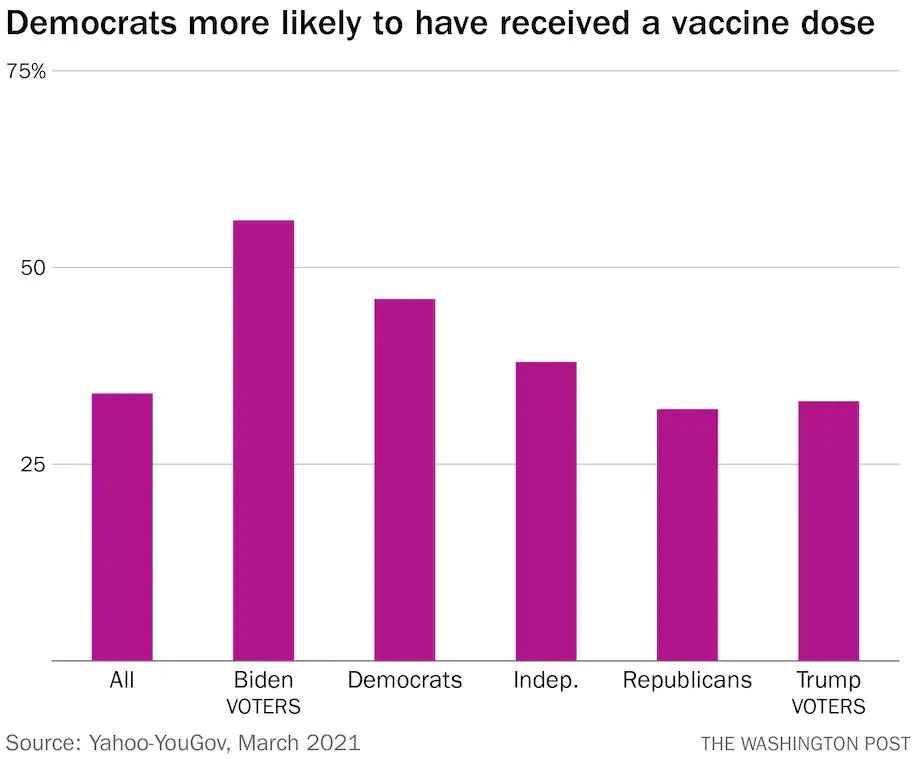
Among those who hadn’t yet received a dose, Democrats were far more likely to indicate that they planned to do so as soon as possible. Among Republicans, half of those who haven’t been vaccinated say that they don’t have any plans to do so at all.

One reason is that Republicans are simply less worried about the virus. More than half say that they’re not very worried about it or not worried at all. Among those who voted for Donald Trump, the figure is over two-thirds. By contrast, more than three-quarters of Democrats say that they are at least somewhat worried about the virus.
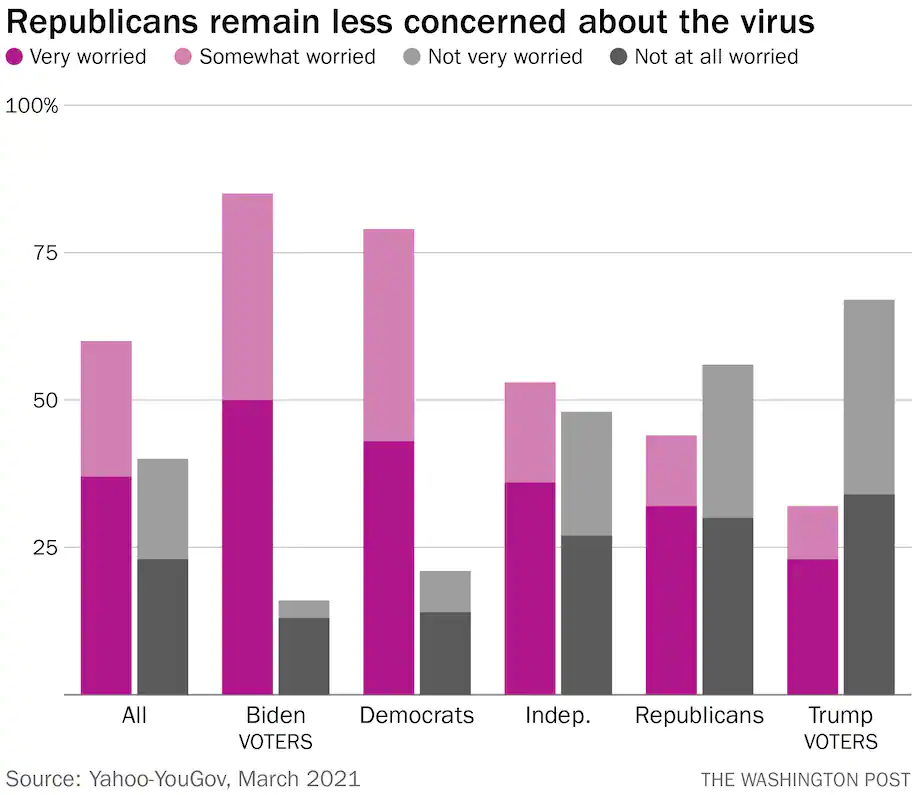
In the YouGov polling, 60 percent of Republicans say that the worst of the pandemic is behind us. They’re also much more likely to say that restrictions aimed at preventing the spread of the virus — mask mandates, limits on indoor dining — should be lifted immediately.

As we mentioned Thursday, there are two ways to achieve herd immunity. One is fast and safe: widespread vaccinations. The other — people contracting the virus — is slow and dangerous. The path the United States is on will take us to a place where much of the country has opted for the first option and the rest, the latter.

So the question again becomes: How many people will die, both over the short term and the long term, as a result of those choices?
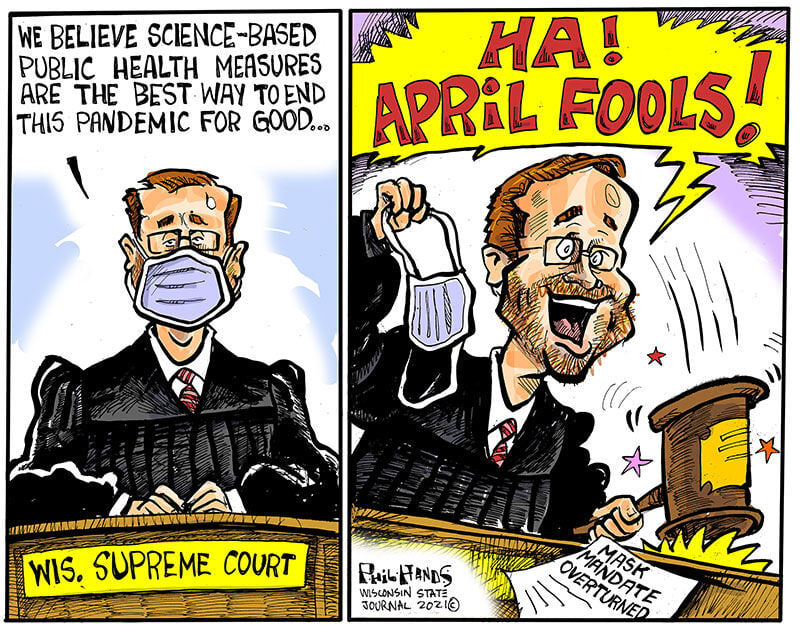
Hands on Wisconsin: Supreme Court plays April Fools’ Day prank on Wisconsin

https://madison.com/wsj/opinion/cartoon/hands-on-wisconsin-supreme-court-plays-april-fools-day-prank-on-wisconsin/article_48f60a90-9ada-502c-a134-e7f3ebbbe77a.html

MY VIEW | PHIL HANDS

America’s nightmarish year is finally ending

America's nightmare year of COVID is finally ending

One year after the World Health Organization declared COVID-19 a pandemic, the end of that pandemic is within reach.

The big picture: The death and suffering caused by the coronavirus have been much worse than many people expected a year ago — but the vaccines have been much better.

Flashback“Bottom line, it’s going to get worse,” Anthony Fauci told a congressional panel on March 11, 2020, the day the WHO formally declared COVID-19 to be a global pandemic.

  • A year ago today, the U.S. had confirmed 1,000 coronavirus infections. Now we’re approaching 30 million.
  • In the earliest days of the pandemic, Americans were terrified by the White House’s projections — informed by well-respected modeling — that 100,000 to 240,000 Americans could die from the virus. That actual number now sits at just under 530,000.
  • Many models at the time thought the virus would peak last May. It was nowhere close to its height by then. The deadliest month of the pandemic was January.

Yes, but: Last March, even the sunniest optimists didn’t expect the U.S. to have a vaccine by now.

  • They certainly didn’t anticipate that over 300 million shots would already be in arms worldwide, and they didn’t think the eventual vaccines, whenever they arrived, would be anywhere near as effective as these shots turned out to be.

Where it stands: President Biden has said every American adult who wants a vaccine will be able to get one by the end of May, and the country is on track to meet that target.

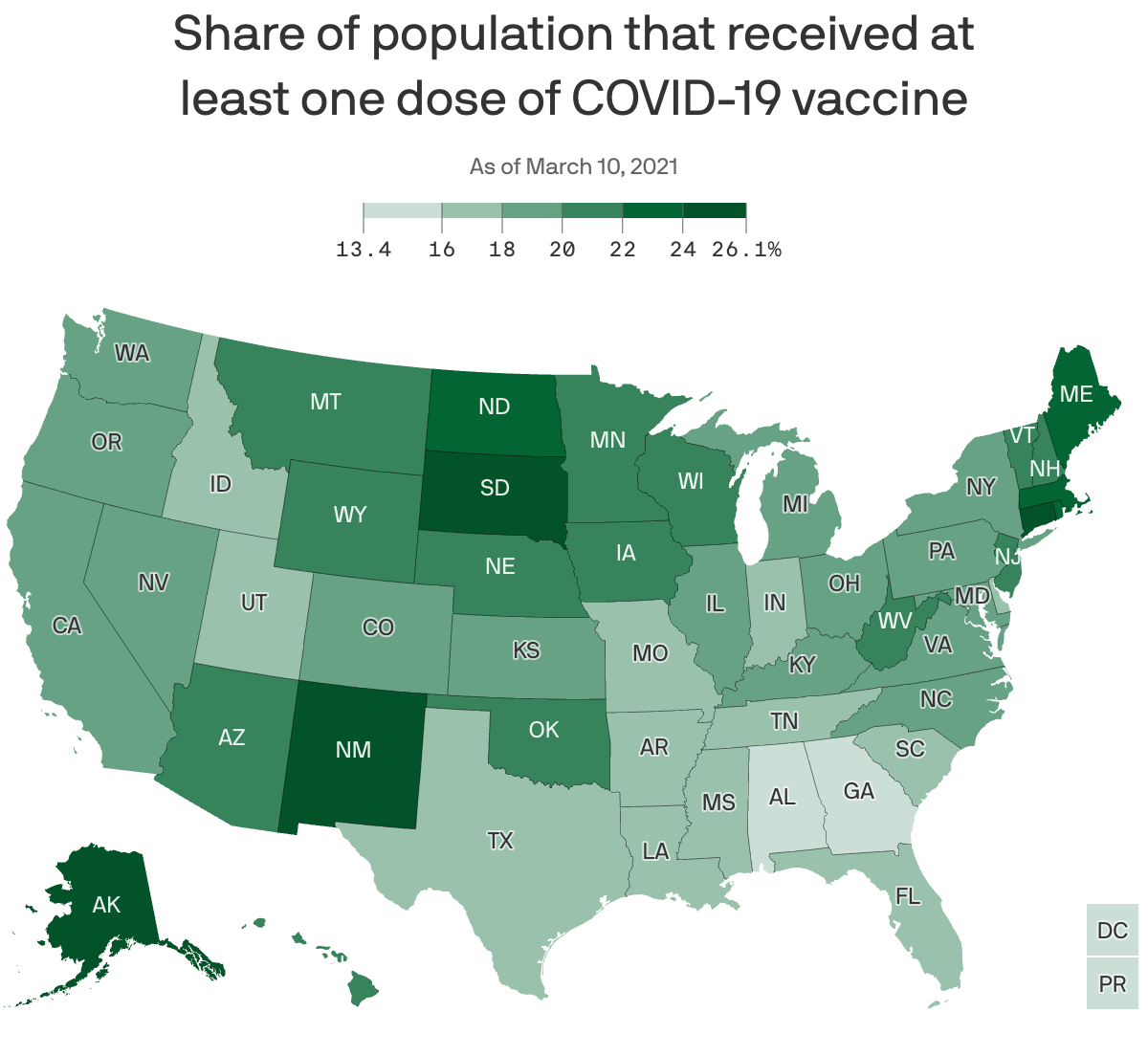
  • The U.S. is administering over 2 million shots per day, on average. Roughly 25% of the adult population has gotten at least one shot.
  • The federal government has purchased more doses than this country will be able to use: 300 million from Pfizer, 300 million from Moderna and 200 million from Johnson & Johnson.
  • The Pfizer and Moderna orders alone would be more than enough to fully vaccinate every American adult. (The vaccines aren’t yet authorized for use in children.)

Yes, millions of Americans are still anxiously awaiting their first shot — and navigating signup websites that are often frustrating and awful.

  • But the supply of available vaccines is expected to surge this month, and the companies say the bulk of those doses should be available by the end of May.
  • Cases, hospitalizations and deaths are all falling sharply at the same time vaccinations are ramping up.

The bottom line: Measured in death, loss, isolation and financial ruin, one year has felt like an eternity. Measured as the time between the declaration of a pandemic and vaccinating 60 million Americans, one year is an instant.

  • The virus hasn’t been defeated, and may never fully go away. Getting back to “normal” will be a moving target. Nothing’s over yet. But the end of the worst of it — the long, brutal nightmare of death and suffering — is getting close.

Experts warn US risks delaying ‘normal’ summer

Experts warn US risks delaying ‘normal’ summer

Overnight Health Care: Experts warn US risks delaying 'normal' summer |  Alabama GOP governor extends mask mandate | Senate votes to take up relief  bill | TheHill


President Biden‘s announcement that there will be enough vaccines for all adults by May is raising hopes for a return to normal soon.

But the next few months in the pandemic are critical. Concern is growing over moves by some states to lift restrictions already, while new variants of the virus are on the rise in the U.S. Experts warn that actions taken now risk delaying getting back to some semblance of normal.

Health officials are urging restrictions to remain in place for the final stretch, saying that it will not be much longer before the situation markedly improves, and it does not make sense to lift all restrictions when widespread vaccinations are in sight.    

Biden on Wednesday issued his most forceful comments to date, calling out the governors of Texas and Mississippi for lifting their states’ mask mandates and all capacity limits on businesses. 

He noted that vaccinations for all adults are on the horizon.

The last thing we need is Neanderthal thinking that in the meantime everything’s fine, take off your mask, forget it,” he said. “It still matters.”

Estimates differ on when exactly the country might return to something like “normal,” though many say they expect this summer will be much better.

Former Food and Drug Administration Commissioner Scott Gottlieb said on CNBC on Wednesday that he thinks even as soon as April will be “profoundly better,” given that vaccine supply will have ramped up significantly, allowing vaccine availability to be “wide open” by then.

Centers for Disease Control and Prevention Director Rochelle Walensky on Wednesday put the time frame at three months until the country could be vaccinated. 

“The next three months are pivotal,” she said.   

Thomas Tsai, a researcher at the Harvard T.H. Chan School of Public Health, said that by summer, “I think we can have a much more, I don’t want to say normal, but at least a ‘new normal’ summer.”

But experts warn that the return to normal could actually be delayed if restrictions are lifted too soon, causing a new spike in cases in the near term. 

Tsai likened the current situation to the seventh inning stretch of a baseball game. “Progress has been made; it’s OK to take stock of that,” he said. “How we play the next two innings determines if this is a single game or turns into a doubleheader.”

Maintaining restrictions as people get fatigued and see the end in sight could be a challenge, though, particularly in red states that were skeptical of instituting health restrictions from the start. 

Texas Gov. Greg Abbott and Mississippi Gov. Tate Reeves, both Republicans, pointed to the ongoing vaccination campaign in saying that the time has come to end restrictions. 

“With the medical advancements of vaccines and antibody therapeutic drugs, Texas now has the tools to protect Texans from the virus,” Abbott said Tuesday. “We must now do more to restore livelihoods and normalcy for Texans by opening Texas 100 percent.”

Responding to Biden’s criticism on Wednesday, Reeves added: “Mississippians don’t need handlers.” 

“As numbers drop, they can assess their choices and listen to experts,” he added. “I guess I just think we should trust Americans, not insult them.”

Gottlieb argued for a middle ground, saying that public health officials risk having the public simply ignore all guidance if they do not provide a “realistic glide path to a better future,” though March is “a little bit premature” to lift all restrictions. 

“March really is a difficult month,” he said. “It sits between two worlds. February was a raging epidemic, it was very clear we needed to have measures in place. I think April’s going to be profoundly better, and March is sitting in the middle.”

Variants of the virus also pose a threat that adds another degree of uncertainty. The most common variant spreading in the US, known as B117, or the United Kingdom variant, responds well to vaccines, but is more infectious. 

“The B117 hyper-transmissible variant looms ready to hijack our successes to date,” Walensky said. 

Variants first identified in Brazil and South Africa also pose a risk of reducing the effectiveness of the vaccines, though the extent is not fully clear, and vaccine manufacturers are preparing backup plans to provide booster shots or updated vaccines if necessary. 

“We are at a critical nexus in the pandemic,” Walensky said. “So much can turn in the next few weeks.”

After weeks of declines, both cases and deaths are ticking up. According to CDC data, the seven-day average of new cases per day, at 66,000, is up 3.5 percent from the past week, and deaths, at just over 2,000 per day, are up 2.2 percent. 

Barbara Alexander, president of the Infectious Diseases Society of America, issued a statement Wednesday calling on people to continue wearing masks, distancing from others, and avoiding large gatherings. 

“All of these measures together will bring us closer to ending the pandemic,” she said. “Abandoning them now will postpone the day we can put COVID-19 behind us.”  

Still, the declines in past weeks and the increasing pace of vaccinations is offering some hope after a long year.

“I’m more optimistic than I have been in the last year,” Tsai said. 

Cartoon – It’s not the Heat, it’s the Stupidity!

How cartoons are chronicling the battle between mask wearers and Trump -  The Washington Post

Cartoon – We’re all in this together

Not all in this together - ND Cartoons

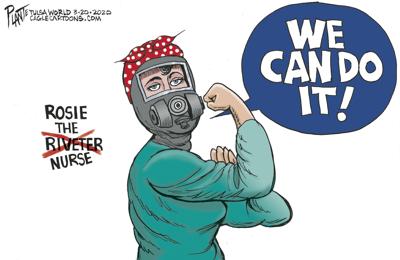
Cartoon – We can do it!

Editorial Cartoon: Rosie the Nurse | Opinion | dailyastorian.com

The danger of a fourth wave

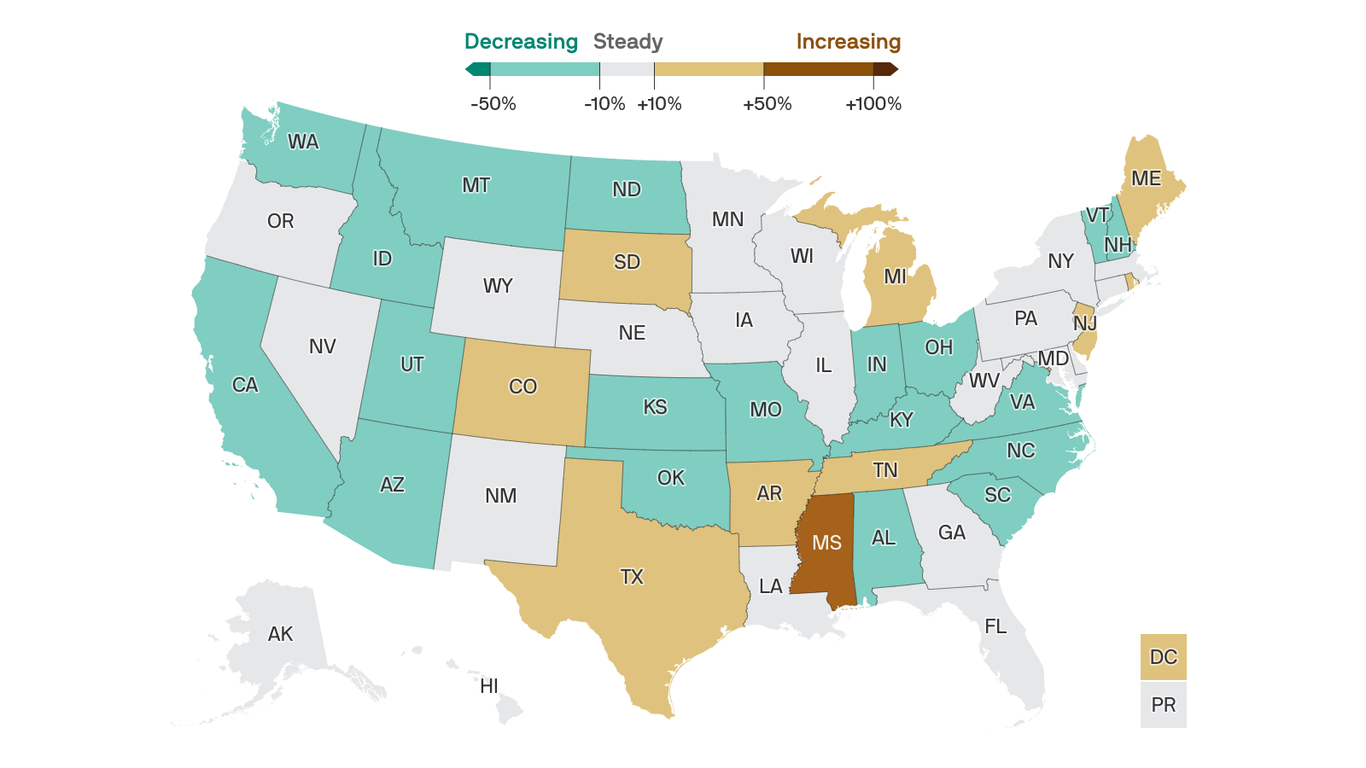
Change in new COVID-19 cases in the past week

Percent change of the 7-day average of new cases

on Feb. 23 and March 2, 2021

The U.S. could be in danger of a fourth coronavirus wave - Axios

The U.S. may be on the verge of another surge in coronavirus cases, despite weeks of good news.

The big picture: Nationwide, progress against the virus has stalled. And some states are ditching their most important public safety measures even as their outbreaks are getting worse.

Where it stands: The U.S. averaged just under 65,000 new cases per day over the past week. That’s essentially unchanged from the week before, ending a six-week streak of double-digit improvements.

  • Although the U.S. has been moving in the right direction, 65,000 cases per day is not a number that indicates the virus is under control. It’s the same caseload the U.S. was seeing last July, at the height of the summer surge in cases and deaths.

What we’re watching: Texas Gov. Greg Abbott on Tuesday rescinded the state’s mask mandate and declared that businesses will be able to operate at full capacity, saying risk-mitigation measures are no longer necessary because of the progress on vaccines.

  • But the risk in Texas is far from over. In fact, its outbreak is growing: New cases in the state rose by 27% over the past week.
  • Mississippi Gov. Tate Reeves also scrapped all business restrictions, along with the state’s mask mandate, on Tuesday. New cases in Mississippi were up 62% over the past week, the biggest jump of any state.
  • The daily average of new daily cases also increased in eight more states, in addition to Mississippi and Texas.

How it works: If Americans let their guard down too soon, we could experience yet another surge — a fourth wave — before the vaccination campaign has had a chance to do its work.

  • The vaccine rollout is moving at breakneck speed. The U.S. should have enough doses for every adult who wants one by May, President Biden said this week.
  • At the same time, however, more contagious variants of the coronavirus are continuing to gain ground, meaning that people who haven’t gotten their vaccines yet may be spreading and contracting the virus even more easily than before.

What’s next: The bigger a foothold those variants can get, the harder it will be to escape COVID-19 — now or in the future.

  • The existing vaccines appear to be less effective against two variants, discovered in South Africa and Brazil, which means the virus could keep circulating even in a world where the vast majority of people are vaccinated.
  • And that means it’s increasingly likely that COVID-19 will never fully go away — that outbreaks may flare up here and there for years, requiring vaccine booster shots as well as renewed protective measures.

The bottom line: Variants emerge when viruses spread widely, which is also how people die.

  • Whatever “the end of the pandemic” looks like — however good it’s possible for things to get — the way to get there is through ramping up vaccinations and continuing to control the virus through masks and social distancing. Not doing those things will only make the future worse.
  • “Getting as many people vaccinated as possible is still the same answer and the same path forward as it was on December 1 or January 1 … but the expected outcome isn’t the same,” Shane Crotty, a virologist at the La Jolla Institute for Immunology in San Diego, told Reuters.

The Pandemic is a long way from over

May be an image of text

A somber milestone on the path to brighter days ahead

https://mailchi.mp/05e4ff455445/the-weekly-gist-february-26-2021?e=d1e747d2d8

U.S. tops 500,000 COVID-19 deaths | PBS NewsHour

Although the nation reached a grim and long-dreaded milestone on Monday, surpassing 500,000 lives lost to COVID—more than were killed in two World Wars and the Vietnam conflict combined—the news this week was mostly good, as key indicators of the pandemic’s severity continued to rapidly improve.

Over the past two weeks, hospitalizations for COVID were down 30 percent, deaths were down 22 percent, and new cases declined by 32 percent—the lowest levels since late October. This week’s numbers declined somewhat more slowly than last week’s, leading Dr. Rachel Walensky, director of the Centers for Disease Control and Prevention, to caution people against letting their guard down just yet: “Things are tenuous. Now is not the time to relax restrictions.” Of particular concern are new variants of the coronavirus that have emerged in numerous states, including one in New York and another in California, that may be more contagious than the original virus.
 
The best news of the week was surely a report from the Food and Drug Administration (FDA) evaluating the new, single-shot COVID vaccine from Johnson & Johnson (J&J), showing it to be highly effective at preventing severe disease, hospitalization, and death caused by COVID, including variants. On Friday, a panel of outside experts met to assess whether to approve the J&J vaccine for emergency use, which would make it the third in the nation’s arsenal of COVID vaccines. If approved, the vaccine will be rolled out next week, according to the White House, with up to 4M doses available immediately.

The sooner the better: new data show that since vaccinations began in late December, new cases among nursing home residents have fallen more than 80 percent—a hopeful glimpse at the future that lies ahead for the general population once vaccines become widely available.