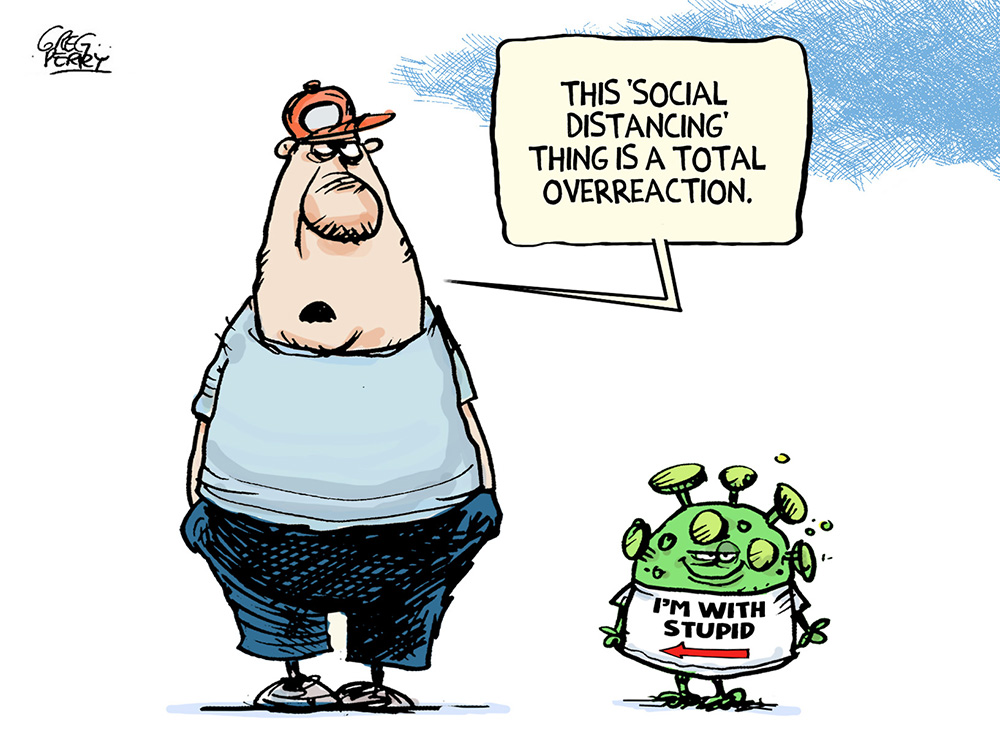
Dr. Anthony Fauci, the nation’s top infectious disease expert, tells CBS Evening News anchor and managing editor Norah O’Donnell that Americans need to “double down” on mask-wearing and social distancing to help control a surge in new coronavirus cases.
He also spoke about President Trump’s recovery from COVID-19, progress towards a vaccine, and how the pandemic will affect this year’s holiday gatherings. Watch the full interview.
Dr. Anthony Fauci on Thursday denounced the concept of herd immunity — the notion that if a large enough group of people contract an infection, it will ultimately stop the disease from spreading — calling it “nonsense” during an interview with Yahoo News.
“Anybody who knows anything about epidemiology will tell you that is nonsense and very dangerous,” Fauci said, “because what will happen is that if you do that, by the time you get to herd immunity, you will have killed a lot of people that would have been avoidable.”
Fauci, the director of the National Institute of Allergy and Infectious Diseases and member of the White House coronavirus task force, discussed the coronavirus pandemic and the country’s response to it during a live interview Thursday morning with Yahoo News Editor in Chief Daniel Klaidman and Chief Investigative Correspondent Michael Isikoff.
The coronavirus has killed more than 216,000 people in the U.S. and infected almost 8 million, according to data from Johns Hopkins University.
Now, more than seven months after the coronavirus was declared a pandemic, Fauci said Thursday that the U.S. is not in a good place.
“We talk about a second wave,” he said. “We’ve never really gotten out of the first wave. If you look at the baseline number of daily infections that we have had over the last several weeks, [it’s] been around 40,000 per day. It’s now gone up to about 50,000 per day. So right away, we have a very unfortunate baseline from which we need to deal.”
President Trump and his administration have been pushing the herd immunity approach as a possible solution to ending the pandemic, the New York Times reported Wednesday. During a call with reporters, two officials who requested anonymity cited a petition called the Great Barrington Declaration, which calls for states to lift coronavirus restrictions for the bulk of American citizens, the Times reported.
When asked about the herd immunity approach, Fauci said that while he agrees with what the declaration says about protecting the vulnerable and not closing down the country, virtually anyone with a solid understanding of epidemiology would disagree with the idea of letting everyone get infected.
“My position is known. Dr. Deborah Birx’s position is known, and Dr. [Robert] Redfield,” he said. “So you have me as the director of the National Institute of Allergy and Infectious Diseases, Debbie Birx, as the coordinator and a very experienced infectious disease person, the coordinator of the task force — and you have Bob Redfield, who’s the director of the [Centers for Disease Control and Prevention]. All three of us very clearly are against that.”
The White House is reportedly embracing a herd-immunity approach focused on “protecting the elderly and the vulnerable” but experts are calling the plan dangerous, “unethical”, and equivalent to “mass murder”.
“Current lockdown policies are producing devastating effects on short and long-term public health,” the declaration states, adding, “The most compassionate approach that balances the risks and benefits of reaching herd immunity, is to allow those who are at minimal risk of death to live their lives normally to build up immunity to the virus through natural infection, while better protecting those who are at highest risk. We call this Focused Protection.”
Essentially, herd immunity is when enough people are immune to a disease, like Covid-19, that the disease can’t be transmitted as easily and thus provides indirect protection.
It’s been rumoured that the government has been leaning towards this plan of action for some time now, although this is the first real admission.
In response to today’s news, experts around the world have been voicing their concerns.
And this isn’t the first time we’ve heard experts say herd immunity is not a good idea.
For example, the head of the World Health Organization said Monday that allowing the novel coronavirus to spread in an attempt to reach herd immunity was “simply unethical.”
Similarly, the National Institutes of Health (NIH) director Francis Collins also denounced herd immunity as a viable plan.
“What I worry about with this is it’s being presented as if it’s a major alternative view that’s held by large numbers of experts in the scientific community. That is not true. This is a fringe component of epidemiology. This is not mainstream science. It fits into the political views of certain parts of our confused political establishment,” he said in an interview.
Not to mention studies continue to show that Sweden’s attempts at herd immunity have failed and have resulted in a higher Covid-19 death toll than expected.
As more research comes out, scientists are starting to learn that Covid-19 immunity, even in those who were severely infected, can fade after a few weeks.
This is why we’ve seen cases of reinfection and why many experts are advising against a herd immunity plan.
To put that into context, that means around 197 million people would need to be infected in America. And assuming that the Covid-19 fatality rate is somewhere between 0.5% and 1%, based on numbers from the World Health Organization (WHO), more than 1 million people would die – at minimum.
William Haseltine, Chair and President of ACCESS Health International, told CNN “herd immunity is another word for mass murder. We are looking at two to six million Americans dead – not just this year but every year.”
“This is an unmitigated disaster for our country – to have people at the highest levels of our government countermanding our best public health officials. We know this epidemic can be put under control. Other countries have done it. We are doing the opposite.”
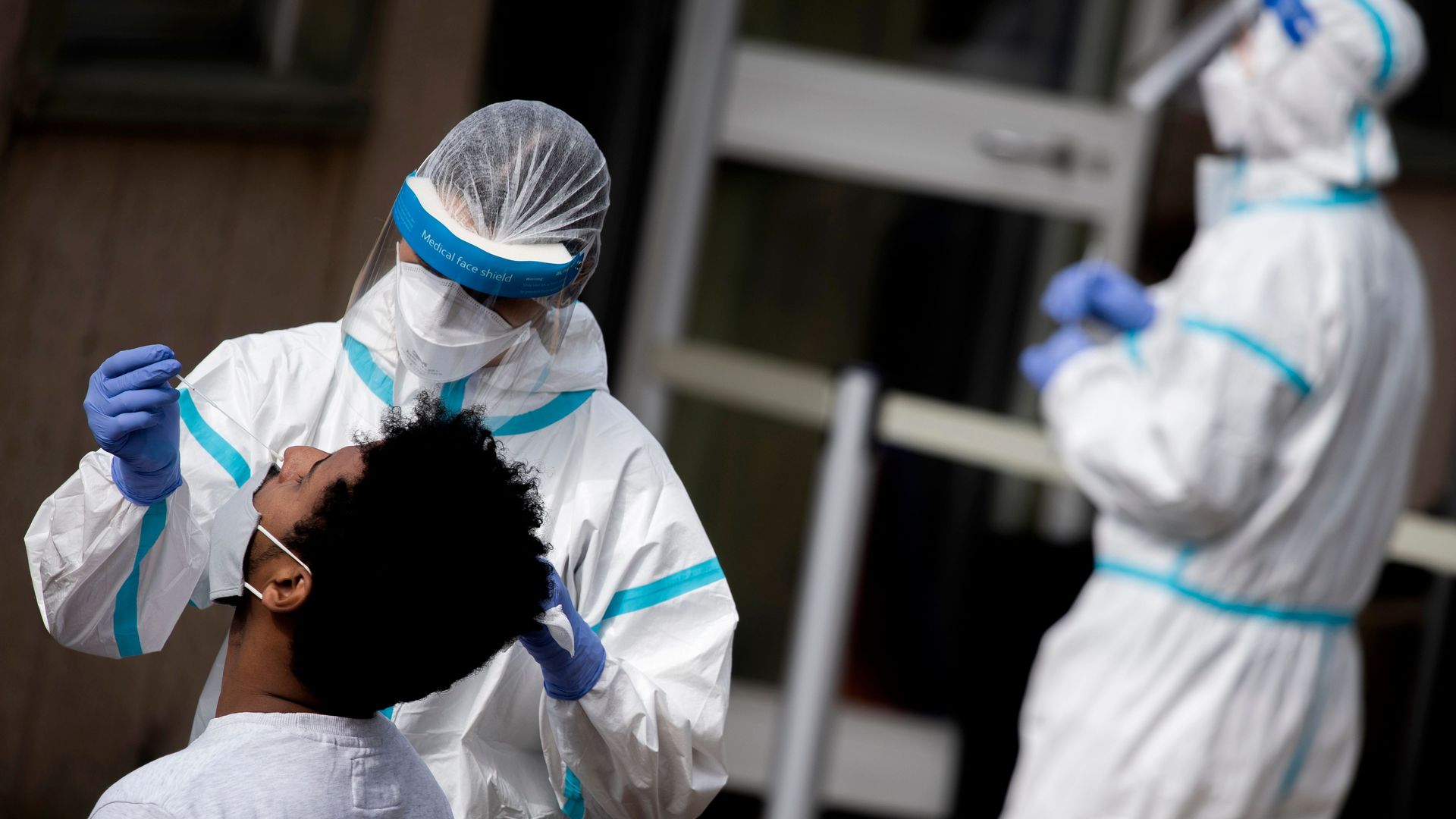
Government spending on testing and contact tracing pays for itself more than 30 times over, according to yet another paper published in JAMA (good series!).
What they found: Harvard economists David Cutler and Lawrence Summers calculated the total cost of the coronavirus pandemic at more than $16 trillion in the U.S. alone. Of that, about $7 trillion is attributable to loss of life and long-term impairment from the disease, Axios’ Felix Salmon writes.
Enhanced testing and tracing would cost about $6 million per 100,000 inhabitants, they calculate. Out of that population, 14 lives would be saved, on which they place a value of $96 million, and 33 critical and severe cases would be avoided, representing savings of $80 million.
That adds up to $176 million in benefits from $6 million in costs — before taking into account any second-order effects from even fewer cases down the road.
The bottom line: “Currently, the U.S. prioritizes spending on acute treatment,” write Cutler and Summers, “with far less spending on public health services and infrastructure.”
Going forward, they write, “a minimum of 5% of any COVID economic relief intervention should be devoted to such health measures.”
The first coronavirus vaccinewill likely get authorized within months, but that will only be the beginning of what’s likely to be a long, chaotic vaccination process, the New York Times’ Carl Zimmer reports.
The big picture: The first vaccines probably will offer only moderate protection against the virus, meaning we can’t ditch our masks even if we get one. And we probably won’t have a good way to choose between these vaccines once several of them are on the market.
Some vaccines that are in earlier stages of development today may struggle to cross the finish line, even if they work better than earlier vaccines.
And some vaccines may be pulled off of the market because they’re unsafe.
Between the lines:Some of this is inherent to the breakneck speed of the vaccination effort, but some of it is a result of how that effort was designed.
Earlier this year, some government scientists had wanted to test vaccine candidates against each other, instead of testing all of them against a placebo. But these kinds of trials are risky for drug companies, because they show the value of one vaccine against another.
That information could be useful for patients, but is a business risk for manufacturers.
“You have to have the total cooperation of the pharmaceutical companies to get involved in a master protocol,” top infectious disease expert Anthony Fauci told NYT. “That — I don’t know what the right word is — didn’t turn out to be feasible.”
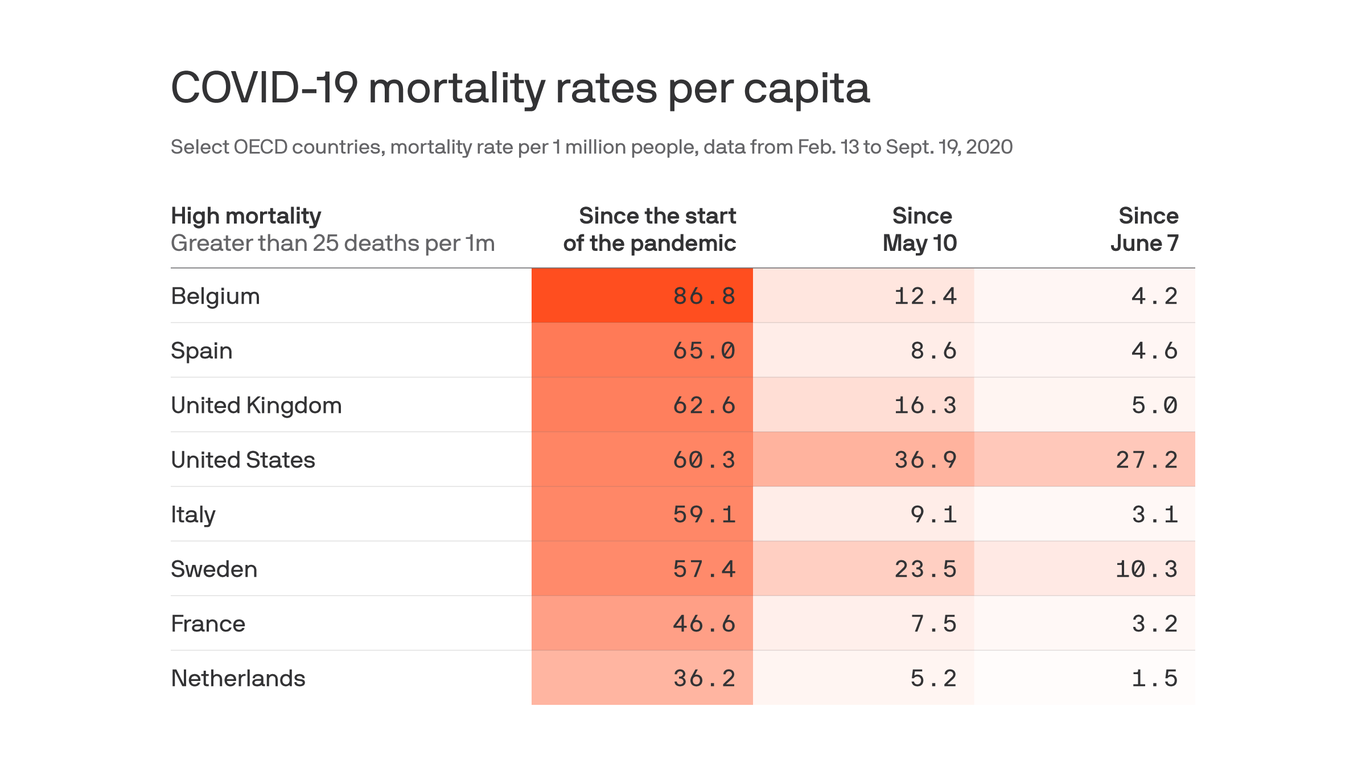
Although other wealthy countries have higher overall coronavirus mortality rates than the United States, the U.S. death rate since May is unrivaled among its peers, according to a new study published in JAMA.
Between the lines:After the first brutal wave of outbreaks, other countries did much better than the U.S. at learning from their mistakes and preventing more of their population from dying.
Why it matters:“If the U.S. had comparable death rates with most high-mortality countries beginning May 10, it would have had 44,210 to 104,177 fewer deaths,” the authors conclude.
Excess deaths have followed a similar pattern: The hardest-hit European countries had similar or higher rates of excess deaths of all causes to the U.S. early on, but these fell much lower than the America did after the first wave.
Yes, but: Death rates are not static, as this study proves, and outbreaks in several European countries have taken a turn for the worse lately.
The head of the World Health Organization said Monday that allowing the novel coronavirus to spread in an attempt to reach herd immunity was “simply unethical.”
The remark was a sharp rebuke of the approach amid mounting new infections around the world. Recent days have seen the most rapid rise in cases since the pandemic began in March.
“Never in the history of public health has herd immunity been used as a strategy for responding to an outbreak, let alone a pandemic,” WHO Director-General Tedros Adhanom Ghebreyesus said at a Monday media briefing. “It is scientifically and ethically problematic.”
In a public health context, herd immunity typically describes a scenario in which a large enough share of the population is vaccinated against a disease to prevent it from spreading widely, thereby providing default protection to a minority of people who have not been vaccinated.
But as there is still no vaccine for the coronavirus, achieving herd immunity in the current environment would require a large number of people to contract the virus, survive covid-19, and then produce sufficient antibodies to provide long-term protection.
While the scientific community has roundly rejected herd immunity the approach, public interest in it has waxed and waned amid pressure to reopen schools and economies.
Last month, President Trump appeared to praise the idea during a town hall in Pennsylvania.
“You’ll develop herd — like a herd mentality,” he said. “It’s going to be — it’s going to be herd developed — and that’s going to happen.”
British Prime Minister Boris Johnson’s government initially expressed interest in the theory before backtracking amid public outcry over the dangers of letting the virus spread. Johnson himself was hospitalized with a severe case of covid-19, which he said could have killed him.
Tedros, noting that there had been “some discussion” about the concept recently, told reporters Monday that allowing people to be exposed to a deadly virus whose effects are still not fully known was “not an option.”
“Most people who are infected with the virus that causes covid-19 develop an immune response within the first few weeks, but we don’t know how strong or lasting that immune response is, or how it differs for different people,” he said.
Though rare, there are multiple documented instances of people being infected for a second time after recovering from covid-19. An 89-year-old woman in the Netherlands died after being infected with the coronavirus for a second time, Dutch news reported Monday.
Antibody studies suggest that less than 10 percent of people in most countries have contracted covid-19, Tedros said, which is nowhere near the majority that would be needed for herd immunity.
With the “vast majority” of the world’s population susceptible, letting the virus spread “means allowing unnecessary infections, suffering and death,” he said.
Just in the last four days, Tedros said Monday, the global coronavirus count has continued to break its daily record for the number of new confirmed infections.
“Many cities and countries are also reporting an increase in hospitalizations and intensive care bed occupancy,” he added.
Tedros has urged governments to pursue comprehensive plans that include widespread testing, social distancing, and other preventive measures, such as face-mask wearing, alongside a global push to develop a vaccine. The WHO is spearheading an effort to distribute coronavirus vaccines equitably once they are available, which Trump declined to join.




 HENRY KOTULA