What the U.S. can learn from other countries in the coronavirus fight

https://www.axios.com/coronavirus-lessons-other-countries-24794264-1653-4500-922c-7f1c66efa011.html
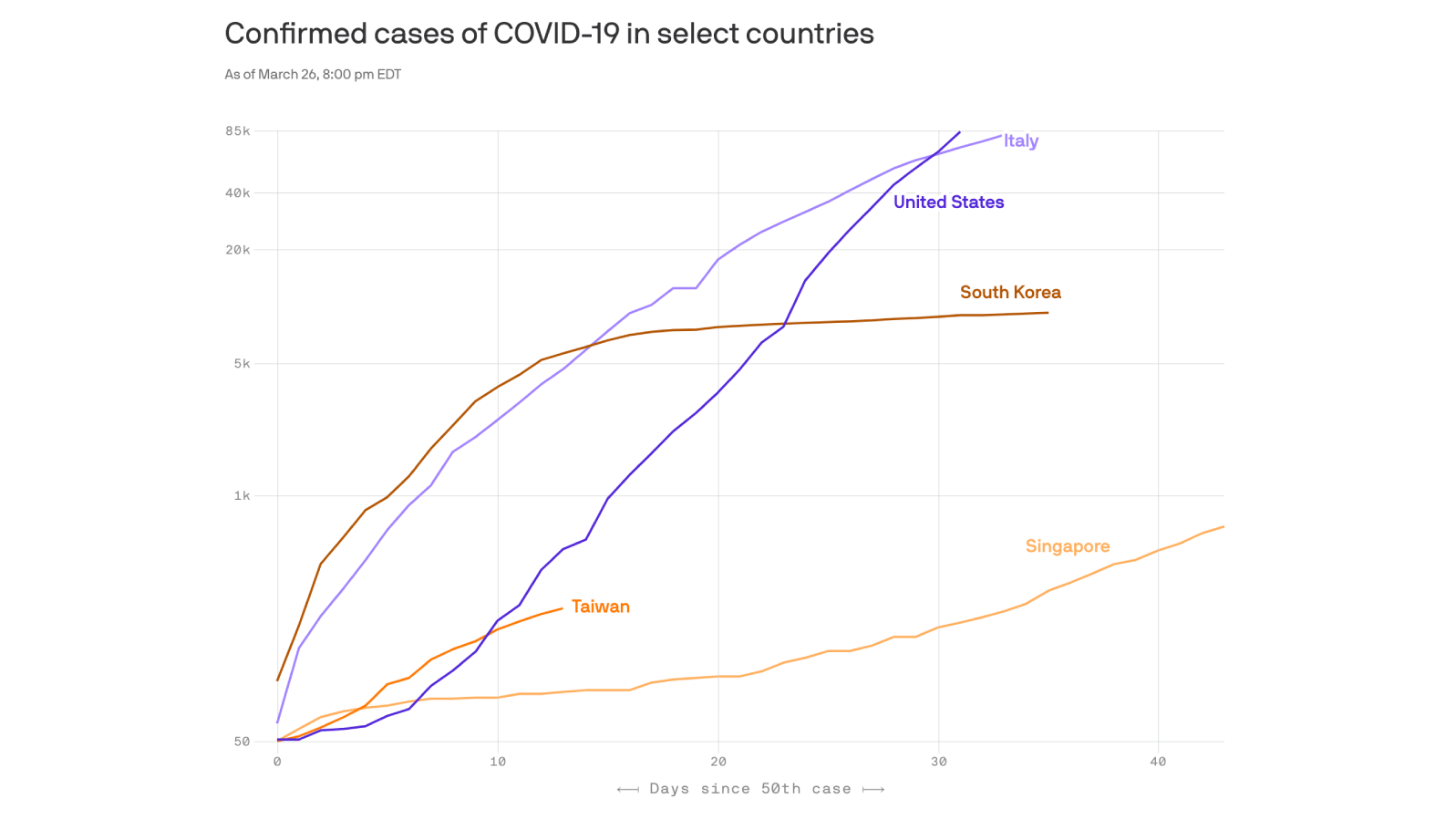
Coronavirus lessons that the U.S. can learn from other countries ...

The countries that have most successfully fended off the novel coronavirus have mainly done it with a combination of new technology and old-school principles.

Why it matters: There’s a lot the U.S. can learn from the way other countries have handled this global pandemic — although we may not be able to apply those lessons as quickly as we’d like.

The big picture: A handful of Asian countries, including South Korea, Singapore and Taiwan, have succeeded where the U.S. and Europe have failed.

  • They were able to quickly bring the virus under control, reducing the number of new cases that cropped up each day. And they did it largely without shutting down schools, businesses and public life.

The bad news: It’s too late for the U.S. to simply do what worked in those countries. We’ve already made too many mistakes.

  • But there are still lessons for the U.S. to learn for future outbreaks — and, hopefully, there are some pieces of those countries’ larger strategies that we can adapt to our coronavirus response now.
Lesson 1: The playbook works

As a new infection begins to spread, you want to quickly test the people who might have it, and quarantine the ones who do. Then you want to figure out who else they might have infected, and test those people, and quarantine the ones who are indeed sick. This process gets repeated.

  • “If you don’t know what your population is that you’re supposed to be monitoring, you don’t have a chance,” said Claire Standley, an infectious-disease expert at Georgetown University’s Center for Global Health Science and Security.

This test-and-trace process is nothing new. It’s the standard playbook. South Korea, Singapore and Taiwan just executed it a lot better than the United States.

  • Testing and contact tracing are particularly important with this strain of coronavirus because people can spread it before they start to feel sick — so if you’re only testing the sickest patients, the virus is still spreading unchecked.
  • And it’s important to do this early. It’s a lot easier to stop five people from infecting another 15 than it is to stop 20,000 people from infecting another 60,000.

Next time a mysterious virus starts spreading abroad, better testing and a much faster response will be imperative.

Lesson 2: Technology can help

Singapore has gotten pretty draconian with its track-and-trace process.

  • The government tracks the location of residents’ smartphones, so it knows exactly who had come within a few feet of an infected or potentially infected person.
  • It uses the same location data to help enforce mandatory quarantines.

That might be too Big Brother for the U.S., but a voluntary version of it might work — we already consent to a whole lot of location tracking for much less important ends.

  • And researchers are already using population-level smartphone data to see, for example, which cities are flouting stay-at-home orders. That can help inform local response even without individualized tracking.
  • “I think we’re further along that pathway than maybe people think,” Standley said.

Taiwan, meanwhile, aided its coronavirus response by making better use of data it already had. It quickly merged its immigration and health care databases, giving authorities a real-time view of who was getting sick and where they had traveled.

  • That might be hard to copy in the U.S., though, because the relevant data are scattered across multiple local, state and federal agencies with little to no integration. And we have no centralized health data.
Lesson 3: Messaging matters

Public communication is one of the big things Italy — a leading example of what not to do — got wrong.

  • Some Italian officials downplayed the virus for too long. Leaders often contradicted each other, and sometimes themselves, about piecemeal interventions before finally locking down the entire country as cases skyrocketed.

Singapore, by contrast, came out early with a clear message: This was going to be bad for a while, and people needed to stick together and do their part.

The U.S., so far, looks a lot more like Italy.

  • President Trump has sent similarly mixed messages here, initially downplaying the virus and saying it would go away on its own before changing his tone as cases mounted.
What’s next

The U.S. can’t go back in time to get things right at the beginning. So we can’t match the success of places like South Korea.

  • Our best backup plan is to stick with aggressive social distancing and give our testing capacity more time to ramp up.
  • We don’t seem to be on track to ever achieve the kind of sophisticated track-and-trace programs Asia employed, but hopefully some cruder version can help us find our way out of this if we keep the number of new cases low in the meantime.

The bottom line: “If we had got on top of this thing two months ago, America would look very, very different,” Ashish Jha, director of Harvard’s Global Health Institute, said in a recent interview with the New Yorker.


4 ETHICAL DILEMMAS FOR HEALTHCARE ORGANIZATIONS DURING THE COVID-19 PANDEMIC

https://www.healthleadersmedia.com/clinical-care/4-ethical-dilemmas-healthcare-organizations-during-covid-19-pandemic

Image result for 4 ETHICAL DILEMMAS FOR HEALTHCARE ORGANIZATIONS DURING THE COVID-19 PANDEMIC

There has already been rationing of testing in the United States and rationing of critical care resources is likely if severely ill COVID-19 patients surge significantly.


KEY TAKEAWAYS

Rationing of care for novel coronavirus patients has been reported in China and Italy.

Medical utility based on scientific patient profiles should guide decisions to ration critical care resources such as ventilators, medical ethicist James Tabery says.

In a pandemic, public health considerations should drive decisions on prioritizing who is tested for disease, he says.

The novel coronavirus (COVID-19) pandemic is raising thorny medical ethics dilemmas.

In China and Italy, there have been reports of care rationing as the supply of key resources such as ventilators has been outstripped by the number of hospitalized COVID-19 patients. China, the epicenter of the pandemic, has the highest reported cases of COVID-19 at more than 80,800 as of March 17, according to worldometer. Italy has the second-highest number of COVID-19 cases at nearly 28,000 cases.

The severest form of COVID-19 includes pneumonia, which can require admission to an ICU and mechanical ventilation. “Those are not just things, there are expertly trained healthcare workers who man those domains. There just isn’t enough of these resources than what we anticipate needing,” says James Tabery, PhD, associate professor in the University of Utah Department of Philosophy and the University of Utah School of Medicine’s Program in Medical Ethics and Humanities.

He says the COVID-19 outbreak poses four primary ethical challenges in the healthcare sector.

1. TREATMENT

In the United States, caring for the anticipated surge of seriously ill COVID-19 patients is likely to involve heart-wrenching decisions for healthcare professionals, Tabery says. “The question is how do you ration these resources fairly? With treatment—we are talking about ICUs, ventilators, and the staff—the purpose is you are trying to save the severely sick. You are trying to save as many of the severely sick as you can.”

The first step in managing critical care resources is screening out patients who are unlikely to need critical care and urging them to self-quarantine at home, he says.

“But eventually, you bump up to a place where you not only have screened out all of the folks who are at low risk of serious illness, but you have millions of people across the country who fall into high-risk groups. If they get infected, many are going to need access to ventilators, and the way you do that ethically is you screen patients based on medical utility,” Tabery says.

Medical utility is based on scientific assessments, he says. “You basically look at the cases and try to evaluate as quickly and efficiently as possible the likelihood that you can improve a patient’s condition quickly.”

Rationing of critical care resources would be jarring for U.S. clinical staff.

Under most standard scenarios, a patient who is admitted to an ICU and placed on mechanical ventilation stays on the machine as long as the doctors think the patient is going to get better, Tabery says.

However, the COVID-19 pandemic could drive U.S. caregivers into an agonizing emergency scenario.

“When there are 10 people in the emergency room waiting to get on a ventilator, it is entirely feasible that you would be removing people from ventilators knowing that they are going to die. But you remove people from ventilators when your evaluation of the medical situation suggests that patients are not improving. If a patient is not improving, and it doesn’t look like using this scarce resource is a wise investment, then you try it out on another patient who might have better luck,” he says.

2. TESTING

There has been rationing of COVID-19 testing in the United States since the first novel coronavirus patient was diagnosed in January.

While there are clinical benefits to COVID-19 testing such as determining what actions should be taken for low- and high-risk patients, the primary purpose of testing during a pandemic is advancing public health, Tabery says.

“The primary purpose of the test is pure public health epidemiology. It’s about keeping track of who has COVID-19 in service of trying to limit the spread of the disease to other people. When that is the purpose, the prioritization isn’t so much about who is at greatest risk. It’s about who is more likely to interact with lots of people, or who is more likely to have interacted with more people.”

A classic example of rationing COVID-19 testing based on public health considerations is the first reported infection of an NBA player, he says.

“For the Utah Jazz player who had symptoms, it made sense to test him very quickly because it was clear that he had interacted with a lot of people. Once he tested positive, the testing of the other players was not because public health officials thought the players were more valuable than the average person on the street. It was because the players had come into contact with more people than the average person on the street.”

3. HEALTHCARE WORKERS

The COVID-19 pandemic involves competing obligations for healthcare workers, Tabery says. “On the one hand, they have a set of obligations that inclines them to go to work when they get the call. On the other hand, healthcare workers have their own interests—they don’t want to get sick, which can incline them not to work,” he says.

“The punchline is there is an ethical consensus that healthcare workers have a prima facie duty to work because of everything that has been invested in them, because of their unique position where not just anybody can replace them, because society looks to them to serve this function, and because they went into this profession and are expected to go into work,” he says.

However, the obligation of healthcare workers to show up for their jobs is not absolute, Tabery says. “If hospitals don’t have personal protective equipment, they are in no position to tell their staff to show up and work. If a hospital cannot provide even a basic level of safety for their employees to do their job, then they are turning their hospital not into a place to treat patients—they are turning it into a hub to exacerbate the problem.”

4. VACCINE

When a vaccine becomes available, policymakers, public health officials, and healthcare providers will face rationing decisions until there is sufficient supply to treat the entire U.S. population, Tabery says.

“When the vaccine comes out, the first group you are going to want to prioritize are healthcare workers, who are at risk of getting infected by doing their jobs and saving lives. You would also want to prioritize people who serve essential functions to keep society going—the people who keep the water running, the lights on, police, and firefighters. Then you want to start looking at the high-risk groups,” he says.


Doctors Fear Bringing Coronavirus Home: ‘I Am Sort of a Pariah in My Family’

Image result for Doctors Fear Bringing Coronavirus Home: ‘I Am Sort of a Pariah in My Family’

One doctor dreamed he was surrounded by coughing patients. “Most physicians have never seen this level of angst and anxiety in their careers,” a veteran emergency room doctor said.

SEATTLE — After her shifts in the emergency room, one doctor in Utah strips naked on her porch and runs straight to a shower, trying not to contaminate her home. In Oregon, an emergency physician talks of how he was recently bent over a drunk teenager, stapling a head wound, when he realized with a sudden chill that the patient had a fever and a cough. A doctor in Washington State woke up one night not long ago with nightmares of being surrounded by coughing patients.

“Most physicians have never seen this level of angst and anxiety in their careers,” said Dr. Stephen Anderson, a 35-year veteran of emergency rooms in a suburb south of Seattle. “I am sort of a pariah in my family. I am dipping myself into the swamp every day.”

As the coronavirus expands around the country, doctors and nurses working in emergency rooms are suddenly wary of everyone walking in the door with a cough, forced to make quick, harrowing decisions to help save not only their patients’ lives, but their own.

The stress only grew on Sunday, when the American College of Emergency Physicians revealed that two emergency medicine doctors, in New Jersey and Washington State, were hospitalized in critical condition as a result of the coronavirus. Though the virus is spreading in the community and there was no way of ascertaining whether they were exposed at work or somewhere else, the two cases prompted urgent new questions among doctors about how many precautions are enough.

“Now that we see front-line providers that are on ventilators, it is really driving it home,” Dr. Anderson said.

Doctors, nurses and other staff members in a variety of hospital departments face new uncertainty. In intensive care units, for example, health care providers must have extended exposure to people who have contracted the virus. But they know in advance of the risk they face.

In emergency departments, the danger comes from the unknown.

Patients arrive with symptoms but no diagnosis, and staff members must sometimes tend to urgent needs, such as gaping wounds, before they have time to screen a patient for Covid-19, the disease caused by the virus. At times, the protocols they must follow are changing every few hours.

“Many of us have trained for disasters, like Ebola and hurricanes,” said Dr. Adam Brown, the president of emergency medicine for Envision Healthcare, the largest provider of contract physicians to emergency rooms. “This is different because of the scale and scope of the disease.”

Add to that the shortage of protective gear and delays in testing, and health care workers fear they are flying blind.

Though the numbers are still low, Envision, which employs 11,000 emergency clinicians across the United States, has five times as many doctors under quarantine as it did a week ago, Dr. Brown said.

Several providers spoke on the condition of anonymity because their employers have told them not to talk to the news media.

The personal strain is cascading as the virus reaches new parts of the country. “Everybody feels the stress, but everybody is pulling together,” said Dr. K. Kay Moody, an emergency room doctor in Olympia, Wash., who runs a Facebook group with 22,000 emergency physicians. “That is what is keeping us OK.”

A few doctors said they were talking about bunking up in Airbnbs to create “dirty doc” living quarters to avoid endangering their children when they go home. Some are showing their partners where to find their passwords and insurance, should they end up in intensive care. Dr. Moody said she knew of at least one doctor whose former spouse was threatening to take their children away if the doctor went to work.

Many emergency physicians work as contractors, not hospital staff, so they will not necessarily be paid if they are quarantined. “As it stands, that is one of the most anxiety-provoking things,” Dr. Moody said, “on top of fear for your life.”

Nurses face similar challenges, though with less pay and support. An emergency nurse in Milwaukee said she bought her own goggles after hearing that protective gear was running low. A nurse at a rural hospital near Lake Tahoe in California said that the hospital was providing physicians with shower facilities as well as clean scrubs to wear, but that nurses had to wash their work clothes at home. She said that the physicians she worked with lobbied the hospital to provide clean scrubs for the nurses, but that the hospital concluded it would cost too much.

One doctor, who spoke on condition that the identity of the veterans hospital where she worked was not revealed, said the protocols have not kept up with the changing reality on the ground. When determining if a patient should get a separate room, she said, the emergency department still asks patients if they have been to high-risk countries, like China and Italy, even though community transmission of the virus has been well established.

Doctors have begun building plans for how they will ration supplies when there are more patients than their hospitals can handle. Emergency room doctors have experience sitting families down to advise discontinuing care because it would be futile. But in the United States, they are not used to making such calls based on resources alone.

Some said they were looking to Italy, where doctors on the front line have sometimes had to ration care in favor of younger patients, or those without other complicating conditions, who are more likely to benefit from it.

“If we get it all at once, we don’t have the resources, we don’t have the ventilators,” said Dr. William Jaquis, chair of the American College of Emergency Physicians.

Last week, Italian media reported that Bergamo, a city northeast of Milan, saw roughly 50 doctors test positive for the virus. In the region of Puglia in the south, local media reported that 76 employees had been quarantined after being exposed to patients who contracted Covid-19.

After the coronavirus broke out at a nursing facility near Seattle, Dr. Anderson sat with the leaders of his hospital, MultiCare Auburn Medical Center, to talk about how urgently they should prepare. Their hospital is ringed by nursing homes and other care facilities, and he rattled off those most at risk for fatal cases of the virus: males over 60, and those with cardiac and pulmonary problems. “I literally stopped what I was saying and realized that that was me,” he said.

He said his hospital was down to a two-day supply of surgical masks — he wears one per shift. “Those are supposed to be disposable,” he said. Now he must carefully remove and clean the mask each time he takes it off and on. “That may sound just like a nuisance, but when you’re potentially touching something that has the virus that could kill you on it, and you’re doing it 25 times a shift, it’s kind of nerve-racking,” he said.

His wife has moved to their mountain cabin, and they have given up on their retirement cruise in Europe. “I haven’t slept for longer than three hours in the past two weeks,” he said.

In the early hours of Monday morning, he could not sleep. More than 200 emails had come into his inbox since he went to bed, including news that three other health care providers had been admitted to a hospital overnight, he said.

But he plans to be at his next shift nonetheless.

“I have been doing this for 35 years,” he said, “and I’m not going to stop now.”


The Recurring Themes of Disease Outbreaks

The Recurring Themes of Disease Outbreaks

Image result for Disease Outbreaks"

With news this weekend that the coronavirus is poised to become a global pandemic and that China covered up early evidence of its spread, I was pleased to see an article from Ashley Fuoco Antonelli of the Advisory Board’s Daily Briefing revisiting a four-year-old post of mine. Kristina Daugirdas (my wife) and I had just taught a class on global outbreaks, and we pulled together a list of recurring patterns.

Fuoco Antonelli goes through that list and carefully shows how each of them maps pretty well onto what we’ve seen so far with the coronavirus. Here’s a taste:

Bagley’s 2016 list features several recurring themes that center on governments’ responses to disease outbreaks. For instance, three themes that he highlighted are:

  • Governments are typically unprepared, disorganized, and resistant to taking steps necessary to contain infectious diseases, especially in their early phases”;
  • Public officials are reluctant to publicize infections for fear of devastating the economy”; and
  • “Local, state, federal, and global governing bodies are apt to point fingers at one another over who’s responsible for taking action. Clear lines of authority are lacking.”

Each of those themes certainly holds true today. Media outlets have reported that China was slow to report the new coronavirus outbreak and implement measures to contain it. And some observers have questioned whether Chinese officials downplayed the outbreak’s severity.

For example, the New York Times‘s Li Yuan writes that, as the first cases of the virus emerged, officials “insisted that it was controlled and treatable,” and “the [Chinese] government took pains to keep up appearances.” For example, she notes, “[T]wo days before Wuhan told the world about the severity of the outbreak, it hosted a potluck banquet attended by more than 40,000 families so the city could apply for a world record for most dishes served at an event.”

Media reports also have highlighted complications and conflict between local and central officials in China regarding what information could be shared with the public. For instance, the Wall Street Journal‘s Josh Chin writes that Wuhan Mayor Zhou Xianwang has cited rules set by leaders in Beijing for “limit[ing] what he could disclose about the threat posed by the pathogen.”

As I told Fuoco Antonelli, there’s a sense that we’ve seen this movie before, and history offers us resources for thinking about how this is likely to play out. That may explain why some of the best writing on the virus has come from historians of infectious disease—including in particular my colleague Howard Markel, who has criticized the Chinese authorities for their heavy-handed quarantine.

I wanted to close by flagging Ashish Jha’s recent post at the Health Affairs Blog. Ashish takes an early look at the American response and closes with a look toward the future:

Here is the bottom line: we need to be doing more. This outbreak, under the best of circumstances, is going to cost countries around the world tens of billions of U.S. dollars and American businesses possibly many billions more. Yet we spend a fraction of that each year on vaccine platforms, research on viruses, and capacity-building for rapid vaccine production.  Firefighting is always more expensive than fire prevention. In a highly connected world, with climate change upon us, novel disease outbreaks that become global is the new normal.

Indeed, if history teaches us anything, it’s that outbreaks of novel infectious diseases have always been normal. Even so, we’re almost never ready. History teaches us that too.