The recession risk

https://www.axios.com/newsletters/axios-future-trends-0eb404e7-34a3-40ac-af56-8fefba59535c.html?utm_source=newsletter&utm_medium=email&utm_campaign=newsletter_axiosfuturetrends&stream=top

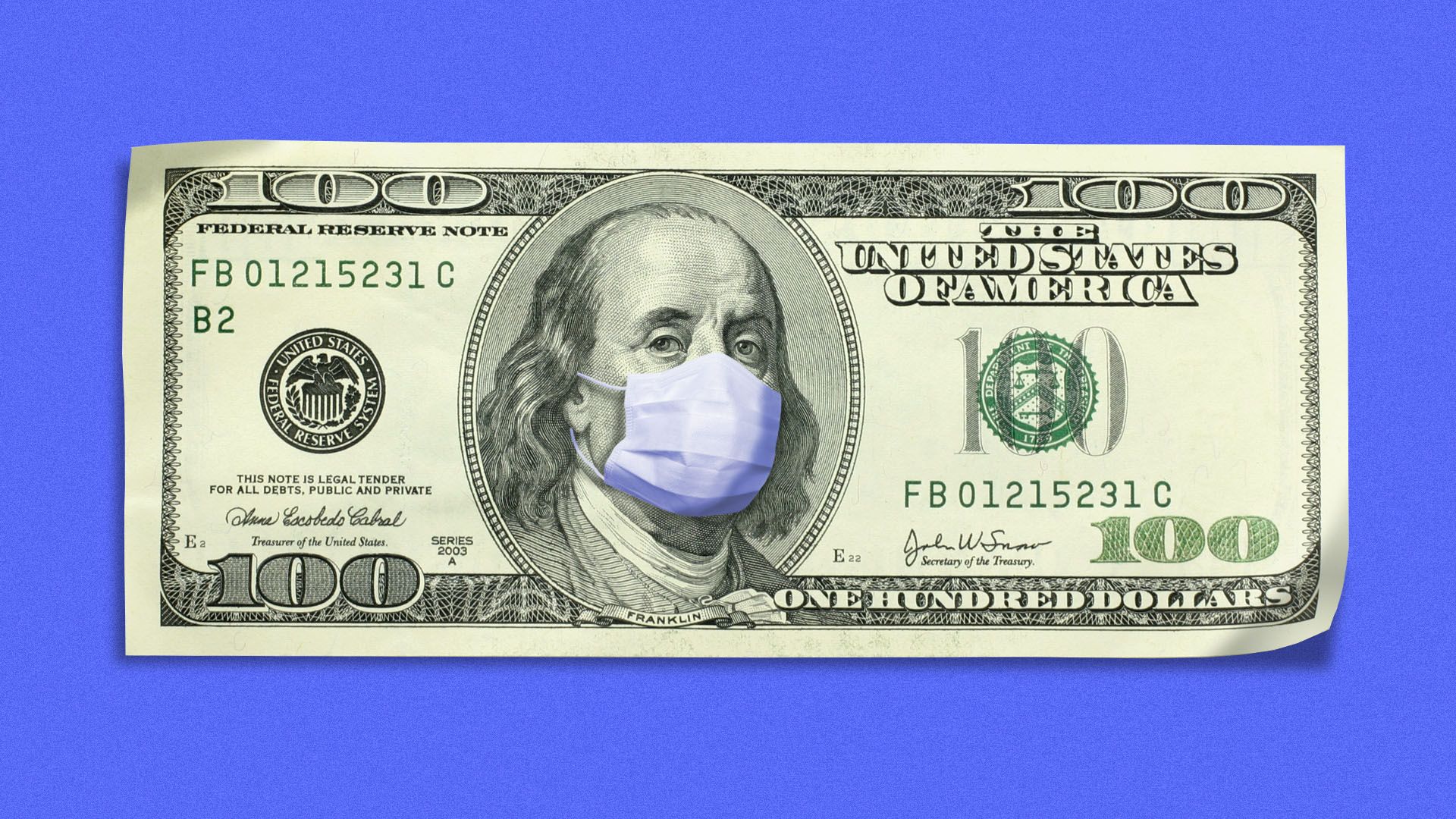
Illustration of Benjamin Franklin on a 100 dollar bill wearing a medical mask

Economists are growing more certain both the U.S. and the world are going to have a recession in 2020, Axios markets editor Dion Rabouin reports.

The big question: How bad will it be?

  • The answer depends on how quickly the outbreak can be contained and how fast people regain confidence to participate in activities they once enjoyed.

What’s happening: Economists and investment banks continue to write down their expectations for growth this year, as more economic activity is halted “until further notice.”

  • The shutdown of the NCAA’s annual March Madness basketball tournament and Austin’s South by Southwest festival are just two examples of mass gatherings that were expected to generate billions of dollars.
  • And that’s to say nothing of the millions of dollars that Chinese and European tourists would have spent, but who are temporarily banned or reluctant to come to the United States.

The bottom line: Businesses had pulled back on spending even before the year began, as a result of the U.S.-China trade war. That left consumer spending as the only thing holding up the economy, and the COVID-19 outbreak will kick that leg out from under us for an unknown period of time.

Go deeper: Listen to Dion discuss the risk of a recession with Dan Primack on the Pro Rata podcast.


Confronting a national emergency over coronavirus

https://mailchi.mp/325cd862d7a7/the-weekly-gist-march-13-2020?e=d1e747d2d8

Image result for national emergency

President Trump declared a national emergency today, in response to the growing spread of coronavirus across the country. The administration had come under sharp criticism for its sluggish response to the coronavirus crisis, in particular the widespread shortage of tests. Dr. Antony Fauci, director of the National Institute of Health’s infectious disease branch, told Congress on Thursday that the government’s response on testing was “not really geared to what we need right now…That’s a failing. Let’s admit it.”

In response, the administration today announced a series of emergency steps to increase testing capacity, turning to private labs to support the effort. The emergency status frees up $50B in federal emergency funding. Trump also announced that the Health and Human Services (HHS) Secretary will be able to waive regulations around telemedicine licensing, critical access hospital bed requirements and length of stay, and other measures to provide hospitals with added flexibility. House Speaker Nancy Pelosi and Treasury Secretary Steven Mnuchin have negotiated a sweeping aid package that would strengthen safety net programs, and offer sick leave for American workers affected by the virus.

Meanwhile, the American economy likely entered a recession, as consumers continued to pull back on spending on airline travel, entertainment, and other discretionary areas, while financial markets experienced the worst one-day drop in more than 30 years. Many school districts and universities shut down and announced plans to convert to online instruction for the foreseeable future. Employers imposed broad travel restrictions on their employees, moved to teleworking where possible, and even began to lay off workers as demand for services cratered. Shoppers stocked up on staples, cleaning supplies, and (inexplicably) toilet paper, as shelves ran bare in many stores.

Epidemiologists and disease experts urged broad adoption of “social distancing”, restricting large gatherings and reducing the ability of the virus to spread person-to-person. The objective: “flattening the curve” of transmission, so that the healthcare delivery system does not become overwhelmed as the virus spreads exponentially.


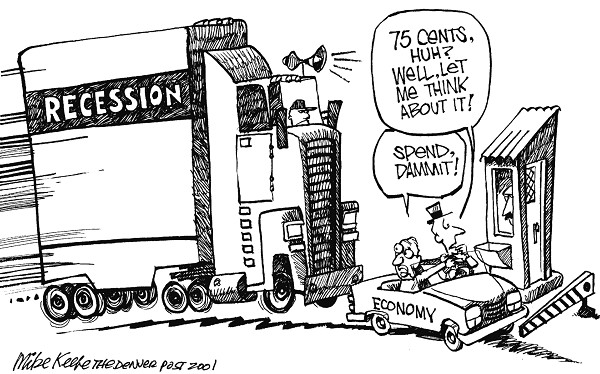
Recession could come in 6 to 9 months, Morgan Stanley says

https://www.beckershospitalreview.com/strategy/recession-could-come-in-6-to-9-months-morgan-stanely-says.html?origin=cfoe&utm_source=cfoe

Image result for cartoon recession

Recent moves from President Donald Trump to raise tariffs on Chinese goods are leading the global economy closer to the brink of recession, according to a Morgan Stanley note cited by Newsweek.

In a recent research note, Morgan Stanley said if President Trump goes through with proposals to raise existing tariffs and China responds, the global economy would fall into recession in the next six to nine months. Specifically, Morgan Stanley’s U.S. public policy lead, Michael Zezas, said the tariffs would be what pushes the global economy into recession.

“Friday’s escalation of tariffs between the U.S. and China suggests they’ve not moved any closer on the key negotiation points that have separated them since May 5,” he said, according to Newsweek. “Neither side sees the benefit to cooperating as better than hanging tough. … We expect that tensions will continue to escalate at least until the costs of doing so are too big to ignore.”

The president said Aug. 23 that he plans to raise existing tariffs to 30 percent from 25 percent on $250 billion of Chinese goods starting Oct. 1. Additionally, he proposed tariffs on another $300 billion of Chinese imports to increase from 10 percent to 15 percent over the coming months. The president’s proposals come after China said it will impose tariffs on another $75 billion of U.S. imports, and that it would reinstate tariffs on auto products that were previously suspended.

Read more here.