Seventy two percent of all rural hospital closures are in states that rejected the Medicaid expansion

https://www.gq.com/story/rural-hospitals-closing-in-red-states

Image result for rural hospital bankruptcies

States that refused Obamacare’s Medicaid expansion are hemorrhaging hospitals in rural areas.

Roughly 20 percent of Americans live in rural areas, including more than 13 million children, according to the last U.S. census. And, according to research and reporting by the Pittsburg Morning Sun and its parent company, GateHouse Media, those people have been steadily losing access to hospitals for years.

In Oklahoma, Georgia, South Carolina, and Mississippi, at least 52 percent of all rural hospitals spent more money than they made between 2011 to 2017. In Kansas, it’s 64 percent, and five hospitals there shut down completely in that time. Since 2010, 106 rural hospitals have closed across the country. (Another 700 are “on shaky ground,” and about 200 are “on the verge of collapse,” according to Gatehouse.) Of those 106 that closed, 77 were in deep red states where local politicians refused the Obama administration’s Medicaid expansion that came about as a result of the Affordable Care Act.

In short, the federal government provided funds to expand coverage for Medicaid, a program that helps pay for health care for low income patients. But the expansion was optional, and 14 Republican-controlled states rejected to take the money. The only state that bucked this trend was Utah, where rural hospitals were among the most profitable in the country thanks to a policy of shifting funds and resources from urban hospitals. Only 14 percent of rural hospitals operated at a loss and none shut down over the same time period.

The number of rural hospitals has been shriveling for some time now: more than 200 rural hospitals closed between 1990 and 2000, according to a report from the Office of Health and Human Services. Since rural areas have been losing hospitals for decades already, every additional closure is more devastating. And even the hospitals that remain open are struggling to stay fully staffed. According to the Health Resources and Services Administration, rural parts of the U.S. need an additional 4,022 doctors to completely close their coverage gaps.

Just refusing the Medicaid expansion alone doesn’t completely account for the hundreds of rural hospital closures across Republican-controlled states. For one thing, medical treatment and technology has gotten more advanced. Dr. Nancy Dickey, president of the Rural and Community Health Institute at Texas A&M, told Gatehouse, “Most of what we knew how to do in the 1970s and 1980s could be done reasonably well in small towns. But scientific developments and advances in neurosurgery, microscopic surgery and the like required a great deal more technology and a bigger population to support the array of technology specialists.” As a result, the number of services that rural hospitals offered started to shrink, while at the same time rural populations dwindled as both jobs and young people moved away. What’s left were older, poorer populations that needed more medical care and had less money to pay for it. In that situation, hospitals can’t generate enough revenue to stay open, let alone enough to pay the salaries of even new doctors, who carry an average of $200,000 in student debt.

Still, if the state legislatures and governors had accepted the money, billions of dollars could have gone to improving insurance coverage and propping up the hospitals’ bottom lines. In a health-care industry where the average CEO pay is $18 million a year, hospitals have to produce a lot of money to justify their existence to shareholders. The Medicaid expansion was one of the few lifelines available to rural Americans, and their politicians snubbed it.



Medical monopoly: An unusual hospital merger in rural Appalachia leaves residents with few options

https://www.tennessean.com/story/news/health/2019/06/23/ballad-health-merger-rural-hospital-closures/1342608001/

Protest organizer Dani Cook of Kingsport, Tennessee, conducts a Facebook Live outside Holston Valley Medical Center in Kingsport on May 7. The merger of Mountain State Health Alliance and Wellmont has led to the downgrading of the area's NICU and trauma center.

KINGSPORT, Tenn. – Molly Worley is an angry grandma.

For weeks she has stubbornly occupied a folding lawn chair on a grassy median outside Holston Valley Medical Center, sheltered from sweltering Appalachian summer sun by a thin tarp and flanked by a rotating crew staging a round-the-clock protest since May 1.

Behind them is the state-of-the-art neonatal intensive care unit where Worley’s newborn grandson spent his first weeks of life treated for opioid exposure.

In the same building is a Level I trauma center to respond to the most critical emergencies.

Both facilities will downgraded in the coming months, diverting the sickest babies and adults elsewhere.

The cuts are the latest fallout from an unusual and controversial merger between two former rival hospital systems headquartered in northeast Tennessee.

The newly formed company, Ballad Health, is now the sole hospital provider for a region the size of New Jersey. For nearly 1.2 million people people living in a largely rural stretch of 29 counties in northeast Tennessee and nearby parts of Virginia, North Carolina and Kentucky, Ballad hospitals are the only inpatient option.

Mergers involving hospitals that compete for same patients face opposition from the Federal Trade Commission, which can block mergers on the grounds the combined company can limit patient choices, cut services, raise prices and diminish quality.

Ballad officials found a way to bypass FTC rules. They turned to Tennessee state Sen. Rusty Crowe, R-Johnson City, who successfully carried legislation making the merger possible. Crowe is a longtime paid consultant with Ballad hospitals. 

Only a handful of other states have exempted similar hospital mergers from FTC anti-monopoly rules. Ballad’s is the largest.

CEO Alan Levine said the merger lets the hospital system save money and keep rural hospitals afloat in a state that is already No. 2 in the nation for closures.

Eliminating overlapping staff and services, including the trauma center and NICU, will free funds to invest in other public health initiatives. Ballad pledged to keep open all of its rural hospitals for five years and to invest $308 million in public health, medical education and other initiatives.

“Every decision we make starts and ends with how can we best serve the community and what does the evidence show will lead to the best possible outcome,” Levine said.

“You don’t want a trauma center on every corner and you don’t want a NICU on every corner because it dilutes volume and hurts quality,” he said.

No rural hospitals owned by Ballad have been closed. 

Some residents, doctors, nurses, EMS workers and public officials say the changes by Ballad expose the dangers of a single system imposing decisions on health care services on a captive audience that has no other options. More than 23,000 people have signed a petition opposing Ballad’s proposed changes.

“Never ever have I been this outspoken about anything,” said Worley, 60. “This NICU saved my grandson’s life. With Ballad we have no other choice. They have a monopoly at every level of health care.”

As hospital systems across the country struggle to stay afloat, particularly in rural areas, Ballad’s plan is being closely watched by other states weighing whether to allow other hospitals to take a similar approach.


The hospitals staying silent on Medicare for All

https://www.axios.com/hospitals-medicare-for-all-health-care-bernie-sanders-5d28dc00-05cd-411b-98cc-556ddfa12c9b.html

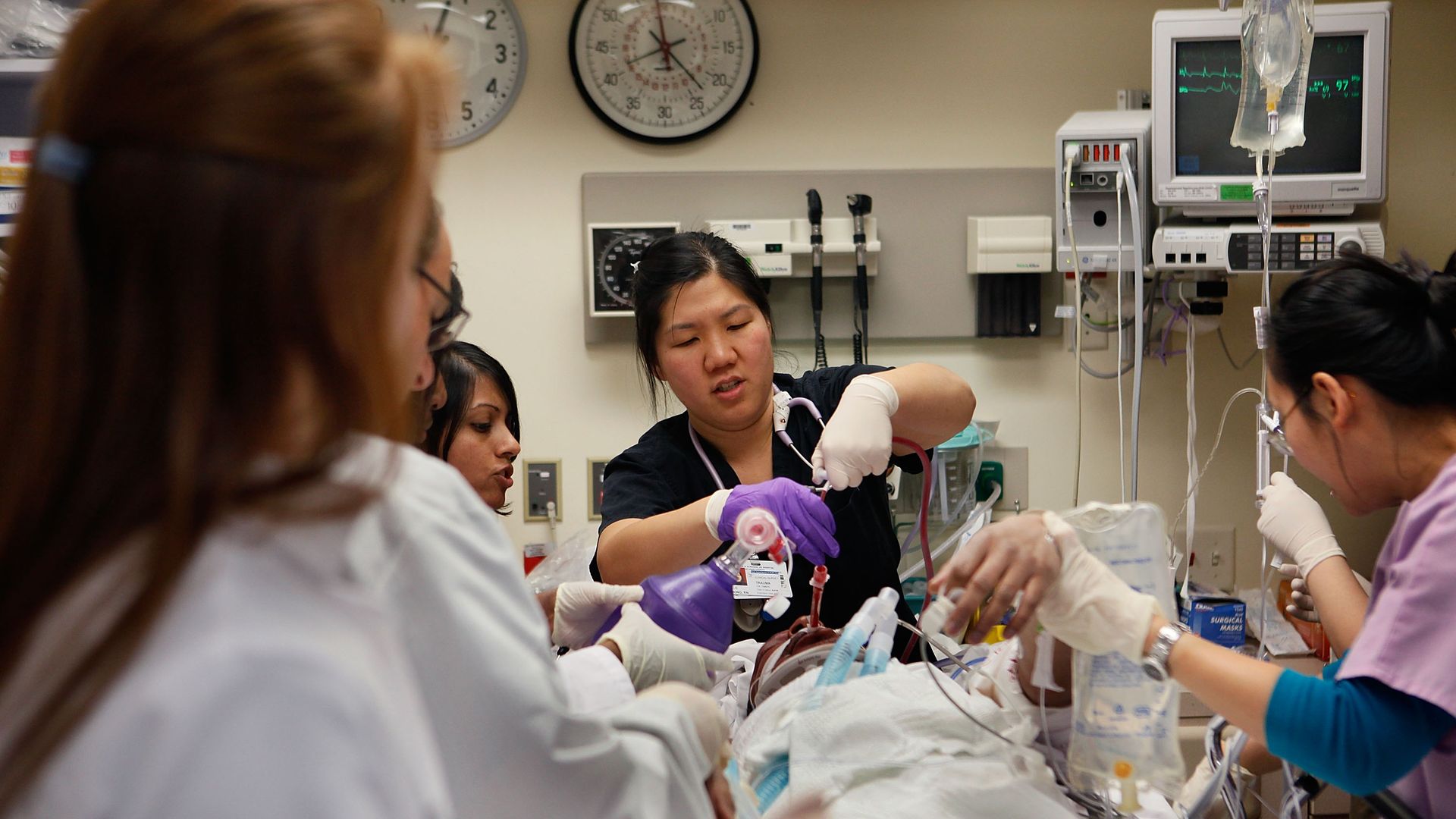
Doctors and nurses treat a patient in a hospital trauma room.

Large hospital systems and trade groups have vociferously criticized Democrats’ “Medicare for All” proposals, but rural facilities and public hospitals that treat mostly low-income patients are sitting on the sidelines of the debate.

Why it matters: Safety nets and many rural hospitals could hypothetically benefit under Medicare for All, but expressing support would put them at odds with their larger brethren.

Between the lines: The Partnership for America’s Health Care Future has become one of the loudest industry-funded voices against Medicare for All.

  • Pharmaceutical companies, health insurers and others are part of PAHCF. But 10 hospital systems and lobbying groups, like Ascension and the American Hospital Association, drive PAHCF.
  • Chip Kahn, the head of the Federation of American Hospitals, said PAHCF was his “brainchild,” according to Modern Healthcare.

Yes, but: Some hospital constituencies aren’t part of the anti-single-payer lobbying.

  • America’s Essential Hospitals, the trade group for safety net hospitals, and the National Rural Health Association, which represents rural hospitals and providers, are not part of PAHCF. They also don’t have official positions on Medicare for All.
  • A spokesperson for AEH said the group recognizes industry peers “have raised reasonable questions” about Medicare for All, but “our focus right now is where our members want it: on stopping the $4 billion cut” to supplemental Medicaid payments.
  • “With specific legislation not moving forward at this time, I don’t see us weighing in anytime soon,” NRHA CEO Alan Morgan said. “I don’t see us at odds. We just haven’t entered the national debate yet.”
  • In an interview, Kahn would not discuss on the record why those two groups were not part of PAHCF.

The big picture: Hospitals that mostly care for poor and uninsured patients could see higher, more stable revenues if everyone had Medicare — a program that often pays higher base rates than Medicaid and infinitely higher rates than nothing at all.

  • Cook County’s public hospital system in Chicago, for instance, gets 79% of its gross patient revenue from the uninsured and Medicaid. That system and multiple other hospitals did not respond to interview requests.
  • Separately, Medicare pays rural “critical access” hospitals 101% of their allowable costs, although those payments have suffered since Congress instituted mandated cuts in 2013.

The intrigue:If you’re trying to solve the problem that we want to get everybody covered and we want to level the playing field between the hospitals that take care of the poor people and hospitals that take care of the rich people, Medicare for All is something we better take a look at,” Eric Dickson, CEO of UMass Memorial Health Care, told Politico.