Two lawmakers test positive for coronavirus, one after receiving both doses of vaccine

Politics - The Washington Post

Two members of Congress from Massachusetts have tested positive for the coronavirus, one after receiving both doses of the vaccine, a reminder that people can still be vulnerable to infection after being vaccinated, particularly in the two weeks after receiving the second dose.

Rep. Stephen F. Lynch (D-Mass.) tested positive for the virus on Friday afternoon after a staff member in his Boston office tested positive earlier in the week, his spokeswoman Molly Rose Tarpey said.

Lynch received a second dose of the Pfizer-BioNTech vaccine before the inauguration of President Biden on Jan. 20, but his office declined to specify the date it was administered. Lynch had tested negative for the virus before attending the inaugural ceremonies, Tarpey said.

“While Mr. Lynch remains asymptomatic and feels fine, he will self-quarantine and will vote by proxy in Congress during the coming week,” she said.

Tarpey added that Lynch “has followed CDC guidelines and continues to do so since he received the vaccine.”

Another Democrat from Massachusetts, Rep. Lori Trahan, announced Thursday that she had tested positive for the virus and was asymptomatic. Trahan, whose staff members have been working remotely, also said she planned to vote by proxy next week.

“I encourage everyone to continue taking this virus seriously and to follow the science and data-driven guidance to wear a mask, maintain a safe social distance from others, avoid large gatherings and stay home whenever possible,” Trahan said.

Trahan received her first shot of one of the vaccines last week, spokeswoman Francis Grubar told The Washington Post.

Occasional cases of people testing positive after receiving one or both doses are not unexpected, medical experts say. Clinical trial data published by Pfizer show that the vaccine is about 52 percent effective at preventing illness after the first shot, compared to 95 percent effectiveness seven days after the second dose.

A small number of patients can still become mildly sick even after they are fully vaccinated. But only one of the roughly 20,000 people who received both doses in the clinical trial developed severe covid-19, suggesting the vaccine is powerful protection against the most dangerous cases of the disease.

Members of Congress began getting vaccinated as early as Dec. 18, but Lynch at the time said he was “waiting for the vaccine to be first offered to health care personnel, first responders and vulnerable seniors” in his district, the Boston Herald reported. It is unclear when Lynch ultimately received his first dose of the vaccine; he would have received the second dose of the Pfizer-BioNTech vaccine about three to four weeks after the first.

Public health experts have emphasized that it usually takes one week after the second dose of the Pfizer-BioNTech vaccine to reach 95 percent efficacy and two weeks after the second dose of the Moderna vaccine to reach 94 percent efficacy.

“There’s no vaccine that I know that protects you the same day you get it,” Onyema Ogbuagu, the principal investigator for Pfizer’s vaccine trial at Yale University, told The Post’s Allyson Chiu. “On a population level, 95% efficacy still translates to 5/100, or 50/1,000, or 500/10,000 vaccinated persons still being vulnerable to symptomatic disease and maybe even more having asymptomatic carriage.”

At least 23.2 million people in the United States have received one or both doses of the vaccine. The Centers for Disease Control and Prevention recommends that vaccinated people continue to wear masks, socially distance, avoid poorly ventilated spaces and wash their hands frequently to prevent the spread of the virus.

“We also don’t yet know whether getting a covid-19 vaccine will prevent you from spreading the virus that causes covid-19 to other people, even if you don’t get sick yourself,” CDC guidelines state. “While experts learn more about the protection that covid-19 vaccines provide under real-life conditions, it will be important for everyone to continue using all the tools available to help stop this pandemic.”

Mask-wearing in particular has become politicized, including in the hallways of Congress. After the Jan. 6 siege at the Capitol, several Democrats said they feared they had been exposed to the virus after sheltering with Republican lawmakers who refused to wear masks. In the following, at least three lawmakers tested positive for the virus.

On Friday, Rep. Cori Bush (D-Mo.) accused Rep. Marjorie Taylor Greene (R-Ga.) of berating her in the hallways after she told Greene to put on a mask. The incident, coupled with other hostile rhetoric and Greene’s refusal to abide by rules and protocols put in place because of the pandemic, prompted Bush to decide to move her office away from Greene’s for safety reasons, the Missouri lawmaker said.

My Parents Will Be Vaccinated Long Before Me. Can They Come Visit?

Can I Visit People Who Are Vaccinated During COVID-19? | Time

Welcome to COVID Questions, TIME’s advice column. We’re trying to make living through the pandemic a little easier, with expert-backed answers to your toughest coronavirus-related dilemmas. While we can’t and don’t offer medical advice—those questions should go to your doctor—we hope this column will help you sort through this stressful and confusing time. Got a question? Write to us at covidquestions@time.com.

Today, E.B. in New York asks:

My parents and in-laws will hopefully be vaccinated soon. My husband and toddler and I don’t expect to be vaccinated for quite some time. How should we think about whether it’s safe to spend time together in a mixed-vaccinated group? Could they get on a plane and fly to visit with us unmasked and indoors? Or is there enough risk that we should wait until we are all vaccinated (which may be a very long time especially with children in the mix)? Or split the difference and take some precautions?

To state the obvious, we are in a strange limbo state right now. The vaccines we’ve eagerly awaited for almost a year are here, and yet…nothing about our daily lives has really changed. Unfortunately, that’s going to be the case for a bit longer.

“The end is in sight,” says Dr. Colleen Kelley, a vaccine researcher and associate professor of infectious diseases at the Emory University School of Medicine in Georgia. “I just don’t know that it’s right now.”

Your loved ones getting vaccinated is unequivocally a step forward, Kelley says. It would certainly be safer to visit with your parents or in-laws after they’ve gotten both vaccine doses, but the safest plan is to wait until you and your husband are also vaccinated, she says.

The two coronavirus vaccines currently authorized for use in the U.S.—those made by Pfizer-BioNTech and Moderna—are both extremely effective at preventing people from getting sick with COVID-19. That’s a huge benefit on its own, especially for people at high risk of severe illness, such as elderly adults and people with underlying medical conditions.

But the outstanding question is whether COVID-19 vaccines also stop people from getting asymptomatically infected with the virusEarly evidence suggests both shots offer at least some protection against asymptomatic infection, and many experts are optimistic about their chances of stopping transmission, but the data are still coming together.

If the shots turn out not to stop asymptomatic infections entirely, even your vaccinated parents could feasibly get your family sick if they picked something up while traveling to see you. Or, if you happened to be exposed to the virus, your parents could potentially carry it and pass it to others. And, while the authorized COVID-19 vaccines are very effective, there is always a tiny chance of them failing, leaving your parents at risk of illness.

These are all worst-case scenarios, of course. But given the uncertainty and the extent to which COVID-19 is still spreading in the U.S., Kelley says you should wait a little while longer to visit with your parents and in-laws. If that’s not possible, you should take the same precautions you’ve been hearing about for a year: quarantining beforehand, and ideally staying outdoors and masked when possible.

Here’s the good news, though. Once you and your husband are fully vaccinated (along with more of the general population), Kelley says you can feel much better about spending time with other vaccinated people indoors and unmasked—even if your toddler isn’t yet vaccinated.

As you suggest, it may be a while before kids younger than 16 are eligible for COVID-19 vaccination, since pharmaceutical companies haven’t yet finished testing their shots on younger children. But “if the toddler is the only one who’s not vaccinated, I would say that’s a pretty darn safe scenario,” Kelley says.

Luckily, young kids rarely get seriously ill with COVID-19, so once all the adults in the room are fully protected, Kelley says you can feel pretty comfortable with your parents or in-laws coming for a visit.

“We’re not going to get to a zero-risk situation,” Kelley says, “but we are going to get to places that are safer and safer.”

Fauci: Lack of facts ‘likely did’ cost lives in coronavirus fight

Fauci: Lack of facts 'likely did' cost lives in coronavirus fight | TheHill

Anthony Fauci on Friday said that a lack of facts “likely did” cost lives over the last year in the nation’s efforts to fight the coronavirus pandemic.

In an appearance on CNN, the nation’s leading infectious diseases expert was directly asked whether a “lack of candor or facts” contributed to the number of lives lost during the coronavirus pandemic over the past year.

“You know it very likely did,” Fauci said. “You know I don’t want that … to be a sound bite, but I think if you just look at that, you can see that when you’re starting to go down paths that are not based on any science at all, that is not helpful at all, and particularly when you’re in a situation of almost being in a crisis with the number of cases and hospitalizations and deaths that we have.”

“When you start talking about things that make no sense medically and no sense scientifically, that clearly is not helpful,” he continued.

President Biden on Thursday unveiled a new national coronavirus strategy that is, in part, aimed at “restoring trust in the American people.”

When asked why that was important, Fauci recognized that the past year of dealing with the pandemic had been filled with divisiveness.

“There’s no secret. We’ve had a lot of divisiveness, we’ve had facts that were very, very clear that were questioned. People were not trusting what health officials were saying, there was great divisiveness, masks became a political issue,” Fauci said.

“So what the president was saying right from the get-go was, ‘Let’s reset this. Let everybody get on the same page, trust each other, let the science speak.’”

Fauci, who was thrust into the national spotlight last year as part of former President Trump‘s coronavirus task force, often found himself at odds with the former president. Trump frequently downplayed the severity of the virus and clashed publicly with Fauci.

Speaking during a White House press briefing on Thursday, Fauci said it was “liberating” to be working in the Biden administration.

There have been more than 24,600,000 coronavirus infections in the U.S. since the pandemic began, according to a count from Johns Hopkins University. More than 410,000 people have died.

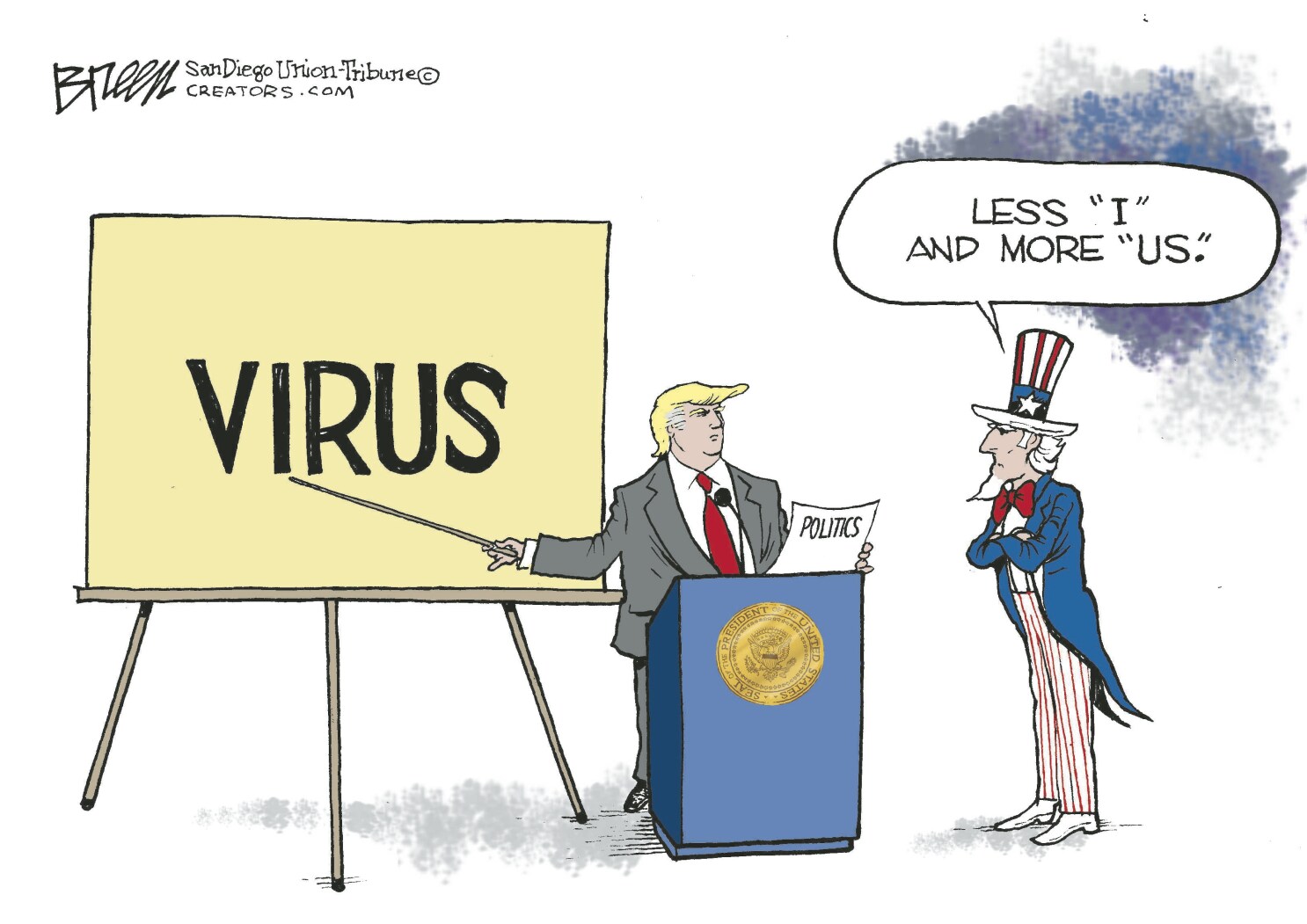
Cartoon – Less “I” and more “US.”

Trump's coronavirus press conference less than inspiring - The San Diego  Union-Tribune

Are manly men showing a little too much…nose?

https://mailchi.mp/128c649c0cb4/the-weekly-gist-january-22-2021?e=d1e747d2d8

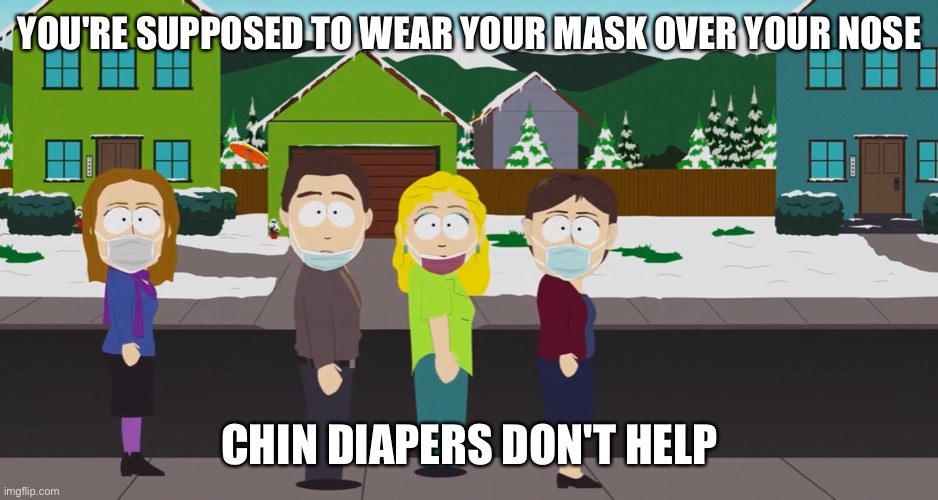
Image tagged in chin diaper - Imgflip

If you, like us, wanted to reach into your television this week, tap former President Bill Clinton on the shoulder and remind him to pull up his mask while attending the inauguration, a piece by New York Times science writer James Gorman says you weren’t alone, posing the question: “Is mask-slipping the new manspreading?

Just as every man on a plane or bus does not “manspread” into the middle seat, not every man’s mask slips off his nose. But whether you’re watching the inauguration or milling around the grocery store, it does seem that men are far more likely than women to be found with their mask dangling at their chins. Gorman notes it’s unlikely that the shape of men’s noses or their need for more air flow account for the mask-slipping.

And, examples seem to abound across the political spectrum (see also Chief Justice John Roberts at the inauguration), so it’s not a Republican or Democratic thing. It’s a man thing. Also in this category: the dude on every airline flight we’ve taken in the past year, often outfitted in a Titleist cap and Greg Norman polo, who sports a neck gaiter plucked from his ski bag instead of a real mask (despite the large body of highly publicized evidence noting the gaiters’ inferior performance).

His demeanor says, I am paying lip service to this mask rule, but I don’t like it. Now I will pull down my gaiter and slowly nurse this whiskey and soda until we land.” Perhaps men are less afraid of catching COVID, or, as some surveys suggest, ignoring mask rules is seen as a sign of machismo. But regardless of the motivation, fellas, we need you to wear your masks. And pull them up over your nose.

There’s nothing manly about a chin diaper.

A Warning From California

https://view.newsletters.time.com/?qs=2f6c9ce95c5cc497353555bcde854be27f2912b888d5db7cf6697393570b5a03d79b3dd7c5b1f74a43f8b5801ed5e237e5fe79c3965907b24dd6a8da7062f0c6efaa12e73db5bac67e9866303e48171f

FDA and FTC Issue Warning Letters to Seven Companies Selling Fraudulent  COVID-19 'Treatments' | BioSpace

Over the last year, COVID-19 has taught us painful lessons about the pitfalls of wishful thinking. Early in the pandemic, some people speculated that the virus would slow down over as the weather got warmer over the summer months; instead, the U.S. experienced a deadly wave of new cases. A few months ago, I hoped that here in Southern California, it would be easier for people to avoid spreading the virus than in colder parts of the country, because people can socially distance outdoors more easily year-round. Instead, our outbreak is now among the world’s deadliest—on Monday, California became the first state to report more than 3 million cases of the virus. Here in Los Angeles County, so many people are dying that officials temporarily lifted air quality regulations to permit more cremations, the Los Angeles Times reports.

California’s struggles to contain COVID-19 can at least partly be attributed to pandemic fatigue—after nearly a year of wearing masks and avoiding contact with others, people’s resolve is simply wearing thin. However, while we may feel done with the virus, it isn’t done with us—between 70 and nearly 120 people per 100,000 have died of COVID-19 in California every day in the last week, while more than 3,200 have died each day nationwide; the U.S. just today passed the grim milestone of 400,000 COVID-19 deaths.

If California can’t get its outbreak under control, more pain could lie ahead. Officials have discovered that new variants of the virus are spreading in the Golden State, including a more transmissible strain first identified in the U.K., where caseloads are skyrocketing and hospitals are overwhelmed. What’s happening here in California could be a bellwether for the rest of the country, as the virus continues its spread mostly unchecked across the country and world.

Regardless of which variant is spreading, experts say the defensive measures remain the same: we need to keep wearing our masks (new research shows just how effective they are), maintaining physical distance from others, and spend as much time as possible at home. It’s natural to want to give up—or even bend just a little—and spend time with friends and family we haven’t seen in ages, or do other risky things. That temptation is all the more real now that multiple highly effective vaccines are here, and the end of the pandemic seems within sight. But the vaccination process has gone frustratingly slowly so far, and not enough of us have the necessary protection to let our collective guard down, especially given the presence of at least one highly transmissible mutation.

With those alarming new variants spreading across the globe, it’s probably time to recalibrate our behavior in favor of safety—until more people are inoculated, it’s vital for us to reduce spread through other proven means. In the coming weeks, Californians and Americans elsewhere must buckle down, with their eyes on the final mission: ensuring that as many people as possible survive to see the end of the pandemic.

VACCINE TRACKER

While 28.4 million doses of the COVID-19 vaccine have been shipped to various U.S. states as of this morning, only about 10.6 million doses have been administered thus far, according to TIME’s vaccine trackerrepresenting 3.2% of the overall U.S. population.

India launched its nationwide coronavirus vaccine rollout on Saturday, starting with healthcare workers, according to the New York Times. Prime Minister Narendra Modi has said that the 1.3 billion-person country aims to vaccinate 300 million healthcare and other front line workers by July. More than 10.5 million people have been infected in India, and more than 152,500 people have died.

Yesterday, New York Governor Andrew Cuomo asked Pfizer whether his state could purchase vaccines directly from the pharmaceutical company, thus bypassing the federal government. But Dr. Celine Gounder, who’s advising President-elect Joe Biden on the pandemic, said that such a strategy could create problems. “I think we’ve already had too much of a patchwork response across the states,” Grounder said in an interview with CNBC today; she also argued that Cuomo’s idea could create a bidding war among states for vaccines.

TODAY’S CORONAVIRUS OUTLOOK

The Global Situation

More than 95.5 million people around the world had been diagnosed with COVID-19 as of 3 p.m. E.T. today, and more than 2 million people have died. On Jan. 18, there were 514,013 new cases and 9,276 new deaths confirmed globally.

Here’s how the world as a whole is currently trending:

Here’s where daily cases have risen or fallen over the last 14 days, shown in confirmed cases per 100,000 residents:

And here is every country with over 1.5 million confirmed cases:

Hua Chunying, a spokeswoman for China’s foreign ministry, is pushing back on findings from an independent World Health Organization report that was critical of Beijing’s early response to the COVID-19 outbreak. China’s early lockdowns, Chunying said, helped reduce deaths and infections, Al Jazeera reports. Still, China has been criticized for failing to adequately disclose the scope and nature of the outbreak when it first began.

German leaders have agreed to extend a lockdown for businesses and schools until Feb. 14 and to require medical masks on public transportation, Reuters reports. While Germany is now reporting fewer than half as many new cases as it was a month ago, experts have raised concerns about new coronavirus variants that are thought to be more contagious, some of which have been detected in the country.

The Situation in the U.S.

The U.S. had recorded more than 24 million coronavirus cases as of 3 p.m. E.T. today. More than 400,000 people have died. On Jan. 18, there were 141,999 new cases and 2,422 new deaths confirmed in the U.S.

Here’s how the country as a whole is currently trending:

And here’s where daily cases have risen or fallen over the last 14 days, shown in confirmed cases per 100,000 residents.

President-elect Joe Biden plans to continue a travel ban on non-U.S. citizens from European countries and Brazil, reversing outgoing President Donald Trump’s order to end the ban on Jan. 26, six days into Biden’s presidency. Jennifer Psaki, Biden’s incoming press secretary, tweeted that the Biden administration plans “to strengthen public health measures around international travel.” A week ago, the U.S. Centers for Disease Control and Prevention ordered that almost all airline passengers must have a negative coronavirus test or proof of recovery before entering the U.S.

US passes 400,000 coronavirus deaths

https://thehill.com/policy/healthcare/534765-us-passes-400000-coronavirus-deaths?rnd=1611069180

COVID update: US passes 400,000 deaths; Rebekah Jones arrested

The United States on Tuesday passed 400,000 deaths from COVID-19, a stunning total that is only climbing as the crisis deepens. 

The country is now averaging more than 3,000 coronavirus deaths every day, according to Johns Hopkins University data, more than the number of people killed in the Sept. 11, 2001, terror attacks, and the daily death toll has been rising. The effects of a surge in gatherings and travel over the holidays are now coming into focus. 

The grim milestone of 400,000 deaths came on the last full day in office for President Trump, who has long rejected criticism of his handling of the pandemic.

The situation threatens to get even worse as a new, more contagious variant of the virus becomes more prevalent. The Centers for Disease Control and Prevention (CDC) warned last week that one of the new variants, first discovered in the United Kingdom, could be the predominant strain in the U.S. by March. 

Vaccines offer hope, but it is crucial for the inoculation campaign to progress as quickly as possible to get as many people protected before the new variant takes greater hold. 

The U.S. vaccination campaign has started slowly, though there are signs it is beginning to pick up some speed. President-elect Joe Biden has pledged a more aggressive federal role in the vaccination effort, including using the National Guard and the Federal Emergency Management Agency to set up more vaccination sites.

In the short term, however, the country is in for a bleak period. 

Biden’s incoming CDC director, Rochelle Walensky, said Sunday on CBS’s “Face the Nation” that she expects 500,000 COVID-19 deaths by the middle of February. 

“I think we still have some dark weeks ahead,” she said. 

The country passed 300,000 deaths in mid-December.

At the end of March, as the crisis was beginning, Trump said that if deaths are limited to between 100,000 and 200,000 “we all, together, have done a very good job.” The country has long ago exceeded those numbers. 

The U.S. has by far the most COVID-19 deaths of any country in the world. Brazil follows with around 210,000, and India and Mexico are around 150,000, according to Johns Hopkins University. 

More than 124,000 people are in the hospital with coronavirus in the U.S., according to the COVID Tracking Project, though the number is starting to decline somewhat from a peak of over 130,000 about a week ago. 

The spread of the more contagious variant, however, threatens to send that number spiking again.

Another coronavirus variant linked to growing share of cases, several large outbreaks, in California

Coroner Elizabeth Napoles, right, of the Los Angeles County Department of Medical Examiner, works with National Guardsmen, helping to store the bodies of covid-19 victims last week. 

Health officials stress they haven’t determined whether the variant might be more contagious or resistant to vaccines.

coronavirus variant first identified in Denmark has ripped through Northern California — including outbreaks at nursing homes, jails and a hospital in the San Jose area — prompting state and local officials to investigate whether it may be more transmissible.

California officials disclosed the rise of the variant Sunday night after genetic monitoring linked it to a fast-growing share of new cases, as well as to the outbreaks in Santa Clara county, which includes San Jose.

This rising variant is distinct from the highly contagious mutation discovered by Britain, which has also been found in California, and which federal health officials project could become the dominant strain in the United States by March based on its proven higher transmissibility.

Experts stress that they need to look more closely at the circumstances of the Northern California outbreaks, as well as at the latest variant — this one, known as L452R — before declaring it more contagious or more dangerous than the virus already broadly circulating.

The L452R variant was first detected in northern Europe in March and has since been confirmed in more than a dozen states, including California in May. The discovery did not garner much attention at the time because all viruses change constantly as they replicate. But public health authorities deem some variants to be “of concern” if evidence suggests they might be more contagious, potentially deadlier or resistant to vaccines.

California publicized the latest variant at a late Sunday news conference after researchers identified it in about 25 percent of samples collected between Dec. 14 and Jan. 3, a surge from 3.8 percent of samples collected in the preceding three-week period.

“That is suggestive, and it’s a little worrisome,” Charles Chiu, a virologist at the University of California at San Francisco said at the briefing. But Chiu stressed it was too early to conclude the variant is more infectious because scientists do not know whether their sampling was representative or whether the variant’s increase might be due to random chance, or even a series of superspreader events.

Officials urged people to follow public health guidelines to minimize the risk of contracting the variant as new daily cases in the hard-hit state plateau at more than 38,000, while deaths average more than 515 daily.

“It’s too soon to know if this variant will spread more rapidly than others,” said Erica Pan, California’s state epidemiologist, “but it certainly reinforces the need for all Californians to wear masks and reduce mixing with people outside their immediate households to help slow the spread of the virus.”

Genetic sequencing of viruses is still limited in the United States, preventing health officials from having a real-time picture of all the strains of coronavirus spreading across the country and their prevalence.

California’s preliminary data is based on fewer than 400 samples that overwhelmingly came from the state’s north. Southern California is the heaviest hit part of the state, with deaths in Los Angeles County reaching one every seven minutes and ICU beds and oxygen running out, although hospitalizations have begun to plateau. Environmental regulators on Sunday temporarily lifted limits on cremations because of a backlog in Los Angeles County.

The L452R strain in California raised alarms because it is associated with several large outbreaks in Santa Clara County, including one at a hospital that infected at least 90 people and killed one staff member. Officials at Kaiser Permanente San Jose Medical Center said a staff member wearing an inflatable Christmas tree costume to spread holiday cheer likely spread coronavirus-laden droplets instead.

A Kaiser Permanente employee died and dozens of others contracted the coronavirus after a staffer appeared at the San Jose medical center wearing an inflatable, air-powered holiday costume on Christmas Day.

Sara Cody, Santa Clara’s top public health official, described that episode as a “very unusual outbreak with a lot of illnesses, and it seemed to spread quite fast.” The county is working with state health officials and the CDC to investigate what happened, she said.

Cody cautioned that the outbreak could have been driven by factors unrelated to the variant, such as changes in ventilation or personal protective equipment practices at the hospital.

“The takeaway is not that we need to start worrying about this,” Cody said Sunday. “The takeaway is, this is a variant that’s becoming more prevalent, and we need to lean in and understand more about it.”

County officials on Monday disclosed other places where the variant had been found as a result of aggressive genetic sequencing, “including cases associated with the Kaiser outbreak, skilled nursing facility outbreaks, cases in jails and shelters, and specimens from testing sites in the community,” according to a statement. “This suggests that the variant is now relatively common in our community.”

Chiu, the virologist who conducted the genetic sequencing, said a deeper investigation must be done to determine if the strain is more transmissible like the one found in the United Kingdom.

He also raised concerns that a mutation associated with the variant might make it more resistant to vaccines because it occurs in a critical part of the spike protein that is targeted by the vaccines,but he added that the virus must be grown in a lab and tested more fully before any conclusions can be drawn.

“Mutations happen all the time,” said William Hanage, an epidemiologist at the Harvard T.H. Chan School of Public Health. “Some of them take off and the great majority of them don’t. The main reason why we are paying attention to this is because this mutation has previously been noted as being of particular concern in terms of diminishing the efficacy of the immune response.”

Carlos del Rio, a professor of medicine and global health at Emory University, said the rising prevalence of the variant shows the urgent need for more genetic sequencing in the United States and for greater compliance with public health measures such as wearing masks and avoiding crowds.

“We really need to hunker down because if you are really concerned about mutations, stop transmission,” del Rio said. “The more mutations you see, the more uncontrolled transmission you will see.”

After starting the new year with record-high cases, deaths and hospitalizations, the United States is starting to see signs of slowing spread despite fears of a post-holiday surge that would continue through January. The seven-day average of new infections has slowed since last Tuesday, and hospitalizations have started to plateau, according to Washington Post tracking.

Still, Scott Gottlieb, a former Food and Drug Administration commissioner, warned that the advent of more transmissible variants could reverse that progress.

“As current epidemic surge peaks, we may see 3-4 weeks of declines in new cases but then new variant will take over,” Gottlieb tweeted Sunday, referring to the British variant. “It’ll double in prevalence about every week. It’ll change the game and could mean we have persistent high infection through spring until we vaccinate enough people.”

Trump moves to lift coronavirus travel restrictions on Europe, Brazil

https://thehill.com/homenews/administration/534718-trump-moves-to-lift-travel-restrictions-on-europe-brazil?rnd=1611014258

Trump moves to lift coronavirus travel restrictions on Europe, Brazil |  TheHill


President Trump on Monday moved to lift restrictions imposed on travelers to the U.S. from much of Europe and Brazil that were implemented last year to slow the spread of the novel coronavirus, though the action is expected to be stopped by the incoming Biden administration.

Trump issued an executive order terminating the travel restrictions on the United Kingdom, Ireland, Brazil and the countries in Europe that compose the Schengen Area effective Jan. 26. The order came two days before Trump leaves office. President-elect Joe Biden’s team immediately signaled they would move to reverse the order.

“With the pandemic worsening, and more contagious variants emerging around the world, this is not the time to be lifting restrictions on international travel,” tweeted incoming White House press secretary Jen Psaki.

“On the advice of our medical team, the Administration does not intend to lift these restrictions on 1/26. In fact, we plan to strengthen public health measures around international travel in order to further mitigate the spread of COVID-19,” Psaki continued.

The order states that Trump’s action came at the recommendation of outgoing Health and Human Services Secretary Alex Azar. The memo cites the new order from the Centers for Disease Control and Prevention (CDC) that requires passengers traveling by air to the U.S. to receive a negative COVID-19 test within three days before their flight departs, saying it will help prevent travelers from spreading the virus.

The Trump administration’s travel restrictions on China and Iran will remain in place, however, because, the order states, the countries “repeatedly have failed to cooperate with the United States public health authorities and to share timely, accurate information about the spread of the virus” and therefore cannot be trusted to implement the CDC’s order.

“Accordingly, the Secretary has advised me to remove the restrictions applicable to the Schengen Area, the United Kingdom, the Republic of Ireland, and the Federative Republic of Brazil, while leaving in place the restrictions applicable to the People’s Republic of China and the Islamic Republic of Iran,” Trump’s order states. “I agree with the Secretary that this action is the best way to continue protecting Americans from COVID-19 while enabling travel to resume safely.”

Though Trump signed the order on Monday, the action does not take effect until six days after he leaves office and Biden is inaugurated. 

The order comes as coronavirus cases and deaths continue to hit worrisome, record-high levels on a daily basis. Nearly 400,000 people in the U.S. and more than 2 million people globally have died from COVID-19. While two vaccines have been approved for emergency use in the U.S., the Trump administration has fallen far short of early targets in distributing and administering the vaccine.

The order will be one of the final actions that Trump takes with respect to the pandemic, after being widely criticized for regularly minimizing the threat posed by the virus.

Trump announced in mid-March of last year that he would impose travel restrictions on individuals entering the United States from the 26 countries that compose the Schengen Area, weeks after the first case was reported in the U.S. The move initially attracted scrutiny because it did not include the U.K. or Ireland, and the Trump administration later moved to restrict travel from those countries as well.

Trump later placed travel restrictions on Brazil at the end of May.

The executive order lifting the travel restrictions was one of several released by the White House on Monday as the final hours of Trump’s presidency wind down. Trump is also expected to grant a final slew of pardons before he leaves office on Wednesday. 

The United States could hit half a million covid-19 deaths by mid-February

“It took 12 weeks for the death toll to rise from 200,000 to 300,000. The death toll has leaped from 300,000 to almost 400,000 in less than five weeks,” The Post’s  Marc Fisher, Lori Rozsa, Mark Kreidler and Annie Gowen report. 

Yet despite the massive death toll and the changes to daily life caused by the pandemic, the individual deaths are largely invisible.  

“Coronavirus victims who die in the hospital often spend their final days cut off from family and friends, their only human contact coming from medical personnel hidden behind layers of protective gear. Even those who die at home often decline in quarantine, keeping a lonely vigil over their body’s fight,” my colleagues write.

The numbers are expected to quickly rise. Rochelle Walensky, the incoming director of the Centers for Disease Control and Prevention, told “Face The Nation” on Sunday that she anticipated half a million deaths by mid-February.

“That doesn’t speak to the tens of thousands of people who are living with a yet- uncharacterized syndrome after they’ve recovered. We still yet haven’t yet seen the ramifications from holiday travel, holiday gathering in terms of high rates of hospitalizations,” Walensky added.