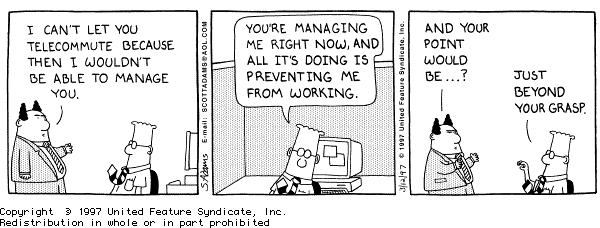
Cartoon – And Your Point Would Be?


https://mailchi.mp/burroughshealthcare/pc9ctbv4ft-1586513?e=7d3f834d2f

With the midterms less than a week away, a new poll published October 18th by the non-partisan Kaiser Family Foundation got a lot of attention. Over seventy percent of voters say health care is a very important issue in deciding who to vote for.
But exactly what happens to key healthcare initiatives, especially the Affordable Care Act including expansion of Medicaid in many states—which tends to be more popular among Democratic lawmakers than Republicans–depends on whether it’s the Democrats or Republicans who get control of the House, says Eric Feigl-Ding, MPH, Ph.D., a health economist and visiting scientist at the Harvard Chan School of Public Health in Cambridge, Mass.
Based on multiple polls, the New York Times reported on October 23 that a likely outcome is that Democrats will gain the majority in the House of Representatives and the Republicans will keep the majority in the Senate. But the Times and many other news outlets continually point out that many factors including the news of each day make it difficult to predict the outcome.
Feigl-Ding says having opposing parties in the House, Senate and White House could make it harder to pass national legislation. Changes can still happen to the ACA, however, because the President can continue to make certain executive level decision such as ending the penalty for not having health insurance which he did last year. That change takes effect in 2019.
In terms of new legislation, Feigl-Ding says a split Congress and White House means that passing legislation will be difficult because what comes from the House side, if most members are Democrats in the next sessions, could be more liberal and the corresponding bills from the Senate, likely to remain Republican, could be more conservative. So, says Feigl-Ding, either a bill won’t pass at all, or there will have to be much more of a compromise. “And assuming they would get to compromise is a big assumption, that then requires the president to agree to sign that legislation,” adds Feigl-Ding.
A report this week by strategy and policy group Manatt Health, based in Washington, DC lists the health care issues the firm thinks will dominate in states and the federal government after the elections:
According to the report what states do will depend on the election outcomes for governors in more than a dozen states and many of those races are as impossible to predict as the Congressional races.
Other important health care issues for 2019-20120 include:
Pre-Existing Conditions
Listening to ads for some Republicans candidates for Congress makes it appears protecting pre-existing conditions will be a top priority for some Republicans, even among some who voted against them previously. But Feigl-Ding says keeping coverage for preexisting conditions in health insurance plans also requires figuring out how to pay for it. Under the original ACA legislation, the hope was that a financial penalty for not having health coverage would keep more healthy people in the plans—along with the prohibition against letting insurers “cherry pick” only healthy consumers. But that penalty is now gone. “Take that away and you probably can’t sustain the preexisting conditions, says Feigl-Ding.
Medicaid Work Requirements and Other Conditions of Eligibility.
Legal challenges in several states could impact the implementation of work requirements. Some governors have said they’ll cut the number of state Medicaid beneficiaries to save money if work requirements are overturned.
ACA Repeal. Twenty states are challenging the constitutionality of the ACA in Texas v. The U.S., a case that could make it to the Supreme Court.
Association Health Plans and Short-Term Plans. Several Democratic state attorneys general have filed a lawsuit against the administration’s rule promoting association health plans that allow individuals and small businesses to join to purchase health care coverage and short-term plans. The suit argues that the new rules for both avoid protection for people with pre-existing conditions, according to Manatt.
No one has a crystal ball for what will happen, but everyone has hindsight. According to the Manatt report, in 2010 Republicans replaced Democratic governors in eleven states, and all but one of those states ended plans to establish a state-based health insurance marketplace (SBM). In five states where Democrats replaced Republicans, all those states set up those marketplaces.
And whatever the outcome of the 2018 elections, their impact on healthcare may only be short lived. At a foundation briefing on the midterm elections earlier this week Mollyann Brody, Executive Director, Public Opinion and Survey Research at the Kaiser Family Foundation reminded the crowd that “the day the 2018 elections are over the 2020 campaign starts.”
Still the end of the week also brought a glimmer of hope. In response to President Trumps remarks on October 25thabout his administration’s plan to test new drug pricing models in Medicare Part B help to lower drug prices Frederick Isasi, executive director of FamiliesUSA, a liberal leaning health insurance advocacy group, released a statement that said, in part, “I hope this is a serious policy that will be formally proposed and finalized by the Trump administration. If so, it is an important step forward for our nation’s seniors and taxpayers.”

Blue Cross Blue Shield of Massachusetts (BCBS-MA) announced this week that it plans to launch a new extension of its long-standing value-based payment program, the Alternative Quality Contract (AQC), which ties physician payments to the total cost of care delivered to their patients. In the first arrangement of its kind in the AQC program, BCBS-MA will pilot a similar, capitation-like approach with South Weymouth, MA-based South Shore Health, an independent health system serving southeastern Massachusetts.
As we described in a blog post on the AQC earlier this year, the broader program is structured around physician networks and their primary care practices, which bear two-way, upside-downside risk for the cost of care for patients attributed to them. Participating practices also have the ability to earn sizeable bonuses based on their performance on a number of quality metrics. The new approach is intended to experiment with putting the hospital directly at risk, encouraging it to reduce unnecessary admissions and other high-cost care by collaborating with physicians and other care providers.
While full details of the plan were not released, the agreement was described as a pilot program, to test the model of so-called “global budgeting” for hospitals. A similar approach to paying hospitals has been in place in Maryland for several years, as part of that state’s Federal waiver program. Notably, the CEO of South Shore Health, Dr. Gene Green, previously served as President of Suburban Hospital in Bethesda, MD, and in a press release stated, “What’s so encouraging about this partnership is that the provider and the payer are finally coming together at the same table with the same goal: drive down costs without affecting quality of care”.
The move is noteworthy because health plans—and particularly BCBS carriers—have historically been reluctant to share true risk with hospitals, for a variety of reasons. Some have claimed that hospitals lack the ability to manage commercial risk, while others have worried about the strategic implications of enabling health systems to move into the commercial risk market, fearing new competition for employer contracting.
For the most part, carriers have preferred to limit risk-based programs to physician practices, encouraging doctors to manage total cost of care by limiting referrals to high-cost specialists and hospitals. To the extent health plans have “shared risk” with hospitals, it has typically been in the form of performance-based bonuses added onto fee-for-service payments.
That phenomenon has served to stall the broader transition to provider risk envisioned by the authors of the Affordable Care Act (ACA) in creating the Medicare Shared Savings Program (MSSP) and its much-debated accountable care organizations (ACOs). The new BCBS-MA pilot with South Shore Health will be closely watched by BCBS leaders across the country.
It’s no accident that the first such pilot in the AQC program is with a smaller, independent system that operates in the shadow of the dominant Partners Healthcare system, an arrangement unlikely to raise competitive concerns among BCBS-MA executives.

Yesterday the Center for Medicare & Medicaid Services (CMS) finalized the 2019 Physician Fee Schedule (PFS), announcing they will delay implementation of changes to physician evaluation and management (E&M) codes until 2021. CMS had proposed to collapse five E&M codes into two, and to streamline physician documentation requirements.
The delay is a win for the thousands of physicians who submitted comments opposing the changes, complaining that the proposal would penalize doctors who see more complex patients. Doctors also expressed concern that the rates assigned to the proposed codes were too low, discouraging doctors from seeing Medicare patients and creating access challenges.
Along with the two-year delay, CMS also raised base rates, and created an additional code for complex visits. These changes are a win for doctors—and provide time for continued lobbying to permanently forestall implementation.
The 2019 rule also includes several other noteworthy changes that were largely lost in hubbub surrounding E&M visit coding, most of which will be well-received by doctors.
At the top of our list: CMS significantly expanded telemedicine coverage, and will now reimburse for telemedicine and telephone visits for brief check-ins, evaluation of patient-submitted images or remote monitoring data, as well as more comprehensive and preventive care visits. This is a substantial step toward increasing access for the two-thirds of Medicare beneficiaries who are ineligible for telemedicine coverage today.
We will be continuing to make our way through the details of the rule, and sharing our thoughts on its impact for doctors and health systems. In the longer term, it is worth watching whether continued pressure from doctors postpones further action, and whether the administration will enact changes that could upset the physician base—significantly, the 2021 PFS rule will likely drop in the weeks just before the 2020 Presidential election.
Healthcare Triage News: Women on Web Move to Increase Access to Abortion Pills in the US

Women on Web is an organization that increases access to pharmaceutical abortion services in countries where those options are limited. The organization has now started a separate service that will fill prescriptions in the United States to replace access in states that have made access to abortion difficult. Healthcare Triage talks through the details.
I mention it in the video, and we link to it in the description, but you should also read Olga Khazan’s coverage of this at The Atlantic.
https://www.theatlantic.com/health/archive/2018/07/after-abortion-is-illegal/565430/

Ever since the U.S. Supreme Court ruled in 2012 that states must have an option whether or not to expand Medicaid as authorized in the Affordable Care Act, expansion has been a long, slow slog, state by state, inch by inch. While blue states had mostly lined up to expand Medicaid by 2013, nearly every purple and red state proved to be a battlefield. Today, 19 states have yet to expand, with 31 in the “yes” column (plus the District of Columbia) (see table 1). The last state to expand, #31, was Louisiana in mid-2016. But, might a mighty Medicaid wave be coming courtesy of the November 6thelections? The answer is a definite maybe.
Right now, all that’s certain is that Virginia will become state #32 to expand Medicaid in January. The state enacted the 400,000-person expansion last May, albeit with a “work requirement” to be filed with the Centers for Medicare and Medicaid Services (CMS) sometime in 2019.
Maine is certain to become #33 early next year if Democratic Attorney General Janet Mills wins the Governor’s Chair. In November 2017, Maine voters approved expansion—59-41 percent—in a state ballot initiative. Departing Republican Governor Paul LePage refused to implement the expansion in spite of strong legislative support to do so, as well as an order from Maine’s highest court. In previous years, the Legislature failed by only a small number of votes to override LePage’s vetoes (5 times). Progressive forces expect to pick up state legislative seats on November 6th, so it’s also possible expansion could happen with a new Republican governor, supportive or not.

Activists in three states—Idaho, Nebraska, and Utah—are standing in the wings hoping to be states #34, 35, and 36 depending on the outcomes of state ballot initiatives in each of them on November 6th. Montana has an initiative on the ballot to continue its expansion with dedicated funding.
While Idaho’s departing Governor Butch Otter fought consistently against Medicaid expansion throughout his tenure, he recently changed his position and announced his support for the Medicaid ballot initiative. Republican gubernatorial candidate Brad Little says he will respect the ballot initiative’s outcome—even though the measure does not specify how to finance the 10 percent financing match states will need to pay by 2020 (7 percent in 2019). Two organizations, Idahoans for Healthcare and Reclaim Idaho raised $594,191 by the late September reporting deadline, while the opposition Work, Not ObamaCare has raised $29,999. Idaho’s Hospital and Medical Associations contributed nearly $200,000 to the “yes” effort. Recent polling shows 66 percent support, including 77 percent from independents and 53 percent from Republicans. The yes campaign co-chair is Republican State Representative Christy Perry.
Nebraska previously did not have enough support to overturn a Governor’s veto against expansion. Nebraska Governor Pete Rickets maintains his opposition as he coasts toward an easy re-election. But it’s a spirited race for Nebraska Initiative 427, the Medicaid Expansion Initiative that would cover an estimated 90,000 low-income Nebraskans. The lead organization—Insure the Good Life—has raised $1.69 million as of late September to support a yes vote, versus $0 by the opposition Americans for Prosperity. The “yes” camp’s largest contributor is a national progressive political action committee called the “Fairness Project” which also backed the 2017 Maine Medicaid initiative and which has donated $1.19 million. Other key supporters include the Nebraska Hospital Association, the state health center association, Nebraska AARP and 24 other organizations.
Of the three ballot initiative campaigns, Utah’s is the most compelling. Proposition 3 would raise the state’s sale tax from 4.70 to 4.85 percent to fully finance the expansion for 150,000 low-income Utah residents. In 2021, that is projected to raise $88 million to cover the state’s projected $78 million share of the $846 million total expansion cost (the federal government pays the rest). A February 2018 poll showed 68 percent support among Utah voters. As in Nebraska, the national Fairness Project is driving the campaign, providing $2.7 of the $2.83 million raised as of late September. A wide array of health care and religious organizations are public supporters. No organization is registered with the state in public opposition to the initiative, as of late September.
To thwart the proposal, in March, Governor Gary Herbert signed House Bill 472 into law to expand Medicaid for individuals with household incomes no higher than 95 percent of the federal poverty line, as opposed to 138 percent in Proposition 3, as authorized under the ACA. HB472 would also impose work requirements on many enrollees and would cover 90,000 as opposed to the initiative’s 150,000. Earlier this year, the Trump Administration rejected a plan similar to HB472 that was advanced by Oklahoma to expand Medicaid eligibility no higher than 100 percent of the federal poverty level. So it is unclear whether the Trump Administration will allow the Utah HB472 expansion to go forward.
Montana is another state with a Medicaid expansion ballot initiative facing the voters on November 6th, but to continue the existing expansion. The state expanded Medicaid in 2015, though only through 2019. The November 6th ballot will present an initiative, I-185, to continue expansion past 2019 by raising tobacco taxes by $2 a pack as the state’s funding source. Healthy Montana for I-185 backers have raised $4.8 million and are battling the tobacco industry in the form of Montanans Against Tax Hikes (MATH) which has invested at least $12 million to defeat the initiative; 97 percent of the MATH’s money has come from Altria Client Services, maker of Marlboro cigarettes and other smoking products. If voters approve, the expansion will continue without restraints. If the referendum fails, the legislature still could pass a new funding law, likely with a work requirement attached.
Of the 14 remaining non-expansion states, the November 6th results may have consequential impact. If Democratic candidates win currently competitive gubernatorial races in Florida, Georgia, Kansas, and Wisconsin, and pick up legislative seats, that could alter the Medicaid expansion equation. This would be especially true in Kansas where prior expansion efforts were thwarted by a narrow inability to override gubernatorial vetoes by only three votes. In other states, notably North Carolina with Democratic Governor Roy Cooper, significant Democratic gains in the state legislature may also have a consequential impact.
Some noteworthy features of this issue are worth considering. First, in many of these remaining states with Republican control, the price of expansion is likely to include work requirements on many newly eligible enrollees—as occurred in Virginia this past year. Unless ruled illegal by the federal courts, this national experiment will more than likely run at least for the duration of Republican control of the executive branch. As is apparent from the track record in Arkansas thus far, this is about values and ideology more than dollars and sense.
Second, after six years of fighting the Medicaid expansion wars, it is clear that most expansion opponents are not going to change their minds. Not much is left to say that hasn’t been said countless times before. As we saw in Virginia, a change of mind accompanies a change in occupants of legislative and gubernatorial seats. And in the four November 6th ballot initiative states, if successful, we should anticipate that one or more of the affected Governors may imitate Maine Governor LePage in seeking to block expansion in spite of voter sentiment.
Third, in spite of all the uproar, it is significant that not one expansion state has gone back on it, or even considered doing so. The closest an expansion came to a rollback was the election of hard right conservative Matt Bevin as Kentucky’s governor in 2015. Bevin abandoned his pledge to repeal Kentucky’s ground-breaking and successful Medicaid expansion early in his gubernatorial campaign, and never returned to that stance, turning to mandatory work requirements as the next best thing.
Much like how the public’s support for banning pre-existing condition exclusions has become calcified in the public’s mind from the battles of 2017 and 2018, similarly the expansion of Medicaid has become hard-wired into public consciousness in the states that adopted it.
I have yet to read an insider’s account on how and why the U.S. Supreme Court lined up 7 votes to secure their atrocious 2012 ruling to make Medicaid expansion an option for states. It is true that their decision played a role in compelling Americans to grapple with and understand the rationale and importance for Medicaid expansion. But at what a damn price!