Surprise hospitals bills are everywhere

An analysis of out-of-network claims in large employer health plans

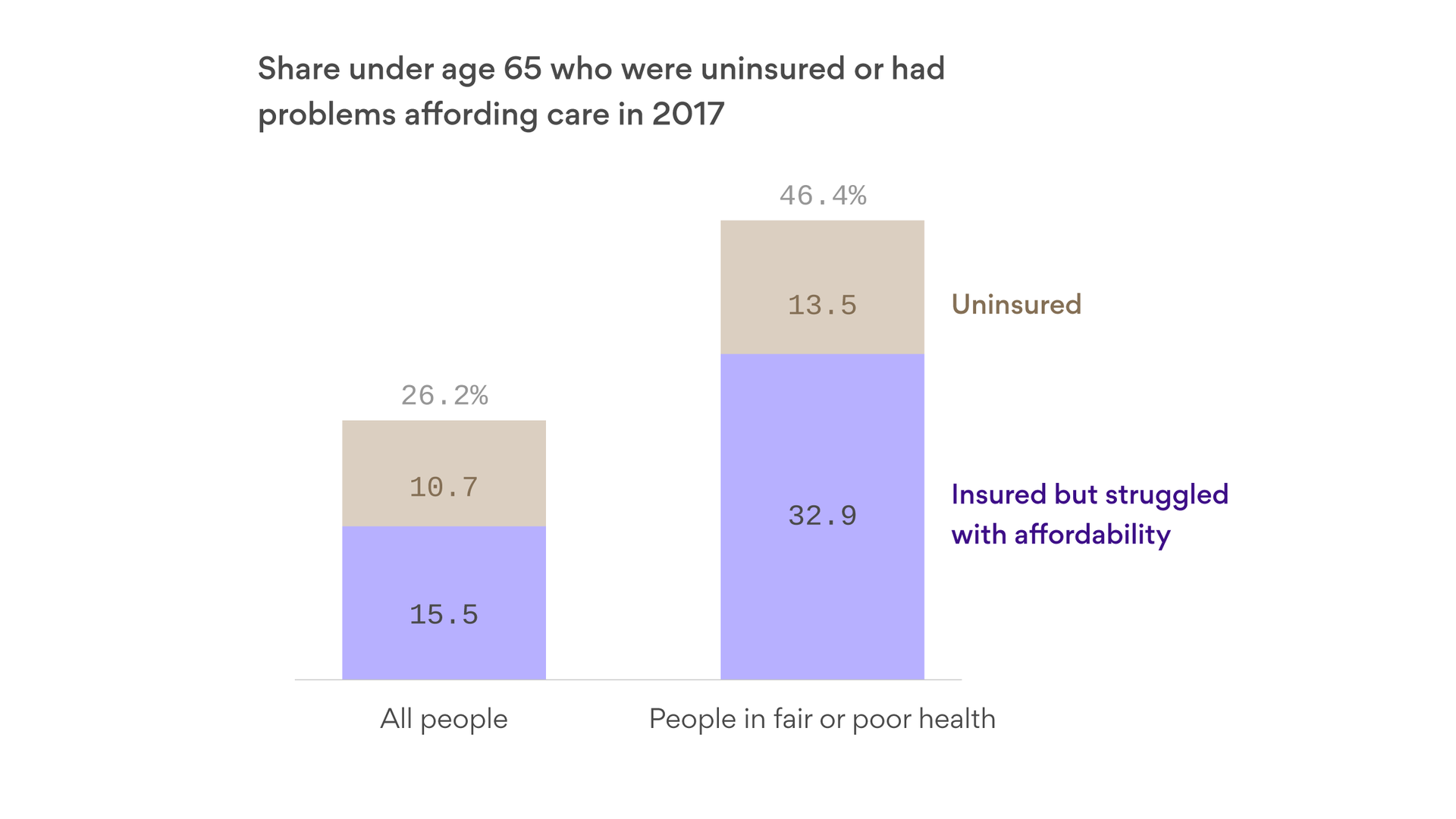
Surprise hospital bills are remarkably common, my colleague Caitlin Owens reports. A new Kaiser Family Foundation brief finds that, among people with employer-based coverage, almost 1 in 5 patients admitted to the hospital end up getting a bill from an out-of-network provider.

Why it matters: Patients have to pay more out of their own pockets for out-of-network care.

  • As a lot of excellent recent reporting on emergency room billing has shown, it can be almost impossible to avoid out-of-network bills even when you take pains to ensure you’re going to an in-network hospital.

Balance billing — the practice of providers billing patients for the difference between their charges and insurance payments — is often responsible for these situations.

  • The Affordable Care Act required private plans to limit annual cost-sharing, but these generally only apply to in-network service charges.
  • Patients with emergency room claims and psychological/substance abuse claims are more at risk of receiving an out-of-network provider claim, per Kaiser.

By the numbers:

  • For inpatient admissions, those who use in-network facilities still receive a claim from an out-of-network provider 15.4% of the time.


2018 Mid-Term Healthcare Issues

https://www.washingtonpost.com/news/powerpost/paloma/the-health-202/2018/08/15/the-health-202-senate-democrats-stay-focused-on-health-care-even-during-short-august-recess/5b72f0901b326b4f9e90a72c/?utm_term=.2403975557c2

Senate Democrats used their truncated August recess to talk to their constituents about one key issue: Health care. 

And though they are returning to Washington tonight, they have no plans to stop talking about it. 

That’s a remarkable turnaround for Democrats who have been on the defensive about health care for the better part of a decade. Obamacare played a major role in their loss of control of the House in the first midterm election of President Obama’s presidency in 2010. But now, they’re hoping to take back the House and retain their seats in the Senate largely by running on the merits of the Affordable Care Act.

Over their 10-day mini break, Sen. Joe Donnelly (D-Ind.) held a roundtable discussion with voters about health care, as did Sen. Joe Manchin (D-W.Va.), who held his third roundtable this year focused specifically on pre-existing conditions. And Sen. Claire McCaskill (D-Mo.) also met with voters with pre-existing conditions on Tuesday.

“Cutting people off from insurance and making it harder for people to get insurance, we’re all still gonna pay the bill because in America we’re not going to stop people at the door at the emergency room and I’m sorry you don’t have health insurance, we’re gonna let you die,” she said, according to Missourinet.

In Nevada, Democratic Rep. Jacky Rosen, who is hoping to unseat GOP Sen. Dean Heller, also held a public meeting with voters with pre-existing conditions.  Sen. Bob Casey (D-Pa.) met with health care providers and patients to talk pre-existing conditions, and Rep. Kyrsten Sinema (D-Ariz.), who is vying for the open Senate seat there, also met with constituent groups to discuss health care.

“It doesn’t matter which community you are in, health care is the number-one issue that Arizonans are talking about,” Sinema told the Arizona Daily Star. “It is not just Arizonans who don’t have health-care coverage, many of those who are expressing concerns and fear are Arizonans who do have coverage but cannot afford it.”

As campaign cycles go, it’s still early in this one. And the deluge of ads will really heat up come fall. Republicans still see an opening to talk about rising costs of health care and President Trump continues to declare that the ACA is dead. But unlike years past when the GOP could run on an anti-Obamacare message, this year the party is more likely to focus on other issues like tax cuts and job creation. 

It’s harder for GOP candidates to make their case that health care policy is failing in the first election where they are in control of both houses in Congress and the White House. And recent scuttlebutt that Republicans would consider another repeal effort if they held Congress may not be helpful this cycle.

And so Democrats, if August activity is the precursor to the fall campaign, are going all in on health care. 

Earlier this month, the New York Times’ Margot Sanger-Katz had a great anecdote from an event with McCaskill. The senator, who may be in the toughest fight of her career, asked voters to stand if they have a pre-existing condition. There were reportedly few people left in their seats.

The Democrats and the groups who support them have homed in specifically on the warning that if the ACA is struck down, people with pre-existing conditions would lose protection. Notably, McCaskill and Manchin, two of the Democrats’ most vulnerable members, are running against state attorneys general who joined a lawsuit arguing the ACA should be deemed unconstitutional. If the law were struck down, it would take with it protections for people with past and current health conditions.

Before the Senate left, Minority Leader Chuck Schumer (N.Y.)  pledged to keep health care front and center this month in Congress, which is in keeping with Democrats’ election strategy this year.  Schumer’s office declined to show its hand, but on the floor he detailed exactly what the Democrats would be pushing for, including votes to protect people with pre-existing conditions and a Medicare buy-in program. They’re unlikely to get those votes, but that’s all part of the game plan to keep the attention on health care.

“The number one thing Americans want is health care, and we Democrats will spend August recess focusing on that issue, and forcing Republicans to cast votes or deny votes on those important issues,” Schumer said. “It’s a great opportunity, not just for Democrats, not just for Republicans, but for America. We are going to do it.”

The first television ad the campaign arm for the Democrats released in 2017 was about health care. It showed a man selling his car and a woman pawning her engagement ring. Then it cuts to them sitting at the hospital bedside of a sick child.

Most of the heavy ad buys are still to come, but an independent analysis of political ads so far this cycle found pro-Democrat ads have been overwhelmingly about health care.  According to Kantar Media/CMAG data by the Wesleyan Media Project, “An astounding 63 percent of pro-Democratic ads for U.S. House discuss healthcare, and 16 percent contain an explicit statement about being in favor of the Affordable Care Act. U.S. Senate contests are less likely to feature health care, but it is still the top issue, appearing in over a quarter (28 percent) of all ad airings.”

Take Rosen, the congresswoman running against Heller. She has a television ad that shows her talking to voters about their anxieties over the ACA being repealed. She says in the ad that ACA has “real problems,” but repealing it isn’t the answer. 

It’s a strategy divergent from previous years when Democrats were defensive of their support for Obamacare. They’d make macro arguments about the millions of people who would lose coverage without it. But now, with the focus on pre-existing conditions, they’ve found a way to make it personal and accessible for voters. 

“What we’re seeing on the trail is that health care remaining the defining issue of the election and voters are aware and concerned that GOP policies will increase their costs and jeopardize their coverage and voters are preparing to hold GOP candidates accountable on this issue,” said David Bergstein, a spokesman for the Democratic Senatorial Campaign Committee.

When asked, most Republicans will say they support keeping protections for pre-existing conditions. For example, when asked, McCaskill’s opponent, Missouri Attorney General Josh Hawley, said he thinks“insurance companies should be forced to cover pre-existing conditions.”

For his part, Hawley’s first television ad of the campaign was about his work as a clerk on the Supreme Court and accused McCaskill of supporting “liberal activist judges.”

In a press release in response to the ad, McCaskill’s campaign said, “Josh Hawley is suing to strip protections for nearly 2.5 million Missourians with pre-existing conditions.”


Allina’s operating income sinks 45% in Q2

https://www.beckershospitalreview.com/finance/allina-s-operating-income-sinks-45-in-q2.html

Image result for allina health

Allina Health’s revenues increased in the second quarter of 2018, but the Minneapolis-based system’s operating income plummeted due to growth in expenses.

Allina reported revenues of $1.07 billion in the second quarter of this year, up from $1.01 billion in the same period of 2017, according to recently released bondholder documents. The boost was attributable to higher net patient service revenue, which climbed 6.4 percent year over year.

The system’s operating expenses totaled $1.06 billion in the second quarter of 2018, up from $990.4 million in the same period a year earlier.

Allina ended the second quarter of this year with operating income of $13.1 million. That’s down 45 percent from the first quarter of 2017, when the system reported operating income of $23.9 million.

Allina reported an investment return of $33.8 million in the second quarter of 2017, but that number dropped to $6.3 million in the second quarter of this year.

After factoring in the drop in investment income, Allina’s net income tumbled 56 percent year over year to $19.1 million in the second quarter of 2018.


Montefiore Health scores $1.2 billion financing deal that will add $600 million to flagship hospital’s balance sheet

https://www.healthcarefinancenews.com/news/montefiore-health-scores-12-billion-financing-deal-will-add-600-million-flagship-hospitals?mkt_tok=eyJpIjoiTVRNMk5XUm1PR1EwT1dFMyIsInQiOiIyeElkV3FjNjcrbkVCUTRURUlLZ0tTaXBaQW9OZVFQXC9Rd3lDdlJFcjhcL0FJU1FQUGdvOTd3aFc2aGZ5S21ndm9vY2pHcHgzcUV1VUg4UXZnVjVSY2xSMVVmdHpWUkpIbW0wb0plVjFSUVpLRFhuMXZBdG1tWFFFZWVpMEM0aDZjIn0%3D

Credit: Google Street View


The financing package is a hybrid of taxable and nontaxable bonds that will reimburse the system for more than $350 million in capital projects.

Montefiore Health System has landed a $1.2 billion financing deal with the Dormitory Authority of the State of New York that will add roughly $600 million of cash to Montefiore Medical Center’s coffers.

The bonds issued by DASNY were 30-year revenue bonds that were used to pay down $315 million in prior bonds insured by the Federal Housing Administration, including bonds backed by securities guaranteed by the Government National Mortgage Association. The new bonds issued also reimburse Montefiore for $357 million in past capital project spending on its facilities and take advantage of low interest rates in the market, the system said.

The system confirmed that the revenue bonds were secured by a pledge of gross receipts of Montefiore Medical Center and a mortgage on the Moses Division’s primary care facilities and its two parking garages. The new bonds were used to refinance existing bonds and loans as well as reimburse the health system for prior capital expenditures.

“The financing benefits the system by refinancing front-loaded debt to achieve a more level debt service structure and implements a flexible financing structure that can support future initiatives,” a spokesperson said.

According to a recent report from Moody’s Investors Service, the proceeds of the Series 2018 bonds will be used to refinance existing debt including FHA insured bonds, and will add about $600 million of cash to MMC’s balance sheet.

Moody’s assigned an initial Baa2 rating to Montefiore Obligated Group’s $1.2 billion in revenue bonds, which are a hybrid of both taxable and nontaxable bonds. Moody’s also gave a rating outlook of stable.

“Montefiore Obligated Group’s Baa2 rating reflects Moody’s belief that Montefiore Health System will maintain a leading market position in the Bronx, supported by its clinical excellence and its flagship position as the primary teaching hospital for the Albert Einstein College of Medicine (AECOM). Montefiore’s rating also reflects its experience with value based contracting, which will be aided by integration with its large base of faculty practice and primary care physicians,” Moody’s said.

“With this bond rating, Montefiore can continue our leadership in developing risk-based care and delivering care in the most appropriate settings at the right time. In the rating, Montefiore was noted for its clinical excellence, care, and its ability to attract internationally renowned physician scientists, complementing Albert Einstein College of Medicine’s long history of pioneering medical research,” Montefiore said in a statement.

Moody’s also cautioned that the system’s “keen commitment to its community and surrounding counties” could mean uncertainty, as some of MHS’s affiliated hospitals will experience losses despite state funding. The agency also said the med school’s financial issues will require cash support from Montefiore and unusually high levels of Medicaid and a “heavily unionized” workforce will also strain the system’s margins.

Montefiore is a major medical system in the New York metro area that includes three inpatient campuses with 1,558 licensed beds in the Bronx, as well as several other affiliated organizations in Westchester, Rockland and Orange Counties. Its hospitals include the 292-bed White Plains Hospital, 121-bed Montefiore Mount Vernon Hospital, 223-bed lMontefiore New Rochelle Hospital, 375-bed Nyack Hospital, 242-bed St. Luke’s Cornwall Hospital, and 150-bed Burke Rehabilitation Hospital. Montefiore Medicine Academic Health System is the parent above MHS that controls its Albert Einstein College of Medicine.


Investors Cash Out of HCA Healthcare as Stock Soars to Record

https://www.bloomberg.com/news/articles/2018-08-14/investors-cash-out-of-hca-healthcare-as-stock-soars-to-record

Long-term shareholders were cashing out of HCA Healthcare Inc. in the second quarter, as the stock rallied to record highs in late June — levels since eclipsed by bigger gains this quarter.

Hedge funds Glenview Capital Management, Highfields Capital Management, Wellington Management Group, Magellan Asset Management and Harris Associates cut their stakes in the hospital chain, which saw its shares rise 17 percent in the first half and an additional 27 percent so far this quarter. The investment firms sold a combined 17.3 million shares, according to their latest 13F filings.

After being under pressure for nearly two years, hospitals have staged a comeback in 2018, outperforming most of their health-care peers with a 21 percent gain. The rally was led by Tenet Healthcare Corp., which has more than doubled, and HCA, which saw earnings and patient visits improve. HCA was also among hospitals uniquely benefiting from the U.S. corporate tax overhaul.


Policy Basics: Top Ten Facts about Social Security

https://www.cbpp.org/research/social-security/policy-basics-top-ten-facts-about-social-security


Happy Birthday, Social Security!

President Franklin D. Roosevelt signed the Social Security Act into law on August 14, 1935, 83 years ago today. Here are some key facts about the program:

  • About 62 million people received Social Security checks in June of this year.
  • The average monthly check was $1,343.
  • Social Security lifts about 15 million elderly Americans out of poverty.
  • Benefits for the average worker are only about half those in other developed countries.
  • About 1 in 5 seniors rely on Social Security for more than 90 percent of their income.
  • Administrative costs for the program are just 0.7 percent of annual benefits.
  • Social Security’s trust funds will be exhausted by 2034. If policymakers do not act by then, payments could be reduced by about 25 percent.


Cigna prevails in Texas hospital’s suit over $50M in unpaid claims

https://www.bna.com/cigna-prevails-texas-n73014481565/

Image result for hospital out of network fee forgiving

Cigna Healthcare defeated a lawsuit by a Houston hospital accusing it of underpaying hundreds of medical benefit claims.

Cigna didn’t abuse its discretion when it reduced benefit payments to North Cypress Medical Center Operating Co. Ltd after it learned that the hospital engaged in fee-forgiving—a practice where out-of-network providers charge patients less than what they owe under their health insurance plans, a federal judge in Texas held Aug. 7.

Multiple lawsuits challenging the billing and payment practices between out-of-network providers and health insurers have been filed in the past decade, when insurers started reducing or withholding payments to providers that engaged in fee-forgiving. Insurers such as Cigna, Aetna, and UnitedHealthcare allege this practice is fraudulent.

The ruling, which came after an eight-day bench trial, is a significant victory for Cigna in a long-running lawsuit by North Cypress, which sought to hold the insurer liable for at least $50 million in unpaid claims.

In 2016, Judge Keith P. Ellison held that Cigna violated federal benefits law by denying full payment of benefit claims.

Since then, the U.S. Court of Appeals for the Fifth Circuit issued a number of opinions in favor of insurers, including one where it reversed a $16.4 million judgment against Cigna in a case in which another small Texas-based hospital accused it of underpaying medical claims. Last week, the Fifth Circuit affirmed a ruling against the hospital in its lawsuit accusing Aetna Life Insurance Co. of underpaying medical claims in violation of the Employee Retirement Income Security Act and Texas law.

After the parties Cigna and North Cypress engaged in full discovery, the claims at issue were limited to the 575 benefit claims for which the hospital exhausted its administrative remedies. Cigna argued at trial that in these 575 claims, it didn’t apply its fee-forgiving protocol to reduce payments to 395 of them because they were for nonemergency services.

Cigna’s interpretation of its plans to require an out-of-network provider to collect the full portion of coinsurance from a patient was reasonable, Ellison said.

Ellison, who sits in the U.S. District Court for the Southern District of Texas, pointed out that Cigna had substantial evidence to support its determination that North Cypress engaged in fee-forgiving. Cigna had sent surveys to patients who had received treatment at North Cypress and it discovered that the hospital was discounting or forgiving out-of-network coinsurance, Ellison said.


6 Ways Leaders Bully People Without Realizing It

6 Ways Leaders Bully People Without Realizing It

Bullying at Work

In the latest edition of Leaders Behaving Badly, the University of Maryland has placed multiple members of the men’s football team staff on administrative leave, including head coach DJ Durkin, while the school investigates their role in creating a toxic culture that contributed to the death of offensive lineman Jordan McNair in June after a football workout.

The ESPN report cited these examples:

  • There is a coaching environment based on fear and intimidation. In one example, a player holding a meal while in a meeting had the meal slapped out of his hands in front of the team. At other times, small weights and other objects were thrown in the direction of players when Strength and Conditioning coach, Rick Court, was angry.
  • The belittling, humiliation and embarrassment of players is common. In one example, a player whom coaches wanted to lose weight was forced to eat candy bars as he was made to watch teammates working out.
  • Extreme verbal abuse of players occurs often. Players are routinely the targets of obscenity-laced epithets meant to mock their masculinity when they are unable to complete a workout or weight lift, for example. One player was belittled verbally after passing out during a drill.
  • Coaches have endorsed unhealthy eating habits and used food punitively; for example, a player said he was forced to overeat or eat to the point of vomiting.

There is absolutely no room for that kind of behavior in sports, school, or the workplace. Leaders have to be held to a higher standard.

Bullying is not just verbal or physical intimidation of someone. Especially in the workplace, bullying can manifest itself in many subtle ways. Any behavior you use to intimidate, dominate, embarrass, harass, or purposely make someone feel inferior could be considered bullying.

Here are six subtle ways you may be acting like a workplace bully without even realizing it:

1. You are condescending—When you act in a condescending manner, whether it’s patronizing someone, being dismissive of a person’s contributions, or minimizing someone’s accomplishments in order to highlight yours, you are sending a message that you believe you are superior to the other person.

2. Wounding with sarcasm—I like sarcastic humor as much as the next guy, but there is a huge difference between sarcasm that highlights the irony of a situation and is self-deprecating, versus sarcasm that is intended to belittle and injure another person. Next time you’re ready to drop that witty, sarcastic joke, pause and consider if it will build up the other person or tear her down.

3. Being cliquish—Cliques aren’t only for high school. Unfortunately, many adults carry that same behavior into the workplace. Purposely excluding people from activities is a bullying behavior intended to send the message that “you’re not one of us” and “we’re better than you are.” Trusted leaders look for opportunities to include people so they feel valued and appreciated.

4. Thinking you know it all—Have you ever worked with a person who thinks she knows it all? How annoying is that?! Much like behaving in a condescending manner, acting like you are the all-knowing expert is a way to intimidate others to go along with your ideas or wishes. Just stop it! No one really believes you anyway.

5. Being passive-aggressive—Perhaps one of the most subtle forms of bullying and manipulation, passive-aggressive behavior poisons teams, departments, and organizations. A common trait of bullies is expressing aggression in order to intimidate another person. Passive-aggressive people are bullies who express aggression in indirect ways such as disguising hostility in jokes, stubbornness, procrastination, resentment, or giving just the minimum effort required. I perceive passive-aggressive people as double-agent bullies disguised as victims. Watch out for them!

6. Gossiping—Have you ever considered gossiping as a form of bullying? Probably not, but it easily could be considered bullying, and some experts even consider it a form of workplace violence because it’s intended to harm another individual or group. Why do people gossip? It’s to make themselves feel powerful. The gossiper believes she knows something that other people don’t and she uses that information as leverage to elevate herself above others.

Leaders are charged with bringing out the best in their people and I don’t understand how some leaders, particularly sports coaches, believe that bullying is an acceptable form of motivation. It’s not. It’s belittling, destructive, demeaning, dehumanizing, and does nothing but feed the power-hungry ego of the bullying leader.

If you’re a leader in the workplace, whether it’s in an office, factory, warehouse, construction site, or any other place, make sure you’re not being a bully without even realizing it. You’re better than that and your people deserve your best.